
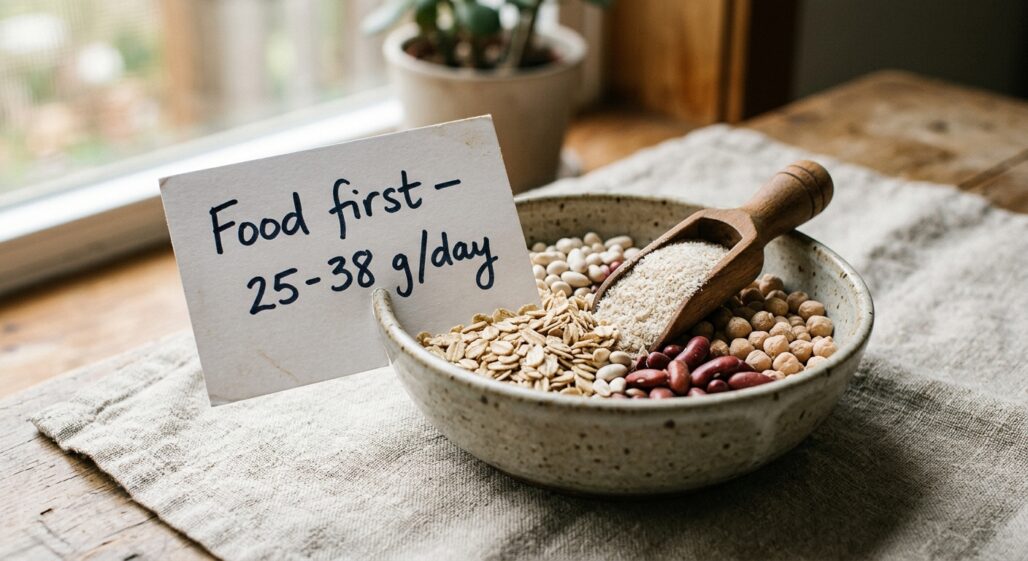
If you are standing in the supplement aisle staring at a wall of fiber powders, capsules, and gummies wondering which one actually does something, you are asking the right question. The short answer: for most people, food covers fiber, and the one supplement worth knowing is psyllium. This guide breaks down soluble versus insoluble, why a viscosity lens beats the label, what each supplement fiber actually does, how much you need, and how to start without spending a week bloated.
Before you decide

Fiber is one of the few supplements where food genuinely wins for most people. Beans, oats, fruit, vegetables, and whole grains deliver fiber plus the vitamins, minerals, and polyphenols that ride along with it. A supplement earns its place when your diet falls short, your gut needs help, or a specific marker like LDL is high.
Some people should be cautious. If you have a history of bowel strictures, swallowing difficulty, or a narrowed GI tract, bulking fibers can be risky, so clear it with your clinician first. Anyone with IBS should add fermentable fibers slowly, because inulin and FOS can trigger real symptoms in a sensitive gut.
Fiber also changes how other things move through you. Ask your doctor or pharmacist about timing if you take thyroid medication, certain diabetes drugs, lithium, or other narrow-window prescriptions, because fiber can blunt absorption when taken together. Take medications at least one hour before or two to four hours after a fiber dose, and never use fiber to replace a treatment your doctor has prescribed.
Soluble vs insoluble is the wrong question
The soluble-versus-insoluble split is what every label leans on, but it is a poor predictor of what a fiber actually does in your body. The clinically useful distinction is viscosity and fermentability: does the fiber form a thick gel, and does your colon ferment it quickly? That framework comes straight from how these fibers behave in trials.
A 2017 clinical review in the Journal of the American Association of Nurse Practitioners lays it out plainly: viscous, gel-forming fibers like psyllium are the ones that lower cholesterol, steady glucose, and normalize stool. A soluble fiber that ferments rapidly, like inulin, loses its gel before it can do that work and mostly produces gas instead.
Insoluble fiber, like wheat bran, adds bulk and speeds transit but does not form a gel. So the goal-relevant question is not "is it soluble" but "does it stay viscous and resist fermentation long enough to act." Hold that lens and the supplement aisle suddenly makes sense.
Think of it like sponges versus sugar cubes. A gel-forming fiber is a sponge that holds water all the way through your gut; a rapidly fermented fiber is a sugar cube your bacteria dissolve in minutes, releasing gas but leaving no sponge behind.
The main supplement fibers, and what each one does
Not all fiber supplements behave the same way, so matching the fiber to your goal matters more than the price tag. Here is how the common ones stack up.
| Fiber | Type and behavior | Best-supported use | Gas/bloating risk |
|---|---|---|---|
| Psyllium | Soluble, viscous, gel-forming, minimally fermented | Constipation, diarrhea, LDL, glucose | Low |
| Methylcellulose | Soluble, gel-forming, non-fermented (synthetic) | Bulking/regularity; weak trial support | Low |
| Inulin / FOS | Soluble, non-viscous, rapidly fermented (prebiotic) | Feeding gut bacteria; no laxative effect | High |
| Wheat dextrin | Soluble, non-viscous, fermented | Marketed for regularity; thin evidence | Moderate |
| Acacia (gum arabic) | Soluble, non-viscous, slowly fermented | Gentle prebiotic, well tolerated | Low-moderate |
| Glucomannan | Soluble, highly viscous, fermented | Satiety, modest weight and lipid effects | Moderate |
| Partially hydrolyzed guar gum | Soluble, non-viscous, fermented | IBS symptoms, both constipation and diarrhea | Low-moderate |
Psyllium is the most studied and most versatile, because it forms a gel that holds through the colon and ferments slowly. Inulin and FOS are prebiotics, not laxatives, and the same review notes that rapidly fermented fibers increase flatulence without delivering a reliable regularity benefit.
Methylcellulose gels but has surprisingly little controlled trial support for constipation despite its over-the-counter status. Glucomannan is the most viscous of the bunch, which is why it shows up in satiety and weight products, though effects are modest. Partially hydrolyzed guar gum is the gentle outlier: not viscous, but tolerated well enough that IBS patients tend to stick with it.
How much you actually need
The Adequate Intake for fiber is about 25 grams a day for women and 38 grams for men, or roughly 14 grams per 1,000 calories, per the StatPearls clinical guide on dietary fiber. Most people fall far short.
Here is the gap that drives supplement sales: the average US adult eats only about 17 grams of fiber a day, less than half the target. That same source notes roughly 94% of Americans miss the Adequate Intake. So the realistic job of a supplement is to close a 10-to-20-gram shortfall, not to pile fiber on top of an already-good diet.
The intake sweet spot is well defined. A landmark 2019 Lancet series on carbohydrate quality pooled decades of data and found the biggest reductions in heart disease, type 2 diabetes, and colorectal cancer risk clustered at 25 to 29 grams of fiber a day, with more offering some additional benefit. That is an observational association, not proof that a supplement reproduces it, but it anchors the target.
Whole food fiber should do most of the lifting because it arrives packaged with nutrients a powder cannot match. A cup of cooked lentils brings about 15 grams, a cup of raspberries about 8, and a half cup of oats about 4. If you eat broadly, you may not need a tub of anything.
Who genuinely benefits from a supplement
A fiber supplement is not a daily essential for everyone, and that honesty matters. The people who benefit most are those who cannot hit the fiber target from food, or who have a specific issue a particular fiber addresses. GLP-1 medication users are a textbook example, since drugs like semaglutide suppress appetite and slow gut motility at the same time, which is why we wrote a separate guide to the best fiber supplement for GLP-1 users.
If your LDL cholesterol is elevated, psyllium has real evidence. A 2018 systematic review and meta-analysis of randomized trials found psyllium meaningfully lowered LDL cholesterol, non-HDL cholesterol, and apolipoprotein B. Psyllium is an evidence-backed adjunct to diet for high cholesterol, not a replacement for a statin your doctor has prescribed.
If you have type 2 diabetes or prediabetes, viscous fiber may help blunt glucose. A 2015 meta-analysis in the Journal of Nutrition showed psyllium improved fasting glucose and HbA1c, and notably the benefit scaled with how poor glucose control was, with little effect in people who were already euglycemic. That is a useful reality check: a supplement helps the person with a gap, not the person already in range.
For constipation, gel-forming fiber wins, and that is exactly where I would point readers in our guide to the best fiber for constipation. People chasing a prebiotic or gut-bacteria goal are better served thinking in terms of fermentable fiber and probiotics together, which we untangle in our complete guide to probiotics and our breakdown of prebiotics, probiotics, and synbiotics.
How to start without the bloat and gas
The single most common reason people quit fiber is the gas, cramping, and bloating of starting too fast. Almost all of that is avoidable with a slow ramp and enough water. Your gut bacteria need time to adjust to more fermentable substrate, and bulking fibers need fluid to work safely.
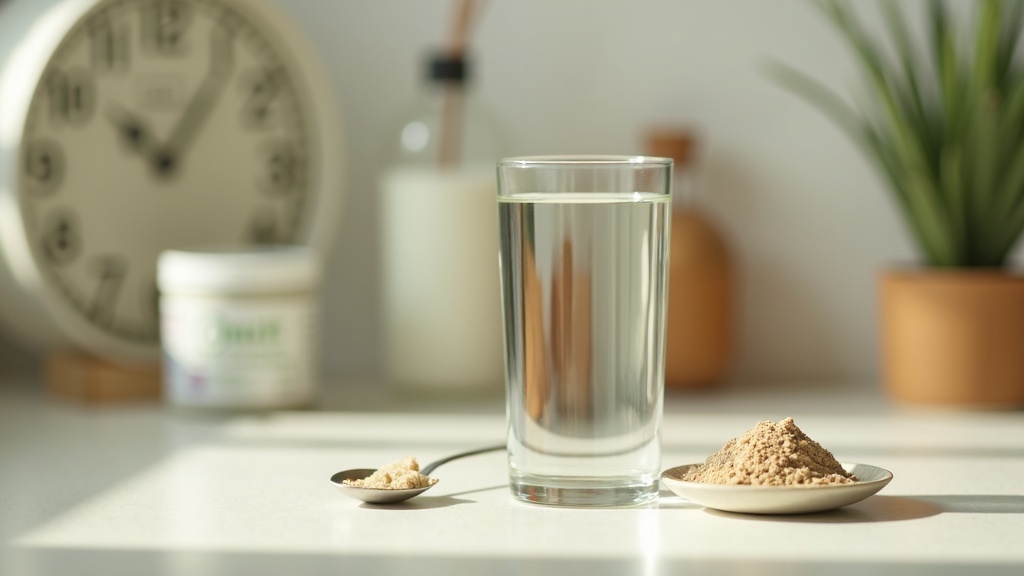
The same 2017 clinical review recommends a gradual schedule: one dose per day for the first week, two doses per day for the second week, building up from there. Taking a gel-forming fiber like psyllium with a full 8-ounce glass of water is not optional, it is how the fiber hydrates instead of clumping.
Fermentable fibers are the real gas culprits, and there is a clever fix. A 2022 study using MRI and in vitro fermentation found that psyllium taken alongside inulin reduced the colonic gas inulin produced on its own in people with IBS. The gel appears to slow fermentation. So if you want a prebiotic but inulin wrecks you, pairing it with psyllium or choosing a gentler fiber is reasonable.
Match the fiber to your tolerance, not just your goal. For sensitive guts, partially hydrolyzed guar gum is the soft landing: a 2006 trial in IBS patients found it eased symptoms in both constipation- and diarrhea-predominant patients and was well tolerated. Acacia fiber is another low-drama option.
Fiber, medications, and minerals: timing matters
Fiber does its job by slowing and trapping what passes through your gut, and that same mechanism can interfere with absorption of some drugs and minerals. This is a timing problem, not a reason to avoid fiber, and it is easily managed.
Separate your fiber dose from medications. The practical rule most clinicians use is take prescription drugs at least one hour before or two to four hours after fiber, especially narrow-therapeutic-window medicines like levothyroxine, some diabetes drugs, and lithium. If you are unsure, your pharmacist can confirm the spacing for your specific prescriptions.
Mineral absorption is less of a concern than the old "fiber blocks all your minerals" myth suggests. For most people eating a normal diet, supplement-level fiber does not cause clinically meaningful mineral deficiency, but if you take iron or calcium supplements, spacing them a couple of hours from a large fiber dose is sensible. The bigger benefits of fiber, including the modest weight and lipid effects seen in the 2008 glucomannan meta-analysis, outweigh this minor caveat for most.
FAQ
Is soluble or insoluble fiber better?
Neither label tells you enough. What matters is whether the fiber forms a gel and resists fermentation, which is why psyllium (a soluble, gel-forming fiber) outperforms inulin (a soluble, rapidly fermented one) for cholesterol and regularity.
Do fiber gummies work?
They are usually low-dose and often built on fibers like inulin or chicory root, so they ferment fast and deliver little gel. Gummies are convenient but rarely supply enough of the right fiber to match a psyllium dose.
Can I just take fiber instead of eating vegetables?
No. A supplement closes a fiber gap, but it does not carry the vitamins, minerals, and plant compounds that come with whole foods. Food first, supplement second is the rule.
How much psyllium should I take?
Studies commonly use around 5 to 10 grams once or twice daily, built up gradually with water. Our best fiber supplements roundup covers specific products and doses.
Why am I more bloated since starting fiber?
Almost always because you ramped too fast or chose a heavily fermented fiber. Slow the schedule, drink more water, and switch to a gel-forming option if symptoms persist.
The bottom line on fiber supplements
Fiber is one of the clearest food-first stories in nutrition. Most adults need 25 to 38 grams a day, average about 17, and the cleanest fix is more beans, oats, fruit, and vegetables, not a powder. A supplement is for closing a genuine gap or targeting a specific issue like high LDL or constipation.
When you do supplement, the evidence points one direction. Psyllium is the gel-forming, slowly fermented fiber with the broadest trial support, while inulin and FOS are prebiotics that feed bacteria and produce gas rather than acting as laxatives. The viscosity lens, not the soluble-versus-insoluble label, is what predicts results.
Next steps:
- Track your fiber for three days against the 25-to-38-gram target before buying anything.
- If you have a real gap, start psyllium at one dose a day with a full glass of water and read our how-we-review-supplements process for what to look for on a label.
- Ask your doctor about a lipid panel or fasting glucose check before assuming fiber is the fix, since the benefit scales with how far off your numbers are.
For the methodology and dietary context behind these picks, see more from Sarah Thompson, RD.
As an Amazon Associate, I earn from qualifying purchases. Product recommendations are based on real reviews and independent research.
Reviewed by Sarah Thompson, Registered Dietitian, focused on vitamin and mineral nutrition.
This article is for informational purposes and not medical advice. Fiber supplements can interact with medications and health conditions. Consult a licensed physician before starting any supplement, particularly if you are pregnant, nursing, taking prescription medications, or managing a chronic condition such as a bowel stricture, diabetes, or thyroid disease.
