
Affiliate disclosure: this article contains affiliate links. As an Amazon Associate, UsefulVitamins.com earns from qualifying purchases at no extra cost to you.
Before you buy
Codeage Multi Collagen shows up everywhere – it's a stack-leader on Amazon and sits on the shelf at Costco, usually in a big tub at a price that looks unbeatable. The real question isn't whether it works. It's whether you're actually getting a meaningful collagen dose, or just a small scoop of a clever-sounding blend.
That distinction matters because collagen research uses specific amounts. Skin trials have shown benefits at doses as low as 2.5 to 5 grams a day, while joint trials more often used around 10 grams of hydrolyzed collagen a day. Codeage gives you 9 grams per scoop, spread across five sources you can't see the breakdown of.
So this review is really two questions. First, is the multi-source idea worth paying for? Second, does the low per-scoop dose undercut the value the big tub seems to promise? For most people chasing skin or joint results, the honest answer leans toward a different product – we'll show you the math.
If you're cross-shopping, our Vital Proteins vs Sports Research collagen breakdown covers the single-source side of this decision in more depth.
What Codeage Multi Collagen actually is
Codeage Multi Collagen Protein Powder is a hydrolyzed collagen blend marketed around its 5 collagen types – I, II, III, V, and X. Those types come from five food sources rather than one animal.
According to the Codeage Multi Collagen product page, the blend combines:
- Grass-fed hydrolyzed bovine collagen peptides (Types I and III)
- Organic chicken bone broth (Type II)
- Organic beef bone broth
- Wild-caught hydrolyzed fish collagen (Type I)
- Eggshell membrane collagen (Types V and X)
The pitch is that more types means more coverage – skin, joints, gut, connective tissue. That sounds appealing, but the evidence behind "more collagen types is better" is thin. Your body breaks all hydrolyzed collagen down into the same amino acids and peptides before it ever reaches your skin or joints. Type X from an eggshell doesn't travel to your knee as Type X.
What the science does support is total dose and consistency. A 2019 dermatological review (Choi et al.) found skin-elasticity and hydration benefits at hydrolyzed-collagen doses of about 2.5 to 10 grams a day, and for joints, a randomized knee-osteoarthritis trial used around 10 grams a day. So the multi-type story is more marketing than mechanism. The number that matters most is grams per scoop, not types per label.
The dose and the proprietary-blend question
Here's the part retailer listings gloss over. Codeage discloses a "Multi-Collagen Complex" of 9,000 mg (9 grams) per scoop, but it does not break out how many grams come from each source.
That's a meaningful transparency gap. You don't know whether you're getting 8 grams of cheap bovine and a token sprinkle of marine and eggshell, or a genuine spread. The five-types claim sells the blend; the label won't tell you the split.
Compare that to a single-source peptide, where the math is simple: one ingredient, one number. With Codeage you're trusting the blend ratio sight unseen. For a "marine collagen" or "Type II for joints" buyer specifically, that opacity is a real problem – you can't confirm you're getting enough of the type you came for.
Nine grams is plenty for skin, where positive trials used as little as 2.5 to 5 grams a day. It sits just under the roughly 10 grams used in joint trials, so for joints you may want to take a scoop and a half (about 13-14 grams) to reach a studied range – which quietly raises your real cost per effective dose.
Third-party testing and the NSF claim
Codeage leans hard on quality language: manufactured in the USA in a cGMP-certified facility, non-GMO, and "third-party tested for purity." Those are reasonable baseline signals and more than many no-name collagen tubs offer.
Codeage also states the powder is "NSF Contents Certified." That is worth understanding precisely. Per NSF's own explainer on supplement seals, Contents Certified means the label matches what's in the tub and the product was screened for contaminants – a genuine quality check. It is not the same as NSF Certified for Sport, the stricter banned-substance program athletes look for. If you're drug-tested, don't read "NSF" here as Certified for Sport.
We could not independently verify a public Certified for Sport listing for this specific powder, so treat the testing as solid-but-baseline rather than elite. If a batch certificate of analysis matters to you, request it from Codeage directly.
On sourcing, "grass-fed" and "wild-caught" are Codeage's own descriptors. They're plausible and consistent with the brand's positioning, but the label carries no independent grass-fed certification mark, so take the wording as a claim, not a verified seal.
For broader context on how to read collagen labels and pick a source, our Vital Proteins collagen alternatives guide walks through the same trade-offs across cheaper Amazon picks.
Cost per serving vs Vital Proteins and Ancient Nutrition
This is where the "bestseller value" story gets complicated. The big Codeage tub looks cheap until you adjust for the small scoop.
Here's the honest comparison on a per-gram basis. Prices are approximate and move often, so check current pricing before you buy.
| Product | Collagen per serving | Servings per tub | Approx. price | Cost per 10g collagen |
|---|---|---|---|---|
| Codeage Multi Collagen | 9 g (multi-source blend) | 63 | ~$39.99 | ~$0.70 |
| Vital Proteins Peptides | 20 g (single bovine) | 28 | ~$47.00 | ~$0.84 |
| Ancient Nutrition Multi | ~9-10 g (multi-source) | ~45 | ~$52.95 | ~$1.18 |
The takeaway: Codeage really is the cheapest per gram of the three – roughly $0.70 per 10 grams as of writing. That's a genuine point in its favor, and it beats Ancient Nutrition's multi-source blend on price clearly.
But look at the dose column. Vital Proteins hands you 20 grams in one scoop, a dose squarely inside the studied range, for only a little more per gram. To match that with Codeage you'd take more than two scoops, which burns through the cheap tub fast and erases much of the savings.
So the real story is: Codeage wins on price-per-gram; Vital Proteins wins on getting an effective dose in a single, simple scoop. Our Ancient Nutrition vs Vital Proteins comparison digs further into the multi-source-vs-single-source choice if that's your sticking point.
Who it's for, and who should buy something else
Buy Codeage Multi Collagen if you specifically want a multi-source blend, you mix collagen into coffee or smoothies daily, and you're fine taking a scoop and a half to reach a real dose. The per-gram cost is legitimately good, and the NSF Contents Certified screening is a reassuring baseline.
Buy something else if you want a clinically meaningful dose without doing scoop math. A single-source bovine or marine peptide at 10-20 grams is simpler, more transparent, and lands you in the studied range in one go.
A few practical notes:
- Mixability is good – the unflavored powder dissolves cleanly in hot or cold liquid, with little taste.
- It is not a meaningful protein source despite the "protein" name, since collagen lacks tryptophan; don't count it toward your daily protein target.
- If you want cheaper single-source options, our cheaper collagen swaps on Amazon list a few transparent picks to compare.

Value pick and cheaper alternatives
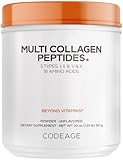
If your goal is skin or joint support at a researched dose, you don't need the multi-type story. A clean single-source peptide usually delivers more usable collagen per scoop for similar money. Below are the picks we'd put up against Codeage.


As an Amazon Associate, UsefulVitamins.com earns from qualifying purchases at no extra cost to you.
UsefulVitamins is reader-supported. We may earn a commission from qualifying purchases made through links on this page, at no extra cost to you. This never changes our verdicts.
For a straight value swap, a single-source bovine peptide at 10 grams or more per scoop gives you a transparent dose and an easy per-gram comparison. If you prefer ocean-sourced collagen for skin, a wild-caught marine peptide is the cleaner pick. And if you genuinely want the blend, Codeage remains the cheapest multi-source option of the bunch.
FAQ
How much collagen is actually in Codeage Multi Collagen? Each scoop provides 9 grams of a combined “Multi-Collagen Complex.” The individual amounts from bovine, chicken, fish, beef, and eggshell sources are not disclosed on the label.
Is Codeage Multi Collagen third-party tested? Codeage says it is third-party tested for purity and NSF Contents Certified, which verifies label accuracy and contaminant screening. That is not the same as NSF Certified for Sport, so drug-tested athletes should confirm separately.
Is Codeage cheaper than Vital Proteins? Per gram of collagen, yes – roughly $0.70 per 10 grams versus about $0.84 for Vital Proteins as of writing. But Vital Proteins gives 20 grams in one scoop, so you reach a studied dose without taking extra scoops.
Do five collagen types work better than one? There is little evidence that more types help. Your body breaks all hydrolyzed collagen into the same amino acids and peptides, so total daily dose and consistency matter far more than the number of types.
Is the 9-gram scoop enough to see results? For skin, yes – positive trials have used as little as 2.5 to 5 grams a day, so 9 grams is already in range. For joints, trials more often used around 10 grams a day, so a scoop and a half gets you to that comparable amount.
Can I count Codeage collagen as protein? Not really. Collagen lacks the amino acid tryptophan, so it is an incomplete protein and should not be counted toward your daily protein goal.
The verdict
Codeage Multi Collagen earns its bestseller spot on price – it's genuinely the cheapest per gram of the major multi-source blends, with reasonable cGMP and NSF Contents Certified baseline testing. If you want a blend and you'll take enough of it, there's nothing wrong here.
But the 9-gram scoop and the undisclosed source split are real limitations. For most people buying collagen for skin or joints, a single-source peptide at 10-20 grams is the smarter, more transparent buy, and Vital Proteins gets you to a studied dose in one scoop for only a little more per gram.
Next step: decide whether you actually want the multi-type blend or just want an effective dose for the lowest cost. If it's the latter, compare the single-source options in our NativePath collagen review before you commit.
This article is for general information only and is not medical advice. Supplements can interact with medications and health conditions. Talk to your doctor or pharmacist before starting collagen, especially if you are pregnant, nursing, or managing a medical condition.
Reviewed by the UsefulVitamins Editorial Team.
