
Affiliate disclosure: this article contains affiliate links. As an Amazon Associate, UsefulVitamins.com earns from qualifying purchases at no extra cost to you.
Before you buy
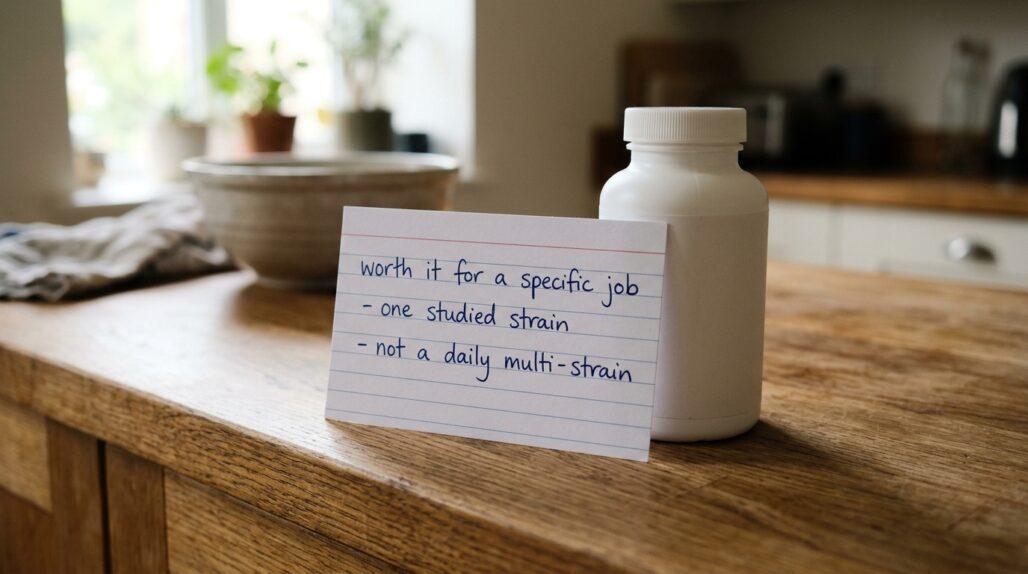
The real question with Culturelle is not "does it work." It is "do I need this one strain, or am I better off with something broader." That distinction decides whether you should buy it.
Most people picking up Culturelle at the drugstore assume any probiotic is roughly interchangeable. They are not. Probiotic effects are strain-specific, a point the NIH Office of Dietary Supplements makes plainly in its probiotics fact sheet: what one strain does at one dose tells you little about a different strain or product.
So the case for Culturelle rests almost entirely on what its strain can actually do. Get that right and the buy decision is easy. If you want a quick primer on the categories first, our explainer on prebiotics, probiotics and synbiotics covers the basics.
What Culturelle actually is
Culturelle is built around Lactobacillus rhamnosus GG, usually shortened to LGG, strain ID ATCC 53103. The "GG" comes from the two researchers, Sherwood Gorbach and Barry Goldin, who isolated it from a healthy human gut in the early 1980s.
The flagship product is the Culturelle Digestive Daily Probiotic capsule. The classic version delivered 10 billion CFU of LGG plus inulin, a prebiotic fiber. The standard Digestive Daily capsule still delivers 10 billion CFU of LGG plus the prebiotic inulin, per the official Culturelle product page; note that Culturelle's Digestive Daily Chewables use a different blend that adds Bifidobacterium animalis subsp. lactis, so check the supplement-facts panel of the exact product you buy.
That is the thing to know up front. Culturelle's whole reputation rests on LGG as a single, heavily studied strain, even though the lineup now includes higher-count and multi-ingredient versions (Pro Strength at 12 billion, Health and Wellness at 15 billion, plus women's and kids' formats).
So you are not buying a kitchen-sink blend. You are buying one or two strains chosen for their research record, which is a genuinely different product philosophy from the 10-strain capsules that dominate Amazon.
What LGG has real evidence for
LGG is often called the most-studied probiotic strain in the world, with several hundred human trials and well over a thousand published papers. That volume is real, but volume is not the same as proof for every use. The strong signal sits in a narrow lane.
The clearest benefit is preventing antibiotic-associated diarrhea (AAD). A systematic review with meta-analysis published in Alimentary Pharmacology & Therapeutics found LGG cut the risk of AAD in people taking antibiotics from about 22.4% to 12.3%. That is a meaningful drop.
Two honest caveats come with that number:
- When the analysis split adults from children, the benefit was statistically significant mainly in children.
- The authors rated the overall quality of evidence as moderate to low, so this is "reasonable to try," not "guaranteed."
An earlier systematic review of LGG for AAD was more mixed: most trials showed a benefit, one showed only fewer diarrhea days, and one showed nothing. Real research looks like this. The takeaway is that LGG helps some people avoid antibiotic-related diarrhea, not that it transforms everyone's gut.
For traveler's diarrhea, the evidence is thinner and less consistent, so treat any "great for travel" marketing as optimistic rather than settled. LGG has also been studied for infant and pediatric conditions, but those are clinical decisions for a pediatrician, not reasons for an adult to self-prescribe.
Bottom line on the science: buy Culturelle for the antibiotics use case with clear eyes, and do not expect it to fix bloating, mood or immunity on its own.
Single strain vs multi-strain – when one is enough
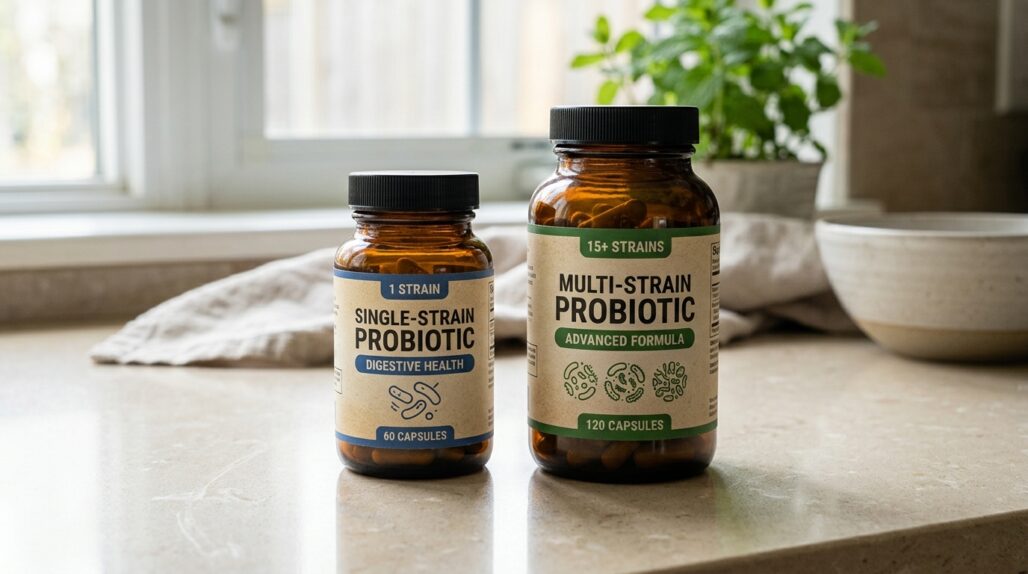
Here is the question that actually trips people up. A bottle of Culturelle gives you one or two strains. A bottle of Physician's Choice or a similar Amazon multi gives you ten. Surely more is better?
Not necessarily. A strain with strong, specific trial data can beat a blend you know nothing about. Many multi-strain products are validated as a finished blend in zero human studies, even if individual strains have been studied elsewhere.
So the decision comes down to your goal:
- One job, strong evidence: if you want protection during antibiotics or simply want a strain you can look up, a single studied strain like LGG is the smarter buy.
- Broad, exploratory daily support: if you have no specific target and just want general digestive variety, a multi-strain capsule gives you more types to "try" for a similar price.
There is no universal winner, which is why our Align vs Culturelle comparison lands on "it depends on the symptom." Align leans on a different single strain for IBS-type complaints; Culturelle leans on LGG for diarrhea-related uses.
One more honest point. More CFU is not automatically better. A 60 or 100 billion CFU label looks impressive, but the dose that matters is the dose studied for your goal. LGG's AAD research used doses in the range Culturelle actually sells, so its modest 10 billion count is not a weakness here.
Third-party testing and quality
This is where Culturelle is average, not exceptional. The brand guarantees the CFU count through the date on the box, measured at expiration rather than only at manufacture, which is the more honest way to state potency. That is a real plus over products that count CFU "at time of manufacture" and quietly lose potency on the shelf.
What you do not get is an independent seal. We did not find NSF, USP or ConsumerLab certification on the standard Culturelle line as of writing. The badges on the packaging tend to be consumer or media awards, not lab verification.
That is not disqualifying. Plenty of solid probiotics skip third-party seals. But if independent verification is your priority, a USP or NSF-marked product would rank higher on that single axis, and you should weigh it for yourself.
Cost per day vs the alternatives
Culturelle is drugstore-priced, not DTC-priced, which is its quiet advantage. The standard Digestive Daily runs around $17 to $18 for a 30-count as of writing, or roughly $0.55 to $0.65 per day; buying the 50 or 80-count brings the per-capsule cost down. Always check current price, since promotions and Subscribe and Save swing it.
Compared with subscription synbiotics, that is cheap. A premium DTC probiotic can run $2 or more per day. If you are cross-shopping the high end, our Ritual Synbiotic vs Seed DS-01 breakdown shows where that money goes and whether it earns its keep.
Here is how Culturelle stacks against two common comparison points. Prices are approximate, as of writing, and you should check current price before buying.
| Product | Strains | CFU | Approx. price (30 days) | Approx. cost/day |
|---|---|---|---|---|
| Culturelle Digestive Daily | LGG (plus B. lactis in current formula) | 10 billion | ~$17 to $18 | ~$0.55 to $0.65 |
| Physician’s Choice 60 Billion | 10 strains plus prebiotic | 60 billion | ~$20 to $24 | ~$0.70 to $0.80 |
| Premium DTC synbiotic | Multi-strain plus prebiotic | Varies (often 50B+) | ~$45 to $60 | ~$1.50 to $2.00 |
Read that table the right way. The multi-strain is not "better value" just because it has more CFU and strains. It is a different product for a different goal. Culturelle wins on focused evidence per dollar; the multi wins on variety per dollar.
Where to buy and a cheaper multi-strain pick
If your goal is an antibiotics buffer or one well-studied strain, Culturelle is the pick and it is genuinely affordable. If you want broad daily variety, a 10-strain Amazon capsule covers more ground for a similar price – and our Physician's Choice probiotic review walks through that option in detail.


As an Amazon Associate, UsefulVitamins.com earns from qualifying purchases at no extra cost to you.
UsefulVitamins may earn a commission from purchases made through the links above, at no extra cost to you. This never affects our verdicts.

FAQ
Is Culturelle good for antibiotic-associated diarrhea? This is its strongest use. A meta-analysis found LGG cut the risk of antibiotic-associated diarrhea from about 22% to 12%, with the clearest effect in children. Take it alongside the antibiotic, spaced a couple of hours apart, and ask your doctor if you are unsure.
Is one probiotic strain really enough? It can be, when that strain has strong trial data for your specific goal. A studied single strain like LGG can outperform a multi-strain blend that has never been tested as a finished product. For broad, undirected daily support, more strains may suit you better.
Does Culturelle need to be refrigerated? No. The capsules are shelf-stable, and the brand guarantees the CFU count through the date printed on the box rather than only at manufacture. Store it somewhere cool and dry and away from humidity.
Is the 10 billion CFU count too low? Not for what it does. Higher numbers look more impressive on a label, but the dose that matters is the one studied for your goal, and LGG’s antibiotic-diarrhea research used doses in this range. More CFU is not automatically better.
Is Culturelle third-party tested? We did not find an NSF, USP or ConsumerLab seal on the standard line as of writing. The brand does verify potency through the expiration date, which is a meaningful quality step, but it is not the same as independent lab certification.
Can I take Culturelle every single day? Yes, it is intended for daily use and is generally well tolerated. Whether you should depends on your goal – daily makes sense for ongoing support, while many people use it mainly during and after a course of antibiotics.
The verdict
Culturelle earns its shelf space, but for a narrower reason than the packaging suggests. Its strength is one of the best-researched probiotic strains on the market, sold at a drugstore price, and its clearest payoff is preventing antibiotic-associated diarrhea.
If that is your reason for buying, Culturelle is an easy yes at roughly $0.55 to $0.65 a day. Pick it up before or at the start of an antibiotic course and you are matching the use case the research actually supports.
If you want broad, exploratory daily gut support with no specific target, a multi-strain capsule is the more sensible buy for similar money. And if independent certification is non-negotiable for you, weight that toward a USP or NSF-marked product instead.
Your next step is simple: decide whether you are buying for the antibiotics job or for general support. That single choice tells you whether Culturelle, a multi-strain, or a different single strain like the one in our Florastor S. boulardii review is the right pick for you.
This article is for general information and is not medical advice. Probiotics are not a substitute for treatment, and you should talk with your doctor or pharmacist before starting one, especially if you are pregnant, immunocompromised, seriously ill, or giving a probiotic to a child.
Reviewed by the UsefulVitamins Editorial Team.
