
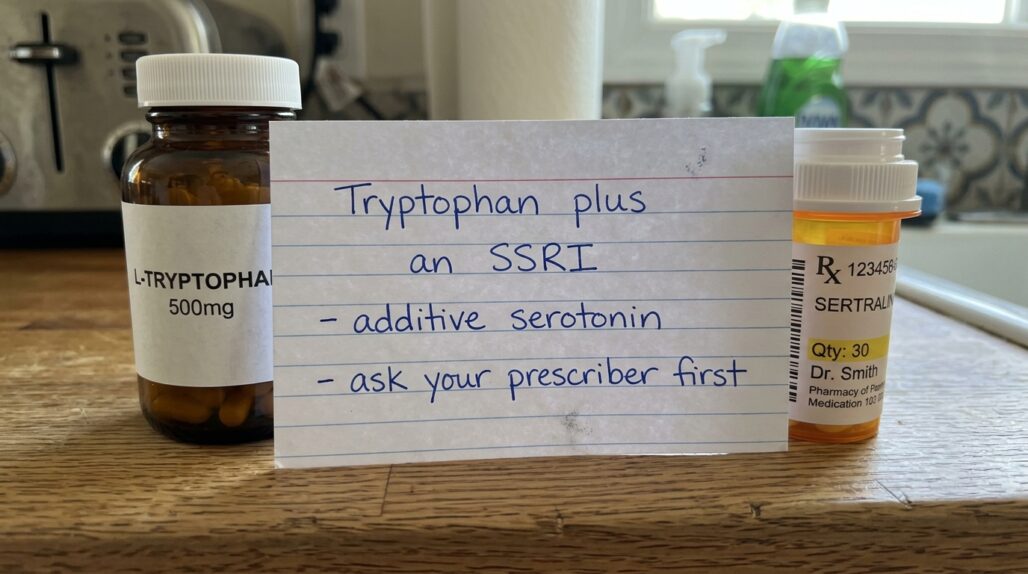
Before you decide
This article is general information, not medical advice for your situation. Drug-supplement decisions depend on your exact medication, dose, and health history, so the safe move is to route the final call to a clinician or pharmacist who knows your chart.
The people at highest risk are anyone already taking a serotonergic prescription. That includes SSRIs such as sertraline, escitalopram, fluoxetine, paroxetine, and citalopram, and it extends to SNRIs and MAOIs. If you take any of these and you are eyeing tryptophan for sleep or low mood, treat that as a conversation to have before, not after.
One more group runs higher risk: people layering several serotonin-raising products at once. A tryptophan capsule on top of an SSRI on top of, say, St. John's wort is three pushes on the same dial.
What L-tryptophan actually does
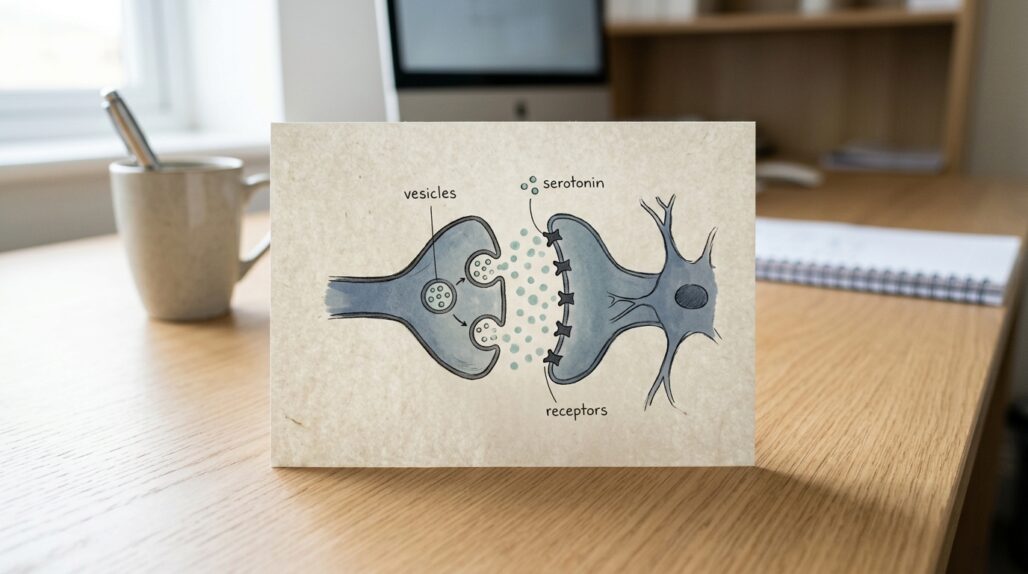
L-tryptophan is an essential amino acid you get from food like turkey, eggs, dairy, and seeds. Your body uses a slice of it to make serotonin, the signaling chemical that SSRIs are designed to keep available in the brain.
The path matters here. Tryptophan is first converted to 5-HTP by the enzyme tryptophan hydroxylase, and 5-HTP is then converted to serotonin. That first hydroxylation step is the rate-limiting one, which is why only a small fraction of the tryptophan you take ends up as serotonin, as a Frontiers review of tryptophan metabolism lays out. Most dietary tryptophan heads down the kynurenine pathway instead.
So a supplement dose still feeds the serotonin assembly line, just less efficiently per gram than its downstream cousin. The direction is the problem, not the efficiency. An SSRI keeps serotonin in the synapse longer; tryptophan helps make more of it. Stack the two and you are working both ends of the same system.
How L-tryptophan differs from 5-HTP (and why it matters)
People often search tryptophan and 5-HTP as if they are unrelated. They are not. 5-HTP is the next step down the same pathway, one conversion closer to serotonin, so it skips the rate-limiting bottleneck.
That makes 5-HTP a more direct serotonin booster gram for gram. But the safety headline is the same for both: adding either to an SSRI raises serotonin and carries serotonin syndrome risk. We cover the downstream precursor in depth in our companion piece on 5-HTP and serotonin syndrome with antidepressants.
The practical takeaway is simple. Switching from 5-HTP to tryptophan, or the reverse, does not make the SSRI combination safe. Same destination, different on-ramp.
The serotonin syndrome risk, in plain terms
Serotonin syndrome happens when serotonin activity climbs too high. It ranges from mild and uncomfortable to a medical emergency, and the more serotonergic agents you combine, the higher the odds.
The case literature on this combination is old but consistent. In a frequently cited report, Steiner and Fontaine documented toxic reactions in patients taking fluoxetine with L-tryptophan, with agitation, restlessness, and other central nervous system effects that had not appeared on the SSRI alone. The reactions resolved when the serotonergic load was reduced.
That said, the picture is not one-sided. A small randomized trial published in the Journal of Psychiatry and Neuroscience gave tryptophan alongside fluoxetine under close supervision and reported the combination was well tolerated, with a faster early drop in depression scores. The higher dose produced daytime drowsiness.
Hold both of those facts together. Supervised, dose-controlled use in a study is not the same as buying a bottle and adding it to your prescription at home. The trial worked because clinicians chose the dose, monitored the patients, and could stop fast.
Warning signs and the timeline
Serotonin syndrome usually shows up quickly. According to the StatPearls clinical reference on serotonin syndrome, most cases appear within 6 to 24 hours of a serotonergic change, such as starting a new agent or raising a dose.
Clinicians group the signs into three buckets:
- Mental status changes: agitation, restlessness, confusion, anxiety
- Autonomic instability: fast heart rate, high blood pressure, sweating, fever, dilated pupils, diarrhea
- Neuromuscular signs: tremor, muscle twitching or jerking (clonus), exaggerated reflexes, and rigidity in severe cases
The neuromuscular signs, especially clonus, tend to be more noticeable in the legs. The same reference notes that diagnosis often leans on the Hunter criteria, which weigh clonus, tremor, agitation, sweating, and elevated temperature in someone who recently took a serotonergic drug.
Here is the table to keep straight what is mild versus what is an emergency.
| Severity | What you might notice | What to do |
|---|---|---|
| Mild | Jitteriness, mild tremor, sweating, fast pulse, restlessness | Stop the supplement and call your prescriber or pharmacist promptly |
| Moderate | Agitation, muscle twitching, exaggerated reflexes, low-grade fever | Seek same-day medical care; do not take another dose |
| Severe | High fever, rigidity, confusion, rapid heartbeat with chest symptoms | Call emergency services – this is a medical emergency |
Treatment starts with stopping all serotonergic agents and supportive care, and benzodiazepines are commonly used to settle agitation and muscle activity. The most important thing you can do is recognize it early and get help.
The eosinophilia-myalgia syndrome history
There is a second, separate reason tryptophan carries a cautious reputation, and it has nothing to do with serotonin. In 1989 a serious illness called eosinophilia-myalgia syndrome (EMS) swept through L-tryptophan users in the United States.
As summarized in the reference history of the EMS outbreak, more than 1,500 cases and dozens of deaths were reported. Investigators traced it not to tryptophan itself but to trace contaminants in batches from a single manufacturer, Showa Denko. The FDA recalled tryptophan supplements and restricted imports for years afterward.
What this means for you today: tryptophan is sold again, but manufacturing quality is part of the safety question, not an afterthought. Look for products with third-party testing and avoid mystery brands. The EMS story is a reminder that purity has mattered with this particular amino acid before.

Safer options to raise with your prescriber
If the goal is better sleep or steadier mood, you have choices that do not stack directly on the serotonin system. None of these is automatically safe with your medication, so the rule still holds: run them by your prescriber.
- Melatonin targets sleep timing rather than serotonin reuptake. The NCCIH overview of melatonin calls short-term use generally well tolerated in adults while advising anyone on medication to check with a provider first. See how it fits with antidepressants in our piece on melatonin with SSRIs and SNRIs.
- Sleep hygiene and a consistent routine do the unglamorous heavy lifting and have no interaction risk. Our sleep supplement protocol walks through where supplements fit and where they do not.
- For anxiety specifically, several non-serotonergic options are worth discussing; we round them up in our guide to natural supplements for anxiety.
A word on the most dangerous pairing: MAOIs plus serotonergic supplements. That combination is in a higher danger tier than SSRIs, and we cover it in our article on SAM-e and MAOIs for anxiety. If you take an MAOI, treat tryptophan as off the table unless a specialist says otherwise.
Keeping an accurate list of everything you take makes these conversations faster and safer. A free app like StackMyMed lets you log your supplements and prescriptions in one place and flag possible overlaps to raise with a pharmacist. It is a prompt for that conversation, not a substitute for clinical judgment.
FAQ
Can I take L-tryptophan with sertraline or Zoloft? Not on your own. Sertraline is an SSRI, so adding tryptophan raises serotonin from two directions and carries serotonin syndrome risk. Ask your prescriber before combining anything serotonergic.
Is tryptophan from turkey or food a problem on an SSRI? Ordinary food amounts are not the concern. The risk discussion is about concentrated supplement doses, which deliver far more tryptophan than a meal and bypass normal appetite limits.
How fast would serotonin syndrome appear? Often within 6 to 24 hours of the change, per clinical references. Early signs include agitation, fast heartbeat, sweating, tremor, and muscle twitching; severe cases add high fever and rigidity and need emergency care.
Is 5-HTP any safer than L-tryptophan with an SSRI? No. 5-HTP sits one step closer to serotonin on the same pathway, so it carries the same combination risk. Switching between the two does not make stacking with an SSRI safe.
Why was tryptophan once banned? A 1989 outbreak of eosinophilia-myalgia syndrome was tied to contaminated batches from one manufacturer, prompting an FDA recall and import limits. The illness was traced to impurities, not tryptophan itself, but product quality still matters.
What should I do if I already took both today? If you feel agitated, sweaty, shaky, or feverish, stop the supplement and contact your prescriber or urgent care now; call emergency services for severe symptoms. If you feel completely normal, do not take another tryptophan dose and check in with your prescriber before continuing.
Conclusion: clear it before you combine
L-tryptophan and SSRIs both raise serotonin, so pairing them is an additive risk, not a neutral add-on. The case literature shows it can trigger serotonin syndrome, while supervised trials show it can be tolerated under tight control – and the difference between those outcomes is medical oversight.
If sleep or mood is the real goal, there are options that do not pile onto the same system, and your prescriber can match one to your medication safely. Bring your full list, including supplements, and let a clinician make the call. For the bigger picture, see our ultimate guide to drug-supplement interactions and run your own combination through the drug-supplement interaction checker.
This article is for general education and does not replace personalized advice from a qualified healthcare professional. Do not start, stop, or combine any supplement or prescription medication without consulting your doctor or pharmacist.
Reviewed by the UsefulVitamins Editorial Team.
