
Before you decide
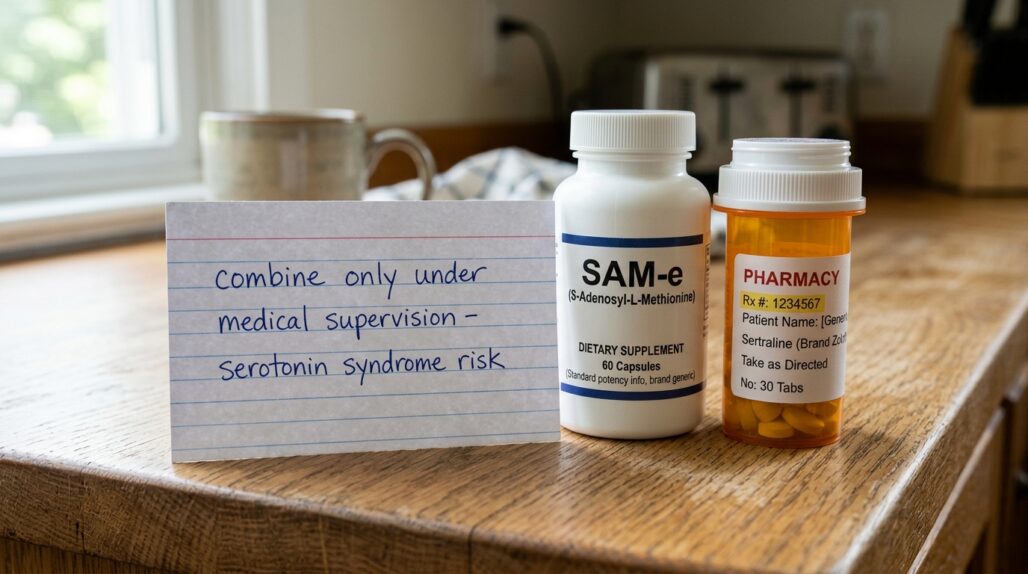
This article is general information, not medical advice. SAM-e (S-adenosyl-L-methionine) is sold over the counter, which makes it easy to assume it is mild. It is not pharmacologically neutral, and the people most affected by that are those already taking a prescription antidepressant.
The highest-risk groups are clear. If you take an SSRI such as sertraline (Zoloft), escitalopram, fluoxetine, or paroxetine, an SNRI, an MAOI, or any other serotonergic drug, adding SAM-e changes the math on your serotonin load. People with bipolar disorder carry a separate risk that has nothing to do with the SSRI.
The safe move is simple: treat SAM-e the way you would treat a second antidepressant, because functionally that is closer to what it is. Loop in the prescriber who manages your SSRI before you start. For a wider view of how supplements collide with prescriptions, our drug-supplement interaction guide maps the common patterns.
What SAM-e actually does to serotonin
SAM-e is a compound your body makes from the amino acid methionine. It donates methyl groups in dozens of reactions, several of which feed into how the brain builds and uses monoamine neurotransmitters, including serotonin and dopamine.
Practically, SAM-e behaves like a mild antidepressant. The National Center for Complementary and Integrative Health notes that SAM-e may interact with drugs that raise serotonin, listing antidepressants, L-tryptophan, and St. John's wort by name in its overview of SAM-e. That is the core of the problem.
An SSRI works by blocking serotonin reuptake, so more serotonin stays in the synapse. Layer a second agent with serotonin-related activity on top and you are pushing the same system from two directions at once. The result you are trying to avoid is too much serotonin, not too little.
Serotonin syndrome: the risk that matters most
Serotonin syndrome is the reason this combination needs supervision. It is a drug reaction caused by excess serotonergic activity, and it ranges from uncomfortable to genuinely dangerous.
Memorial Sloan Kettering's clinical monograph states that people on antidepressants should avoid SAM-e without physician supervision because of case reports of mania and serotonin syndrome, and it documents a report of serotonin syndrome in a woman who used the tricyclic clomipramine alongside SAM-e. You can read the cautions in the Memorial Sloan Kettering SAM-e monograph.
Timing is part of what makes it sneaky. Per the Merck Manual reference on serotonin syndrome, most cases appear within 24 hours, and often within 6 hours, of a dose change or a new serotonergic agent. So a reaction would tend to show up soon after you add SAM-e, not weeks later.
Warning signs to know
Serotonin syndrome shows up across three groups of signs. Learn them before you change anything:
- Mental status: agitation, anxiety, restlessness, confusion, or being easily startled.
- Autonomic: fast heartbeat, high blood pressure, fever, heavy sweating, shivering, vomiting, or diarrhea.
- Neuromuscular: tremor, muscle twitching (myoclonus), exaggerated reflexes, muscle rigidity, and clonus – rhythmic involuntary muscle jerks, often most obvious in the legs.
Mild cases can resemble jitteriness or anxiety, which is exactly why people miss them. Fever, stiffness, confusion, or a racing heart after starting SAM-e is an emergency – stop the supplement and get urgent care. If you want to understand how this plays out with related serotonin precursors, our piece on 5-HTP and antidepressants covers the same syndrome from a different angle.
So why have some doctors combined them?
Here is where the picture gets more honest. SAM-e is not only a risk story; it has been studied as a deliberate add-on for depression that an SSRI alone did not fix.
The most cited trial comes from Papakostas and colleagues, published in the American Journal of Psychiatry in 2010. They took 73 patients who had not responded to an SSRI or SNRI and added either SAM-e at a target of 800 mg twice daily or placebo to the antidepressant they were already on. You can find it indexed as the Papakostas SAMe augmentation trial.
The SAM-e group did better. Response reached 36.1% with SAM-e versus 17.6% with placebo, and remission was 25.8% versus 11.7%. Discontinuation rates were similar between the groups, and the authors described SAM-e augmentation as reasonably well tolerated.
Two things keep that from being a green light. The trial was small and short, and NCCIH still calls the overall evidence that oral SAM-e helps depression not conclusive. More to the point, every patient in that study had a clinician monitoring them. The takeaway is that supervised augmentation is a recognized strategy a doctor can choose, not that self-stacking is safe.
The MAOI combination is in a different league
If you take a monoamine oxidase inhibitor (MAOI) – such as phenelzine, tranylcypromine, isocarboxazid, or selegiline – the calculation changes entirely.
MAOIs block the enzyme that breaks serotonin down. Combining an MAOI with anything that raises serotonin is the textbook setup for severe serotonin syndrome, and SAM-e belongs on that list. SAM-e plus an MAOI is a combination to avoid, not merely to supervise.
This is not a gray area, and it deserves its own search. Our companion article on SAM-e and MAOIs explains why that pairing is treated as a hard no. If you take an MAOI, the spacing and washout questions belong with your prescriber, not a supplement label.
Bipolar disorder: a separate warning
Even setting serotonin syndrome aside, SAM-e carries a risk for anyone with bipolar disorder. Like other antidepressants, it can tip a vulnerable person toward mania or hypomania.
NCCIH states plainly that SAM-e may not be safe for people with bipolar disorder and may worsen mania. The clinical literature backs this with case reports, including a documented manic episode triggered by SAM-e and a report of possible SAMe-induced mania during SSRI use.
The practical rule: if you have bipolar disorder, or depression that has not been clearly distinguished from it, do not start SAM-e without a psychiatrist's input. A "mood supplement" that can flip you into mania is not a small detail.

How risk stacks up
The table below sorts the main scenarios by how much caution each calls for. It is a way to frame the conversation with your clinician, not a substitute for one.
| Scenario | Main concern | General guidance |
|---|---|---|
| SAM-e + MAOI | Severe serotonin syndrome | Avoid; manage only with a prescriber |
| SAM-e + SSRI or SNRI | Serotonin syndrome; mania if bipolar | Only under medical supervision |
| SAM-e + bipolar diagnosis | Mania or hypomania | Do not start without a psychiatrist |
| SAM-e alone, no serotonergic meds | Mild GI upset; quality varies | Lower risk, still tell your doctor |
If you are weighing SAM-e against other options for low mood, our roundups of supplements studied for depression and natural approaches to anxiety lay out what the evidence does and does not support.
What to do if you want to try SAM-e
The order of operations protects you here. Do not change your prescription on your own, and do not treat an over-the-counter label as clearance.
- Talk to the prescriber who manages your SSRI first. Bring the exact SAM-e product and the strength you are considering.
- Never stop a prescribed antidepressant to "make room" for SAM-e. Abruptly stopping an SSRI causes its own withdrawal problems, and the decision belongs with your doctor.
- If you get a green light, watch for early serotonin syndrome signs in the first hours and days, when reactions are most likely to appear.
- Keep one accurate list of everything you take. Apps like StackMyMed let you log a supplement-and-medication stack and flag possible interactions to raise with a pharmacist. It is a prompt for that conversation, not a replacement for clinical judgment.
Because SAM-e quality varies between brands and the active form is unstable, a pharmacist can also steer you toward enteric-coated products if you do proceed. When in doubt, run the pairing through our drug-supplement interaction checker and bring the result to your appointment.
FAQ
Can I take SAM-e with sertraline (Zoloft)? Not on your own. Both raise serotonin, so the combination carries a serotonin syndrome risk. Some supervised trials added SAM-e to an SSRI for people who had not responded, but that was monitored by a prescriber. Ask the doctor who manages your sertraline before adding anything.
How quickly would serotonin syndrome show up? Usually fast. Most cases appear within 24 hours, and often within about 6 hours, of starting or increasing a serotonergic agent. Agitation, tremor, fast heartbeat, sweating, or fever after adding SAM-e is a reason to stop it and seek urgent care.
Is SAM-e safe if I have bipolar disorder? It may not be. Like other antidepressants, SAM-e can trigger mania or hypomania, and NCCIH specifically flags it as possibly unsafe in bipolar disorder. Do not start it without a psychiatrist’s input.
What about combining SAM-e with an MAOI? Avoid it. MAOIs block serotonin breakdown, so pairing one with a serotonin-raising supplement is a high-risk setup for severe serotonin syndrome. This decision belongs entirely with your prescriber.
Does SAM-e actually help depression? The evidence is mixed and not conclusive, per NCCIH. One controlled trial found SAM-e helped some people whose SSRI alone had not worked, but trials have generally been small and short. It is not a proven replacement for prescribed treatment.
Can I just lower my SSRI dose and add SAM-e instead? No, not without your doctor. Changing an antidepressant dose on your own can cause withdrawal effects or a relapse, and combining a reduced SSRI with SAM-e still raises serotonin. Any dose change should be planned with the prescriber.
Conclusion: supervised, not solo
SAM-e is not a harmless add-on to an SSRI. Both raise serotonin, and stacking them without oversight invites serotonin syndrome – a reaction that can start within hours and turn serious. The MAOI combination is more dangerous still, and anyone with bipolar disorder faces a separate mania risk.
The studies that combined SAM-e with an SSRI did so under medical watch, with monitoring for exactly these problems. That is the model to follow. If SAM-e interests you, write it on your medication list, bring it to the prescriber who manages your antidepressant, and let that conversation – not a supplement aisle – decide the next step.
This article is for general education and does not replace personalized medical advice. Supplement and medication decisions, especially around antidepressants, should be made with your doctor or pharmacist.
Reviewed by the UsefulVitamins Editorial Team.
