
Before you decide
This article is general information, not medical advice for your specific situation. Contraceptive choices and drug interactions are personal, so use this to ask sharper questions, not to overrule your prescriber or pharmacist.
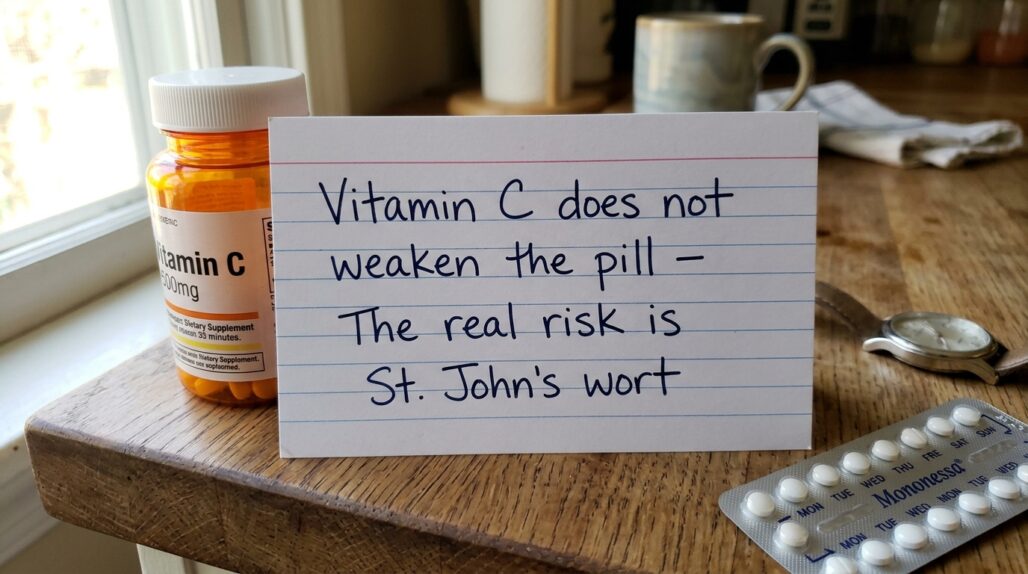
The short version is reassuring. Search results on this topic are saturated with old warnings, and most of them trace back to a single small experiment from 1981 that did not hold up. If you have been worried that your morning orange juice or a vitamin C tablet is quietly undoing your pill, the evidence says it almost certainly is not.
Who should pay closest attention here. If you rely on a combined pill as your only method, if you take large vitamin C doses for another reason, or if you are also using herbal products, it is worth knowing where the real risk sits. Spoiler: it is not vitamin C.
Where the vitamin C myth came from
In 1981, a small study by Back and colleagues, published in the British Medical Journal, reported that 1 gram of ascorbic acid appeared to raise plasma levels of ethinylestradiol in a handful of women on the pill. The proposed mechanism was sulfation.
Ethinylestradiol, the estrogen in most combined pills, is partly broken down by attaching a sulfate group to it in the gut wall. Vitamin C is also sulfated. The theory went that the two compete for the same limited sulfate, so loading up on vitamin C would leave more active estrogen circulating.
Here is the twist most fear-based articles skip. Higher estrogen would not make the pill fail. If anything it would make it slightly stronger. The original worry was really the reverse: that stopping vitamin C after the body had adapted might cause a sudden estrogen drop. That is a fragile chain of assumptions resting on a study of very few people.

What the better evidence actually shows
The 1981 finding was provocative enough that researchers went back to test it properly. A controlled study by Zamah and colleagues, published in Contraception in 1993, gave women on a combined pill (30 micrograms ethinylestradiol plus 150 micrograms levonorgestrel) 1 gram of vitamin C half an hour before their pill across full cycles.
The result was clear. There was no meaningful effect of vitamin C on the maximum concentration or the overall exposure (AUC) of ethinylestradiol. The authors went as far as recommending that ascorbic acid "can be removed from the list of drugs interfering with the pharmacokinetics of ethinyl estradiol."
The same controlled trial used a levonorgestrel-containing pill and found no signal that vitamin C altered the progestin side either, so both halves of the combined pill held steady.
The honest summary: the modern consensus is that vitamin C does not reduce contraceptive efficacy. One small, old, unreplicated signal does not outweigh later controlled work pointing the other way.
The supplement that does matter: St. John's wort
If you want to spend your worry budget wisely, spend it here. St. John's wort, a herbal product taken for low mood, is a strong inducer of the liver enzyme CYP3A4 – the same enzyme that clears both the estrogen and the progestin in your pill. Speed up that enzyme and hormone levels fall.
This is not theoretical. In a randomized crossover trial (Hall and colleagues, 2003) published in Clinical Pharmacology & Therapeutics, women on a low-dose pill had more breakthrough bleeding during the St. John's wort phase (7 of 12 women) than the control phase (2 of 12), alongside signs of returning ovarian activity. Breakthrough bleeding is a visible flag that hormone levels may have dipped below the protective range.
A later systematic review pulled the studies together and concluded the combination raises real concern for reduced contraceptive efficacy. Individual responses vary, so some people are hit harder than the averages suggest.
We cover this in depth in our guide to St. John's wort and birth control failure and the wider roundup of supplements that reduce birth control effectiveness. The takeaway is simple: vitamin C is a non-issue, St. John's wort is the one to flag.

Vitamin C, ascorbic acid, and how the worry stacks up
It helps to put the two supplements side by side. The difference in real-world risk is large, and seeing it laid out usually settles the question.
| Supplement | Effect on the pill | Mechanism | What to do |
|---|---|---|---|
| Vitamin C (ascorbic acid) | No meaningful reduction in efficacy on current evidence | Old sulfation theory not reproduced in controlled studies | No special action; take it if you want it |
| St. John’s wort | Can genuinely lower hormone levels and raise failure risk | Induces CYP3A4, speeding breakdown of estrogen and progestin | Use backup contraception; talk to your prescriber |
| Rifampin (a prescription antibiotic) | Substantial drop in hormone exposure | Strong enzyme inducer, cuts ethinylestradiol exposure sharply | Use a non-hormonal backup during and after the course |
The pattern is consistent. Enzyme inducers are the genuine efficacy threat. Plain nutrients like vitamin C are not enzyme inducers, which is why they sit in the harmless column.
How much vitamin C is actually reasonable
Since you can keep taking it, here is the sensible frame. According to the NIH Office of Dietary Supplements, the recommended daily intake is 90 mg for adult men and 75 mg for adult women, with smokers needing about 35 mg more.
Most people meet that easily through food. A single orange, a cup of strawberries, or a serving of bell pepper covers the day.
For supplements, the tolerable upper intake level is 2,000 mg per day for adults. Going above that does not buy extra benefit and tends to cause the body to simply excrete the excess, with diarrhea and stomach upset being the usual penalty. If you want the wider picture on dosing and forms, see our vitamin C science, benefits and dosage guide.
There is no reason to avoid vitamin C because you are on the pill. The interaction simply is not there at the level the evidence can detect.

When you genuinely do need a backup method
The point of all this is to aim your caution at the right targets. A few situations call for backup contraception or a prescriber conversation, and none of them involve vitamin C.
- Starting St. John's wort. Add a barrier method and speak to your prescriber, because hormone levels can fall within days.
- Taking rifampin or other rifamycin antibiotics. These are strong enzyme inducers; CDC eligibility guidance treats the combination with combined hormonal contraceptives as high-risk and a non-hormonal method is preferred.
- Certain anti-seizure and HIV medicines that also induce liver enzymes – always check with the prescriber who started them.
One common myth deserves a direct correction. Most everyday antibiotics do not reduce pill effectiveness. As the ACOG guidance summary via AAFP makes clear, drugs like amoxicillin, doxycycline and the common penicillins and tetracyclines leave hormone levels essentially unchanged. Rifampin is the standout exception, not antibiotics as a class.
If you want to keep a running list of what you take and surface possible flags before they matter, you can log your stack in StackMyMed and bring it to a pharmacist. It is a way to organize the conversation, not a substitute for clinical judgment.
FAQ
Does vitamin C cancel out birth control? No. Controlled research found no meaningful effect of high-dose vitamin C on the availability of the estrogen in combined pills, so it does not cancel out your contraception.
Where did the vitamin C and birth control myth start? A small 1981 study suggested high-dose vitamin C raised estrogen levels through sulfation competition. A better-controlled 1993 study could not reproduce the effect, and experts removed vitamin C from the list of pill-interacting drugs.
How much vitamin C is too much on the pill? There is no pill-specific limit, but the general tolerable upper intake level is 2,000 mg per day for adults. Above that you mainly get stomach upset and diarrhea, with no added benefit.
What supplement actually makes birth control less effective? St. John’s wort is the main one. It speeds up the liver enzyme that breaks down contraceptive hormones, which can lower their levels and raise the risk of breakthrough bleeding and failure.
Do I need backup contraception if I take vitamin C? No. Vitamin C is not an enzyme inducer and does not lower hormone levels. Backup methods matter for St. John’s wort, rifampin and other enzyme-inducing drugs.
Can I take vitamin C and the pill at the same time of day? Yes. There is no need to space them apart, since current evidence shows no clinically relevant interaction between the two.
Conclusion: vitamin C is a false alarm
Strip away the recycled warnings and the picture is calm. One small 1980s study raised a flag, careful follow-up work took it back down, and the modern position is that vitamin C does not meaningfully affect how well your pill works.
Save your attention for the interaction that is real. St. John's wort can genuinely reduce contraceptive protection by speeding hormone breakdown, and a few prescription drugs like rifampin do the same. If either of those is in your routine, that is the conversation to have with your prescriber or pharmacist. For the broader map of what interacts with what, start with our ultimate drug-supplement interactions guide, run your combination through the drug-supplement interaction checker, and see how we review supplements for the standards behind this article.
This article is for general education and does not replace personalized medical advice. Talk to your doctor or pharmacist before changing any medication, contraceptive, or supplement, and seek urgent care for any sudden or severe symptoms.
Reviewed by the UsefulVitamins Editorial Team.
