
Affiliate disclosure: this article contains affiliate links. As an Amazon Associate, UsefulVitamins.com earns from qualifying purchases at no extra cost to you.
People do not search for cheaper Magnesium Breakthrough alternatives because they dislike the product. They search because they read the price, then read the reviews where other buyers ask the same thing. Is there a version on Amazon that does the same job for less? Usually, yes.
So let's do the math instead of the marketing.
Before you buy
The real question is not whether Magnesium Breakthrough is good. It is a competent product. The question is whether seven forms of magnesium in one capsule earn a meaningful premium over a single, well-dosed form you can buy on Amazon for far less.
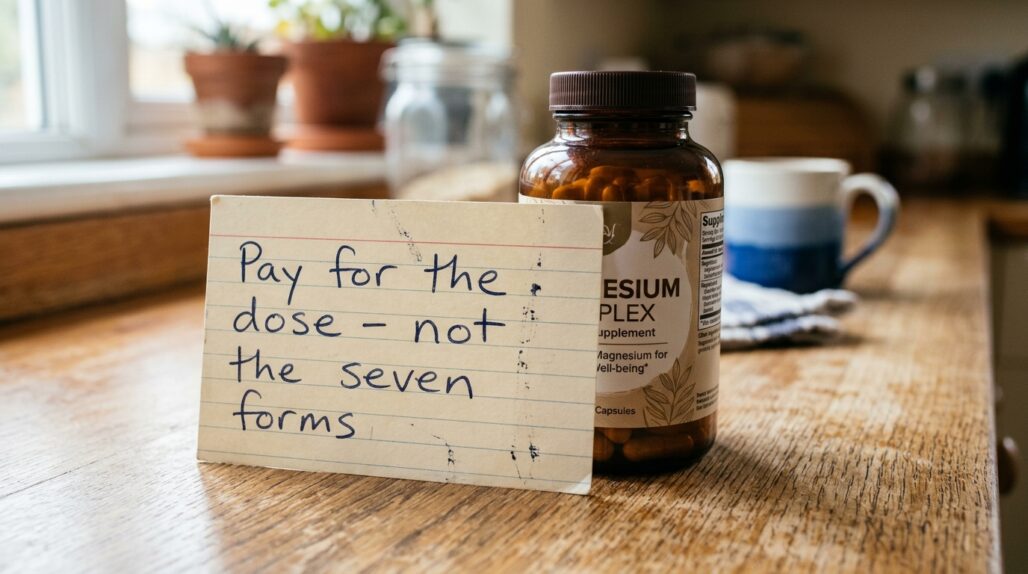
Here is the gap between what the label sells and what your body uses. The label sells variety: chelate, glycinate, malate, citrate, orotate, sucrosomial, taurate. Your body uses elemental magnesium, and it cares about two things – how much shows up, and whether the form sits well in your gut.
That reframes the whole decision. You are choosing between paying for a curated blend or paying for the dose and the tolerability, then pocketing the difference. For most buyers, the second path wins.
What Magnesium Breakthrough actually delivers
Credit where it is due. Per BiOptimizers' own product page, Magnesium Breakthrough provides 500 mg of elemental magnesium per 2-capsule serving drawn from seven forms. A bottle holds 60 capsules, so that is 30 servings.
The brand says it is made in a GMP facility, runs a battery of formula and quality tests, screens for heavy metals, and publishes a manufacturing certificate of analysis. That published testing is a genuine point in its favor, and not every Amazon competitor matches it.
The 500 mg figure matters, though not in the way the marketing implies. Adult magnesium needs from all sources sit at 310 to 320 mg for women and 400 to 420 mg for men, per the NIH Office of Dietary Supplements.
That same fact sheet sets a separate ceiling for supplements alone. The tolerable upper limit for supplemental magnesium is 350 mg, because higher amounts loosen your bowels. A 500 mg supplemental dose in one go sits above that line. Plenty of people tolerate it fine; some will be planning their day around a bathroom.
Now the part the marketing leans on hardest. Each of the seven forms is real, and a couple have a sensible rationale – glycinate for tolerability and calm, taurate as a heart-stack favorite, citrate for occasional constipation.
But you get a sliver of each, not a full studied dose of any single specialty form. The workhorse most reviewers are actually feeling is the bisglycinate: gentle on the gut, where cheap forms like oxide are both poorly absorbed and more likely to cause diarrhea, again per the NIH magnesium fact sheet.
The translation is blunt. The part of Magnesium Breakthrough that earns its reviews is mostly the glycinate plus a solid total dose. You can buy that directly.
One honesty note on certification. Magnesium Breakthrough has appeared in the Informed Sport database, but batch coverage changes over time and older tested lots can stay listed until they expire. If a current sport certification is your deciding factor, check the live status for the specific batch before you assume it is covered.

What to look for in a dupe
If you are replacing a premium blend, do not replace it with a mystery. Run every candidate through this short checklist and most of the "alternatives" search noise falls away.
| What to check | Why it matters |
|---|---|
| Elemental magnesium, not compound weight | A label can shout “500 mg magnesium glycinate” while delivering closer to 100 mg of usable elemental magnesium. Compare elemental to elemental. |
| A form you tolerate | Glycinate is gentle and calming, citrate can loosen stools, oxide is cheap and poorly absorbed. The right form beats the most forms. |
| Third-party testing or a credible standard | Look for a published COA, NSF, USP, or honest heavy-metal testing language. A real standard outranks a long ingredient poem. |
| Cost per serving at your target dose | This is the whole game. Normalize everything to the same elemental dose, then compare price per day. |
| No proprietary-blend hiding | If you cannot see the exact elemental amount per serving, you cannot do the math, which is usually the point. |
Want the full version of that form-by-goal logic? Our magnesium forms and bioavailability guide lays out which form fits which job. And if you read only one page on the mineral, make it the complete guide to magnesium.
The cost-per-serving math
This is the part the marketing would rather you skip. Let's normalize everything to the same elemental dose and compare price per day.
As of writing, Magnesium Breakthrough runs roughly $27 on subscribe-and-save up to around $40 for a one-time 30-serving bottle, based on BiOptimizers' pricing. Call it about 90 cents to a dollar-thirty per serving for 500 mg elemental. The brand discounts heavily, so treat those as as-of-writing numbers and check the current price before you buy.
Now the Amazon alternatives. These are single-form glycinate, third-party tested, and far cheaper per elemental milligram. Doses and prices on Amazon move constantly, so verify the live listing, but the order of magnitude is the point.
| Option | Form & dose | Approx. cost per serving | Notes |
|---|---|---|---|
| Magnesium Breakthrough | 7-form blend, 500 mg elemental per 2 caps | ~90c to $1.30 | GMP facility, published COA, heavy-metal testing; you pay for the blend story. |
| Doctor’s Best (Albion TRAACS) | Chelated glycinate/lysinate, ~100 mg elemental per tablet | ~10c to 20c at a 200 mg target | Branded Albion chelate, large 240-count bottle, longtime staple. |
| NOW Foods Magnesium Glycinate | Bisglycinate, ~200 mg elemental per serving | ~15c to 30c | GMP, publishes its third-party manufacturing testing; note this SKU adds BioPerine (black pepper extract), so it is not a pure single-ingredient glycinate. |
| Pure Encapsulations Magnesium | Glycinate, 120 mg elemental per capsule | ~30c to 45c | Practitioner brand, clean excipients, pricier but still well under MB. |
| Naturebell Pure Magnesium Glycinate | Chelated glycinate, 240 veggie caps | ~10c to 20c | Budget high-count bottle, third-party tested; verify elemental amount on the label. |
Look at that spread. Even the priciest practitioner-grade glycinate undercuts Magnesium Breakthrough per elemental milligram, and the budget options crush it. If your goal is the calm, sleep-friendly glycinate effect, you can hit a comparable elemental dose for a quarter of the cost or less, with a real testing standard behind it.
One fair caveat. Cost per serving depends on the dose you take. If you want the full 500 mg elemental, you will swallow more capsules of a 100 mg or 120 mg product, which narrows the gap a little. But most people sit comfortably at 200 to 350 mg supplemental, where the cheaper picks still win easily.

When a single form beats a 7-form blend
Counterintuitive, but true for most buyers: one good form usually beats seven mediocre slivers.
A blend that splits 500 mg across seven forms hands you a token amount of each. The specialty forms people get excited about – orotate, taurate, malate – show their most interesting evidence at meaningful single-form doses, not a seventh of a serving. So you are paying for forms you are not getting enough of to matter.
A clean glycinate, by contrast, gives you a full, predictable dose of the form most "better sleep, less tension" buyers actually want. For the calm and sleep use case, a focused glycinate is not a compromise. It is arguably the sharper tool.
When does the blend earn its keep? Genuinely narrow cases. If a clinician steered you toward taurate for a cardiovascular stack, or you want a touch of citrate for occasional constipation, a multi-form bottle is convenient. That is a "this fits my situation" reason, not a "seven beats one" reason.
For the full blow-by-blow on the brand itself, see our companion piece on whether Magnesium Breakthrough is worth it.
Where to buy and the value pick
The simple play: buy a third-party-tested magnesium glycinate that clearly lists elemental magnesium, target the dose your clinician or the label supports – often 200 to 350 mg supplemental – and keep the savings. The picks below consistently clear the checklist above.


As an Amazon Associate, UsefulVitamins.com earns from qualifying purchases at no extra cost to you.
UsefulVitamins earns commissions from qualifying purchases made through Amazon links on this page, at no extra cost to you. It does not change which products we recommend or what we say about them.
How to choose between them in one breath: go Doctor's Best for the lowest cost per serving, NOW Foods if you want a well-known brand that publishes its testing, and Nature Made for the simplest mainstream option. All three beat the blend on value.

FAQ
Is Magnesium Breakthrough actually better than a plain magnesium glycinate? Not in a way most people will feel. The calming workhorse inside the blend is the glycinate, plus a solid total dose, and a single well-dosed glycinate delivers that same core benefit for far less. That is exactly why so many reviewers ask for a cheaper dupe.
What is the cheapest Amazon alternative that is still good quality? A third-party-tested chelated glycinate like Doctor’s Best (Albion TRAACS) or a high-count option like Naturebell often lands near 10 to 20 cents per serving at a 200 mg elemental target, versus roughly a dollar or more for Magnesium Breakthrough. Verify the current price and the elemental amount on the label before buying.
Do I really need seven forms of magnesium? No. Your body uses elemental magnesium and cares about the dose and whether the form sits well in your gut. Seven forms in one capsule means a small fraction of each, not a full studied dose of any specialty form. One form you tolerate at a proper dose is usually the smarter buy.
How much elemental magnesium should I take from a supplement? The NIH Office of Dietary Supplements lists a tolerable upper limit of 350 mg for supplemental magnesium specifically, because higher amounts can loosen stools. Many people do well at 200 to 350 mg, but the right number depends on your diet and health, so check with a clinician or pharmacist.
Why is “magnesium glycinate 500 mg” on a label confusing? Because that 500 mg is usually the weight of the whole compound, not the usable elemental magnesium, which may be closer to 100 mg. Always compare elemental to elemental. If a label hides the elemental amount, treat that as a reason to pick a more transparent product.
Is Magnesium Breakthrough third-party tested or sport certified? BiOptimizers publishes a certificate of analysis and heavy-metal testing. Its sport-certification coverage has varied by batch over time, so newer lots may not be tested under that programme. If a current sport certification matters to you, confirm the live batch status before buying.
The verdict
Magnesium Breakthrough is a competent product in an expensive costume. The seven-forms pitch is mostly a story; the part that earns the good reviews is the glycinate and the total dose, and you can buy that directly on Amazon for a quarter of the cost or less, with a real testing standard behind it.
Buy the blend only if you have a specific, clinician-backed reason to want a particular niche form. Otherwise, pick a third-party-tested glycinate, hit your elemental dose, and keep the money. That is the honest call.
Still on the fence about the brand itself? Read our full worth-it breakdown before you decide.
This article is informational and not medical advice. It is not a substitute for guidance from your doctor or pharmacist, especially if you take medications or have kidney issues, since magnesium needs and limits are individual. Prices, formulas, and certifications change constantly, so verify current details on the product page before you buy.
Reviewed by the UsefulVitamins Editorial Team.
