
Affiliate disclosure: this article contains affiliate links. As an Amazon Associate, UsefulVitamins.com earns from qualifying purchases at no extra cost to you.
Before you buy
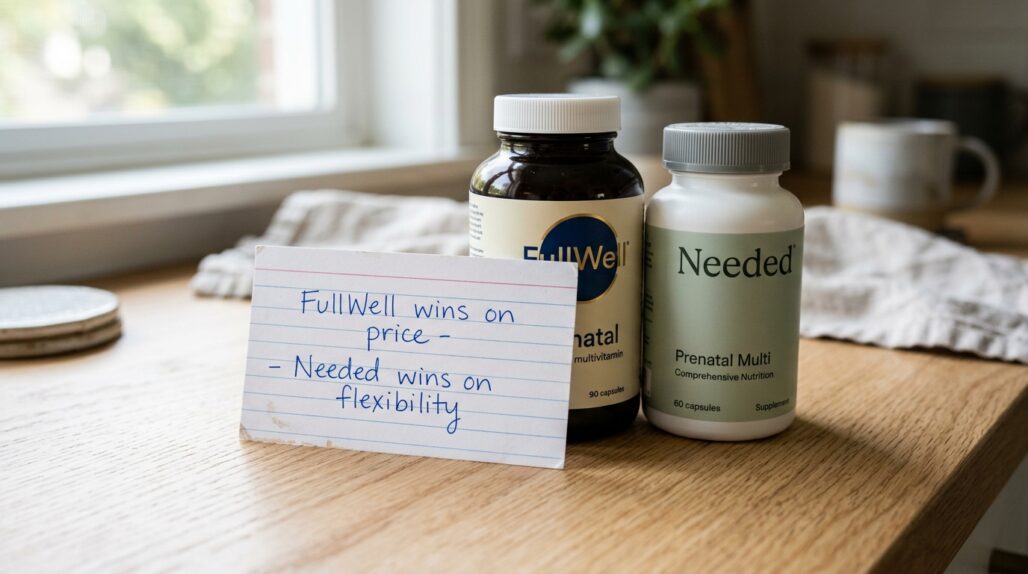
Needed and FullWell sit in the same corner of the prenatal market: full-dose, practitioner-style formulas built around methylated folate, real choline, and clean third-party testing. Midwives and dietitians recommend both. The marketing reads almost identically.
So the honest question is not "which is better" in some absolute sense. It is which one is worth the extra money, because the formulas land within a hair of each other and the price gap is real.
Here is the part the brand pages bury: both prenatals are 8 capsules a day, and neither includes iron. If you were hoping a premium price tag buys you a one-pill, everything-included prenatal, neither of these is that. They are unapologetically high-dose, multi-capsule formulas for people who want optimal nutrient amounts and will work the pill count into their routine.
If that sounds like more than you want to commit to, this comparison still helps – it tells you what you are paying a premium for, and when a simpler prenatal is the smarter call. For a wider look at where Needed lands against the field, our full Needed prenatal breakdown goes deeper on the brand.
What both prenatals actually are
Both are designed by nutrition professionals and aimed at the same buyer: someone preparing for pregnancy, pregnant, or nursing who reads supplement labels closely.
Needed Prenatal Multivitamin Pro is the higher-dose capsule in Needed's lineup (the brand also sells a lighter 3-capsule "Essentials" version and a powder). The Pro is the fair head-to-head match here because, like FullWell, it is an 8-capsule daily formula.
FullWell Women's Prenatal Multivitamin was formulated by a registered dietitian and built around the same philosophy: full nutrient doses, bioavailable forms, no fillers, and testing every lot for heavy metals.
The shared traits matter more than the differences:
- Both use methylated folate, not synthetic folic acid, so people with MTHFR variants can convert it.
- Both deliver 4,000 IU of vitamin D, which is 2 to 4 times what budget prenatals provide.
- Both include meaningful choline, a nutrient most prenatals barely touch.
- Both leave iron out and tell you to dose it separately.
That last point is a feature, not a flaw, in their view. Iron competes with other minerals for absorption, which is the brands' stated rationale for leaving it out. Note, though, that CDC and ACOG recommend most pregnant people take low-dose iron (around 27 mg a day) from early pregnancy, so for the majority a separate iron supplement is not really optional. We will come back to the iron question, because it is the thing most likely to trip you up.
Choline, folate, and iron compared
Choline is where the premium positioning earns its keep. The NIH Office of Dietary Supplements puts the adequate intake for pregnancy at 450 mg per day, and most pregnant people fall well short of it through diet alone. A University of Colorado Anschutz analysis of 47 prenatals found that only about a quarter listed choline on the label at all, and fewer than half of those delivered within 20% of the amount they claimed – so the labeled number is often unreliable.
Against that backdrop, both of these prenatals look strong. Needed Pro delivers 400 mg of choline; FullWell delivers 300 mg. Neither hits 450 mg on its own, but both get you most of the way and leave a gap diet can close. Needed's extra 100 mg is the single clearest formula edge in this matchup.
On folate, the numbers flip. FullWell provides 1,360 mcg DFE of methylfolate; Needed Pro provides 918 mcg DFE. Both clear the 600 mcg DFE pregnancy target comfortably, so this is less a winner-loser split than a note that FullWell leans higher.
Now the one that matters most: iron. Neither prenatal contains it. Needed says to take its separate iron supplement away from the multi for better absorption; FullWell sells a standalone iron product ("Iron Bump") for the same reason. If you are anemic or your OB wants you on iron, you must buy and dose it separately with either brand – budget for that.
| Nutrient / spec | Needed Prenatal Pro | FullWell Prenatal |
|---|---|---|
| Choline | 400 mg | 300 mg |
| Folate | 918 mcg DFE (methylated) | 1,360 mcg DFE (methylated) |
| Iron | None (sold separately) | None (sold separately) |
| Vitamin D | 4,000 IU | 4,000 IU (100 mcg) |
| Iodine | Included | 250 mcg |
| DHA / omega-3 | None (separate) | None (separate) |
| Capsules per day | 8 | 8 |
One thing the table makes obvious: neither includes DHA, so a separate prenatal fish oil is on your shopping list either way. That is standard for this tier, but it adds to the real monthly cost.
The pill count is the real catch
Eight capsules a day is the headline most reviews soft-pedal. It is a lot. If you have pregnancy nausea, 8 large capsules can be genuinely hard to keep down.
Both brands let you split the dose across meals, which helps. Needed is a little more upfront about flexible dosing – take some in the morning, some later. FullWell can be split too, but expect to manage the timing yourself.
Here is the practical read: if 8 pills feels like too much, that is a sign to look at a different prenatal entirely, not to agonize over these two. A 2-to-3 capsule formula trades some choline and vitamin D headroom for an order of magnitude better odds you actually take it daily, and a prenatal you skip is worth nothing. A one-or-two-pill option like Ritual is a far easier daily habit if pill count is your sticking point.

Third-party testing and quality
This is a near-tie, and it is the strongest reason both brands can charge what they do.
Needed Pro is Clean Label Project Certified and states every batch is third-party tested for purity and potency. The Clean Label Project screens for heavy metals and other contaminants, and that certification is meaningful because it is a named, verifiable program rather than a vague "tested" claim.
FullWell says it tests every single lot through independent labs for harmful contaminants, including heavy metals, and makes Certificates of Analysis available on request. That is a strong, specific claim – just verify by asking for the current COA if contaminant data is your deciding factor, since FullWell does not carry the Clean Label Project seal.
Call it a wash on substance. Needed has the slight edge on paper because a third-party certification you can look up beats a self-reported testing program, even a good one. For most buyers, both are clean enough that this should not be the deciding factor.
Cost per day – where FullWell pulls ahead


As an Amazon Associate, UsefulVitamins.com earns from qualifying purchases at no extra cost to you.
UsefulVitamins may earn a commission from qualifying purchases made through links on this page, at no extra cost to you. It does not change our verdicts.
Both are 30-day supplies, so the math is clean.
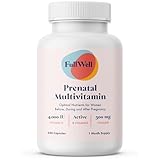
- FullWell: around $49.95 one-time, or about $44.95 on subscription – roughly $1.50 to $1.67 a day. Prices as of writing; check current price.
- Needed Pro: around $62.99 one-time, dropping to about $50.39 on a 6-month subscription – roughly $1.68 to $2.10 a day.
At full retail, FullWell is about $13 a month cheaper for a formula that is genuinely comparable. Across a 9-month pregnancy plus preconception and nursing, that gap adds up to real money – well over $100.
Needed narrows the gap if you lock into its 6-month subscription, where the per-day cost lands close to FullWell's full price. So the value verdict has a wrinkle: FullWell wins on flexibility and cheap entry; Needed only competes on price if you commit to a long subscription. If you like that subscribe-and-save model, our Needed worth-it review walks through the plans.
If you are weighing these against the other big practitioner name, our Needed versus Perelel comparison is the next read. And if a one-pill convenience prenatal is more your speed, see whether Ritual is worth it before you commit to an 8-capsule routine.
A quick word on interactions
Prenatals are layered on top of whatever else you take, and a few combinations matter. High-dose iron, thyroid medication, and certain antibiotics can interfere with each other when taken at the same time. Since both of these prenatals push you toward a separate iron supplement, timing it apart from thyroid meds is worth a glance. Run your full stack through our drug and supplement interaction guide and confirm with your OB.
FAQ
Which is better, Needed or FullWell? They are close. FullWell is the better value for most people, while Needed offers slightly more choline and a more polished subscription program. Neither is clearly superior on formula quality.
Do either of these prenatals contain iron? No. Both Needed Pro and FullWell leave iron out and recommend dosing it separately for better absorption. If you need iron, budget for a standalone supplement either way.
Why are they both 8 capsules a day? Full nutrient doses in bioavailable forms take physical space, and neither brand uses fillers to shrink the pill count. You can split the 8 capsules across meals, which most people find easier.
Is the choline difference between 400 mg and 300 mg meaningful? Both fall a bit short of the 450 mg pregnancy target, so neither covers it fully through diet alone. Needed’s extra 100 mg is a modest edge, not a dealbreaker for FullWell.
Do I still need a separate DHA supplement? Yes, with either brand. Neither includes DHA or omega-3s, so a prenatal fish oil is a separate purchase you should factor into the total cost.
Are these worth it over a drugstore prenatal? If you value methylfolate, real choline, and verifiable testing, yes. If you want one pill a day with built-in iron and DHA, a different prenatal will serve you better and cost less.
The verdict
These two prenatals are so similar that the choice comes down to money and habit. FullWell is the better buy for most people: comparable formula, the same 8-capsule commitment, and a lower price whether you pay once or subscribe.
Pick Needed Pro if you want the extra 100 mg of choline, value the Clean Label Project certification you can verify, or plan to lock into its longer subscription where the per-day cost closes in on FullWell.
And pick neither if 8 capsules a day is a hard no – that is the honest call. A simpler prenatal you take every day beats a premium one you abandon by week three. Whichever way you lean, plan for a separate iron supplement and a separate DHA, because both formulas leave those out.
Next step: confirm your iron needs with your OB, then buy the prenatal you will actually finish. For most readers, that is the cheaper FullWell.
This article is for general information and is not medical advice. Supplement needs during pregnancy vary, and prices and formulas can change. Talk with your OB-GYN, midwife, or a registered dietitian before starting or changing a prenatal, especially regarding iron.
Reviewed by the UsefulVitamins Editorial Team.
