
Summary
If you follow a plant-based diet and have been researching peptide supplements, you have almost certainly encountered the phrase "vegan collagen." It sounds like exactly what you need. It is not.
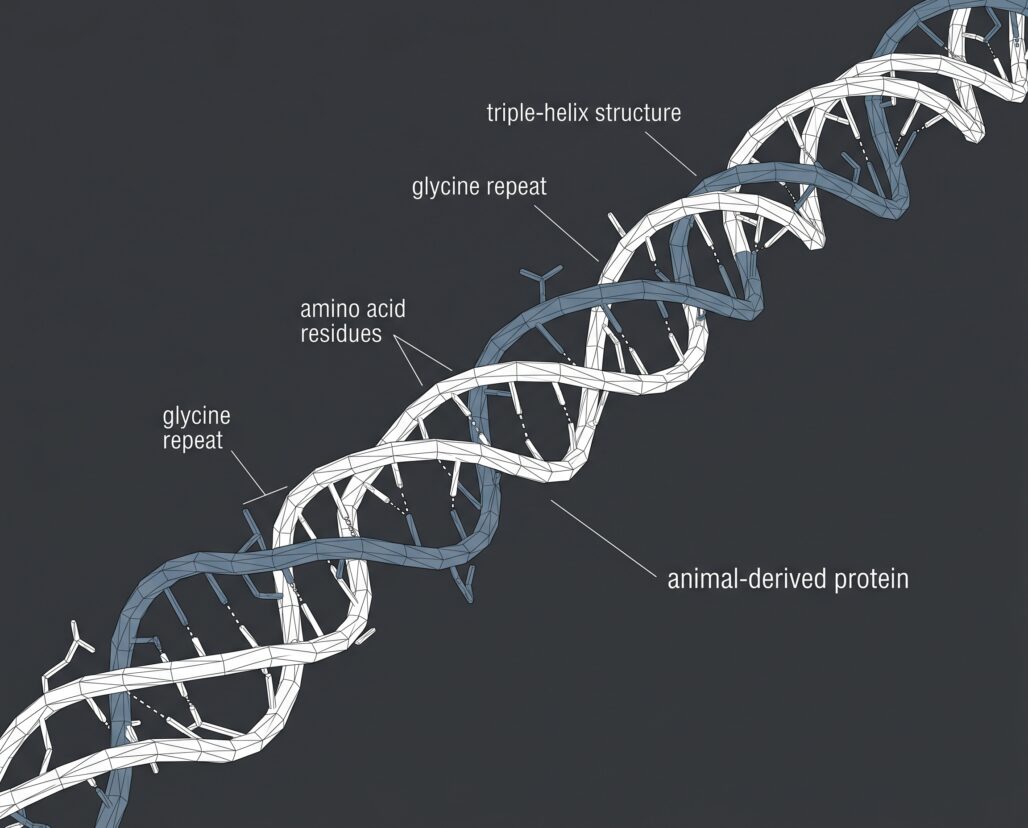
Collagen is an animal-only structural protein. Every commercial collagen supplement on the market — hydrolyzed bovine, marine, porcine, or chicken — is derived from animal tissue. No plant produces collagen. Products marketed as "vegan collagen" are not collagen at all; they are typically vitamin C and amino acid blends designed to support your body's own collagen production. That distinction is not a technicality. It changes how you should think about whether these products do anything useful, and for whom.
This article is a plain-language walkthrough of what the science actually supports: why collagen has no plant-based equivalent yet, what "collagen builders" genuinely are, where biotech-derived collagen stands right now, and which peptide categories are inherently vegan by design. If you have read the foundational explainer on what peptides are or are weighing collagen options after seeing our broader collagen peptides guide, this piece fills in the vegan-specific gaps those articles leave open.
Why "Vegan Collagen" Is a Misleading Label
Collagen is the most abundant structural protein in the human body, accounting for roughly 12 to 17 percent of total body protein depending on sex. It forms the scaffolding of skin, tendons, ligaments, cartilage, and bone. Its defining feature at a molecular level is a repeating amino acid triplet — glycine-proline-hydroxyproline — that winds into a right-handed triple helix. This triple helix structure is produced exclusively in animal cells.
Every commercial collagen supplement currently on the market is extracted from animal tissue. A 2025 dermatology review in PubMed confirmed the standard sources: "marine organisms, cows, pigs, and chickens." An independent analysis of collagen supplement formulations (PMC8620403) added chicken feet, ovine tendon, and goat tendon to the list of specialized sources. The word "vegan" does not appear in these catalogues, because the chemistry does not accommodate it.
Plants do not produce collagen. They produce other structural molecules — cellulose in cell walls, lignin in woody tissue — but none with the amino acid profile or triple-helix architecture of collagen. This is not an oversight by supplement manufacturers; it is a basic fact of evolutionary biology. The collagen genes are present in animals, not in plants, fungi, or algae.
When a brand labels a product "vegan collagen," what they are selling is almost always a blend of ingredients that are claimed to support the body's own collagen synthesis: commonly vitamin C, glycine, proline, and sometimes additional botanicals like amla fruit extract or gotu kola. The product may genuinely do something useful (more on that below), but it is not collagen. Calling it collagen is marketing shorthand that collapses an important distinction for the consumer.
The FDA does not define or regulate the term "vegan collagen" as a product category. There is no approved standard for what a "collagen builder" must contain or demonstrate.
What "Plant-Based Collagen Builders" Actually Are
The legitimate idea behind these products is straightforward: your body synthesizes its own collagen continuously, and that synthesis depends on specific inputs. If you provide those inputs in adequate amounts, you give your collagen-producing cells (primarily fibroblasts in the dermis and chondrocytes in cartilage) the materials they need to work.
The key cofactor in collagen biosynthesis is vitamin C. Research published in PMC5579659 explains the mechanism precisely: "Vitamin C acts as a co-factor for the proline and lysine hydroxylases that stabilise the collagen molecule tertiary structure." These enzymes — prolyl 4-hydroxylase and lysyl hydroxylase — add hydroxyl groups to proline and lysine residues on the collagen precursor chain (pro-collagen). Without hydroxylation, the triple helix cannot form correctly and collagen becomes structurally unstable. The same research notes that "vitamin C also stimulates collagen mRNA production by fibroblasts," meaning it acts at the gene expression level as well as the enzymatic level. Severe vitamin C deficiency produces scurvy — a condition characterized by fragile skin, poor wound healing, and corkscrew hairs — because collagen synthesis essentially breaks down.
The amino acid substrate side matters too. Collagen's unusually high glycine content (roughly one in every three residues) and substantial proline content mean that collagen synthesis places a specific demand on these amino acids. A plant-based diet can supply glycine and proline through foods like legumes, pumpkin seeds, and soy protein, though in lower concentrations than meat-based sources.
So what does a "vegan collagen builder" supplement actually contain? Most current products combine some version of these elements:
- Vitamin C (often from acerola cherry or ascorbic acid) — the hydroxylase cofactor
- Glycine and/or proline — direct amino acid substrates
- Zinc — involved in collagen cross-linking and matrix metalloproteinase regulation
- Silica or bamboo extract — often added on the basis that silicon plays a role in bone and connective tissue, though the clinical evidence here is thinner
- Botanical extracts (amla, gotu kola, grape seed) — antioxidant support, with variable human evidence
A critical limitation: there are no large, well-controlled randomized trials demonstrating that these blends produce collagen outcomes in humans comparable to what has been shown with hydrolyzed collagen peptides. The hydrolyzed collagen literature — which documents improvements in skin hydration, elasticity, and collagen density across over 60 clinical studies — involved direct supplementation with animal-derived collagen peptides, not collagen-support nutrient stacks. The mechanisms are different and the two bodies of evidence are not interchangeable.
What collagen builders genuinely offer is optimized substrate and cofactor availability for a biological process your body is already running. If your diet is genuinely deficient in vitamin C or glycine (a realistic scenario on a poorly planned vegan diet), correcting that deficiency may meaningfully support collagen production. If your diet is already adequate, the marginal benefit of additional supplementation is less clear.
This is not a reason to dismiss these products. It is a reason to read the label carefully and understand what you are actually buying.
The Recombinant and Microbial Collagen Frontier
There is a third category that most vegan supplement guides ignore: biotech-derived collagen produced without animal slaughter. This is real, it is commercially active in adjacent industries, and it matters for the future of vegan supplementation — but it is not yet a meaningful consumer supplement option.
Research into producing recombinant human collagen in microbial systems has been underway since at least 2000, when a paper in PubMed (PMID 10961918) described "expression of recombinant human type I-III collagens in the yeast Pichia pastoris." The system works: the collagen gene sequence is inserted into yeast or bacterial DNA, the microorganism expresses collagen protein, and the protein is harvested and purified. More recent work (PMID 36191842, 2023; PMID 40381768, 2025) has focused on scaling the output and achieving proper post-translational hydroxylation — the same step that vitamin C supports in vivo — which requires co-expressing the human hydroxylase enzymes alongside the collagen gene.
Companies including Geltor (now part of Amyris) and MOTIF FoodWorks have pursued microbial fermentation routes to collagen-like proteins for cosmetic and food ingredient applications. These are technically not "vegan" in the strictest sense, since the gene sequence originates from human or animal DNA, but no animal is farmed or slaughtered in the production process. How consumers and certifying bodies classify this is not yet standardized.
The practical reality for someone shopping for a supplement today: recombinant collagen is not available as an over-the-counter dietary supplement in any meaningful form at mainstream retail. The technology exists at lab and early commercial scale. What reaches cosmetic formulations in very small quantities has not translated into affordable, third-party-tested collagen peptide capsules or powders that a vegan consumer can purchase and use with confidence. The timeline for this changing is measured in years, not months, and will depend on fermentation yield economics as much as regulatory clarity.
If you are following this space, watch for developments from companies working on precision fermentation proteins rather than traditional supplement brands.
Synthetic Peptide Drugs Are Inherently Vegan
Here the news is genuinely good for vegan consumers, and it is under-reported in mainstream vegan health content.
Not all peptides are derived from animals. Many of the most clinically relevant peptide drugs are synthesized entirely in a laboratory using solid-phase peptide synthesis (SPPS) — a chemical manufacturing process that assembles amino acids in sequence on a solid resin support, with no animal tissue involved at any stage.
Semaglutide (Ozempic, Wegovy, Rybelsus), the GLP-1 receptor agonist that has become one of the most prescribed drugs globally, is a synthetic peptide. Its sequence is based on a modified version of the human GLP-1 hormone, not derived from any animal source. The same applies to:
- Tirzepatide (Mounjaro, Zepbound) — synthetic dual GIP/GLP-1 agonist
- Liraglutide (Saxenda, Victoza) — synthetic GLP-1 agonist
- Sermorelin and CJC-1295 — synthetic growth hormone-releasing hormone analogs
- Ipamorelin — synthetic growth hormone secretagogue
- BPC-157 — synthetic 15-amino-acid peptide, sequence derived from a protein found in gastric juice but produced entirely through chemical synthesis
- GHK-Cu (copper peptide) — tripeptide produced synthetically; commonly used in skin applications (see peptides for skin for a fuller breakdown of topical vs. oral routes)
For prescription GLP-1 medications, the vegan status of the drug itself is settled: the active pharmaceutical ingredient contains no animal-derived components. The complicating factors are the excipients (some injectable formulations use phenol as a preservative; some capsule formulations may use gelatin shells) and the fact that drugs like semaglutide are tested on animals during development and approval, which some ethical vegans consider a disqualifying factor. Those are valid personal considerations; they are separate from the question of ingredient sourcing.
For research peptides used outside of prescription contexts — a category this site covers descriptively, not prescriptively — the same logic applies. Most are synthesized compounds with no animal-derived raw material in the finished peptide itself. Consult a qualified provider about any excipients, fillers, or peptide stability additives in specific products.
None of this is medical advice. If you are considering a GLP-1 medication or any prescription peptide therapy, that conversation belongs with a licensed prescriber who knows your full health history.
Practical Peptide Options for Vegan Consumers
To organize what the above means practically:
Not available from vegan sources (yet): Hydrolyzed collagen peptide supplements. Bovine collagen, marine collagen, chicken collagen, porcine collagen — all require animal tissue. No credible retail alternative exists right now.
Potentially useful for collagen support: Vitamin C (confirmed mechanism), adequate dietary glycine and proline (via legumes, soy, pumpkin seeds), zinc. A supplement stack covering these bases addresses the genuine nutritional gap that can exist on a plant-based diet. The evidence for comparable outcomes to direct collagen supplementation is not there yet, but the mechanism is sound.
Inherently vegan by synthesis: Prescription GLP-1 peptides (semaglutide, tirzepatide, liraglutide); GHRH analogs (sermorelin, CJC-1295); secretagogues (ipamorelin, GHRP-2, GHRP-6); BPC-157; GHK-Cu; carnosine; and most other research peptides. The active ingredient in these is produced by chemical synthesis, not animal extraction.
Emerging but not consumer-ready: Microbial fermentation collagen (Geltor, precision fermentation routes). Worth monitoring; not yet purchasable as a supplement.
One practical note on collagen-adjacent vegan sources: glycine is the rate-limiting amino acid for collagen synthesis in humans, and some researchers (notably Christopher Masterjohn and others in nutritional biochemistry) have noted that omnivores who eat nose-to-tail get substantial glycine from connective tissue and skin that vegans miss. This gap becomes more consequential as endogenous collagen production declines with age — a pattern explored in detail in peptides for women over 40. Supplementing glycine directly — which is vegan, synthesized commercially from serine or through other chemical routes — is a low-cost, low-risk option that addresses this gap without requiring any animal products.

Frequently Asked Questions
Is there any collagen supplement that is vegan?
No. As of 2026, no commercially available collagen supplement is vegan. All collagen is derived from animal tissue (bovine hides, fish scales and skin, chicken cartilage, porcine skin). Products labeled "vegan collagen" are not collagen; they are collagen-support nutrient blends.
Do collagen builder supplements work?
The mechanisms are real — vitamin C and adequate amino acid substrate do support endogenous collagen synthesis. Whether supplementing these nutrients in someone already eating a reasonably complete diet produces measurable collagen outcomes comparable to direct collagen peptide supplementation has not been robustly demonstrated in clinical trials. The honest position: they may help if your baseline intake is low, and are unlikely to harm.
Is semaglutide (Ozempic/Wegovy) vegan?
The active pharmaceutical ingredient is a synthetic peptide with no animal-derived components. Some formulation excipients (stabilizers, buffers) may not be vegan in all products. Check the prescribing information for the specific formulation. Consult your prescriber and pharmacist with specific questions.
Can vegans build collagen through diet alone?
Your body synthesizes its own collagen continuously. A plant-based diet that includes adequate vitamin C (citrus, bell peppers, broccoli, kiwi), glycine and proline (legumes, tofu, tempeh, pumpkin seeds), and zinc (legumes, seeds, fortified foods) provides the inputs for that synthesis. There is no equivalent to supplementing pre-formed collagen peptides, but the question of whether those supplements produce meaningful additional outcomes in otherwise-healthy individuals is itself contested in the broader literature.
What about vegan gelatin alternatives like agar or carrageenan?
These are polysaccharides (seaweed-derived carbohydrates) used as gelling agents. They have no amino acid content and are not collagen analogs in any functional biochemical sense. They do not support collagen synthesis.
If I am pregnant and vegan, should I supplement for collagen support?
Pregnancy decisions about supplementation should be made with your OB or midwife. General nutritional adequacy during pregnancy on a plant-based diet — including vitamin C, zinc, and complete protein — is a topic your obstetric provider is best positioned to address for your specific situation.
Conclusion
The landscape for vegan peptide consumers breaks cleanly into two zones. In the collagen category, no vegan option genuinely exists yet: collagen is an animal-only protein, and the products that claim otherwise are rebranded nutrient stacks at best. The honest use for those products is supporting your body's endogenous collagen synthesis — a legitimate goal, particularly if your plant-based diet is low in vitamin C or glycine, but a meaningfully different claim than "take this instead of collagen."
In the synthetic peptide category, including GLP-1 medications and most research peptides, veganism is not an obstacle. These compounds are assembled chemically, amino acid by amino acid, with no animal tissue in the process.
A few targeted supplements — vitamin C, glycine, zinc — address the genuine nutritional gaps a plant-based diet can create for connective tissue health. Beyond that, watch the precision fermentation space. The yeast-expressed and bacterial-fermentation routes to recombinant human collagen are scientifically mature enough that consumer products are plausible within the next several years. When they arrive, the calculus here will change.
For now, the honest answer is also the useful one: know what you are buying, understand what mechanism it acts through, and do not let a label substitute for that knowledge.
This article is for informational purposes only and does not constitute medical advice, diagnosis, or treatment. Consult a qualified healthcare provider before starting any supplement or medication.
