
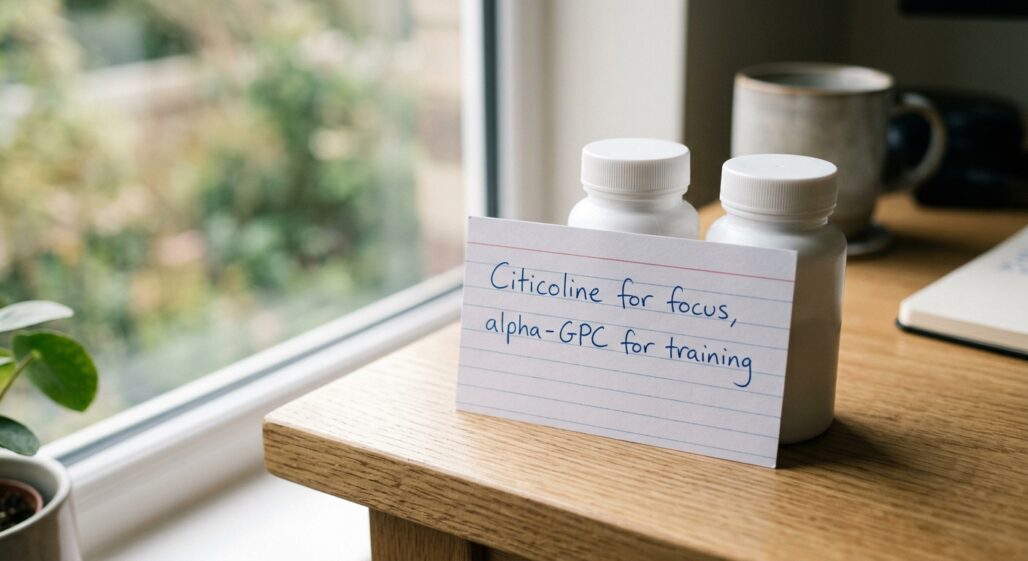
If you are searching for the best choline supplements for focus, you have probably noticed the aisle hides three very different molecules behind one word, and you want to know which one actually reaches your brain. The short answer: the form is the whole decision, and matching it to your goal matters more than the brand on the label. This article walks through citicoline, alpha-GPC, choline bitartrate, and phosphatidylcholine, what dose the human trials used, and the one safety signal most roundups quietly skip. These are the same picks I would keep in my own family's cabinet, so the bottles at the bottom are worth scrolling for.
Affiliate disclosure: this article contains affiliate links. As an Amazon Associate, UsefulVitamins.com earns from qualifying purchases at no extra cost to you.
Before you decide

Most people do not need a choline supplement at all. Food covers it for many adults, and three eggs alone deliver close to the daily target, so the first move is to fix the plate before reaching for a capsule. Eggs, liver, beef, soybeans, and salmon are the densest sources, per the NIH Office of Dietary Supplements choline fact sheet, which sets the Adequate Intake at 550 mg/day for men and 425 mg/day for women.
The people who actually benefit from a brain-targeted form are different from the people who just need more dietary choline. A supplement makes sense if you eat few eggs or organ meats, you are chasing acetylcholine-driven focus, or you want a pre-training stimulus, not if you simply skipped breakfast.
One caveat that belongs at the top, not buried in the fine print. A large observational cohort linked alpha-GPC use to higher stroke risk over ten years, which I cover honestly in the alpha-GPC section. If you have cardiovascular or cerebrovascular history, raise it with your physician before adding alpha-GPC.
On dosing: choline is water-soluble but not infinitely safe. The NIH ODS sets a Tolerable Upper Intake Level of 3,500 mg/day for adults, and the effective brain doses below sit far under that. More is not better here; the trial doses are modest, and overshooting mostly buys you a fishy body odor and lower blood pressure.
How choline becomes acetylcholine (and why the form decides everything)

Choline is the raw material your neurons convert into acetylcholine, the neurotransmitter that drives attention, working memory, and muscle activation. It also builds phosphatidylcholine, a core component of every cell membrane, including the membranes your brain is constantly remodeling.
The catch is delivery. A choline source only helps your brain if it crosses the blood-brain barrier, and the four common forms differ enormously on that single point. Citicoline and alpha-GPC pass readily and raise central choline; plain choline salts largely do not.
Citicoline is the interesting one mechanistically. When it is metabolized it splits into a choline arm and a cytidine arm, and the cytidine converts to uridine, which feeds the Kennedy pathway that assembles new phosphatidylcholine in neurons. So citicoline supplies both the raw material and the assembly signal, which is the cleanest biochemical rationale of any form in this category.
Alpha-GPC is a more direct acetylcholine precursor and crosses the barrier efficiently, which is why it shows up in pre-workout and power-output research rather than memory studies. The two are not interchangeable; they were studied for different endpoints.
Citicoline (CDP-choline): the focus pick
Why it helps: citicoline reliably raises brain choline and supports phosphatidylcholine synthesis through the uridine pathway described above, which is the mechanism most directly tied to membrane integrity and cholinergic signaling.
What the trials show: in a 2021 randomized, double-blind, placebo-controlled trial in 100 healthy older adults with age-associated memory impairment, 12 weeks of 500 mg/day citicoline improved composite memory (mean change 3.78 versus 0.72 for placebo, P = 0.0052) and episodic memory on the Paired Associates test. In a smaller acute study, 500 and 1000 mg of CDP-choline improved sensory gating in 24 healthy volunteers, an effect the authors tied to the alpha-7 nicotinic acetylcholine receptor.
Be honest about the gaps, though. The Cochrane review by Fioravanti and Yanagi found modest, statistically significant benefits for memory and behaviour in the elderly but no significant effect on attention, so the "laser focus" marketing outruns the strongest data.
Dose used in trials: 250 to 500 mg/day, taken with or without food, ideally earlier in the day.
Form to look for: Cognizin is the branded, patented citicoline used in most of the published human trials, so it is the closest thing to buying the studied molecule.
Skip if: you are pregnant, nursing, or taking medication for Parkinson's disease; cholinergic agents can theoretically interact, so clear it with your prescriber first.
Alpha-GPC: the training pick (with the caveat)

Why it helps: alpha-GPC is a fast, efficient acetylcholine precursor, and acetylcholine drives the neuromuscular signal behind force production, which is why the performance literature centers on it rather than on citicoline.
What the trials show: a randomized study of 250 and 500 mg alpha-GPC in 48 college-aged men found significant gains in countermovement jump power, with the 250 mg dose performing best, though strength measures were mixed. Earlier work reported sharply higher growth hormone and roughly 14 percent greater peak bench-press force after 600 mg. The mechanism is plausible and the power signal is real, but the trials are small, short, and partly funded by industry, so treat the effect as a modest edge, not a transformation.
Now the caveat almost no roundup mentions. A 2021 observational cohort of more than 12 million Korean adults, published in JAMA Network Open, linked alpha-GPC use to a 46 percent higher 10-year stroke risk in a dose-responsive pattern (adjusted hazard ratio 1.46). This was prescription-level use, observational, and cannot prove cause, but the dose-response relationship is the kind of signal you do not ignore if you carry vascular risk.
Dose used in trials: 300 to 600 mg, about 30 to 60 minutes before training.
Form to look for: alpha-GPC verified by a third-party program (USP, NSF, or a published certificate of analysis).
Skip if: you have a personal or family history of stroke, uncontrolled hypertension, or cerebrovascular disease; choose citicoline instead and discuss it with your physician.
Choline bitartrate and phosphatidylcholine: where each fits
Worth knowing, with caveats. Choline bitartrate is the cheapest form, and it does raise blood choline, but it crosses into the brain poorly, so it is a fine way to top up a dietary shortfall and a weak way to chase focus. If your only goal is meeting the NIH Adequate Intake, bitartrate at 500 mg is reasonable and inexpensive. If your goal is cognition, it is the wrong tool.
Phosphatidylcholine is the form found naturally in food and in lecithin supplements. It is a legitimate source of choline and membrane phospholipids, but the human cognitive trials are thin and mostly older. Phosphatidylcholine is a sensible general-nutrition choline source, not a targeted nootropic, and lecithin is its most common and least concentrated delivery vehicle.
A quick map of where each form earns its place.
| Form | Brain delivery | Best use | Typical dose |
|---|---|---|---|
| Citicoline (CDP-choline) | Crosses well; dual choline + uridine pathway | Focus, memory support | 250 to 500 mg/day |
| Alpha-GPC | Crosses well; direct acetylcholine precursor | Pre-training power, with stroke-risk caveat | 300 to 600 mg pre-workout |
| Choline bitartrate | Poor brain entry | Cheap dietary top-up only | 500 mg/day |
| Phosphatidylcholine / lecithin | Modest; food-form choline | General nutrition, membrane support | 1 to 2 g/day |
What to look for when buying
A simple way to judge a choline product without a PhD. Match the form to the goal first, then check the dose against the trial dose, then confirm someone other than the brand tested the bottle.
Form: citicoline (ideally branded Cognizin) for focus, alpha-GPC for training. Skip bitartrate unless you only want a cheap dietary top-up.
Dose: confirm the per-serving milligrams land in the trial ranges above. Many capsules are dosed at a third of the studied amount, which is not enough to expect the trial result.
Third-party testing: look for USP Verified, NSF Certified for Sport, or a brand that publishes its own certificate of analysis. A choline brand can look clean on the label and still skip independent assay, so verification is the cheap insurance.
Red flags: proprietary "focus blends" that hide per-ingredient milligrams, and any product promising a dramatic cognitive leap. The honest effect sizes here are modest.
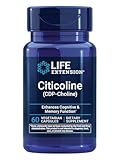
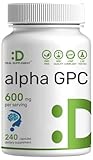

As an Amazon Associate, UsefulVitamins.com earns from qualifying purchases at no extra cost to you. We only recommend products supported by published research or third-party testing.
Who should skip choline supplements
Some people should not start here. If you eat eggs, liver, fish, or soy regularly, you are likely meeting the Adequate Intake from food and a supplement adds little. If you are pregnant or nursing, prenatal choline is a real and important topic, but it belongs with your OBGYN and the right form, not a self-directed nootropic dose, so consult your OBGYN before supplementing.
If your concentration problem is severe enough to interfere with work, school, or driving, a stimulant evaluation by a clinician is the more honest first step, and choline comes after, not instead. And if you have cardiovascular or cerebrovascular history, the alpha-GPC stroke signal means you should default to citicoline and clear any choline plan with your physician.
For broader cognitive strategy beyond a single nutrient, our roundups on the best supplements for memory and the best supplements for focus and concentration put choline in context with the rest of the stack.
FAQ
Is citicoline or alpha-GPC better for focus?
For focus specifically, citicoline has the cleaner human evidence and the dual choline-plus-uridine mechanism. Alpha-GPC has stronger data for pre-training power than for sustained attention, so reach for it when training, not desk work.
Does choline bitartrate work for the brain?
It raises blood choline cheaply but crosses into the brain poorly, so it is a reasonable dietary top-up and a weak focus aid. If cognition is the goal, citicoline or alpha-GPC are the better-supported choices.
How much choline should I take per day?
The NIH Adequate Intake is 425 mg/day for women and 550 mg/day for men, and the Tolerable Upper Intake Level is 3,500 mg/day. Studied focus doses of citicoline (250 to 500 mg) sit well under that ceiling.
Is alpha-GPC safe?
Short trials report it as well tolerated, but a large observational cohort tied it to higher 10-year stroke risk in a dose-dependent pattern. That cannot prove cause, yet it is reason enough to favor citicoline if you carry vascular risk.
Can I just eat eggs instead of supplementing?
Often, yes. Three eggs deliver close to the daily target, so a choline-rich plate covers many adults. Targeted forms matter mainly when you eat little choline-dense food or want a specific cognitive or training effect.
The bottom line on the best choline supplements
The honest synthesis is that the form is the entire decision. Citicoline (ideally Cognizin) at 250 to 500 mg/day is the best-supported pick for focus and memory support, alpha-GPC at 300 to 600 mg is the pre-training choice with a real stroke-signal caveat, and choline bitartrate is a cheap dietary top-up that does little for the brain. What this article adds that most roundups skip is that goal-matching, not brand-hunting, and the alpha-GPC stroke cohort that competitors leave out.
Next steps:
- Fix the plate first: eggs, liver, fish, and soy before any capsule.
- For focus, start with branded citicoline at the studied 250 to 500 mg/day.
- For mechanism and food sourcing, read our complete guide to choline and see how we review supplements.
As an Amazon Associate, I earn from qualifying purchases. Product recommendations are based on real reviews and independent research.
This article is for informational purposes and not medical advice. Choline-based supplements can interact with medications and health conditions. Consult a licensed physician before starting any supplement, particularly if you are pregnant, nursing, taking prescription medications, or managing a cardiovascular or neurological condition. Reviewed by Maria Rodriguez, MS Nutrition Science, focused on cognitive and mood biochemistry.
