
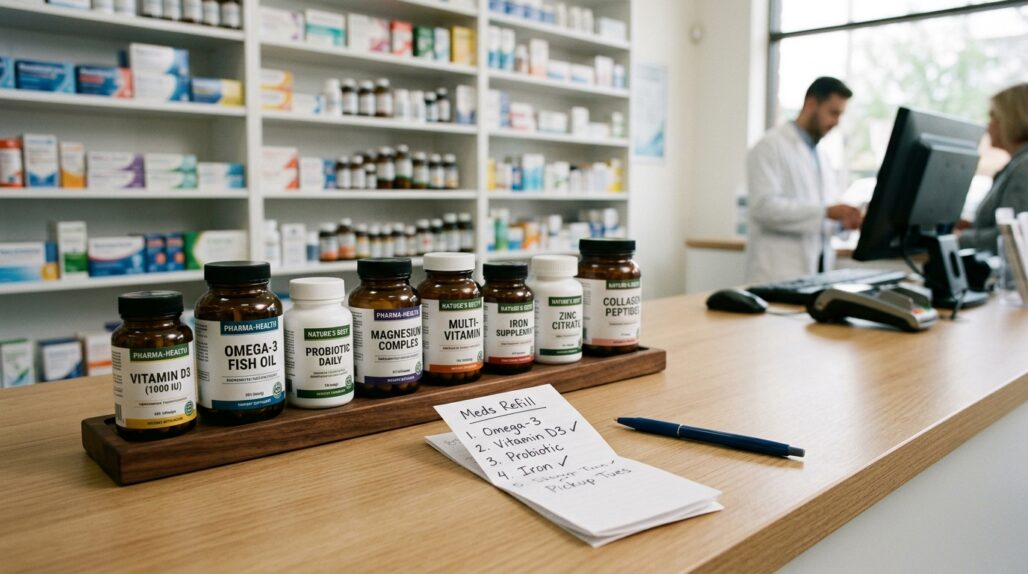
Why the pharmacist is the right person to ask
Most people think of supplements as a doctor question, then never quite get around to raising them in a rushed visit. The pharmacist is easier to reach. You can walk up to the counter at most pharmacies, no appointment, and ask about a bottle you are holding.
Pharmacists are trained to spot drug and supplement interactions, and they see the full picture if you bring it to them. The catch is in that last part. A pharmacist can only check what they can see, so the value of the conversation depends almost entirely on whether you show up with your complete list.
Treat the questions below as a menu, not a script. Pick the ones that fit your situation. None of this replaces your own doctor's advice, and a pharmacist will route anything serious back to your prescriber.
Before you go: build the list that makes the answers useful
The single most useful thing you can do is arrive with one written list of everything you take. The NIH Office of Dietary Supplements is blunt about this: tell every health care provider, including your pharmacist, about the supplements you take so the right combination can be sorted out for you.
Write down each item the same way every time. Here is a simple template you can copy onto paper or into a phone note before you leave the house.
| Column | What to write | Example |
|---|---|---|
| Name | Exact product name and form | Vitamin D3 softgel |
| Dose | Amount per serving and how many | 2000 IU, one daily |
| When | Time of day and with or without food | Morning, with breakfast |
| Why | What you take it for | Low level on bloodwork |
| Since | Roughly when you started | January this year |
Do the same rows for every prescription, every over-the-counter product, and every as-needed item. Do not leave the supplements off the list because they feel minor. The interactions that surprise people most often involve a supplement they did not think to mention.
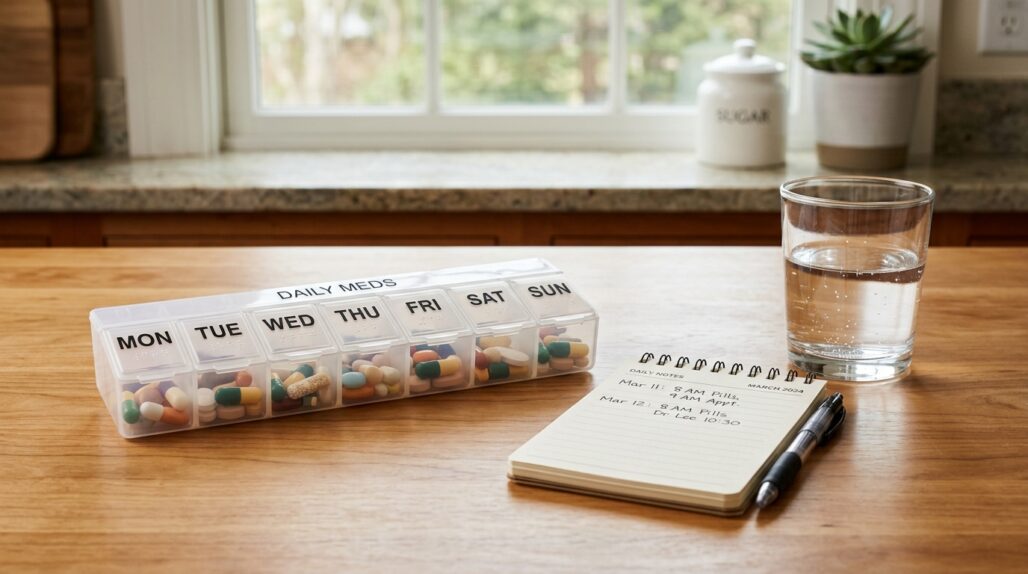
The interaction questions (ask these first)
These are the questions that protect you from harm, so lead with them.
- Does any supplement on my list clash with my medications? The FDA warns that supplements can change how a drug is absorbed, used, or cleared, which can make a medication stronger or weaker than expected. A pharmacist can flag the known problem pairs against your specific drugs.
- I take a blood thinner. Which supplements raise my bleeding risk? Several common ones, including high-dose fish oil, vitamin E, ginkgo, garlic, and turmeric, can add to the effect of anticoagulants. If you take warfarin, ask whether starting or stopping anything should be paired with an INR check, and ask about keeping your vitamin K intake steady rather than swinging it up and down.
- What should I space apart, and by how many hours? Some minerals physically bind a drug in your stomach so less of it gets absorbed. The classic example is calcium or iron with levothyroxine. A peer-reviewed study found that taking calcium at the same time as thyroid medication lowered the drug's absorption, while separating them protected it, which is why pharmacists commonly suggest a several-hour gap.
If a pharmacist flags a possible interaction, that is the start of a conversation, not a verdict. Ask what to do next, and let them loop in your prescriber if a change is needed. Never stop a prescription on your own to make room for a supplement.
The is-it-worth-it questions
Not every interaction is dangerous. Some are just a waste of money, and a pharmacist will tell you straight.
- Is there real evidence this helps with what I am taking it for? NCCIH notes that strong evidence behind supplement claims is often missing. A pharmacist can tell you whether a product has decent support for your goal or whether the marketing is doing the heavy lifting.
- Is the dose on this label reasonable? More is not safer. The NIH points out that side effects are more likely at high doses, when supplements replace medicine, or when you take many products at once.
- Am I doubling up without realizing it? Combination products and multivitamins often repeat the same ingredient. Ask the pharmacist to scan your list for overlap, for example two products both stacking vitamin D or magnesium past what you intend.
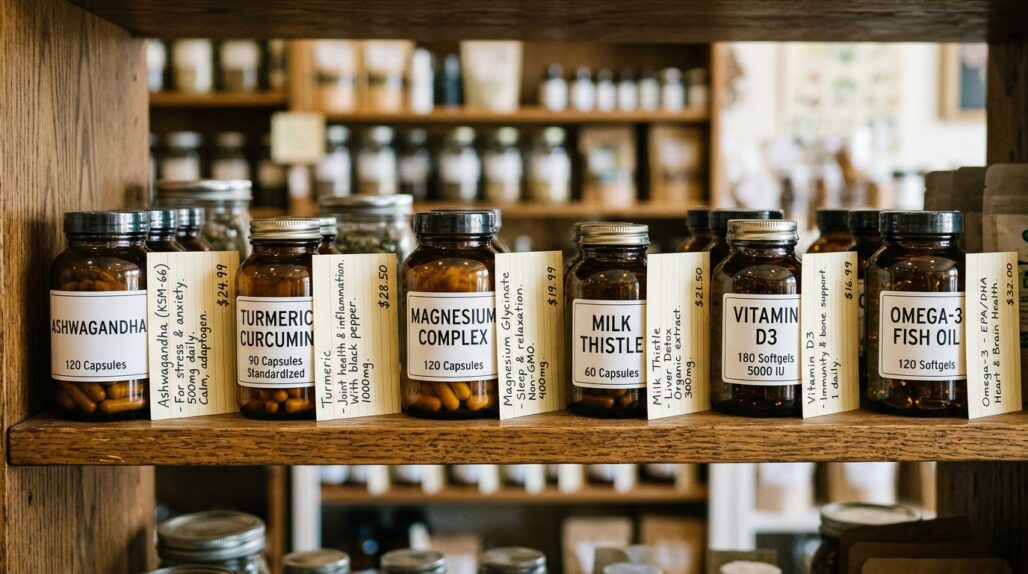
The safety questions for your specific situation
These depend on your body and your timeline, so be specific about your conditions and plans.
- Is anything on my list a problem with my health conditions? A supplement that is fine for most people can be the wrong choice with kidney, liver, heart, or other conditions.
- I have surgery coming up. What should I stop, and when? NCCIH advises talking to your providers well in advance because some supplements raise bleeding risk or affect anesthesia. Professional anesthesia groups commonly recommend stopping many herbal products one to two weeks before an elective procedure, but the timing depends on the product and on you, so get a plan rather than guessing.
- I am pregnant or breastfeeding. Which of these are still okay? Many supplements have not been studied in pregnancy or nursing. This is a route-to-a-professional question. A pharmacist may answer some of it and send the rest to your obstetric provider or a lactation-aware clinician.
For anything in this group, the safe move is to let the professional make the call. The questions get you the right conversation; they do not clear a product on their own.
The practical questions that make the routine work
Once safety is settled, these small details decide whether a supplement actually does anything.
- What is the best time to take this? Some are better in the morning, some at night, and a few should not share a slot with certain meds.
- With food or on an empty stomach? Fat-soluble vitamins often absorb better with a meal; others can upset an empty stomach.
- How long should I try it before deciding it works? A realistic window keeps you from quitting too early or refilling something that never did anything.
Keep the list current, not just correct once
A list helps only if it stays true. The moment you add, change, or stop something is exactly when the old list goes stale and the next pharmacist conversation gets less useful.
Pick a low-tech anchor you will actually keep up. A paper card in your wallet, a note in your phone, or a weekly pill organizer all work, as long as you update them the day something changes. For people who would rather not retype everything, StackMyMed (our own free app) lets you export your current stack so the pharmacist can scan meds and supplements in one pass instead of you reading them out from memory. Either way the rule is the same: the pharmacist decides what is safe, and the list just makes sure nothing is hidden from them.
If you are building or auditing your routine more broadly, our drug and supplement interaction checker is a useful first read before the visit, and the complete guide to drug and supplement interactions goes deeper on the common problem pairs. If you are helping an older relative, checking whether their supplements are safe with their prescriptions walks through that conversation, and our brown-bag review checklist covers what to bring when you sit down with a pharmacist or doctor.
FAQ
Do I need an appointment to ask a pharmacist about supplements? Usually not. Most pharmacies let you ask at the counter, though calling ahead or going at a quieter time means the pharmacist has more room to talk it through.
Will the pharmacist tell me to stop my supplements? Not as a rule. They are more likely to flag a specific pairing, suggest spacing two things apart, or send a question back to your doctor. Any decision to start or stop a prescription stays with your prescriber.
What is the most important thing to bring? One complete list of everything you take, prescriptions, over-the-counter products, and supplements included. The FDA recommends telling your providers about all of it, and the pharmacist can only screen what they can see.
Are supplements really risky if they are sold over the counter? Being sold without a prescription does not mean a product is harmless with your medications. The NIH notes that interactions and side effects are more likely at high doses and when you combine several products, which is exactly what a pharmacist can review.
Can a pharmacist tell me if a supplement is worth the money? Often yes. They can give you a quick read on whether there is decent evidence for your goal and whether the dose looks reasonable, which can save you from refilling something that is not doing anything.
Should I ask the pharmacist or my doctor about supplements during pregnancy? Start with whoever you can reach first, but treat pregnancy and breastfeeding as a route-to-a-professional question. Many supplements have not been studied in those situations, so confirm each one for your own case.
The bottom line
Your pharmacist is a free, accessible expert who can catch a supplement problem before it becomes one, but the whole conversation rises or falls on the list you bring. Write down every prescription, over-the-counter product, and supplement, lead with the interaction questions, and let the pharmacist route anything serious back to your doctor. The single most useful action is the simplest: keep one current list and actually show it to someone trained to read it.
This article is for general information and is not medical advice. It does not replace a conversation with your own pharmacist or doctor, who can account for your medications, conditions, and circumstances. Do not start, stop, or change a prescription on your own.
StackMyMed is made by UsefulVitamins. It helps you organize your list and flag things to discuss with a pharmacist or doctor; it is not a diagnosis or treatment tool and does not replace professional medical advice.
Reviewed by the UsefulVitamins Editorial Team.
