

Why fixed clock times fall apart on shift work
Most pill bottles assume your day looks like everyone else's: wake around 7, sleep around 11, take the morning one with breakfast. When your "morning" lands at 6 p.m. and your week rotates between days and nights, that quiet assumption breaks. A reminder set for 8 a.m. is useless when 8 a.m. is the middle of your sleep.
This is not a small problem. A large study in the Korean working population found that shift workers were more likely to miss medication doses than fixed-day workers, and the most common reason was simply forgetting when the usual cue was gone. If you regularly end a shift unsure whether you already took something, our walk-through on what to do when you cannot remember if you took your supplement today pairs well with this one. The fix is not more willpower. It is a routine built around the things in your day that stay steady even when the clock does not.
The plan below works on paper, with a pill box, or with a phone. Read the manual method first so the routine holds even on a dead-battery, double-shift kind of day.
Anchor every dose to an event, not a time
The core move is to stop thinking in hours and start thinking in moments that happen no matter what your schedule does. You almost always have three of them:
- Wake. The first thing you do after sleep, day or night.
- First real meal. Your first proper food after waking, whenever that lands.
- Before sleep. The wind-down right before your main rest block.
Take each dose at the same anchor every cycle. A once-daily supplement you tolerate well can ride on "with first meal." A bedtime medicine rides on "before sleep," whether that sleep starts at 9 a.m. or 11 p.m. Your body responds to the rhythm of waking, eating, and sleeping more than to the number on the wall.
There is one rule that matters more than the anchors themselves: keep the spacing roughly the same. If a medicine is meant to be twice a day, that usually means about every twelve hours, not "morning and night" squeezed into a short waking window. Anchoring to events keeps the cue reliable; protecting the interval keeps the dose doing its job. When the two pull against each other, the interval wins, and that is a question for your pharmacist. For the general rules on with-food, empty-stomach, and spacing requirements, our guide to medication and supplement timing covers the common cases.

Build your anchor schedule on paper first
You do not need an app to do this. You need a sheet of paper and ten quiet minutes. Here is a fill-in template you can copy by hand:
My anchor schedule (copy this)
- My anchors today: Wake at ____ / First meal at ____ / Before sleep at ____
- At WAKE I take: ______________________________
- At FIRST MEAL I take: ______________________________
- BEFORE SLEEP I take: ______________________________
- Doses that need a set gap (and the gap): ______________________________
- Took it? Tick the box: Wake [ ] Meal [ ] Sleep [ ]
Write it once for a "day" cycle and once for a "night" cycle, then tape both inside a cabinet door. When your shift flips, you just follow the matching card. The tick boxes double as a quick log so you can glance back and see whether you actually took the bedtime one before you crashed.
The grid below shows how the same regimen maps onto two opposite cycles. Notice the items stay tied to the same anchor; only the clock time moves.
| Anchor | Day cycle (sample) | Night cycle (sample) | What rides here |
|---|---|---|---|
| Wake | 7:00 a.m. | 4:00 p.m. | Morning prescription, vitamin D |
| First meal | 8:00 a.m. | 5:30 p.m. | Anything labeled “with food,” iron, magnesium |
| Mid-cycle | 7:00 p.m. | 4:00 a.m. | A second dose that needs a steady gap |
| Before sleep | 10:30 p.m. | 8:00 a.m. | Bedtime medicine, sleep support if advised |
These are only examples. Your anchors and your spacing come from your own schedule and your own labels, and any time-sensitive medicine should be mapped with your pharmacist rather than guessed.
The medicines that do not bend to your schedule
Anchoring works for most routine pills, but some medicines have rules that override convenience. Treat these as off-limits for DIY timing changes until a professional weighs in.
- Blood thinners (such as warfarin or the newer oral anticoagulants) often need a steady daily interval, and a wandering schedule can matter.
- Seizure medicines tend to have narrow timing windows; package inserts for many of them direct you to take a missed dose as soon as you remember unless it is near the next one, and never to double up.
- Thyroid medicine usually wants an empty stomach and consistent spacing from food and other pills.
- Some heart medicines are timed for blood-pressure or rhythm reasons.
- Birth control can lose reliability if the daily interval drifts too far.
If any of your medicines fall in these groups, build their timing with a pharmacist before you reshuffle a thing. As the CDC's safe medication-use guidance puts it plainly, take medicines as directed, and if you do not understand the label instructions, ask your pharmacist or doctor before taking the medicine. That is not a brush-off; it is the safest order of operations.
Sleep aids deserve their own caution. Many shift workers reach for melatonin to fall asleep during daylight. The National Center for Complementary and Integrative Health notes that long-term safety data on melatonin is limited and that studies in shift workers have been small or inconclusive, and it specifically advises people who take other medicine to talk to their provider first, because melatonin can interact with drugs like blood thinners and certain seizure medicines. A sleep aid is not a free add-on to your stack. It is one more thing on the list, and it belongs in the same pharmacist conversation as everything else. If you want to read up on common pairings before that conversation, our reference on drug and supplement interactions is a useful starting point, though it does not replace a pharmacist's read of your specific list.
Keep the routine running on a moving schedule
A routine only helps if it survives the week your schedule turns inside out. A few habits make that easier:
- Pre-load a pill organizer for the cycle ahead so a groggy version of you does not have to count anything. A weekly box with morning and bedtime rows works for most stacks. If the box itself is overflowing, it may be worth running a self-audit of whether you take too many supplements before you build the schedule around all of them.
- Pack a travel organizer for the shift itself, so a dose due mid-shift does not get skipped because the bottle is at home.
- Keep a quick log. A tick on the paper card or a note on your phone answers the "did I already take it?" question that haunts the end of a long shift.
- Shift gradually when you rotate. Where your medicine allows it, nudging a dose an hour or two per day across a transition is gentler than swinging it twelve hours overnight. Whether that is fine for your specific medicine is, again, a pharmacist question – and as a US Pharmacist review of shift work disorder describes, counseling on dosing, timing, and interactions for shift workers is squarely in their wheelhouse.
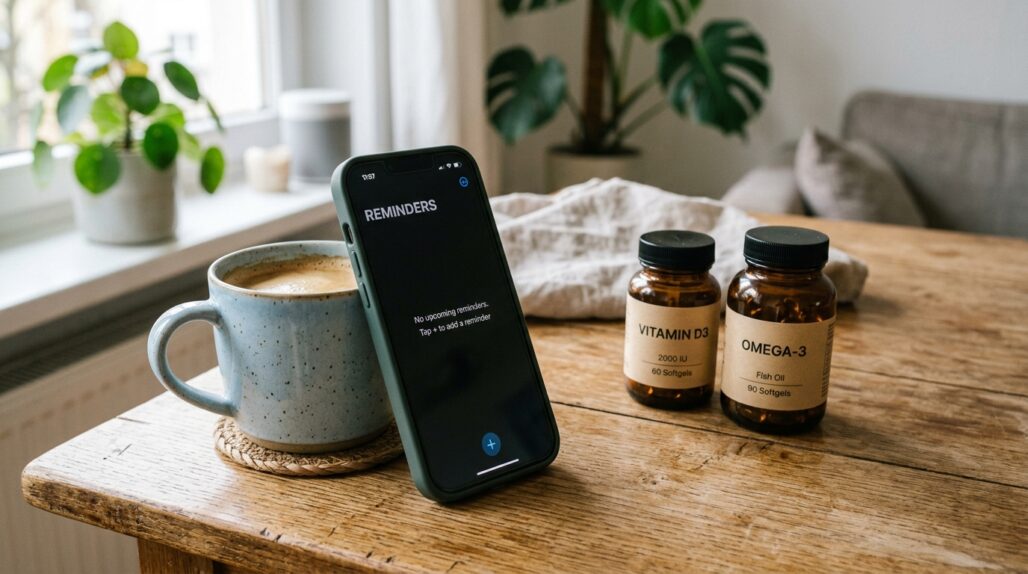
Once the manual version is steady, you can let a reminder carry the load – and the useful trick on shift work is to tie reminders to your wake and sleep blocks rather than a fixed hour, which is exactly what StackMyMed (our own free app) lets you do when you set doses to "after I wake" instead of "8 a.m.", with the same low-tech backup of a pill box and a paper card if you would rather not use a phone at all. If you are unsure whether a particular medicine's timing can flex with your schedule, the app can hold the list and flag the question, but the call belongs to your pharmacist.
Keeping that list current is the quiet part that pays off. The CDC recommends keeping a written list of your medicines, vitamins, and supplements and making sure your providers know about all of them. A rotating schedule is precisely when an out-of-date list bites you, so update it the day anything changes.
FAQ
Can I just take all my doses when I wake up to keep it simple? Usually no. Bunching doses ignores the spacing many medicines need and can push some too close together. Spread them across your wake, meal, and sleep anchors, and ask your pharmacist before collapsing a twice-daily medicine into one.
I forgot a dose during a night shift. Do I double up next time? Generally no. AHRQ's patient guide for blood thinners, for instance, tells people never to skip a dose and never to take a double dose, and most drug labels warn against doubling to catch up, because a stacked dose can cause harm. Take the missed dose when you remember unless it is near the next one, then resume your normal anchors. If you miss several doses of a critical medicine, call your pharmacist.
Is melatonin a safe way to sleep after a night shift? It may help some people fall asleep during the day, but NCCIH points out the evidence in shift workers is weak and long-term safety is not well studied. It can also interact with medicines like blood thinners and seizure drugs, so check with your pharmacist before adding it, especially if you take anything daily.
How do I handle the week my shift rotates from days to nights? Where your medicine allows it, move dose times gradually, an hour or two per day, rather than flipping them all at once. Keep the spacing between doses steady through the change. For any medicine with strict timing, get the transition plan from your pharmacist instead of improvising.
Do supplements need the same strict timing as prescriptions? Most general supplements are lower-stakes and can ride on a meal anchor, though some are better absorbed with or without food. They still belong on your list, and anything you are unsure about – or anything that might interact with a prescription – is worth raising with your pharmacist.
What if I work irregular on-call hours with no real pattern? Anchor to events even harder, since the clock gives you nothing. Wake, first meal, and pre-sleep still happen. Carry a travel organizer and a log so a dose is never lost to a surprise shift, and map any time-sensitive medicine with your pharmacist.

The bottom line
Shift work does not have to wreck your routine, but the clock cannot be your cue. Tie each dose to a steady event – wake, first meal, before sleep – keep the spacing between doses consistent, and write the plan on a card you can follow on autopilot. The single most useful step is to stop chasing fixed times and start anchoring.
The one thing not to do solo is reshuffle the timing of a medicine with strict rules, or add a sleep aid, without checking first. Bring your full list – prescriptions and supplements – to your pharmacist or doctor and let them tell you what can flex and what cannot. They make the medical call; your job is to give them the real picture and keep it current.
This article is for general information and is not medical advice. It is not a substitute for guidance from your doctor or pharmacist, who know your full history. Do not start, stop, or change the timing of any medication on your own; talk to a professional first.
StackMyMed is made by UsefulVitamins. It helps you organize your list and flag things to discuss with a pharmacist or doctor; it is not a diagnosis or treatment tool and does not replace professional medical advice.
Reviewed by the UsefulVitamins Editorial Team.
