
You may have encountered SS-31 in a longevity blog, a biohacking forum, or — if you searched long enough — listed in the catalog of a grey-market peptide vendor. The pitch is usually some version of: "mitochondrial optimizer, clinically tested, fights aging at the cellular level." The reasonable question is whether any of that reflects what the science actually shows. The honest answer is that elamipretide, the drug candidate formally known as SS-31, is one of the most scientifically serious mitochondria-targeted compounds ever tested in humans — and it is also a prescription drug candidate that is NOT FDA-approved for primary mitochondrial myopathy or any age-related condition, failed its pivotal trial in that disease in 2023, and has no legitimate consumer product form; anything sold as "SS-31" to the public is an unverified grey-market compound with no validated safety or dosing data.
If you are new to peptide biology, start with our primer on what peptides are before continuing here. For context on why energy-metabolism peptides attract research attention, our overview of peptides studied for energy and endurance is a useful companion. For a closely related mitochondrial-derived peptide, see our article on MOTS-c.
What SS-31 / Elamipretide Actually Is
SS-31 is a tetrapeptide — a chain of exactly four amino acids — with the sequence D-Arg-Dmt-Lys-Phe-NH2. The "SS" stands for Szeto-Schiller, for its inventors Hazel Szeto and Peter Schiller, who developed the compound at Weill Cornell Medical College. It is also called Bendavia by some investigators and elamipretide under the International Nonproprietary Name system used by regulators.
Four amino acids is an unusually short structure for a drug candidate in clinical trials. Most therapeutic peptides run to dozens of amino acids. What makes SS-31 functional at such small size is its alternating aromatic and basic amino acid residues. This pattern gives the molecule an amphipathic structure — part of it carries positive charge, part is hydrophobic — that drives it preferentially toward the inner mitochondrial membrane. It does not require any active transporter to reach this location. It partitions there based on chemistry.
Elamipretide is developed by Stealth BioTherapeutics, a Boston-based biotech company. The compound is administered by subcutaneous injection, typically 40 mg per day in clinical trials. It is not available as an oral supplement, a topical formulation, or any consumer product. It is a clinical-trial-stage drug candidate. As of the time of writing, elamipretide is FDA-approved only for Barth syndrome, a specific rare genetic disorder discussed in detail below, and remains under investigation for other indications.
The Cardiolipin Mechanism: What SS-31 Does Inside the Mitochondria
To understand why SS-31 attracted serious pharmaceutical development interest, you need a basic picture of cardiolipin.
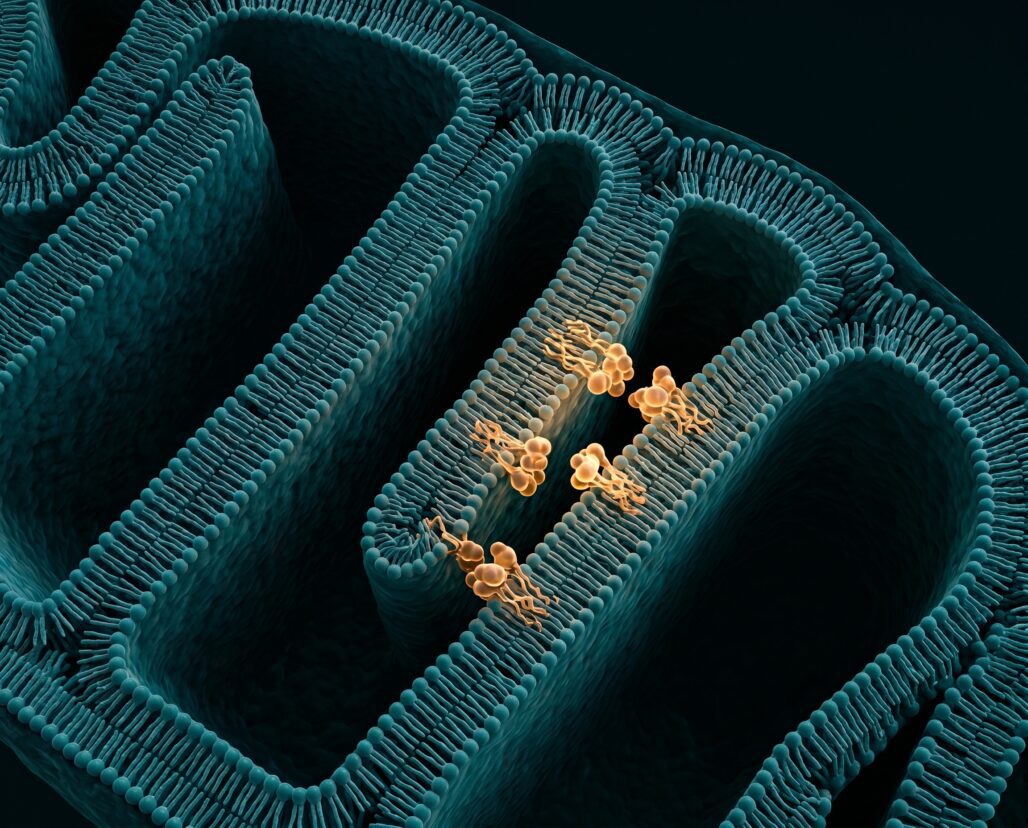
Cardiolipin is a phospholipid — a fat molecule — found almost exclusively in the inner mitochondrial membrane. It is unusual because it carries four fatty acid tails where most phospholipids carry two, giving it a cone-shaped geometry that promotes the tight membrane curvature of the cristae, the accordion-like folds of the inner membrane where oxidative phosphorylation occurs. Think of cristae as the surface area amplifier for cellular energy production. Without properly organized cristae, the respiratory chain complexes that produce ATP cannot assemble into the supercomplexes that make them efficient.
Cardiolipin plays a structural anchoring role for these respiratory chain supercomplexes (Complexes I through IV). When cardiolipin is oxidized by reactive oxygen species, or when its remodeling is disrupted by genetic mutations (as in Barth syndrome), the supercomplexes destabilize, electron transport slows, and mitochondria produce less ATP while leaking more free radicals.
SS-31 binds directly to cardiolipin at the inner mitochondrial membrane. A 2025 review by Tung et al. in the International Journal of Molecular Sciences (PMID: 39940712) describes the compound as selectively binding cardiolipin, thereby stabilizing mitochondrial cristae structure, reducing oxidative stress, and enhancing ATP production. A 2020 study by Allen, Pennington, and colleagues in Communications Biology (PMID: 32680996) used advanced cardiac ischemia-reperfusion models in rats to show that elamipretide does not prevent cardiolipin loss outright but aggregates remaining cardiolipin molecules into configurations with improved biophysical properties — essentially reorganizing the lipid architecture to maintain membrane integrity under metabolic stress.
The mechanistic picture that emerges from this body of work is more nuanced than simple antioxidant activity. Early papers framed SS-31 primarily as a reactive oxygen species scavenger, but the current understanding holds that its structural stabilization of cardiolipin-dependent protein complexes is the more fundamental effect, with ROS reduction as a downstream consequence rather than the primary mechanism. A 2025 review by Sabbah et al. in Biomedicine and Pharmacotherapy (PMID: 40294492) updates this picture, noting that elamipretide modulates mitochondrial membrane electrostatic potentials and the assembly of cardiolipin-dependent proteins.
The MMPOWER-3 Phase 3 Trial: What Happened
The most high-profile test of elamipretide was MMPOWER-3, a Phase 3 randomized clinical trial in adults with primary mitochondrial myopathy (PMM). Primary mitochondrial myopathy is a group of genetic disorders caused by mutations in mitochondrial DNA or nuclear genes encoding mitochondrial proteins, leading to muscle weakness, exercise intolerance, fatigue, and in many patients, multi-organ involvement. There is no FDA-approved pharmacological treatment for PMM.
MMPOWER-3 enrolled patients across multiple sites in North America and Europe. The trial tested whether 40 mg of subcutaneous elamipretide daily could improve functional capacity compared to placebo, as measured by the primary composite endpoint combining the 6-minute walk test (6MWT, a standardized measure of functional exercise capacity) and fatigue scores. Results were published in Neurology in July 2023 by Karaa and colleagues (PMID: 37268435).
The trial missed its primary endpoint. Elamipretide did not produce a statistically significant improvement over placebo on the composite measure in the primary mitochondrial myopathy population.
This outcome was a substantial setback for Stealth BioTherapeutics and for the PMM patient community, which has few treatment options. The trial did not establish safety concerns — the compound continued to demonstrate a tolerability profile dominated by mild injection-site reactions — but it failed to demonstrate the functional benefit that would support regulatory approval for this indication.
The failure raised questions about trial design, patient stratification, and whether the composite endpoint was sensitive enough to detect real-world improvements. Some investigators have noted that primary mitochondrial myopathy is an extremely heterogeneous disease, and the broad enrollment criteria may have diluted signal. These are legitimate scientific discussions. They do not change the regulatory reality: elamipretide is not approved to treat primary mitochondrial myopathy.
The Barth Syndrome Program: A Different Outcome
Barth syndrome is a rare X-linked disorder caused by mutations in the tafazzin gene, which encodes an enzyme required for cardiolipin remodeling. Without functional tafazzin, cardiolipin accumulates in an immature form and cannot properly anchor respiratory chain complexes. Patients — almost exclusively male, because the gene is X-linked — develop cardiomyopathy, skeletal muscle weakness, neutropenia, and growth retardation. Life expectancy historically has been severely reduced, though cardiac management has improved outcomes over recent decades.
Because Barth syndrome involves a direct genetic disruption to cardiolipin biology, it represents the clearest possible mechanistic match for a cardiolipin-binding therapeutic like SS-31. Stealth BioTherapeutics conducted the TAZPOWER trial, a randomized, double-blind, placebo-controlled crossover study followed by a 168-week open-label extension.
The primary endpoints of the randomized crossover portion did not reach statistical significance on the 6-minute walk test or fatigue measures — mirroring the MMPOWER-3 challenge. However, the open-label extension data, reported by Thompson, Manuel, and colleagues in Genetics in Medicine (PMID: 38602181), showed cumulative improvements of 96.1 meters on the 6-minute walk test by week 168 (p = 0.003), with sustained improvement in fatigue and positive cardiac trends. The biomarker monolysocardiolipin to cardiolipin ratio, a direct measure of cardiolipin remodeling dysfunction in Barth syndrome, also showed meaningful improvement.
On September 19, 2025, the FDA granted elamipretide accelerated approval for Barth syndrome, making it the first cardiolipin-directed mitochondrial therapeutic to receive regulatory authorization in the United States. Accelerated approval means the approval is based on a surrogate endpoint or intermediate clinical endpoint reasonably likely to predict clinical benefit — a confirmatory trial is required as a condition of this approval. The trade name and full prescribing details are managed by Stealth BioTherapeutics.
This is a genuine and meaningful regulatory milestone for the Barth syndrome community. It also has a precise scope: the approval is for Barth syndrome specifically, not for primary mitochondrial myopathy, heart failure, dry macular degeneration, or any other indication.
The Dry AMD Program: Still in Clinical Trials
Age-related macular degeneration (AMD) is the leading cause of irreversible vision loss in people over 65. The dry form, accounting for roughly 80% of AMD cases, involves the progressive loss of photoreceptors and retinal pigment epithelium in the macula. Geographic atrophy — the advanced stage of dry AMD — has very limited treatment options.
Mitochondrial dysfunction in retinal cells is increasingly recognized as a factor in AMD progression, which provided a rationale for testing elamipretide in this indication. The ReCLAIM program tested subcutaneous elamipretide in patients with intermediate AMD and noncentral geographic atrophy.
Results from the ReCLAIM-2 (SPIAM-202) trial, published in 2024 in Ophthalmology Science by Ehlers, Hu, Boyer, Cousins, and colleagues (PMID: 39605874), showed that primary endpoints were not met statistically. The trial did not achieve significant improvement on the planned measures of low-luminance visual acuity change or geographic atrophy area progression. However, elamipretide produced a 43% reduction in the mean progression of macular ellipsoid zone attenuation and a 47% reduction in partial ellipsoid zone degradation compared to placebo. Ellipsoid zone integrity reflects photoreceptor health, and its preservation is considered clinically meaningful. A larger proportion of elamipretide-treated patients gained 10 or more letters of vision (14.6% versus 2.1% in placebo).
The picture in AMD research as of late 2025 is that elamipretide shows a consistent biological signal that has not yet translated into statistically significant improvement on primary regulatory-grade endpoints. The program is still in clinical development. Elamipretide is not FDA-approved for AMD or any other eye condition.
Why No Legitimate Consumer SS-31 Product Exists
This section matters regardless of how scientifically compelling the mechanism looks.
Elamipretide is administered by subcutaneous injection in a precisely formulated pharmaceutical-grade preparation. The dose used across clinical trials is 40 mg per day, developed by Stealth BioTherapeutics through pharmacokinetic studies in animals and Phase 1 human trials.
No legitimate consumer product containing SS-31 or elamipretide exists. The compound is not FDA-approved as a dietary supplement. It is not available over the counter. Outside of the Barth syndrome accelerated approval, it has not demonstrated sufficient efficacy for regulatory authorization in any other condition.
Vials labeled "SS-31" or "Elamipretide" sold on grey-market peptide websites are unverified compounds of unknown purity, concentration, and sterility. No regulatory oversight applies to their manufacture. The structural simplicity of a four-amino-acid peptide does not make it safe to inject from an unregulated source — it means synthesis errors, contamination, or degradation would be undetectable without pharmaceutical-grade analytical methods the buyer cannot access.
Pregnancy and nursing data are insufficient to establish safety. Use in those populations would carry unknown risk.

Frequently Asked Questions
Is SS-31 the same as elamipretide?
Yes. SS-31 is the research designation from the Szeto-Schiller nomenclature. Elamipretide is the International Nonproprietary Name. Bendavia is another name used in older literature. They all refer to the same compound: D-Arg-Dmt-Lys-Phe-NH2.
Did the MMPOWER-3 trial prove elamipretide does not work?
It proved the compound did not outperform placebo on the primary composite endpoint in a heterogeneous primary mitochondrial myopathy population in that specific trial design. It does not settle whether elamipretide has no biological activity — the mechanism is established — or whether different patient populations, endpoint choices, or treatment durations might produce different results. What it does establish is that the compound is not approvable for PMM based on MMPOWER-3 data.
Was elamipretide approved by the FDA?
Yes, but narrowly. On September 19, 2025, the FDA granted accelerated approval of elamipretide for Barth syndrome specifically. This approval does not extend to primary mitochondrial myopathy, dry AMD, heart failure, or any use in the general population.
What about MOTS-c, which is also called a mitochondrial peptide?
MOTS-c is a different compound entirely. It is encoded by mitochondrial DNA and operates as a retrograde signaling molecule. Our MOTS-c article covers its distinct biology. Both operate in the mitochondrial space but through different mechanisms and regulatory pathways.
Actionable Takeaways
Three points worth retaining from this article.
The cardiolipin-binding mechanism is real and peer-reviewed. Elamipretide is not hype. It is among the most mechanistically specific mitochondrial drug candidates ever advanced to Phase 3 in humans, and its FDA accelerated approval for Barth syndrome in September 2025 validates the approach in that population.
The broader clinical record is mixed. MMPOWER-3 missed its primary endpoint in primary mitochondrial myopathy. The dry AMD program has not met primary endpoints as of late 2025. Biology does not always translate to clinical proof on the first attempt, and elamipretide is an ongoing demonstration of that reality.
No legitimate consumer product exists. Vials labeled "SS-31" from grey-market vendors are unverified compounds with no regulatory oversight, no validated dosing, and no established safety profile. If you or a family member has Barth syndrome, discuss the approved prescribing pathway with a treating cardiologist or metabolic disease specialist — not an online vendor.
Conclusion
SS-31 / elamipretide is the kind of compound that gives mitochondrial medicine researchers genuine reason for optimism. Its cardiolipin-binding mechanism addresses a fundamental bottleneck in cellular energy failure implicated in conditions from rare genetic diseases to common age-related disorders. The Barth syndrome accelerated approval in 2025 validates the approach in a well-defined population.
But elamipretide also illustrates why the distance between mechanistic elegance and clinical proof is wide. MMPOWER-3 missed its primary endpoint in primary mitochondrial myopathy. The dry AMD program is still converting a biological signal into regulatory-grade evidence. Elamipretide is a serious pharmaceutical project, not a consumer supplement — and it should be understood on those terms.
If you encounter it for sale in any form at any price, the appropriate response is skepticism, not curiosity.
Primary sources used in this article: Tung et al., Int J Mol Sci 2025 (PMID: 39940712); Allen and Pennington et al., Commun Biol 2020 (PMID: 32680996); Karaa et al., Neurology 2023 (PMID: 37268435); Thompson et al., Genet Med 2024 (PMID: 38602181); Ehlers et al., Ophthalmol Sci 2024 (PMID: 39605874); Zhao et al., Drug Discov Ther 2026 (PMID: 41260682); Sabbah et al., Biomed Pharmacother 2025 (PMID: 40294492).
This article is for informational purposes only and does not constitute medical advice, diagnosis, or treatment. Elamipretide is an FDA-approved drug only for Barth syndrome under specific prescribing conditions; it is not approved for any other indication including primary mitochondrial myopathy, age-related macular degeneration, or general use. The information here reflects published clinical trial data available as of late 2025. Do not use grey-market compounds. Consult a qualified physician before making any decisions about your health.
