
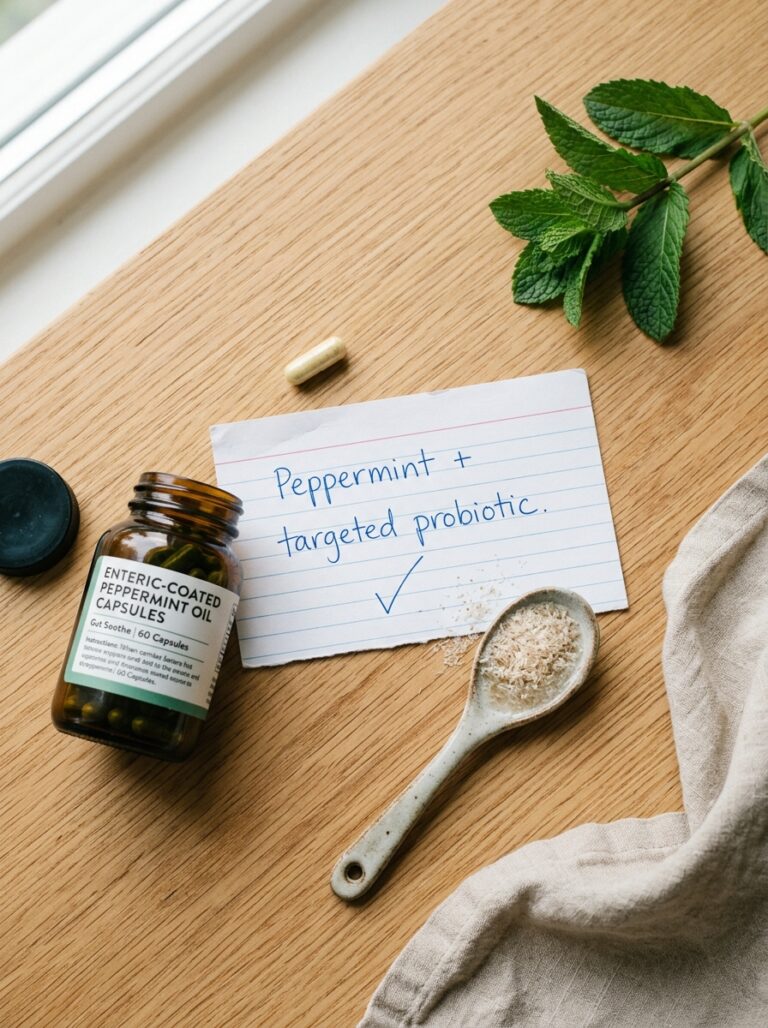
If you're searching for the best supplements for IBS, you're probably past the "eat more fiber" advice and want to know which pills actually moved symptoms in trials. The short answer: two interventions carry most of the evidence, and which one you reach for first depends on whether your IBS runs toward constipation or diarrhea. Most roundups hand you a generic "take a probiotic" and stop there, which is exactly why so many people buy the wrong one.
The picks at the bottom are the enteric-coated peppermint oil and strain-specific probiotic I'd keep in my own family's cabinet for a flare, chosen by subtype rather than by which bottle has the biggest number on it.
Affiliate disclosure: this article contains affiliate links. As an Amazon Associate, UsefulVitamins.com earns from qualifying purchases at no extra cost to you.
Before you decide
A few symptoms mean you should see a doctor before reaching for any supplement. Blood in the stool, unexplained weight loss, anemia, a fever, symptoms that wake you at night, a family history of colon cancer or inflammatory bowel disease, or a first onset after age 50 are alarm features, not IBS, and need a workup first.
The other thing that changes everything is your subtype. IBS is not one condition, and the supplement that helps IBS-C (constipation-predominant) can backfire in IBS-D (diarrhea-predominant). Soluble fiber is a friend to IBS-C; loading it into IBS-D without care can add bloat.
Before you add anything, the most evidence-backed first move is usually a structured diet trial, not a capsule. A short, dietitian-guided low-FODMAP elimination is recommended in the ACG clinical guideline and often does more than any single supplement.
It's also worth asking your doctor about basic labs. Celiac disease and bile-acid issues can masquerade as IBS, and no probiotic fixes a missed diagnosis. You can see how I weigh evidence and conflicts of interest on the how we review supplements page.
What IBS actually is
IBS, irritable bowel syndrome, is a disorder of gut-brain interaction: recurrent abdominal pain tied to bowel movements, with a change in stool frequency or form, and no structural damage that a scope can see. That last part matters; the gut looks normal but signals abnormally.
The mechanisms are a mix. Visceral hypersensitivity (the gut over-reporting normal sensations), altered motility, low-grade immune activation, and a disturbed gut microbiome all show up in the research, in different proportions per person.
Severity ranges widely, from an occasional nuisance to a daily, quality-of-life-wrecking condition. Doctors sort it into subtypes by predominant stool pattern: IBS-C (constipation), IBS-D (diarrhea), and IBS-M (mixed), and that label is the single most useful thing for choosing a supplement.
Conventional first-line management per the American College of Gastroenterology guideline leans on dietary change (including a low-FODMAP trial), soluble fiber, and targeted prescription options; supplements sit alongside that standard of care, not instead of it.
Strongest evidence supplements
These are the interventions with repeated randomized-trial support behind a named IBS outcome. Match them to your subtype rather than stacking all three at once.
Enteric-coated peppermint oil
Why it helps: Menthol, peppermint oil's active compound, relaxes intestinal smooth muscle by blocking calcium channels, which eases the spasm and pain that drive a lot of IBS. The enteric coating is the whole point: it carries the oil past the stomach so it releases in the intestine instead of triggering reflux.
What the trials show: A 2022 systematic review and meta-analysis of 10 RCTs in 1,030 patients found peppermint oil beat placebo for global IBS symptoms, with a number needed to treat of 4, and for abdominal pain specifically. The classic enteric-coated trial showed the same direction decades earlier.
Dose used in trials: Roughly 180 to 225 mg of enteric-coated oil, three times daily, taken 15 to 30 minutes before meals for two to four weeks.
Form to look for: Enteric-coated capsules only. Plain or "regular" peppermint oil tends to relax the lower esophageal sphincter and cause heartburn.
Skip if: You have significant GERD or a hiatal hernia, you're pregnant, or you take medications affected by it; the same meta-analysis noted more mild adverse events (mostly reflux) on peppermint than placebo.
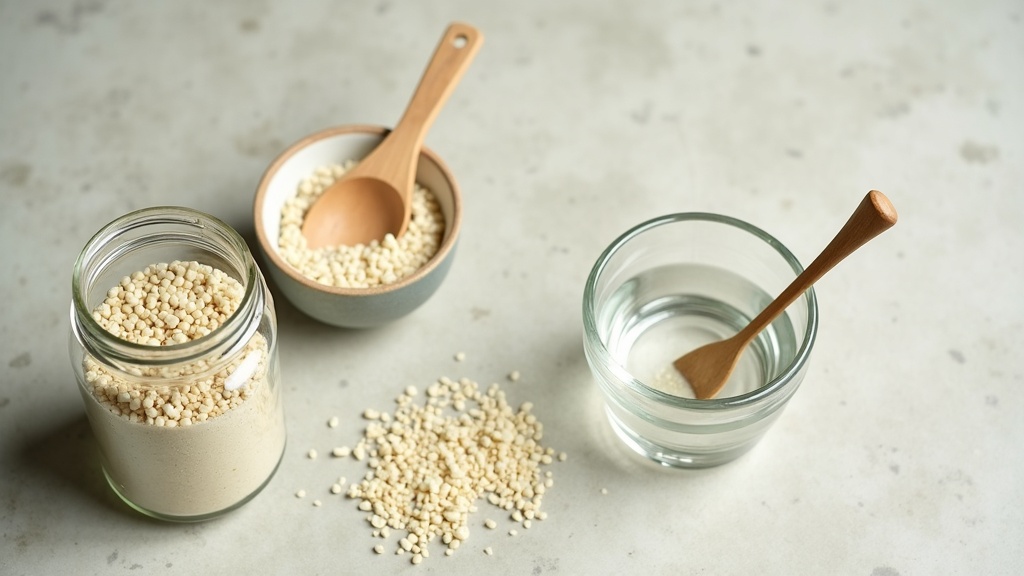
Soluble fiber (psyllium)
Why it helps: Psyllium is a viscous, poorly fermentable soluble fiber that adds gel-like bulk and normalizes transit. It tends to help both constipation and loose stools because it regulates form rather than purely speeding or slowing things.
What the trials show: A meta-analysis of 14 RCTs in 906 patients found fiber helped IBS overall (NNT 10), but the benefit was driven entirely by soluble fiber (NNT 7), while wheat bran showed no benefit. The ACG guideline specifically recommends soluble over insoluble fiber for global symptoms.
Dose used in trials: Build gradually toward about 10 grams of psyllium per day, within the broader 20 to 35 g/day total fiber target, taken with plenty of water.
Form to look for: Plain psyllium husk (ispaghula), ideally unsweetened. Start low and ramp up over a week or two, because too much too fast causes the bloating it's supposed to relieve.
Skip if: You have IBS-D and find any added fiber worsens urgency; introduce it cautiously, and avoid insoluble wheat bran, which the data show can aggravate IBS.
Strain-specific probiotics
Why it helps: Certain bacterial strains appear to modulate gut sensitivity, gas production, and low-grade inflammation. The benefit is tied to the exact strain studied, not to "probiotics" as a category, which is the part most advice gets wrong.
What the trials show: For overall symptoms, Bifidobacterium longum (infantis) 35624 beat placebo in a 362-patient trial, and notably only at the 1 x 10^8 CFU dose, not higher. For pain and bloating, Lactobacillus plantarum 299v improved symptoms versus placebo over four weeks in a 214-patient trial.
Dose used in trials: B. longum 35624 at roughly 1 billion CFU/day; L. plantarum 299v around 10 billion CFU/day, each for at least four weeks before judging.
Form to look for: A product naming the full strain code (genus + species + strain), with CFU guaranteed at expiry, not at manufacture. For more on reading a probiotic label, see my complete guide to probiotics and the dedicated best probiotics for IBS breakdown.
Skip if: You're severely immunocompromised, critically ill, or post-surgical; clear probiotics with your clinician first.
Moderate evidence
These have a real rationale and some supportive data, but the trials are smaller, mixed, or subtype-specific.
Peppermint plus caraway, or other antispasmodic blends. Combination herbal antispasmodics have functional-dyspepsia and IBS data, but the cleanest single-ingredient evidence still sits with enteric-coated peppermint alone, so a blend is reasonable only if peppermint by itself isn't enough.
Partially hydrolyzed guar gum (PHGG). A gentler, prebiotic-style soluble fiber that some people with IBS-C tolerate better than psyllium. The mechanism is sound and small trials are encouraging, but the evidence base is thinner than for psyllium, so treat it as a second-line fiber if psyllium causes bloating.
Vitamin D. Low vitamin D is common in IBS, and a few trials hint at symptom and quality-of-life benefit with correction. As a dietitian I'd frame this honestly: ask your doctor for a blood test before supplementing rather than guessing you're low, because the benefit shows up mainly when you're actually deficient, not as a blanket IBS treatment.
Popular but evidence-thin
Digestive enzymes are heavily marketed for IBS bloating, but outside of specific conditions like lactase deficiency or pancreatic insufficiency, the general IBS evidence is weak. If you suspect lactose is your trigger, a targeted lactase enzyme with dairy is a cleaner test than a broad-spectrum enzyme blend; for general gas, look at the diet first. I cover the gas-and-distension angle separately in best supplements for bloating.
Glutamine, collagen, and "gut-repair" powders show up constantly in IBS marketing under leaky-gut framing. The human IBS evidence is preliminary at best. If you want to try glutamine, the smallest reasonable trial is a defined course discussed with your clinician, but I wouldn't expect it to outperform the peppermint-and-fiber basics.
What to look for when buying
The two non-negotiables here are strain-specificity for probiotics and an enteric coating for peppermint oil. Everything else is secondary.
For probiotics, demand the full strain code (for example, B. longum 35624, not just "Bifidobacterium"), and a CFU count guaranteed through end of shelf life. A higher CFU number is not better; the 35624 trial only worked at 1 x 10^8, and the bigger dose failed.
For peppermint, the label must say enteric-coated or delayed-release. For psyllium, choose plain husk and avoid heavily sweetened or bran-blended products.
Across all three, favor brands carrying third-party testing (USP Verified, NSF, or ConsumerLab) and skip proprietary blends that hide per-ingredient amounts.
When to see a doctor
IBS is a diagnosis of pattern, so anything that breaks the pattern deserves medical attention rather than another supplement.
See a doctor promptly for any alarm feature: rectal bleeding or black stools, unintentional weight loss, iron-deficiency anemia, persistent nighttime symptoms, a palpable mass, fever, or new symptoms starting after age 50. A family history of colorectal cancer, celiac disease, or inflammatory bowel disease also warrants a workup.
Also check in if your symptoms are escalating, not responding to a guideline-based diet trial and these supplements, or interfering with daily life. Supplements support an IBS plan; they do not diagnose what's underneath it, and that diagnostic step belongs to your clinician.
FAQ
What is the single best supplement for IBS?
Enteric-coated peppermint oil has the strongest single-supplement evidence for overall symptoms and pain, with a number needed to treat of 4 in the 2022 meta-analysis. It's the most defensible starting point for most subtypes.
Should I take a probiotic for IBS-C or IBS-D?
Both can benefit, but match the strain. B. longum 35624 has broad symptom data, while L. plantarum 299v is best studied for pain and bloating; give any strain at least four weeks before deciding.
Does fiber help or hurt IBS?
It depends on the type. Soluble fiber like psyllium helps, especially IBS-C, while insoluble wheat bran can make symptoms worse, as the fiber meta-analysis showed. Start low and increase slowly with water.
Can I just do the low-FODMAP diet instead of supplements?
Often, yes. A structured low-FODMAP trial is a recommended first-line step and frequently does more than any supplement, ideally guided by a dietitian so you reintroduce foods properly.
How long until these supplements work?
Peppermint oil can ease symptoms within a couple of weeks, while probiotics and fiber generally need a four-week trial before you judge whether they're helping.
The bottom line on IBS supplements
The two interventions worth starting with are enteric-coated peppermint oil for pain and overall symptoms, and a single named probiotic strain chosen by your subtype, with soluble psyllium as the fiber that actually helps. The realistic effect is meaningful symptom relief for many, not a cure, and it works best layered on a guideline-based diet.
What separates this from the usual "take a probiotic" advice is the matching: pick by IBS-C versus IBS-D and by the exact strain studied, not by CFU headline or brand hype.
Next steps:
- Rule out alarm features and consider a dietitian-guided low-FODMAP trial first.
- Start enteric-coated peppermint oil before meals; add psyllium slowly if subtype fits.
- Choose a probiotic by strain code using the best probiotics for IBS guide.
Reviewed by Sarah Thompson, Registered Dietitian, focused on vitamin and mineral nutrition. See more from Sarah Thompson. This article is educational and is not a substitute for individualized medical advice; talk to your doctor before starting a supplement, especially if you have alarm symptoms, are pregnant, immunocompromised, or managing a diagnosed condition.
Recommended Products


As an Amazon Associate, UsefulVitamins.com earns from qualifying purchases at no extra cost to you. We only recommend products supported by published research or third-party testing.
