
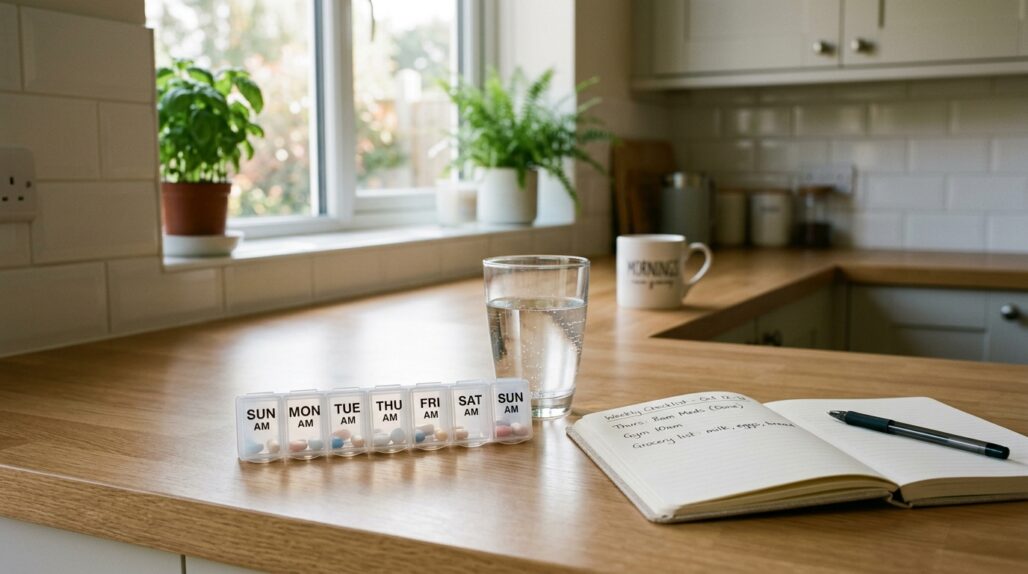
First, breathe – one missed dose is usually fixable
You went to take your pill and realized it is already there in the organizer, untouched, from this morning. Or you are halfway through the afternoon and cannot remember whether you swallowed it. This happens to almost everyone who takes something daily, and a single missed dose is rarely an emergency.
The hard part is that there is no one rule that fits every medicine. The right move depends on what the drug is, how often you take it, and how close you are to the next scheduled dose. So the goal here is to give you a sensible default, show you the short list of medicines where a missed dose deserves a phone call rather than a guess, and leave you with a paper method you can use today.
Two things stay true across almost every situation. The label, leaflet, or your pharmacist always overrides a general rule. And doubling up to "make up" a dose is the move most likely to cause harm, so that is the habit to break first.
The general catch-up rule for most daily medicines
For a typical once-daily medicine or supplement that does not carry a special warning, the standard approach looks like this.
- Take the missed dose as soon as you remember – if it is still well before your next scheduled dose.
- Skip it if your next dose is close. A common rule of thumb is that if more than half the time until your next dose has already passed, skip the one you missed.
- Never take two doses at once to catch up. Return to your normal schedule with the next dose.
The reason that third point matters: the gap between doses is built into how the drug is designed to work, and crowding two doses together can push the amount in your body higher than intended. The CDC's plain guidance is to take medicines as directed on the label or as instructed by a doctor or pharmacist, and a missed-dose decision is exactly the kind of question pharmacists answer all day.
For medicines you take more than once daily, the window is tighter. If you take something twice a day and notice the miss only a couple of hours before the next dose, skipping is usually the safer call. When you are unsure of the spacing, that is a one-minute phone call, not a coin flip.
If you want to see how your daily medicines line up against meals and other items, our medication and supplement timing guide walks through the common slots.
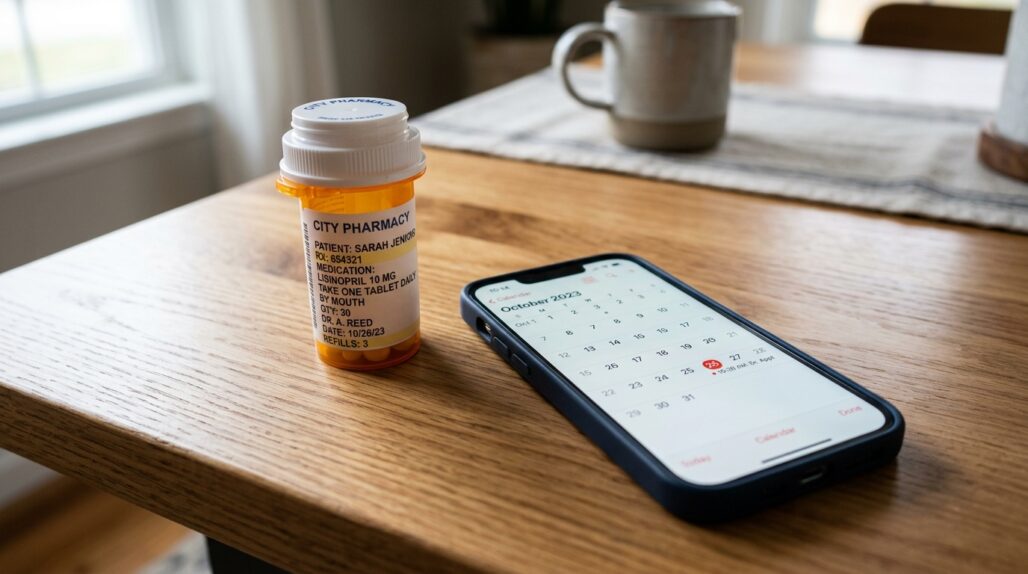
The medicines where a missed dose is not a guess
Some medicines have a narrow margin, and a missed dose can change how well they protect you or how safe they are. For these, follow the leaflet or call rather than apply the general rule above. Treat the list below as examples to confirm with your own pharmacist, not as instructions for your specific prescription.
| Medicine type | Why a miss matters | A reasonable first move |
|---|---|---|
| Blood thinners (anticoagulants) | Protection against clots can drop, and doubling up raises bleeding risk | Follow the leaflet’s timing window and call your clinic if you miss more than one |
| Seizure medicines | A missed dose can lower seizure protection | Check the specific instructions and call your prescriber if unsure |
| Heart and blood-pressure medicines | Some need steady levels to work | Take it if appropriate, but ask before changing timing |
| Diabetes medicines and insulin | Catch-up dosing can drop blood sugar dangerously | Do not guess on insulin; call your care team |
| Birth control pills | Timing affects whether you are protected | Follow the pill-pack rule and use backup if needed |
Blood thinners are a clear example of why the rules differ. For warfarin, the NHS advises you take a missed dose the same day you remember, skip it if you do not remember until the next day, and never take a double dose. The newer once-daily and twice-daily blood thinners each have their own timing window, which is why a leaflet check beats a blanket rule.
Birth control is another case with its own playbook. For a combined pill, the CDC says that if you miss one pill you should take it as soon as you can and keep taking the rest on time, even if that means two in one day, with no backup method needed. Miss two or more, and the advice shifts toward backup protection for several days. Progestin-only pills are stricter still, so the pack insert is your real guide.
If a missed dose has turned into several missed days, you are past simple catch-up. Our missed-dose reset plan covers how to restart a routine that has slipped, which is a different problem from one forgotten pill.
What about a missed supplement?
Supplements are usually lower-stakes than prescription drugs. Forgetting a single vitamin D or magnesium dose rarely matters in any meaningful way, and the right response is simply to take the next one on schedule. There is no benefit to doubling up, and with a few supplements – iron and some fat-soluble vitamins among them – taking extra can cause stomach upset or build up over time.
The exceptions are worth knowing. A supplement that was specifically recommended by a clinician to treat a deficiency deserves the same care as a prescription. And anything that interacts with a medicine you take – the kind of pairing covered in our guide to drug and supplement interactions – is worth a quick check rather than an automatic skip.
When you genuinely cannot remember whether you already took today's dose, do not split the difference by taking "half" or guessing. Treat it as taken and move on, unless it is one of the higher-stakes medicines above.
Build a system so you stop guessing
The most reliable fix for missed doses is removing the memory work entirely. Here is a low-tech method that costs nothing and works without any app.
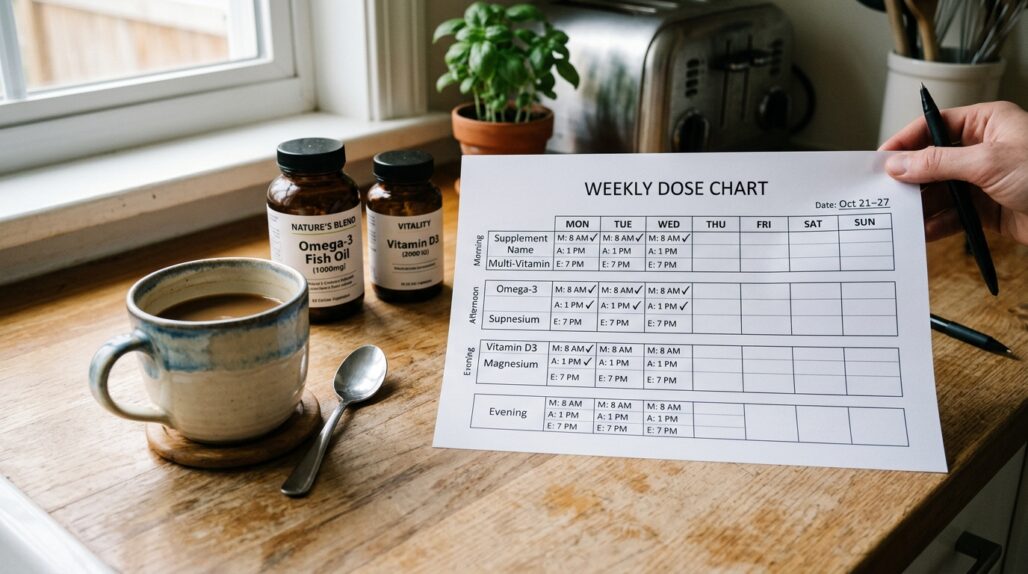
Make a simple weekly chart on paper. Down the left side, list each medicine and supplement by name and dose. Across the top, write the seven days of the week. Each time you take something, draw a checkmark in that day's box. One glance tells you whether today is done.
| Item and dose | Mon | Tue | Wed |
|---|---|---|---|
| Morning med (write name and dose) | [ ] | [ ] | [ ] |
| Vitamin D 1000 IU | [ ] | [ ] | [ ] |
| Evening med (write name and dose) | [ ] | [ ] | [ ] |
A weekly pill organizer does the same job in plastic: fill it once a week, and an empty compartment means you took the dose while a full one means you did not. The key habit is to fill and check it at the same time each week, in good light, working from your list one item at a time.
Whichever method you choose, the point is to make "did I take it?" a thing you can see, not a thing you have to recall. That single shift prevents most accidental misses and most accidental double doses.
Once your method is set, the next step is keeping it current every day without watching the clock. You can do that with a phone-note checklist, an alarm, or a free app we make, StackMyMed, which sends a per-dose reminder and lets you mark each one taken so you can glance at your phone and see whether today's pill is done. For anything where a missed dose or a possible interaction worries you, treat the app as a memory aid and route the actual decision to your pharmacist – it can flag things to raise with them, not clear a combination as safe.
If forgetting is a recurring theme rather than a one-off, our piece on what to do when you cannot remember if you took your supplement goes deeper on building a routine that holds.
FAQ
Should I take a missed pill the moment I remember? For most once-daily medicines, yes, as long as your next dose is not close. If it is nearly time for the next one, skip the missed dose and stay on your normal schedule rather than taking two together.
Is it ever okay to double up to catch up? As a default, no. Doubling up is the most common way a missed dose turns into a problem. A small number of pill-pack situations, like certain birth control rules, do involve taking two on the same day, so follow the leaflet for those rather than the general rule.
Which missed doses should make me call instead of guess? Blood thinners, seizure medicines, some heart and blood-pressure drugs, diabetes medicines and insulin, and birth control all have their own rules. If you take any of these, or you have missed more than one dose, check the leaflet or call your pharmacist.
Does a missed supplement matter as much as a missed medication? Usually less. For most everyday vitamins and minerals, just take the next dose on schedule. The exceptions are supplements a clinician prescribed for a deficiency or any that interact with your medicines.
What if I missed several days, not just one dose? That is a restart, not a catch-up. Do not try to make up the missed days at once. See our reset plan and check with your pharmacist or prescriber before resuming, especially for prescription medicines.
Can my pharmacist really help with this? Yes, and “what should I do if I miss a dose?” is one of the questions pharmacists expect. They can give you the rule for your specific medicine, often without an appointment.
The bottom line
One missed dose is almost always fixable. For most daily medicines and supplements, take it when you remember unless the next dose is close, then skip it – and never double up. The medicines that break this rule, like blood thinners, seizure and heart drugs, diabetes medicines, and birth control, are exactly the ones worth a quick call. Build a paper chart or pill organizer so the answer to "did I take it?" is something you can see at a glance, and bring any uncertainty to your pharmacist, who can give you the rule for your exact prescription.
This article is general information, not medical advice. It does not replace guidance from your own pharmacist or doctor, who know your medicines and your history. Never start, stop, or change the dose of a prescription medicine on your own.
StackMyMed is made by UsefulVitamins. It helps you organize your list and flag things to discuss with a pharmacist or doctor; it is not a diagnosis or treatment tool and does not replace professional medical advice.
Reviewed by the UsefulVitamins Editorial Team.
