

Why a few hours can decide whether your pill works
Most supplements and most medications happily share a stomach. The problem is narrow but real: a handful of minerals can grab onto certain drugs and form a clump your body cannot absorb. The drug then passes through largely unused.
This is not about toxicity. It is about a medication quietly underperforming because it left your gut before it could get into your blood. With something like a thyroid pill, that can mean weeks of feeling off before anyone connects it to the calcium chew you take at the same time.
The good news is that the fix is almost always timing, not stopping anything. You usually keep both items. You just put a few hours between them. This guide walks through which pairs matter, the common 2-hour and 4-hour gaps, and a way to build the spacing into a normal day without watching the clock.
What actually binds to what
The repeat offenders are mineral supplements with a positive charge: calcium, iron, magnesium, and zinc (aluminum, found in some antacids, behaves the same way). These minerals can latch onto certain drug molecules in a process called chelation, and the resulting pair is too bulky to cross the gut wall.
A few medication families are the classic ones to keep an eye on. According to MedlinePlus drug information from the U.S. National Library of Medicine, the thyroid medication levothyroxine should be taken at least 4 hours before or after calcium or iron supplements, because both reduce how much of the thyroid drug gets absorbed.
Some antibiotics have the same weakness. The StatPearls reference on tetracyclines from the NCBI Bookshelf notes that the absorption of all tetracyclines drops when they are taken with calcium, iron, or magnesium, and that dairy and mineral-containing antacids can blunt them the same way. A separate analysis published in PMC describes how magnesium, calcium, and aluminum reduce the absorption of fluoroquinolone antibiotics through that same binding.
Two patterns are worth holding onto. First, it is usually the mineral that disarms the drug, so the drug is the one you protect. Second, the minerals can also compete with each other: the NIH Office of Dietary Supplements iron fact sheet notes that calcium can interfere with iron absorption, which is why some people who take both choose to separate them too.
The common gaps – 2 hours and 4 hours
You do not need to memorize a different number for every pill. In practice, most spacing advice clusters around two windows.
| Medication or product | Common supplement to separate | Typical gap | The simple rule |
|---|---|---|---|
| Levothyroxine (thyroid) | Calcium, iron | About 4 hours | Thyroid pill on an empty stomach, minerals much later |
| Tetracycline antibiotics (such as doxycycline) | Calcium, iron, magnesium, zinc, dairy | About 2 to 3 hours | Antibiotic first, minerals after the gap |
| Fluoroquinolone antibiotics | Calcium, iron, magnesium, zinc, antacids | About 2 hours | Antibiotic at least 2 hours before the mineral |
| Bisphosphonates (osteoporosis pills) | Calcium, iron, magnesium, antacids | At least 30 to 60 minutes, often longer per the label | First thing on an empty stomach, nothing else until the label says |
| Calcium supplement | Iron supplement | About 2 hours | Iron at one meal, calcium at another |
These are illustrations of how the rules usually look, not instructions for your prescription. The exact gap for your medication is set by its label and your pharmacist. Some products are stricter than the general pattern, and a few of the items above (osteoporosis pills in particular) have their own detailed dosing routine.
Speaking of which: osteoporosis tablets like alendronate are a special case. The MedlinePlus information on alendronate describes taking it first thing in the morning on an empty stomach with plain water, staying upright, and waiting before any food, drink, or other product. That waiting period is the spacing, and the label spells it out precisely, so this is one to follow to the letter.
A manual method you can run with zero apps
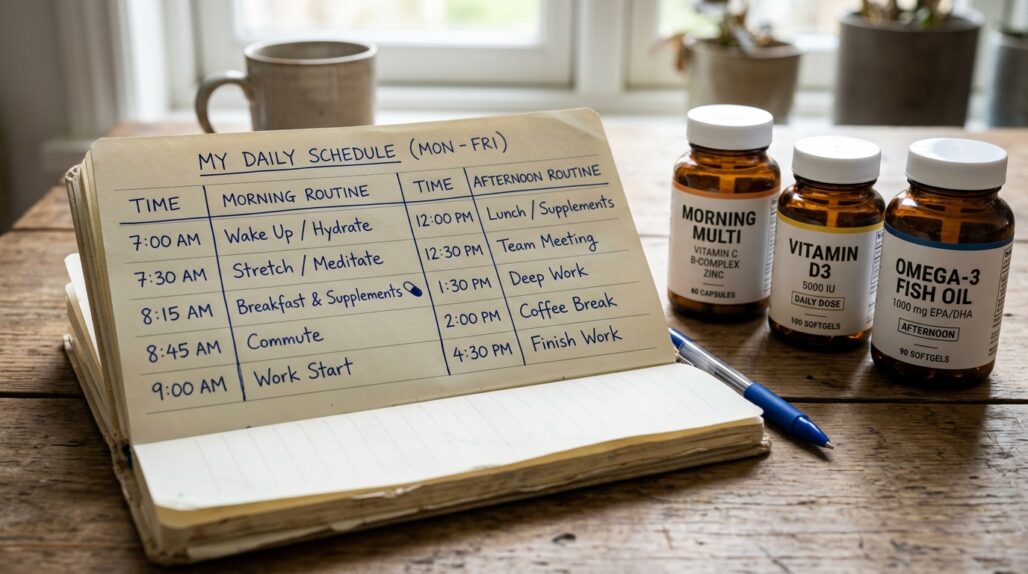
Here is a paper system that handles spacing without any technology. You can copy it into a notebook in five minutes.
- List every medication and supplement on one page, one per line, with the dose and the time you usually take it.
- Mark the spacers. Put a star next to any mineral supplement (calcium, iron, magnesium, zinc, or a multivitamin that contains them) and next to any medication your pharmacist has flagged as needing a gap.
- Give the medication the prime slot. If a starred drug and a starred mineral both need a home, anchor the medication to a fixed time (often morning, on an empty stomach) and push the mineral to a meal several hours away.
- Write the gap next to the pair. For example: "Thyroid 7 a.m. – calcium NOT before 11 a.m."
- Read the line out loud once a day for the first week until the rhythm is automatic.
A blank version looks like this, and it is genuinely all you need:
| Time of day | What I take | Keep apart from |
|---|---|---|
| 7 a.m. (empty stomach) | Thyroid pill, water only | No minerals until late morning |
| 11 a.m. or lunch | Iron + vitamin C | No calcium at this slot |
| Dinner | Calcium, magnesium | No iron at this slot |
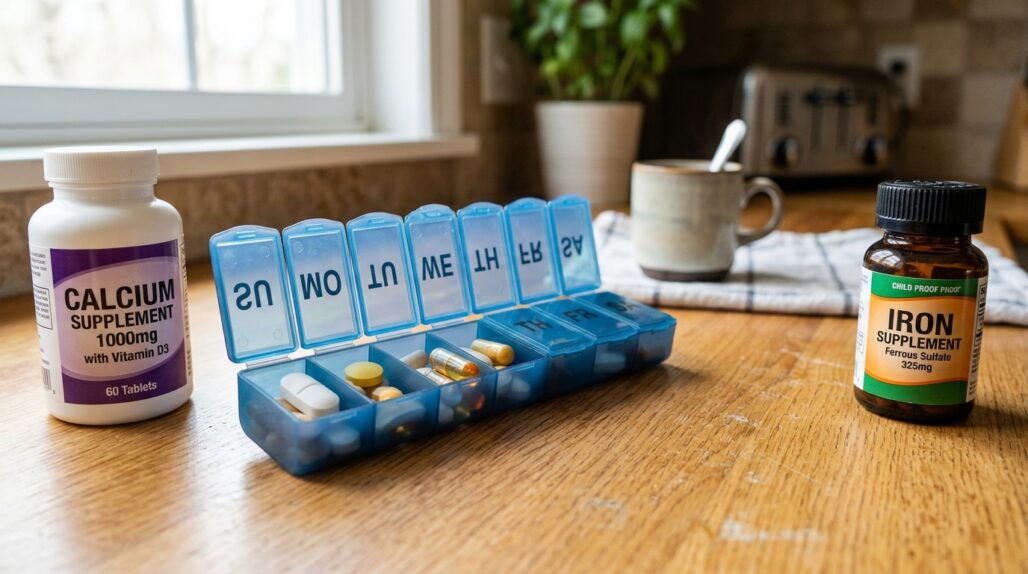
A pill box helps you remember whether you took a dose, but it does not enforce gaps on its own. So the trick with a physical organizer is to use morning and evening compartments and simply never load a starred drug and its starred mineral into the same compartment.
The other low-effort move is to anchor doses to things you already do. Take the thyroid pill when the kettle goes on; take the minerals when you sit down to lunch. Anchoring to fixed events does most of the spacing for you, because your meals are already hours apart.
Keeping it current once the routine is set
Spacing only works if you actually run it every day, and the layout you built can drift the moment a new prescription arrives or a slot gets skipped. Once your pharmacist confirms the right gaps, the hard part is simply remembering them – a free app we make, StackMyMed, lets you set separate dose reminders so the morning item and the two-hours-later item do not collide, and you can keep the whole list in one place. If you would rather stay on paper, two phone alarms or a pill box with labeled morning and evening rows do the same job. Either way, the spacing itself is a decision for your pharmacist to confirm; the reminder just helps you stick to it.
Whenever a medication is added, changed, or stopped, redo the two-minute check: relist everything, re-star the minerals and flagged drugs, and ask your pharmacist whether the new item needs a gap. New prescriptions are exactly when a quiet interaction sneaks in, so that is the moment to look, not months later.
If you take several supplements and want to sort out which ones belong together and which belong apart in the first place, our guide on which supplements to take together versus space apart walks through the common pairs. For the medication side of the picture, the drug and supplement interaction checker and our deeper reference on drug and supplement interactions are good places to gather questions before you call. And if you are building a daily rhythm from scratch, the medication and supplement timing guide ties the slots together.
FAQ
Is a 2-hour gap usually enough? For many mineral-and-antibiotic pairings, around 2 hours is the commonly cited window, though some antibiotics use 2 to 3 hours. Thyroid medication is often spaced about 4 hours from calcium and iron. The safest move is to confirm the exact number for your drug with a pharmacist rather than assume one figure fits all.
Does it matter which one I take first? Usually you protect the medication, so take the drug first and the mineral supplement later. With thyroid pills and bisphosphonates the medication goes first on an empty stomach by design. Your pharmacist can confirm the order for your specific list.
What if I accidentally took them together? A single overlap is rarely an emergency, and you should not double up or skip a future dose to compensate. Note what happened and mention it to your pharmacist, who can tell you whether anything needs adjusting. Do not change your prescription timing on your own.
Do all supplements need spacing from medications? No. The minerals (calcium, iron, magnesium, zinc) and a few specific products cause most of the trouble. Many vitamins and other supplements have no meaningful timing conflict, but the only way to know about your combination is to ask a pharmacist.
Can I just take everything at night to avoid the problem? Stacking everything into one slot often recreates the exact conflict you are trying to avoid, because the minerals and the drug end up together again. Spreading doses across the day is what creates the gap. Build at least one separate slot for the items that need distance.
Does food count as something to space around? Sometimes. Dairy and mineral-rich foods can interfere with certain antibiotics the same way a calcium pill would, and some medications are meant for an empty stomach. Check the label for “with food” or “empty stomach” wording and confirm with your pharmacist.
The bottom line
Spacing is a small, low-cost habit that protects a handful of medications from being quietly blocked by mineral supplements. For most people the whole task is: take the medication first, keep calcium, iron, magnesium, and zinc a couple of hours away, and never load a flagged drug and its mineral into the same time slot.
You do not need anything fancy to do it. A one-page list and two anchored meal times handle nearly all of it. The single most important step is to confirm the exact gap for your specific medication with your pharmacist or doctor, and to redo that quick check every time something new is added. They can also tell you if your combination needs no spacing at all, which is often the case.
This article is general information, not medical advice. It does not replace guidance from your own pharmacist or doctor, who know your full history and your specific medications. Never start, stop, or change the timing of a prescription on your own.
StackMyMed is made by UsefulVitamins. It helps you organize your list and flag things to discuss with a pharmacist or doctor; it is not a diagnosis or treatment tool and does not replace professional medical advice.
Reviewed by the UsefulVitamins Editorial Team.
