

Why some supplements clash and others cooperate
Most supplements get along fine. The friction shows up with a small group of minerals that travel into your gut through the same doors. When two of them arrive at once, they jostle, and one tends to lose.
The clearest example is iron and calcium. Iron is pulled into the intestinal lining through a transporter called DMT1, and calcium gets in the way of that process. A review of mineral interactions notes that calcium is the one element able to block both forms of iron absorption, which is why the same paper suggests taking the two separately when you can.
The good news is that the cooperative side of the ledger is just as real. Some vitamins make their partners work better. So this is less about a long list of rules and more about learning a few pairs, then building a simple layout you can repeat every day.
Pairs that help each other
These combinations either improve absorption or work better together, so there is no reason to split them up.
- Vitamin C with iron. Vitamin C changes iron into the form your gut absorbs more easily. The NIH Office of Dietary Supplements notes that vitamin C improves the absorption of iron from supplements, which is why many iron products already include it or suggest a glass of orange juice.
- Vitamin D with vitamin K2. These two are often sold together. Vitamin D helps your body take in calcium, and many people pair it with K2 as part of a bone routine. Both are fat-soluble, so they belong with a meal that has some fat in it.
- Calcium with vitamin D. Vitamin D is what lets your body actually use the calcium you swallow, so a combined calcium-and-D product is a common and sensible pairing.
Some of these pairs also have a preferred order across the day, which we cover in our walk-through of what order to take supplements.
A quick caution on the cooperative pairs: helping absorption is not the same as a green light to take large amounts. More is not better with fat-soluble vitamins or minerals. Stick to the label and your clinician's guidance on amounts.
Pairs that compete and do better spaced apart
Here is where a little distance pays off. These are the combinations worth separating, usually by a couple of hours.
| Pair | Why they clash | Suggested gap |
|---|---|---|
| Calcium and iron | Calcium blocks iron uptake at the gut transporter | About 2 hours |
| Zinc and copper | High zinc over time can lower how much copper you absorb | Different times of day, and watch total zinc |
| Calcium and magnesium (large doses) | Both are minerals that may compete at higher amounts | Split across the day if doses are large |
| Iron and zinc | They can share absorption pathways and interfere | About 2 hours if taking both as singles |
The iron-and-calcium clash is the best documented. A laboratory study found that calcium reduces iron uptake through the DMT1 transporter, and the practical advice that follows is to keep the two at different times. The NIH consumer fact sheet on iron makes the same point in plain terms: calcium can interfere with iron, so taking them at separate times may help.
Magnesium sits in the middle. At everyday amounts it rarely causes trouble, but large doses of magnesium and calcium together can compete, so splitting them across the day is reasonable if your doses are high. If magnesium is a big part of your routine, our full guide to magnesium covers forms and amounts in more detail.
Zinc and copper work on a slower clock. The issue is not a single dose colliding but steady high zinc intake nudging copper down over weeks. The NIH notes that 40 mg of zinc a day is the upper limit for adults, and that long-term high doses can lead to copper problems. So the real fix here is checking your total zinc across everything you take, not just spacing the pills.
How many hours apart, really
For most competing supplement pairs, about 2 hours is the practical gap people use. That is enough time for the first one to clear the busiest stretch of absorption before the second arrives.
Prescriptions are a different story, and they are where the gap often gets longer. Thyroid medicine is the classic case. MedlinePlus instructs people to take levothyroxine and any calcium or iron product at least 4 hours apart. Some antibiotics need similar spacing from minerals. These are not guesses you should make alone, so a quick read of the label and a question to your pharmacist settles the exact number.
When two items both need spacing from a third, the simplest move is to anchor the strictest one first, then fit everything else around it. If your routine involves several prescription gaps, our breakdown of how long to space supplements and medications apart lays out the common 2-hour and 4-hour rules side by side.

Build your together-vs-separate plan in five minutes
You do not need an app or a chart someone sold you. A scrap of paper and your bottles will do. Here is a method you can run right now at your kitchen counter.
- Line up every bottle, including your multivitamin. A multi often already contains iron, calcium, zinc, and magnesium, so it counts as several items at once.
- Circle the minerals. Iron, calcium, magnesium, zinc, copper. These are the ones that need attention. Vitamins like B, C, and D rarely cause spacing trouble.
- Group the cooperative pairs together. Put vitamin C next to iron, and vitamin D next to its partners, in the same slot. Whether each one needs a meal is a separate question, covered in our note on which supplements to take with food or on an empty stomach.
- Pull the clashing minerals apart. If you take both iron and calcium, assign iron to one meal and calcium to another, roughly 2 hours apart at least.
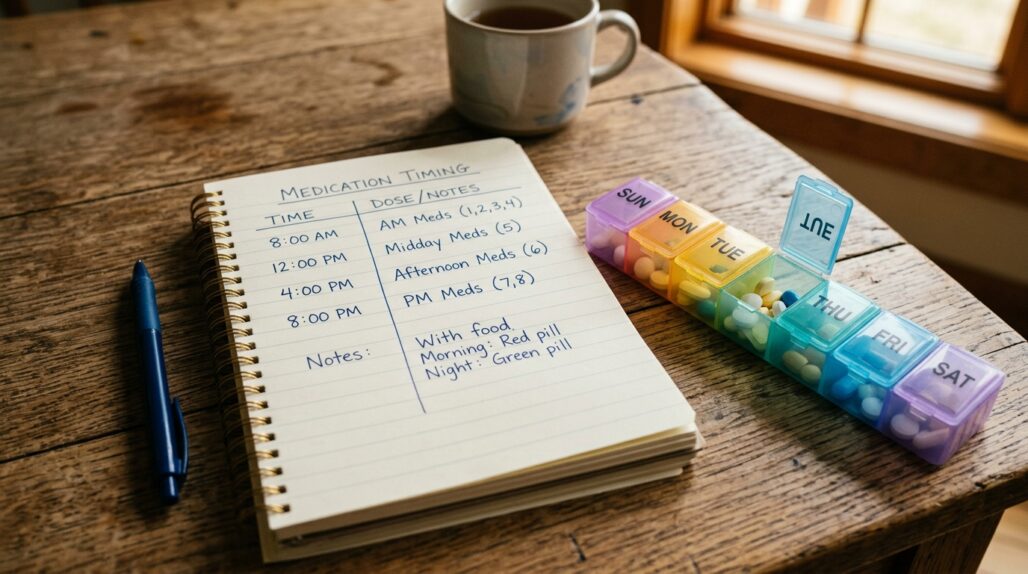
- Write it on a card and tape it inside a cabinet door. Two columns, morning and evening, with each item in its slot. That card is your whole system.
Here is what a finished card might look like for someone taking a multivitamin, extra calcium, iron, and a vitamin D plus K2.
| Time | Take | Why here |
|---|---|---|
| Morning, with breakfast | Iron, vitamin C, vitamin D and K2 | Vitamin C helps iron; D and K2 want food with fat |
| Midday | Multivitamin | Spaces its calcium and zinc away from the morning iron |
| Evening, with dinner | Calcium | Kept well clear of the morning iron |
A paper card like this works forever and never needs charging. The catch is keeping it current as bottles come and go, and remembering to actually follow it on a busy morning. If you are juggling several bottles and trying to keep the two-hours-apart rules straight, logging them in StackMyMed (our own free app) lets you see your whole stack in one place and slot conflicting ones into different times of day; a pill organizer or that taped-up index card does the same job offline. For any pairing you are unsure about, the app can flag it as something to raise with your pharmacist rather than deciding it is safe on its own.
Whichever you choose, the plan only helps if you keep it where you take your supplements and update it the day something changes.
When to stop guessing and ask
Spacing your own vitamins is low-stakes. The moment a prescription enters the picture, the rules tighten and the right answer depends on the specific drug.
Bring your pharmacist the full list, including the multivitamin and anything herbal, and ask which items need separating and by how long. They can also catch the quieter problem of doubling up, where a standalone mineral plus a multivitamin pushes your daily total higher than you realized. That is a five-minute conversation that saves a lot of second-guessing.

FAQ
Can I just take everything at once to keep it simple? For most vitamins, yes. The main exceptions are taking iron and calcium at the same time, and stacking high zinc with low copper over the long run. If those are not in your routine, one daily handful is usually fine.
How long should iron and calcium be apart? Around 2 hours is the common gap people use. A simple approach is iron with breakfast and calcium with dinner, which spaces them naturally.
Does my multivitamin already handle the spacing for me? Not really. A multi packs competing minerals into one pill, so it is formulated as a compromise. If you also take a separate iron or calcium, that is where you space things out.
Is it bad to take zinc and copper together? A balanced product that includes both is generally fine. The concern is high-dose zinc on its own for weeks, since that can lower copper over time. Watch your total zinc against the 40 mg adult upper limit.
What about my thyroid medicine or antibiotic? Those need their own, often longer, gaps from calcium and iron, sometimes 4 hours. Do not work it out from a general supplement rule; check the label and confirm the timing with your pharmacist.
Will spacing supplements out actually change anything I notice? For most people the day-to-day difference is small. It matters most if you are treating low iron, where getting the absorption right is worth the effort. Your clinician can tell you how much it matters in your case.
The bottom line
A handful of pairs help each other, a handful compete, and the rest do not care. Learn the few that matter, keep iron and calcium at different times, take fat-soluble vitamins with food, and write your plan on a card you will see every day. The single most useful step is bringing your complete list to a pharmacist, who can confirm the spacing for any prescription and catch anything you are doubling up on.
This article is for general education and is not medical advice. It does not replace guidance from your own doctor or pharmacist, and you should not start, stop, or change any prescription or supplement based on it. Talk to a qualified professional about your specific situation.
StackMyMed is made by UsefulVitamins. It helps you organize your list and flag things to discuss with a pharmacist or doctor; it is not a diagnosis or treatment tool and does not replace professional medical advice.
Reviewed by the UsefulVitamins Editorial Team.
