
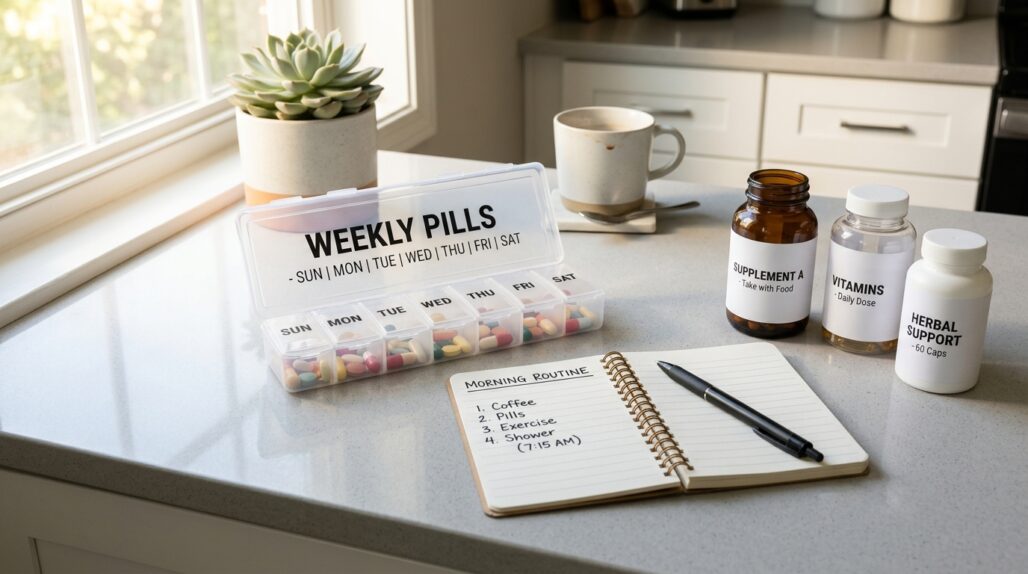
Start with one list, not the bottles
Most people manage their medicines from memory and from wherever the bottles happen to sit. That works until the routine grows. Add a new prescription, a vitamin a friend recommended, and a magnesium you take some nights, and the gaps appear: a missed dose here, a second bottle of the same thing there.
The fix is not a fancier pill box. It is a single written record that lists everything in one place, so you stop holding it all in your head. The FDA recommends keeping exactly this kind of list and treating it as the source of truth for every appointment and pharmacy visit, in its guidance on creating and keeping a personal medication list.
A system has four parts, and the rest of this guide builds them one at a time. None of them need an app. A notebook, an index card, or a printed sheet on the fridge does the job.
Step 1 – Build one master list of everything
Gather every container in the house: prescription bottles, the daily multivitamin, the fish oil in the cupboard, the melatonin in the nightstand, even the occasional pain reliever. Line them up. Then write each one down.
For every item, the FDA suggests recording four things:
- The name of the medicine or supplement (and the brand, if it matters).
- The strength or dose, for example 500 mg or one tablet.
- What you take it for, in your own words.
- When and how you take it, such as once in the morning with food.
Here is a blank template you can copy onto paper or into a phone note. Fill one row per product.
| Name | Strength / dose | What it is for | When and how |
|---|---|---|---|
| Example: Levothyroxine | 75 mcg | Thyroid | Morning, empty stomach |
| Example: Vitamin D3 | 2000 IU | Low vitamin D | With breakfast |
One rule makes this list far more useful: write down the supplements too, not just the prescriptions. The NIH Office of Dietary Supplements is direct about this, advising people to tell every provider about any supplements they take and to keep a combined record of both, in its overview of what you need to know about dietary supplements. A list that hides the fish oil and the herbal blend is not complete, and the gaps are usually where problems start.
This master list is the foundation. The next three steps all read from it.
Step 2 – Sort everything into time-of-day slots
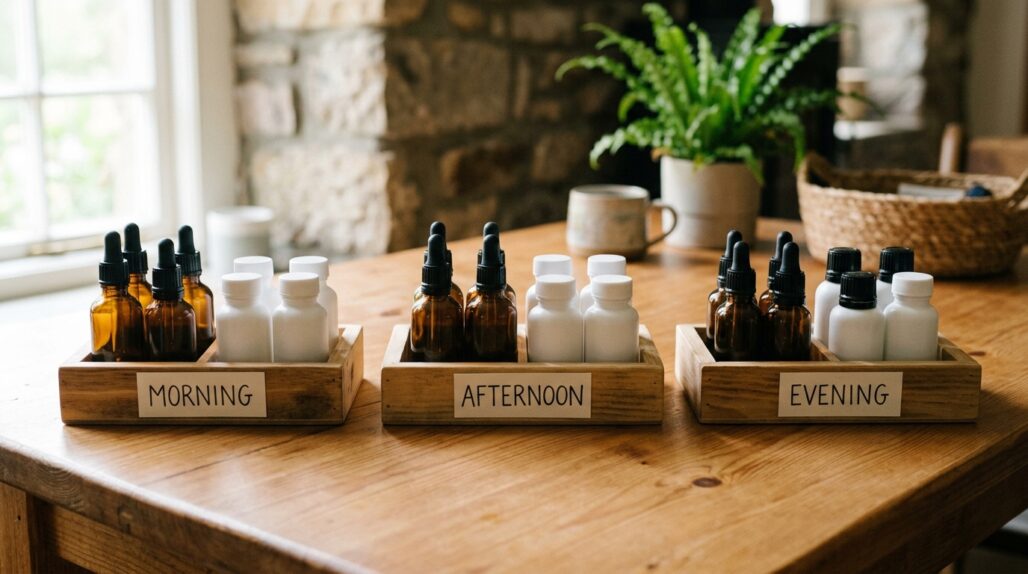
Now turn the list into a daily plan. Group each item into when you actually take it. For most people three or four slots cover it: morning, midday, evening, and bedtime.
A simple way to do this on paper:
- Draw four columns labeled morning, midday, evening, and bedtime.
- Write each item from your master list under the slot where it belongs.
- Note any special rule next to it, such as with food or away from coffee.
Once the plan is written, a weekly pill organizer makes it physical. Fill it from the plan, not from memory, and you can see at a glance whether you have taken a given slot. A morning-and-evening (AM/PM) organizer handles split dosing without confusion.
Anchor each slot to something you already do every day, like a meal or brushing your teeth. The anchor is the reminder. If a few items have timing rules that fight each other, our guides on whether to take supplements together or space them apart walk through the common ones. And if your worry is the opposite problem, that you might be taking more than you need, the supplement self-audit is a good gut check before you build the schedule.
A reminder you should treat as a real safety point: do not change the timing of a prescription on your own to make it fit a tidier slot. If a prescription clashes with a supplement or with another drug, that is a question for your pharmacist, not a do-it-yourself rearrange.
Step 3 – Set up a refill plan so nothing runs out
A schedule only works if the bottles are not empty. The most common failure is a quiet one: you reach for the prescription and there are two pills left, and the refill takes days. Reorder before you run out, not on the day you do.
Build a low-tech early-warning system:
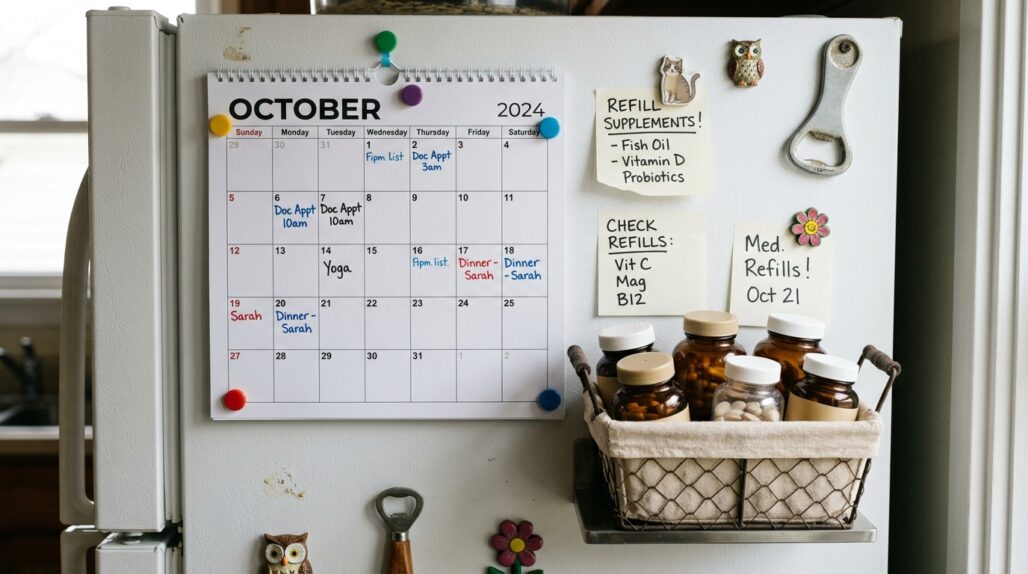
- Pick a refill day. Once a week, glance at your bottles and flag anything getting low.
- Use a one-week buffer. Reorder when you have about seven days left, not when you hit the last pill.
- Write the reorder date on the calendar the day you flag it, so it does not slip.
- Ask about syncing refills. Many pharmacies can line up your prescriptions to the same date, so you make one trip instead of five.
This table shows the difference between guessing and a buffer system.
| Habit | What usually happens | The buffer version |
|---|---|---|
| Reorder when empty | A gap of several days with no medicine | Reorder at 7 days left, no gap |
| Check when you remember | You forget until it is too late | A fixed weekly refill-check day |
| Separate pickup per drug | Several trips, easy to skip one | Synced refills, one pickup |
If you ever do come up short and miss a dose, do not double up to catch up without checking. We cover the general catch-up rules and the do-not-double-up rule in what to do when you cannot remember if you took today's dose.

Step 4 – Check the list for overlaps and interactions
A schedule and a refill plan keep you taking things on time. They do not tell you whether the combination is safe. That is a separate job, and it is the part a pill box cannot do.
Two things to look for yourself first:
- Duplicate ingredients. A multivitamin, a separate vitamin D, and a calcium-with-D product can stack the same nutrient three ways. A cold remedy and a sleep aid can both contain the same antihistamine. Scan your master list for repeated ingredients, not just repeated product names. Our walkthrough on double-dosing from overlapping ingredients shows where these hide.
- Known clashes. Some supplements change how medicines work. NIH NCCIH gives the textbook example: St. John's wort can make a long list of medications less effective, which it explains in its guidance on using dietary supplements wisely. You will not always spot these on your own, which is the point of the next part.
The person who can actually clear a combination is a pharmacist. AHRQ describes the pharmacist's job as a comprehensive review of your full regimen to make sure everything works together and to catch interactions and duplicate therapy, in its primer on the pharmacist's role in medication safety. Bring your master list to one pharmacy and ask for that review, especially after any new prescription. If you want to read up before you go, our drug and supplement interaction checker helps you arrive with the right questions.
This is also why a pill box alone is not a safety system. It sorts your timing beautifully and tells you nothing about whether the contents belong together.
Keep the system current
A system is only as good as the day it was last updated. The FDA's advice is to review your list whenever something changes: a new prescription, a different dose, or a medicine you stopped. Five minutes after every appointment keeps it honest.
The daily habit is the hard part, because the list does not maintain itself. A pill box answers did I take it, and a paper chart answers what am I taking, but neither flags whether two new items might clash. Pill boxes sort by day but do not tell you what is safe together, so keeping the full stack in StackMyMed (our own free app) adds an interaction flag on top of the organizing, which it surfaces for you to raise with a pharmacist rather than clearing anything itself. If you prefer to stay on paper, the same job is done by updating your master sheet and asking the pharmacist to look it over at your next refill. Either way, the safety call belongs to a person, not a tool.
FAQ
Do I really need to write down vitamins and supplements, or just prescriptions? Both. The NIH Office of Dietary Supplements recommends keeping a combined record and telling every provider about supplements, because they can interact with medicines and a partial list hides the risk.
Is a weekly pill organizer enough on its own? It is great for timing and for confirming you took a dose, but it does not check whether the items belong together. Pair it with a master list and a periodic pharmacist review for the safety side.
How often should I update my list? Whenever something changes – a new prescription, a dose change, or a product you stopped – and a quick review after each appointment. The FDA frames the list as a living document, not a one-time chore.
What should I bring to a pharmacist for a medication review? Your full master list, including over-the-counter products and supplements, ideally filled at one pharmacy so the pharmacist sees the whole picture and can catch duplicates and interactions.
I missed a dose. Should I just take two next time? Generally no. The catch-up rule differs by drug, and doubling up can be unsafe. Check the label and your pharmacist, and see our guide on tracking whether you already took today’s dose.
Can an app decide if my combination is safe? No. A tool can organize your list and flag things worth asking about, but only a pharmacist or doctor can judge whether a combination is safe for you.
The bottom line
Organizing your medications and supplements comes down to one written master list, time-of-day slots, a refill buffer, and a regular safety check. The single most useful move is the first one: get everything into one place, supplements included, with the dose and the reason. From there the schedule and refills are mechanical. The one piece you should not do alone is judging whether the combination is safe – bring the complete list to your pharmacist or doctor and let them review it.
This article is general information, not medical advice. It does not replace guidance from your doctor or pharmacist, and nothing here should be used to start, stop, or change a prescription on your own. Talk to a qualified professional about your specific medications and supplements.
StackMyMed is made by UsefulVitamins. It helps you organize your list and flag things to discuss with a pharmacist or doctor; it is not a diagnosis or treatment tool and does not replace professional medical advice.
Reviewed by the UsefulVitamins Editorial Team.
