

Why coffee gets in the way for some supplements
Coffee is not a problem for your stack as a whole. The issue is narrow: a handful of supplements absorb less well when coffee is in your stomach at the same time, and a few others pile on top of the caffeine you are already drinking.
The absorption problem comes mostly from compounds in coffee called polyphenols, along with tannins. The NIH Office of Dietary Supplements notes that polyphenols in coffee and tea, and minerals like calcium, can reduce the absorption of iron. So this is not really about caffeine. Decaf has the same polyphenols, so it can blunt iron too.
The second issue is the opposite of absorption: stacking. If a supplement or a pre-workout already contains caffeine, your coffee adds to it. That is where the jitters and the racing heart come from, not from any single product.
Most everyday vitamins do not care about your coffee at all. The trick is knowing the short list that does, and giving those a little space.
How coffee blunts iron (and how much)
Iron is the clearest example, so it is worth understanding the size of the effect. In a well-known study published in the American Journal of Clinical Nutrition, researchers found that a cup of coffee taken with a meal cut iron absorption by roughly a third to nearly half, depending on the brew. A more recent look at morning iron supplements taken with coffee found absorption dropped substantially as well.
Here is the part that actually helps you: timing fixes most of it. In that same older study, drinking coffee one hour before a meal did not reduce iron absorption, while coffee taken with the meal or an hour after did. That gives you a simple rule to work with.
A couple of useful caveats. Coffee mainly affects non-heme iron, the kind in supplements and plant foods, more than the heme iron in meat. And the research is not perfectly uniform: a 2024 study found no clear effect on blood iron levels in one group, which is a good reminder that this matters most if you are iron deficient or actively supplementing. If your iron is fine and you eat a varied diet, a cup of coffee with breakfast is not something to lose sleep over.

Which supplements to move away from your cup
Use this as your starting point, not a final answer for your specific prescriptions.
| Supplement or medication | With coffee? | What to do |
|---|---|---|
| Iron | Move it | Take with water, ideally an hour before or two hours after coffee |
| Calcium (larger doses) | Usually fine, but space from iron | Keep separate from iron rather than from coffee |
| Levothyroxine (thyroid) | Move it – ask pharmacist | Empty stomach with water, then wait before coffee or food |
| Stimulant / pre-workout / “energy” blends | Caution – they stack | Count their caffeine plus your coffee toward your daily total |
| Vitamin D | Generally fine | Best with a meal that has some fat |
| Fish oil / omega-3 | Generally fine | Take with food to reduce burps |
| B-complex / vitamin C | Generally fine | No special spacing needed for most people |
A few notes on the rows above.
Iron is the one most people should actually rearrange. Pair it with a little vitamin C or a citrus juice instead, which helps absorption, and save the coffee for later.
Levothyroxine deserves its own caution. The drug reference StatPearls notes that levothyroxine should be taken on an empty stomach and kept separate from calcium, iron, and similar binders, and coffee can reduce its absorption too. Many people are told to wait 30 to 60 minutes after the tablet before coffee or breakfast. That said, do not change how or when you take a thyroid medication on your own – the exact routine is a question for your pharmacist or prescriber.
Stimulant supplements are a stacking issue, not an absorption one. The FDA puts the general ceiling for healthy adults at about 400 mg of caffeine a day, while noting that sensitivity varies widely from person to person. If your pre-workout has 200 mg and you have two cups of coffee, you are near that line before lunch.
Which supplements are generally fine with coffee
Plenty of common supplements have no meaningful clash with a normal cup of coffee. For most healthy people, the following sit comfortably with your morning routine:
- Vitamin D – fat-soluble, so it does best with a meal, but coffee does not interfere.
- Fish oil and other omega-3s – take with food to avoid aftertaste; coffee is not the issue.
- Vitamin C – no spacing needed, and it actually helps iron if you happen to take them together away from coffee.
- A standard B-complex – fine with coffee for most people, though sensitive folks who feel wired may prefer it without.
- Probiotics – generally fine; some people take them with a cool or room-temperature drink rather than something piping hot, but this is comfort, not a hard rule.
Magnesium is a bit of a special case. It does not clash with coffee, but many people take it in the evening for its calming feel, which naturally keeps it far from the morning cup. If you want the full picture on forms and timing, our complete guide to magnesium walks through it.
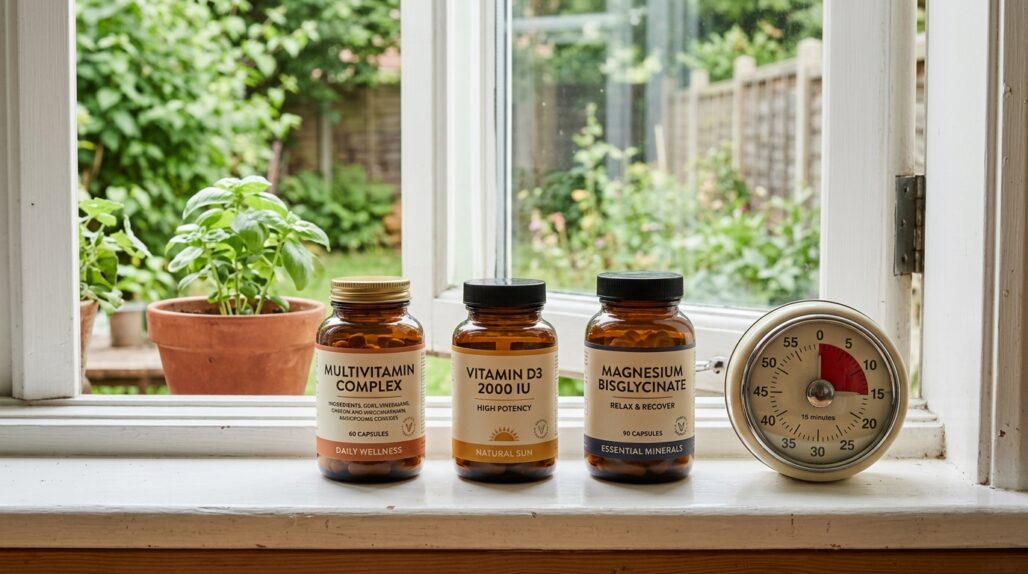
The simple gap, and a paper method that needs no apps
You do not need to overhaul your morning. You need one number and one small habit.
The practical rule for the absorption crowd, iron especially, is a one-to-two hour gap between the supplement and the coffee. Take the supplement with water first, then enjoy the coffee once the gap has passed – or have the coffee first and take the supplement well after. Either direction works as long as they are not landing together.
Here is a low-tech way to lock it in. Grab a sticky note or the back of an envelope and write your two short lists:
| Time block | Take with water (no coffee yet) | Coffee-friendly |
|---|---|---|
| On waking | Iron, thyroid med if prescribed | – |
| After the gap / with breakfast | – | Vitamin D, fish oil, B-complex, your coffee |
Stick that note where you keep your mug. The cup itself becomes the cue: when you reach for coffee, you already know the "before coffee" items should be done. A cheap kitchen timer or your phone's built-in timer set for an hour does the same job for the gap.
If your iron sits right next to the coffee maker, move the bottle to your bedside or bathroom instead, so it is the first thing you take, well before the kitchen.
Once you know your pattern, the only hard part is doing it on autopilot every day, including the days you are rushed. If the answer is "take iron before coffee and magnesium later," a free app we make, StackMyMed (our own free app), can set a quiet pre-coffee reminder and a separate later one so the spacing happens without you watching the clock – and a paper note by the mug or a two-compartment morning pill box does the same low-tech job if you would rather not add an app. For anything prescription, such as how to fit a thyroid tablet around your coffee, let your pharmacist confirm the exact timing rather than the reminder.
For the bigger picture of how all your items fit across the day, our supplement sequence guide lays out a morning, midday, and evening order, and the empty stomach versus with food reference covers which ones need a meal. If your routine touches prescriptions, the medication and supplement timing guide is the place to start before you change anything.
FAQ
Does decaf coffee affect iron the same way as regular coffee? Yes, largely. The polyphenols that bind iron are present in decaf too, so the absorption effect is similar even though the caffeine is gone. If you are managing low iron, treat decaf like regular and give it the same gap.
How long should I wait between iron and coffee? A gap of about one to two hours covers most people. Older research found that coffee an hour before a meal did not reduce iron absorption, while coffee with the meal did, so spacing genuinely helps. Take the iron with water and a little vitamin C, then have your coffee later.
Can I take my multivitamin with coffee? For most people, yes. The one caveat is the iron inside it – if your multivitamin is iron-heavy and you are correcting a deficiency, you may absorb more by taking it apart from coffee. Otherwise a standard multivitamin with coffee is fine.
Is it bad to take magnesium with coffee? There is no strong absorption clash. Many people simply take magnesium in the evening for its settling feel, which keeps it away from morning coffee anyway. If you prefer it in the morning, coffee is not a reason to avoid it.
I take thyroid medication. Can I have coffee with it? Coffee can reduce how well levothyroxine tablets absorb, and the medication is usually taken on an empty stomach with a wait before food or coffee. The exact timing depends on your dose and form, so confirm it with your pharmacist rather than guessing.
Why does my pre-workout plus coffee make me feel jittery? Because they stack. Many pre-workout and “energy” supplements already contain caffeine, and your coffee adds to it. The FDA puts the general daily ceiling for healthy adults around 400 mg, and sensitivity varies, so count both sources toward your total.

The bottom line
Coffee does not ruin your supplement routine. For most products it changes nothing. The one move that matters is keeping iron – and any prescription like a thyroid tablet – away from your cup, with a one-to-two hour gap and water instead. Vitamin D, fish oil, vitamin C, and a B-complex can stay in your morning lineup.
Write your two short lists, anchor them to the mug, and you have solved it without thinking about it again. And if you take any prescription medication, let your pharmacist or doctor confirm the spacing for your specific drugs before you rearrange anything – that one conversation is worth more than any general rule.
This article is general information, not medical advice. It does not replace guidance from your own pharmacist, doctor, or other qualified clinician, and you should not start, stop, or change any medication or supplement based on it. Talk to a professional about your specific situation.
StackMyMed is made by UsefulVitamins. It helps you organize your list and flag things to discuss with a pharmacist or doctor; it is not a diagnosis or treatment tool and does not replace professional medical advice.
Reviewed by the UsefulVitamins Editorial Team.
