
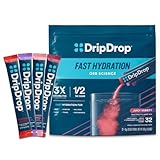
If you're comparing DripDrop and LMNT, you've already done enough research to know they're not the same thing. They share a form factor — single-serve powder sticks — and they both call themselves electrolyte products. That's roughly where the overlap ends. DripDrop was developed by a physician under the World Health Organization's Oral Rehydration Solution protocol. LMNT was formulated for people who eat low-carbohydrate and want to replace the sodium their kidneys shed on a ketogenic diet. At $0.80 per stick versus $1.50 per stick, they're not even competing for the same dollar. This guide explains who should buy which one, why the glucose in DripDrop is a feature and not a flaw, and what you're actually committing to when you subscribe to either.
Affiliate disclosure: this article contains affiliate links. As an Amazon Associate, UsefulVitamins.com earns from qualifying purchases at no extra cost to you.
The 30-second answer
Buy DripDrop if: you are recovering from illness, dealing with acute dehydration, exercising in heat, or want a medically validated rehydration solution at a lower per-stick cost.
Buy LMNT if: you eat ketogenic or very low-carbohydrate, you want high sodium without glucose, and you're willing to pay a $1.50/stick premium for that formulation.
Do not substitute one for the other. Their sodium loads differ by 3x, and DripDrop's glucose is not optional filler — it is the mechanism. If you pull the glucose out of a WHO-formulated ORS, you get a different product that absorbs differently. The products solve genuinely different problems.
Side-by-side at a glance
| DripDrop ORS | LMNT Recharge | |
|---|---|---|
| Price per stick | $0.75 – $0.94 | $1.50 |
| Pack size | 32 sticks | 30 sticks |
| Pack price | $24 – $30 | $45 |
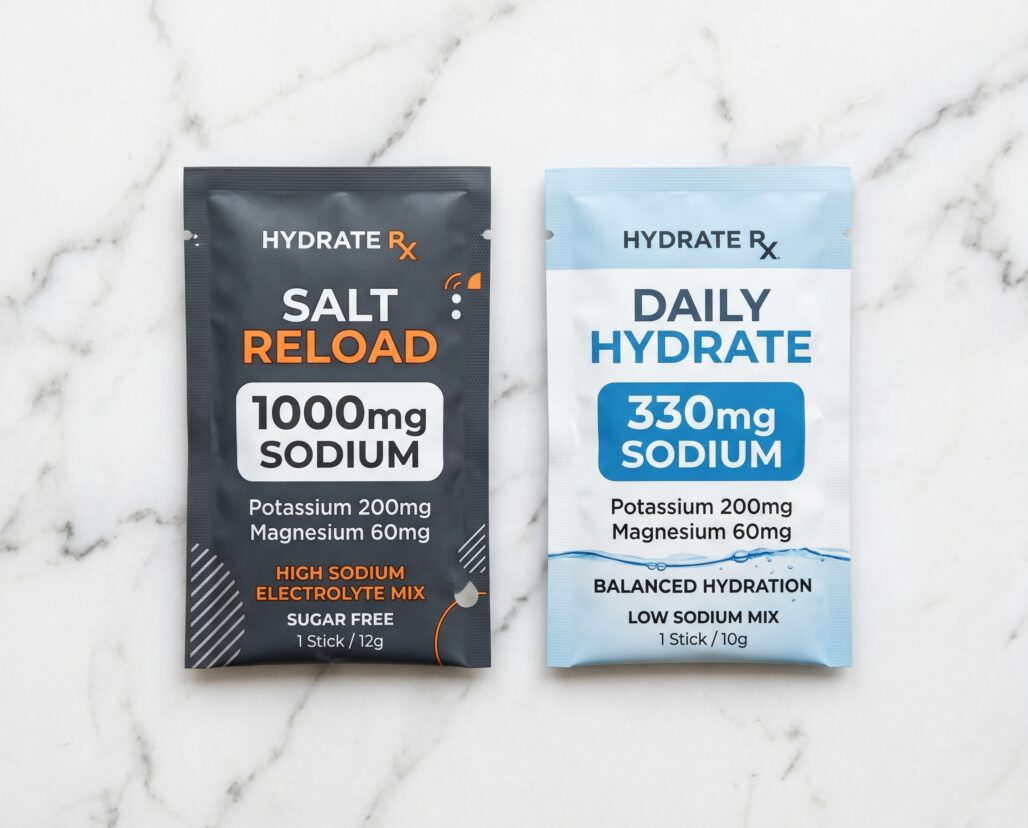
| Sodium | 330 mg | 1,000 mg |
| Potassium | 185 mg | 200 mg |
| Magnesium | 9 mg | 60 mg |
| Glucose / sugar | 7 g | 0 g |
| Keto-friendly | No | Yes |
| ORS protocol | Yes (WHO-based) | No |
| Sugar-free | No | Yes |
| Doctor-formulated | Yes | No (dietitian-advised) |
| Subscription model | Yes (brand site) | Yes (brand site) |
| Amazon availability | Yes | Yes |
Prices based on Amazon and brand-site listings, May 2026. Subscription pricing may differ.
Where DripDrop wins
Lower per-stick cost. At $0.75 – $0.94 per stick, DripDrop costs roughly half of LMNT on a per-serving basis. Over 30 servings, that's a $17 – $22 difference. If you're using electrolyte sticks multiple times per week, that arithmetic compounds fast.
Medically validated rehydration mechanism. DripDrop was formulated by Dr. Eduardo Dolhun under the WHO ORS framework, which means the sodium-to-glucose ratio is intentional and clinically grounded. This matters most when your body is depleted — sickness, heavy sweating, post-vomiting — not just when you want to feel good during a workout.
Broader use-case coverage. Because DripDrop works for acute dehydration, it covers more scenarios than LMNT: illness recovery, travel, heat exposure, pediatric dehydration situations (in adults), and athletic use. LMNT is optimized for one context.
Lower sodium ceiling. Counterintuitively, DripDrop's 330 mg sodium is an advantage for people who are not sodium-depleted. Everyday users who are not eating keto and are not intensely sweating don't need 1,000 mg of sodium per stick. Excess sodium triggers thirst, increases blood pressure in sodium-sensitive individuals, and is excreted by the kidneys — you're not banking it.
Where LMNT wins
Purpose-built for ketogenic physiology. When carbohydrate intake drops below roughly 50 g/day, insulin levels fall significantly. Lower insulin signals the kidneys to excrete sodium rather than retain it. The result: keto eaters lose sodium, potassium, and magnesium faster than people eating a standard diet. LMNT's 1,000 mg sodium per stick is sized for that loss. DripDrop's 330 mg is not.
Zero sugar. DripDrop's 7 g of glucose kicks you out of ketosis. This is not a minor issue — for someone maintaining nutritional ketosis, a single DripDrop stick can interrupt the metabolic state they've structured their entire diet around. LMNT contains no carbohydrates.
Higher magnesium. LMNT delivers 60 mg of magnesium per stick versus DripDrop's 9 mg. Magnesium is the third electrolyte most commonly depleted on a low-carb diet, after sodium and potassium. This isn't incidental — LMNT's formula addresses the full keto electrolyte profile, not just sodium and potassium.
No subscription required to buy on Amazon. LMNT is widely available as a one-time purchase on Amazon. You're not forced into a recurring commitment to get the product. DripDrop is also available on Amazon without subscription, but LMNT's Amazon presence is stronger and more consistently stocked in variety packs.

The ORS protocol angle — why DripDrop's glucose is intentional
This is the section most comparisons get wrong, so it's worth spending real words on it.
ORS stands for Oral Rehydration Solution. The WHO developed ORS in the 1960s as a field-deployable treatment for cholera-induced dehydration, and it has since been called one of the most important medical interventions of the 20th century. The mechanism is sodium-glucose cotransport, and it works like this: in the small intestine, there is a transporter called SGLT1 (sodium-glucose cotransporter 1) that moves sodium and glucose into the intestinal cells together, as a pair. When both are present in the right ratio, water follows via osmosis. The result is dramatically accelerated fluid and electrolyte absorption compared to drinking plain water or even a sodium-only solution.
This is not a marketing angle. It is structural biology. Remove the glucose and the cotransport mechanism doesn't fire the same way. The sodium absorption rate drops. The rehydration speed drops. For someone with mild to moderate dehydration — from a GI illness, from heat exposure, from intense athletic output — the glucose-containing ORS absorbs meaningfully faster than an electrolyte solution without it.
DripDrop's 7 g of glucose per stick is calibrated to activate this mechanism without providing a large carbohydrate load. It is not there to make the product taste sweet (though it does). It is there because removing it would change what the product does at the intestinal level.
The practical implication: if you are acutely dehydrated — sick, post-race, coming off a 12-hour day in the sun — DripDrop's ORS formulation will rehydrate you faster than LMNT will. LMNT's high sodium will pull fluid from tissue toward the blood over time, but it lacks the cotransport acceleration. For the specific clinical use case DripDrop was designed for, LMNT is a slower tool.
Conversely, LMNT was never designed for acute illness rehydration. It is designed for daily maintenance of electrolyte balance in people who excrete sodium rapidly due to dietary choices. Judging LMNT for not being an ORS is the same error as judging DripDrop for containing sugar. They are different products for different physiologies.
Verdict by use case
| Use case | Better pick | Why |
|---|---|---|
| Sick, vomiting, or acute dehydration | DripDrop | ORS protocol, faster absorption via SGLT1 cotransport |
| Ketogenic or very low-carb diet | LMNT | Zero carbs, 1,000 mg sodium matches keto sodium loss |
| Hot-weather athletic performance | DripDrop | Glucose + sodium cotransport during sweat-induced dehydration |
| Daily electrolyte maintenance (standard diet) | DripDrop | Lower sodium load, lower cost, adequate for non-keto physiology |
| Endurance sports (keto-adapted athlete) | LMNT | High sodium for fat-adapted athletes who can't use glucose mid-race |
| Budget-conscious everyday use | DripDrop | $0.80 vs $1.50 per stick — 46% cheaper |
| Avoiding all sugar | LMNT | DripDrop's 7 g glucose is a hard no for this use case |
| Travel, hotel illness, food poisoning | DripDrop | The product was literally designed for this scenario |
| Post-sauna or steam room recovery | Either | DripDrop absorbs faster; LMNT delivers more sodium per stick |
| Pediatric adult equivalent (not for children) | DripDrop | ORS protocol is clinically validated for dehydration management |
A note on subscription friction
Both DripDrop and LMNT sell via subscription on their brand sites. Subscribing is a commitment, and cancellation processes vary. Before subscribing to either, check current cancellation terms on the brand's site directly — these change. If you want to avoid a subscription entirely, both products are available as one-time purchases on Amazon, which is the lower-friction path. You pay a slightly higher per-unit price, but you're not managing a recurring billing relationship.
LMNT's variety packs on Amazon in particular are a sensible way to trial flavors before committing to a subscription. DripDrop's 32-stick variety packs serve the same function. Neither product requires a subscription to evaluate — and for a product you're using as needed for illness or athletic events rather than daily, a subscription model may not make sense at all.
Settled on one? StackMyMed (our companion app) lets you scan the label and log it into your routine, then watches for overlaps and interactions across your whole cabinet.
Related reading
- Is DripDrop worth it? — full review with price history, formula analysis, and who should skip it
- Is LMNT worth it? — full review with keto-specific analysis and subscription terms
- DripDrop alternatives on Amazon — ORS-protocol competitors at every price point
- LMNT alternatives on Amazon — high-sodium, low-carb electrolyte options compared
- How we review supplements — our methodology, sourcing policy, and affiliate disclosure
For 2026 pricing across DTC supplement subscriptions and their Amazon equivalents, see our DTC supplement pricing reference.
As an Amazon Associate, I earn from qualifying purchases. Product recommendations are based on published research and community user reports. This article is for informational purposes and is not a substitute for medical advice. If you are managing a health condition, consult a licensed physician before changing your electrolyte intake.
As an Amazon Associate, I earn from qualifying purchases. Product recommendations are based on real reviews and independent research.
Editorial independence note: UV earns affiliate commissions from Amazon and (selectively) from DTC brand affiliate programs. Commissions never determine our recommendations — top picks are chosen first; affiliate links are added second. Read our full methodology and editorial independence policy →
Frequently asked questions
What is the difference between DripDrop and LMNT?
DripDrop is a WHO-based oral rehydration solution with 330 mg sodium and 7 g glucose, built for illness, dehydration, and heat. LMNT is a keto electrolyte with 1,000 mg sodium and 0 g glucose. Their sodium loads differ roughly 3x.
Can I use LMNT instead of DripDrop when I am sick?
Not ideally. LMNT contains no glucose, so it lacks the sodium-glucose cotransport (SGLT1) mechanism that drives DripDrop’s rapid rehydration. For illness or acute dehydration, DripDrop’s ORS formula is the better fit.
Why is LMNT so much higher in sodium than DripDrop?
LMNT is built for ketogenic diets, where low insulin causes the kidneys to excrete more sodium. Its 1,000 mg per stick replaces that loss. DripDrop’s 330 mg suits everyday users who are not sodium-depleted.
