
If you're searching "is DripDrop worth it," the short answer is: for genuine rehydration after illness, heat exposure, or endurance output, yes — at $0.75-$0.94 per stick it is one of the few consumer ORS products built on actual oral rehydration science rather than just "electrolyte" marketing language. The longer answer involves what ORS actually means, why DripDrop's sugar content is not a flaw, what you give up at this price versus cheaper and more expensive alternatives, and whether the subscription format represents a reasonable commitment or a friction point you need to plan around before you hit "subscribe."
Affiliate disclosure: this article contains affiliate links. As an Amazon Associate, UsefulVitamins.com earns from qualifying purchases at no extra cost to you.
What is DripDrop?
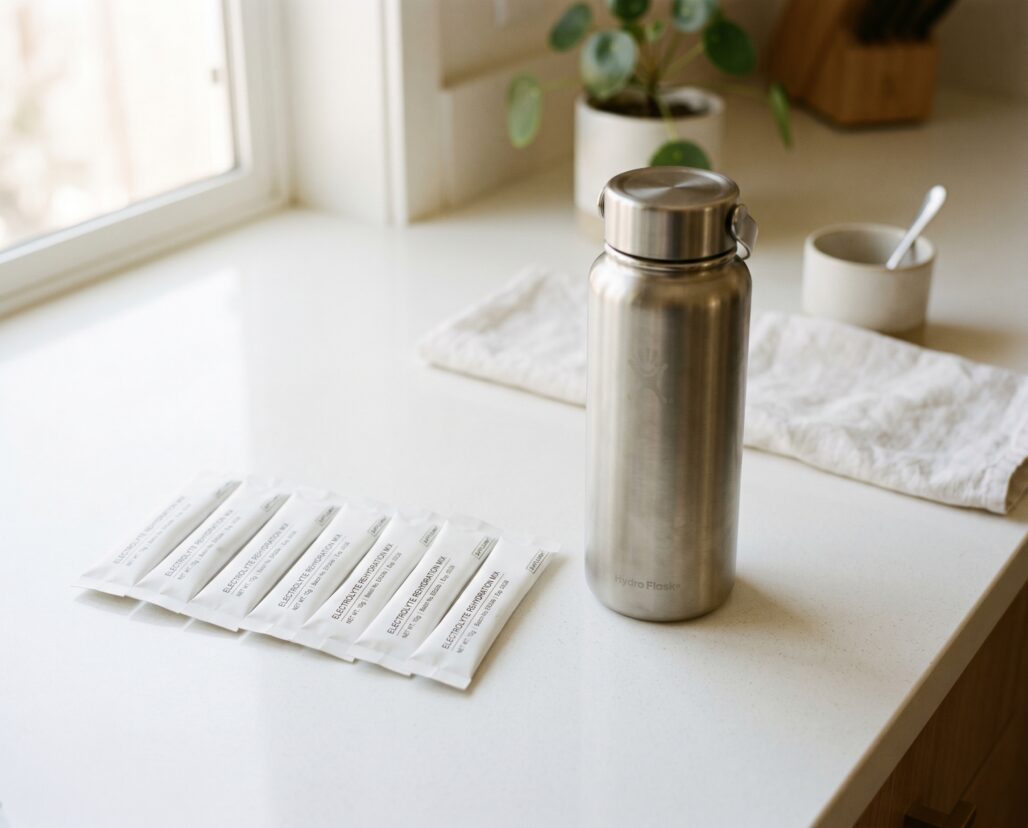
DripDrop is an oral rehydration solution (ORS) in stick-pack format, founded in 2009 by Dr. Eduardo Dolhun, MD, a physician who used ORS in disaster relief deployments before designing a consumer version of the same formulation. The company's commercial backstory — military and Red Cross partnerships before the product reached retail — is genuinely documented, not marketing embellishment. ORS is a specific category of hydration product defined by a glucose-to-sodium ratio calibrated to activate a biological transport mechanism called the sodium-glucose cotransporter (SGLT1), which moves fluid from the gut into the bloodstream faster than water alone can manage.
That mechanism is the reason DripDrop contains 7 grams of sugar. This is the single most frequently misunderstood fact about the product in online discussion. The sugar is not filler, not a sweetener compromise, and not a contradiction of the "medical-grade" positioning. Glucose at the right ratio to sodium is what makes the rehydration mechanism work. The WHO ORS formula — the global clinical standard — contains approximately 13.5 grams of glucose per serving. DripDrop's formulation sits below that ceiling while maintaining enough glucose to activate SGLT1 transport. If you see someone arguing that DripDrop is "too sugary for a medical product," they are describing a misunderstanding of ORS science, not a genuine formulation flaw.
The product ships as individual stick packs in a range of flavors. It is available one-time or via subscription, primarily through the brand's direct website.
What do you actually get?
Each DripDrop stick delivers the following per the published label:
- Sodium: 330 mg — This is the functional core. Most standard sports drinks (Gatorade Thirst Quencher) deliver 160-270 mg per serving. DripDrop's sodium load is meaningfully higher and more aligned with actual sweat-loss replacement, particularly during extended exercise or illness.
- Potassium: 185 mg — Moderate. Sufficient for general use, lower than LMNT (200 mg) and well below the high-potassium formulations used in clinical IV contexts.
- Sugar: 7 g (as glucose) — The SGLT1 transport mechanism requires glucose co-transport with sodium. This is not incidental sweetness; it is mechanism-critical.
- Magnesium and zinc — Present in small functional doses. Not highlighted on the label but noted in brand communications as supporting immune and muscle function.
- Vitamin C — Present per label. Low dose, broadly non-significant for hydration purposes but a reasonable addition.
At 8 fl oz per stick (standard reconstitution), DripDrop sits at a lower osmolarity than standard sports drinks — closer to the WHO ORS osmolarity target of 245 mOsm/L than to Gatorade's roughly 330 mOsm/L. Lower osmolarity matters for rehydration speed in dehydrated states: hypertonic solutions slow gut absorption; hypotonic or near-isotonic ORS solutions facilitate faster fluid uptake.
Packaging is straightforward. Sticks are tear-and-pour. The powder dissolves readily in 8 oz of cold or room-temperature water. Flavor selection as of 2026 includes watermelon, lemon, berry, and several others — palatable across most user reports, though some reviewers on r/HydroHomies describe the sweetness as "artificial-feeling" at the standard 8 oz dilution. Diluting to 12-16 oz resolves this for most users at the cost of proportionally lower electrolyte concentration per volume.
The price math
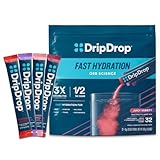
DripDrop's subscription pricing runs $24-$30 for a 32-stick box depending on the bundle you select. That works out to $0.75-$0.94 per stick.
To put that in context:
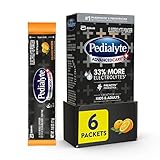
- Pedialyte AdvancedCare powder packs (the incumbent ORS brand in US retail) list at roughly $0.90-$1.10 per packet at major retailers — similar or higher cost per serving for comparable ORS formulation.
- LMNT Recharge runs $1.50 per stick at standard pricing — a 60-75% premium over DripDrop per serving for a product with a different formulation philosophy (very high sodium, no sugar, low potassium, no ORS glucose mechanism).
- Liquid IV runs approximately $1.25-$1.50 per stick, positions as ORS-inspired but uses the "Cellular Transport Technology" branding; sodium is 500 mg per serving and sugar runs 11 g — a heavier formula.
- Generic store-brand electrolyte packs at Walmart or Target run $0.25-$0.40 per packet but deliver sodium in the 100-200 mg range — below the threshold where ORS mechanism activation is meaningful.
At $0.75-$0.94 per stick, DripDrop sits at a reasonable mid-point: higher than bare-minimum electrolyte products that lack genuine ORS formulation, lower than the premium-positioned competitors that market harder without necessarily formulating more precisely.
A 32-stick box at $24/mo subscription lasts roughly one month for a moderate user (one stick per day on training days), or a week for someone using DripDrop daily as a clinical rehydration tool. If you're a once-a-week user on heavy workout days, a 32-stick box covers two months — making the effective cost $12/mo. Run your actual use-case math before committing to a subscription cadence.
What works
The ORS formulation is legitimate. This is the core of DripDrop's value proposition and it holds up. The sodium-to-glucose ratio reflects ORS science rather than flavor optimization. When the goal is actual rehydration — post-illness fluid loss, heat exposure, endurance dehydration — DripDrop delivers a meaningfully different physiological response than low-sodium sports drinks or plain water. The mechanism is established enough that the US military and disaster relief organizations have used ORS formulations matching this profile in operational settings.
The sodium level is appropriate for real use cases. At 330 mg per stick, DripDrop is useful where most sports drinks are not. Gatorade Thirst Quencher at 160-270 mg sodium is calibrated for casual activity and palatability, not rapid rehydration. DripDrop's sodium load makes it relevant for situations where you are actually depleted: multi-hour endurance events, fever-driven dehydration, hot-climate work, post-flight dehydration. If you are mildly thirsty after a 30-minute jog, Gatorade is adequate. If you just ran 15 miles in July, DripDrop's formulation matters.
Cancel friction is low. The brand operates account-based subscription management with a self-service portal. There is no documented email-cancellation-only requirement and no published advance-notice window. This matters: the highest-frustration consumer subscription category in health supplements involves brands that accept your money frictionlessly but require a phone call or 10-day written notice to stop. DripDrop does not appear to operate that way based on publicly available reports. Cancel at any point through account settings.
Price is defensible relative to clinical ORS alternatives. Pedialyte, the most common ORS benchmark in US retail, prices comparably or higher per packet in major pharmacy chains. DripDrop's $0.75-$0.94/stick is not a bargain-bin product, but it is not a premium-extraction price either.
Stick-pack format travels well. No liquid, no refrigeration, no measuring. For travel dehydration, airline recovery, or illness kit assembly, stick packs are the right format. Liquid IV, DripDrop, and Pedialyte powder all share this advantage. DripDrop's stick format is execution-equivalent.
What doesn't work
The sugar content will remain a perceived friction point regardless of the science. DripDrop's 7 g of glucose is lower than Pedialyte Oral Rehydration Solution (12 g) and much lower than Gatorade (21-34 g depending on format), but it's higher than LMNT (0 g) and Ultima Replenisher (2 g). Consumers who are tracking carbs, following ketogenic protocols, or generally sugar-averse will see "7 g sugar" on the label and stop reading. DripDrop's marketing explains the ORS mechanism, but the label itself doesn't tell that story in a scannable way. Expect to encounter this objection from people who looked at the label and not the science.
The flavoring is artificial-feeling for some users. This is the most consistent Reddit critique — not the sugar, not the sodium, but the taste profile. Multiple r/HydroHomies and r/Ultramarathon reports describe the flavor as "medicinal," "overly sweet," or "like a less artificial version of Pedialyte but still artificial." This is highly subjective and partly a dilution issue — DripDrop at 8 oz is noticeably sweeter than the same product at 12-16 oz — but if taste experience drives your supplement compliance, this is worth noting. Ordering the variety pack before committing to a large box of a single flavor is the right call.
Potassium sits on the lower end for high-output users. At 185 mg potassium per stick, DripDrop is functional for general hydration but falls below what high-volume sweaters lose per hour in demanding conditions. Research estimates sweat potassium loss at 160-320 mg per liter depending on individual variation. Heavy trainers using DripDrop as their sole electrolyte replacement during long sessions should assess whether supplemental potassium (from food or additional electrolyte sources) is warranted.
No third-party testing certification is prominently disclosed. DripDrop markets its medical and military credentials extensively, but NSF Certified for Sport or Informed Sport certification is not prominently featured in current product communications. For athletes subject to drug testing or for consumers who require batch-verified label accuracy, this is a gap worth investigating directly with the brand before purchasing in volume.
A 32-stick box is the minimum meaningful unit. There is no low-commitment sampler format at the subscription level. If you've never tried the product and want to evaluate it before committing to a monthly box, find the trial/variety pack or source a smaller quantity through Amazon rather than starting a subscription you'll need to cancel if the taste doesn't work for you.
Who should buy it
DripDrop is the right call for users whose rehydration need is genuine rather than performative. That means:
- Endurance athletes doing 90+ minute sessions, particularly in heat, where sodium loss is meaningful and glucose transport matters. At $0.75-$0.94/stick, it is cheaper than LMNT for a meaningfully different formulation profile.
- People managing illness-related dehydration. Stomach illness, fever, or diarrhea-related fluid loss is precisely the context ORS was designed for. DripDrop is more convenient than pharmacy-mixed ORS sachets and priced comparably to Pedialyte.
- Frequent travelers. Altitude, dry cabin air, and schedule disruption are mild but real dehydration drivers. A stick pack in a carry-on is a sensible preparation for anyone who regularly travels long-haul.
- Hot-climate workers or outdoor laborers. Sustained heat exposure with high sweat output is one of the clearest evidence-based use cases for ORS-grade electrolyte replacement. DripDrop is appropriate here in a way that most sports drinks are not.
- Anyone who finds LMNT too expensive and Gatorade too dilute. DripDrop occupies a useful position between mass-market sports drinks (high sugar, low sodium, poor ORS profile) and premium electrolyte brands ($1.50+/stick, no glucose mechanism). At $0.75-$0.94 with a functional ORS formulation, the value proposition is clear.
Who should skip it
Skip DripDrop if you are following a ketogenic or very-low-carb protocol. The 7 g of glucose per stick is mechanism-critical and cannot be formulated out of an ORS product without making it not-ORS. If carbohydrate elimination is a hard constraint, LMNT (0 g sugar) is the better fit — you will lose the SGLT1 transport advantage but you will stay in ketosis.
Skip it if you're looking for a general-purpose, low-electrolyte daily hydration habit. If you drink electrolytes because it's become a wellness habit rather than because you have a specific rehydration need, DripDrop's 330 mg sodium per stick may be more than your daily activity warrants. A lower-sodium, lower-cost product like Nuun Sport ($0.40-$0.50/tab) is adequate for casual activity and costs roughly half as much.
Skip it if taste compliance is a hard requirement. If you've read the Reddit reviews and the "medicinal sweetness" description sounds like it will affect your adherence, start with a variety pack or Amazon single-purchase before subscribing. The subscription is low-friction to cancel, but it's still friction you don't need.

Verdict
DripDrop at $0.75-$0.94 per stick is a legitimately formulated ORS product in a market full of products that use the word "electrolyte" as a synonym for "mildly salted." The sodium level is appropriate, the glucose is functional (not decorative), the ORS science is real, and the cancel friction is low enough that the subscription format is a reasonable commitment rather than a trap. The taste polarizes a segment of users, the potassium is on the modest side for high-output athletes, and the absence of visible third-party batch certification is a gap worth noting.
The honest summary: if you have a real rehydration need — illness, endurance sport, heat exposure, regular travel — DripDrop is worth it at this price. If you're buying electrolytes as a casual wellness add-on because you've seen them on social media, cheaper products with lower sodium loads and less clinical positioning will serve that casual use case at half the price without the physiological architecture you won't need.
At $24/mo for 32 sticks versus $45/mo for LMNT (30 sticks), DripDrop saves $21/mo for a product formulated around an evidence-based rehydration mechanism. That is the right comparison. Versus Pedialyte powder at comparable price, DripDrop's taste and format are generally considered superior. The product earns its positioning in a category that overuses the word "clinical."
Once you have picked a product, our companion app, StackMyMed, scans its label and tracks it alongside everything else you take, with timing and interaction checks built in.
Related reading
- DripDrop alternatives on Amazon — how DripDrop's ORS formulation compares to cheaper and more expensive electrolyte products available without a subscription
- DripDrop vs LMNT — a direct comparison of the two most discussed "serious hydration" products: glucose-assisted ORS versus zero-sugar high-sodium
- How we review supplements — our methodology, criteria, and what we look for in electrolyte product evaluation
This article is for informational purposes and not medical advice. Electrolyte products can interact with medications and health conditions, particularly for people managing kidney disease, hypertension, or heart conditions. Consult a licensed physician before significantly changing electrolyte intake, particularly during illness or high-intensity training.
For 2026 pricing across DTC supplement subscriptions and their Amazon equivalents, see our DTC supplement pricing reference.
As an Amazon Associate, I earn from qualifying purchases. Product recommendations are based on real reviews and independent research.
As an Amazon Associate, I earn from qualifying purchases. Product recommendations are based on real reviews and independent research.
Editorial independence note: UV earns affiliate commissions from Amazon and (selectively) from DTC brand affiliate programs. Commissions never determine our recommendations — top picks are chosen first; affiliate links are added second. Read our full methodology and editorial independence policy →
