
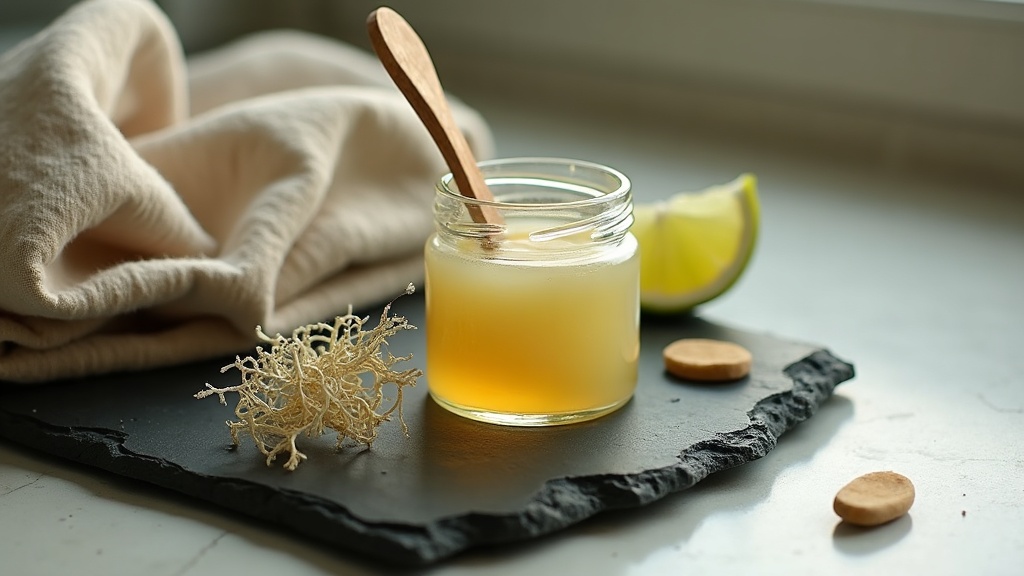
If you're searching for the best sea moss supplements, you've almost certainly been served a TikTok or Instagram reel claiming sea moss contains "92 of the 102 minerals your body needs" and fixes everything from thyroid dysfunction to acne to low libido.
Quick Answer: should you take sea moss?
For most people, no. The trend rests on a fabricated mineral claim, the supplement carries a real iodine-excess risk, and the conditions it's marketed for have better, safer, and better-studied options.
- The 92-minerals claim is false. There are only about 21 minerals considered essential or conditionally essential for humans. Earth's crust contains roughly 92 naturally occurring elements, which is where the viral number was borrowed and repackaged as nutrition.
- The genuine safety concern is iodine. Sea moss (Chondrus crispus and Eucheuma species) accumulates iodine from seawater at highly variable concentrations. Some commercial sea moss gels and capsules deliver 500 to over 2,000 mcg of iodine per serving, which exceeds the adult tolerable upper limit of 1,100 mcg/day set by the Institute of Medicine.
- Do not start sea moss before testing thyroid function. Anyone with Hashimoto's, Graves', a nodular goiter, or unexplained fatigue/weight changes should get a TSH and anti-TPO antibody panel before considering any seaweed-based supplement. Iodine excess can trigger or worsen autoimmune thyroiditis.
- If you genuinely want iodine for thyroid support, the answer is usually iodized salt or one serving of fish or dairy per day, not a variable-dose seaweed gel from social media.
Before we go further: the American Thyroid Association explicitly recommends against routine iodine supplementation in iodine-replete populations, and the United States is iodine-replete. That guidance alone should make a thinking person pause before stirring sea moss gel into a morning smoothie.
What sea moss actually is, briefly
Sea moss is a common name for several species of red marine algae, most commonly Chondrus crispus (true Irish moss from the North Atlantic) and Genus Eucheuma (the warm-water species farmed extensively in the Caribbean, Indonesia, and the Philippines and most often sold as "sea moss"). Both are red seaweeds. Both are commercial sources of carrageenan, a polysaccharide used as a thickener in food and dairy alternatives.
Traditional folk uses do exist. Irish coastal communities historically used Chondrus crispus boiled into a gel to ease coughs and digestive upset, and Caribbean communities have used Eucheuma similarly for chest congestion and convalescent nutrition. Those traditional uses are real, but they are also extremely modest claims. They are not the modern social-media claims of "rebuilding mucous membranes," "balancing hormones," "boosting metabolism," "clearing the skin," or "supporting thyroid health." Traditional use does not validate modern marketing.
Mechanistically, the relevant components in sea moss are: iodine (highly variable concentration, absorbed by the algae from seawater); carrageenan (a sulfated polysaccharide that is generally accepted by FDA and EFSA in its food-grade kappa and iota forms, with controversy around the chemically degraded "poligeenan" form that is not legally permitted in food); modest amounts of iron, calcium, magnesium, potassium, and trace minerals; small amounts of vitamins A and K; and amino acid fragments. The mineral content is genuine but unremarkable. A serving of yogurt or a handful of pumpkin seeds delivers comparable amounts of most of those minerals without the variability or the iodine problem.
The standard of care for thyroid health, per the ATA's iodine supplementation guidance and the NIH Office of Dietary Supplements iodine fact sheet, is iodine adequacy through diet, not iodine excess through supplementation. Pregnant and lactating women in the US are advised 220 to 290 mcg/day total, and most over-the-counter prenatals already contain 150 mcg. Adding a variable-dose sea moss product on top of that is exactly the situation the ATA warns about.
Why the "92 minerals" claim is misinformation
This deserves its own paragraph because it's the single piece of the trend most readers have absorbed without realizing.
The body needs roughly 21 minerals that are classified as essential or conditionally essential. There is no nutritional concept of "102 minerals the body needs." The 92 number traces back to confusion with the count of naturally occurring elements in the periodic table (roughly 92, depending on how you count, with the rest being synthetic). Saying a food contains 92 of 102 minerals is roughly equivalent to saying a glass of seawater contains most of the periodic table, which is technically true and nutritionally meaningless, since most of those elements are present in nanogram concentrations and several (arsenic, cadmium, mercury, lead, aluminum) are contaminants you do not want to be eating in measurable quantities.
The original claim appears to have been popularized by a single naturopathic figure in the early 2010s and amplified through wellness influencers. There is no published nutritional analysis of Chondrus crispus or Eucheuma showing the species delivers anywhere near 92 distinct minerals in physiologically relevant amounts. The peer-reviewed analyses, including the 2017 algae functional-food review and the 2019 systematic review of red seaweeds and human health, describe a much more modest nutrient profile centered on iodine, soluble fiber, and carrageenan.
A supplement category built on a fabricated headline number is the kind of marketing that should make any clinician skeptical, regardless of the underlying ingredient.
The real safety concern: iodine excess
This is where sea moss stops being a curiosity and becomes a clinical concern.
The adult tolerable upper limit for iodine is 1,100 mcg/day per the Institute of Medicine. The daily RDA is 150 mcg for non-pregnant adults. The independent assays I trust most for seaweed-based supplements, including the Zava and Zava 2011 analysis of seaweed-based products, have documented iodine content ranging from below 100 mcg per serving in some products to several thousand mcg per serving in others, often with poor correlation to the label. The variability is not a quality-control failure of one bad brand. It's a feature of seaweed itself: iodine concentration depends on species, harvest location, season, water depth, and processing.
Excess iodine intake does several things. It can paradoxically suppress thyroid hormone production through the Wolff-Chaikoff effect, which most healthy thyroids escape from within 48 hours. In people with underlying autoimmune thyroid disease, it can trigger or worsen Hashimoto's thyroiditis and accelerate the progression to overt hypothyroidism. In people with autonomous thyroid nodules or latent Graves' disease, it can precipitate iodine-induced hyperthyroidism (the Jod-Basedow phenomenon). The Leung and Braverman NEJM review of excess iodine and Farebrother et al.'s 2019 systematic review both walk through the population-level evidence.
The TikTok marketing for sea moss is heaviest in exactly the populations most vulnerable to iodine excess: women in their 20s through 40s, the demographic with the highest prevalence of autoimmune thyroid disease. That overlap is not benign. I have seen, in clinical practice, patients with previously controlled Hashimoto's whose anti-TPO antibodies climbed and whose TSH destabilized within 6 to 12 weeks of starting daily sea moss gel. The supplement isn't the only variable in those stories, but it's an avoidable one.
Actionable takeaway: if you have any personal or family history of thyroid disease, autoimmune disease, or unexplained thyroid symptoms (fatigue, hair changes, palpitations, heat or cold intolerance), do not take sea moss without a current TSH, free T4, and anti-TPO antibody panel and a clinician who will retest you in 6 to 8 weeks if you proceed anyway.
Carrageenan and heavy metals: the secondary concerns
Carrageenan in its food-grade kappa and iota forms is generally accepted as safe by FDA and EFSA's 2018 re-evaluation. The controversy that occasionally surfaces online conflates food-grade carrageenan with poligeenan, the acid-degraded low-molecular-weight form used as a laboratory reagent to induce inflammation in animal studies. Poligeenan is not legally present in food. The food-grade form does not appear to cross the intestinal epithelium in measurable amounts in humans, and the GI symptom signal in observational data is modest.
That said, I'd still rather a patient with active inflammatory bowel disease avoid concentrated carrageenan-containing products until the human evidence is cleaner.
Heavy metals are the more concrete concern. Seaweed bioaccumulates not only iodine but arsenic, cadmium, lead, and aluminum from ocean water and sediment. The FDA's 2022 alert on imported seaweed products flagged inorganic arsenic and lead findings in several commercial products. Reputable brands now publish third-party heavy metal assays. Most TikTok-marketed sea moss gels do not.
Popular but evidence-thin: what sea moss is marketed for
A short, honest tour of the conditions sea moss gets recommended for in social media, with what the human evidence actually says.
- Thyroid health. There are no RCTs of sea moss supplementation for thyroid function. The mechanism (iodine delivery) cuts both ways and is more often harmful than helpful in iodine-replete populations.
- Immune support. No human trials. The mineral and vitamin profile is unremarkable compared with a varied diet.
- Skin clarity. No human RCTs. Topical seaweed extracts have a small dermatology literature for hydration; that's not the same as eating a tablespoon of gel daily.
- Mucus and chest congestion. Traditional folk use, no modern RCTs, plausible mechanism through soluble fiber and hydration but not specific to Chondrus crispus.
- Libido and "hormone balance." No human RCT evidence. Recurring trope across every social-media supplement category.
- Gut health. Some preclinical interest in carrageenan and sulfated polysaccharides as prebiotic substrates. Not yet supported by clean human data.
The pattern is consistent. Sea moss is marketed across categories where there is real demand and thin evidence, and where a vague "92 minerals" claim can rationalize almost anything.
What I'd do instead in clinical practice
If a patient asked me for the best sea moss supplements, this is the conversation I'd have.
If the underlying question is thyroid support, the answer is a TSH, free T4, and anti-TPO panel first, iodized salt or one serving of fish or dairy per day if intake is genuinely low, and selenium 100 to 200 mcg/day only if Hashimoto's antibodies are elevated (the selenium RCT literature for Hashimoto's is small but reasonably consistent). Not sea moss.
If the underlying question is mineral adequacy, the answer is a one-week food log, a serum ferritin and vitamin D, and targeted single-nutrient repletion. Not a polypharmacy-of-trace-minerals gel.
If the underlying question is skin or immune function, the answer is sleep, fiber, omega-3, and a vitamin D check. Not a trending capsule.
If the underlying question is "I want to try it because it feels natural and I trust it", my job is to flag the iodine variability and the absence of human RCTs honestly, then respect the patient's decision while monitoring labs.
Actionable takeaway: in nearly every clinical scenario where sea moss is being considered, there is a better-studied, narrower-dose, lower-variability supplement that addresses the underlying physiology more cleanly. Match the intervention to the question, not to the trend.
For a deeper look at how I think about supplements with strong cultural narratives and weak modern evidence, see our Best Shilajit Supplements article (a different mineral-cure trend with its own evidence triage problem), our methodology page How We Review Supplements, and my author profile for the broader naturopathic posture I try to bring to these trends.
When to skip self-treating and see a clinician
The "refer out" line for sea moss is unusually short and unusually firm.
- Any thyroid symptom (unexplained weight change, hair shedding, persistent fatigue, heart palpitations, heat or cold intolerance, neck swelling) calls for a TSH, free T4, and anti-TPO antibody panel from a primary care physician or endocrinologist before starting any seaweed-based supplement.
- Active autoimmune thyroid disease (Hashimoto's, Graves') is a contraindication to routine sea moss use without endocrinology input.
- Pregnancy and breastfeeding are not the right context for a variable-iodine supplement. Use an OB-recommended prenatal with a known 150 mcg iodine dose and stop there.
- Children should not be given sea moss supplements. Their iodine tolerance is narrower and their thyroids more sensitive.
This is not a category where "trying it and seeing how you feel" is a low-risk experiment. Iodine-induced thyroid dysfunction often shows up subtly over weeks to months, not acutely.
FAQ
Is sea moss safe to take every day?
For most people in iodine-replete countries like the US, daily sea moss intake at typical "1 to 2 tablespoons of gel" servings risks exceeding the 1,100 mcg/day iodine upper limit, especially given how variable product iodine content is. Daily use is not low-risk. Intermittent use with a known-iodine-content product is safer.
Does sea moss really contain 92 minerals?
No. The claim is misinformation. The human body uses roughly 21 essential or conditionally essential minerals. The 92 figure appears to be a misappropriation of the approximate count of naturally occurring elements in the periodic table.
Can sea moss help with weight loss?
There are no human RCTs supporting sea moss for weight loss. Some marketing claims rest on soluble fiber and satiety, which is plausible but not specific to sea moss. Soluble fiber from food (oats, legumes, vegetables) is the cleaner intervention.
Is gel or capsule better?
Capsules at least have a fixed serving size, so iodine variability is somewhat constrained per capsule. Gels are wildly variable both per-batch and per-spoonful. If you proceed despite the cautions above, a third-party-tested capsule with disclosed iodine content per dose is the less-bad option.
What about pregnancy?
Do not start sea moss in pregnancy. Use an OB-recommended prenatal with a labeled 150 mcg iodine dose instead.
Conclusion: the bottom line on best sea moss supplements
The honest answer to "what are the best sea moss supplements" is that the category itself is built on a fabricated mineral claim, carries a non-trivial iodine-excess risk in exactly the demographic most likely to buy it, and has no human RCTs supporting its modern marketing claims. Traditional Irish and Caribbean folk uses are real, but they are modest and they are not the modern social-media claims. If you genuinely want iodine, the answer is iodized salt or one daily serving of fish or dairy. If you want trace minerals, the answer is a varied diet and targeted single-nutrient repletion based on labs. If you want a thyroid-support supplement, the answer starts with a TSH, free T4, and anti-TPO panel, not with a tablespoon of gel from a viral video.
Next steps:
- If you have any thyroid symptoms or family history, request a TSH, free T4, and anti-TPO antibody panel before any seaweed-based supplement.
- Read our How We Review Supplements methodology page to see how we triage trend-driven categories like this.
- For a comparable "ancient mineral cure" trend with its own evidence triage, see our Best Shilajit Supplements article.
This article is for informational purposes and not medical advice. Seaweed-derived supplements can interact with thyroid disease, autoimmune conditions, and pregnancy. Consult a licensed physician before starting any supplement, particularly if you are pregnant, nursing, taking thyroid medication, or managing a chronic condition.
Reviewed by Jonathan Reynolds, ND, focused on botanical and naturopathic protocols.
