
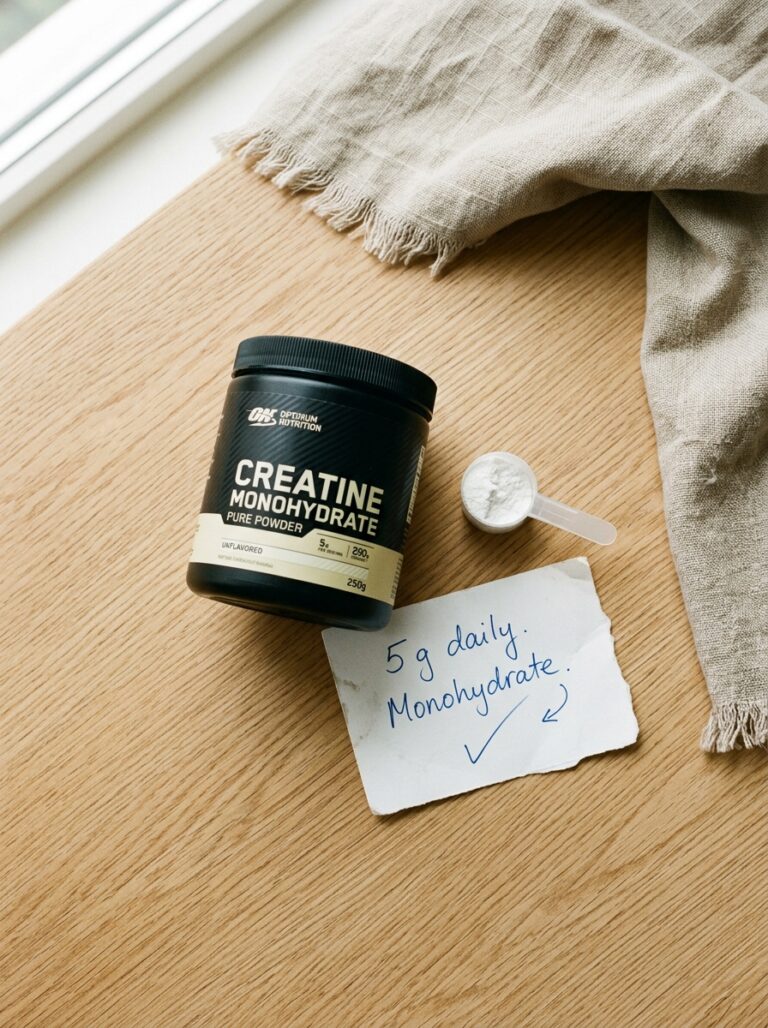
Creatine is the rare supplement where the marketing has outrun the evidence in one direction only: every new "advanced" version on the shelf is trying to improve on a cheap white powder that already works.
The form your grandmother could have bought twenty years ago is still the one with the deepest research behind it, and most of what's sold around it is packaging. This guide sorts the dose and the form that the trials actually support from the upsells layered on top, so you can buy one tub and stop reading labels.
Before you decide
Creatine is one of the most-studied supplements in sports nutrition and is well tolerated in healthy adults, but a few people should clear it with a clinician first. If you have chronic kidney disease, reduced kidney function, or a single kidney, talk to your doctor before starting, because creatine raises serum creatinine slightly as a normal byproduct, and that can complicate how your kidney labs are read even when nothing is wrong.
The same caution applies if you are pregnant or breastfeeding, where safety data are limited, or if you take medications that affect the kidneys. None of this means creatine is dangerous for the general public; it means high-risk individuals should involve a physician rather than start solo.
If none of that applies, the next question is honest about what you want from it. "General health" is a fair reason to consider creatine, but it sets a low bar that's easy to confuse with hype. A specific goal helps: building or preserving muscle and strength alongside resistance training, supporting muscle as you age, covering a thin dietary supply if you eat little or no meat, or the more tentative cognitive angle in older adults.
Each points to the same product but a different expectation. You can see how I weigh evidence and conflicts of interest on the how we review supplements page, and if your real concern is fatigue or weakness rather than training, ask your doctor whether a blood test for iron, B12, or thyroid is the better first step before you assume creatine is the answer.
What creatine actually is

Creatine is a compound your body already makes and stores, mostly in skeletal muscle. Your liver and kidneys synthesize roughly a gram a day from three amino acids, and you take in a bit more from food, primarily red meat and fish.
Together that covers your baseline turnover, which is why creatine is not a "deficiency" nutrient for most omnivores the way iron or B12 can be. It's a substrate you can top up, not a vitamin you can run short of in the classic sense.
The catch is that dietary intake is modest and dependent on what you eat. According to the NIH Office of Dietary Supplements, the typical mixed diet supplies on the order of 1 to 2 grams of creatine a day, almost entirely from meat and fish, and your muscles are not fully saturated at that intake. A supplement closes that gap deliberately: it pushes muscle creatine stores toward their ceiling, which is the whole point of taking it.
As a dietitian I'd frame it the way I frame most supplements, which is that food sources cover the baseline for people who eat broadly, and the supplement earns its place by topping the tank past what diet alone reaches, or by replacing a supply that a meat-light diet doesn't provide.
This is also where creatine gets confused with creatinine, which sounds nearly identical. Creatinine is the waste product your body clears through the kidneys, and a higher creatine intake nudges it up a little. That's a lab-reading nuance, covered below, not a sign of harm.
Why creatine works
The mechanism is genuinely simple, which is part of why the evidence is so consistent. Your cells run on ATP, the molecule that releases energy when one of its phosphate groups breaks off.
During short, hard efforts, a heavy set, a sprint, a jump, your muscles burn through their small ATP store in seconds. To keep going, they need to regenerate ATP fast, and the fastest on-site system uses phosphocreatine: stored creatine donates its phosphate to rebuild ATP almost instantly.
That phosphocreatine reservoir is the limiting factor in repeated bursts of high-intensity work. Supplementing creatine raises how much phosphocreatine your muscles can hold, which lets you regenerate ATP a little faster and a little longer before fatigue sets in. The NIH Office of Dietary Supplements describes exactly this pathway, noting that most supplemental creatine goes to skeletal muscle and is converted to phosphocreatine to help regenerate ATP during exercise.
In practice that shows up as a few extra reps, slightly better sprint repeatability, or more total work in a session, which over weeks of training compounds into measurable gains in strength and lean mass. The brain runs on the same ATP economy, which is the thread that connects the muscle story to the cognitive one later in this guide.
Who actually benefits

The clearest beneficiaries are people doing high-intensity or resistance training. The International Society of Sports Nutrition's position stand calls creatine monohydrate the most effective nutritional supplement available for increasing high-intensity exercise capacity and lean body mass during training, and concludes the benefit holds across a range of populations. If you lift, sprint, or play a sport with repeated explosive efforts, this is the population the evidence was built on.
Women benefit too, though the data are thinner and the picture is more nuanced. A 2025 systematic review of creatine in active females found the performance evidence inconclusive overall, with most studies showing no clear improvement over placebo, while noting that sex-based differences in creatine metabolism, including lower baseline muscle stores and lower dietary intake, leave room for benefit that the small body of female-specific research can't yet confirm cleanly.
My read as a dietitian is that this is an evidence-gap problem, not a "doesn't work in women" finding, and I treat creatine for women as reasonable with realistic expectations while being clear that the female-specific trial base is thinner than the broader mixed-population record.
Older adults are the group I find most compelling outside athletics. Combined with resistance training, creatine supports the muscle and strength that decline with age, and the ISSN position stand explicitly extends its safety conclusions to the elderly.
Vegetarians and vegans are a distinct case: because dietary creatine comes almost entirely from meat and fish, people who eat little or none start with lower muscle stores and tend to show a larger response to supplementation, which is one of the few situations where the supplement is closing a real intake gap rather than topping an already-full tank.
And then there's the brain. A meta-analysis of randomized trials found creatine modestly improved memory in healthy people, with a notably stronger effect in older adults aged 66 to 76 than in younger participants. That's a real but modest signal, not a nootropic miracle, and I keep the careful version in creatine for cognition and aging.
Forms of creatine compared
This is where the money gets wasted. The supplement industry sells creatine in several forms positioned as upgrades, faster absorption, better solubility, fewer side effects, smaller doses, but a critical review of the bioavailability, efficacy, and safety of creatine forms reached a blunt conclusion: creatine monohydrate is the only source with substantial evidence behind it, and there is little to no evidence that newer forms are more stable, absorbed faster, more effective at raising muscle creatine, or gentler on the stomach.
The table below lays out the common forms and what the evidence actually says about each.
| Form | Marketing claim | What the evidence says | Verdict |
|---|---|---|---|
| Creatine monohydrate | The standard, “basic” | Only form with strong evidence for absorption, effect, and safety; near-complete uptake | Buy this |
| Creatine HCl (hydrochloride) | More soluble, smaller dose, less bloating | More soluble in water, but no good evidence it raises muscle creatine better or reduces side effects | Skip the premium |
| Buffered creatine (e.g. Kre-Alkalyn) | Higher pH protects creatine from stomach acid | Not shown superior to monohydrate; monohydrate already survives digestion well | Skip the premium |
| Creatine ethyl ester | Better absorption, more “bioavailable” | Degrades to creatinine more readily; studied as no better and possibly worse than monohydrate | Avoid |
| Liquid / “serum” creatine | Pre-dissolved, convenient | Creatine is unstable in solution over time; limited evidence of efficacy | Avoid |
The practical takeaway is unromantic: the cheapest, plainest tub on the shelf is the one the science supports. If you want a third-party tested seal for purity, that's worth paying for; a fancy form name is not. I compare the three most-hyped alternatives side by side in creatine monohydrate vs HCl vs buffered.
How to take creatine
The default is 3 to 5 grams of creatine monohydrate once a day, every day. The "every day" matters more than the exact gram count or the time on the clock, because the benefit comes from keeping your muscles saturated, not from a pre-workout jolt.
There's a difference between the dose that fills the tank and the dose that just stacks up and gets excreted, and for creatine that ceiling is reached at modest intakes; going much above 5 grams a day for maintenance mostly ends up in your urine.
The loading question is the one people overthink. A classic study of muscle creatine loading showed that 20 grams a day for about six days saturates muscle quickly, but that taking a lower dose of roughly 3 grams a day reaches the same muscle creatine level over time, just more gradually. In plain terms: loading buys you speed, not a higher ceiling.
If you want the effect within a week, split about 20 grams across four daily doses for five to seven days, then drop to a 3-to-5-gram maintenance dose. If you don't mind waiting three to four weeks to feel it, skip loading entirely and just take 5 grams a day from the start. Many people find the no-load route gentler on the stomach.
Timing is a low-stakes detail. Some evidence leans slightly toward taking creatine near your workout, and taking it with a meal that includes carbohydrate or protein may modestly help uptake, but the differences are small and consistency dwarfs them. Pick a time you'll remember, pair it with an existing habit, and don't lose sleep over pre- versus post-workout. I lay out the loading-versus-not math and the timing evidence in more detail in creatine timing and loading.
Side effects and myths
Creatine carries a reputation heavier than its actual risk profile. The ISSN position stand concluded that short- and long-term supplementation, up to 30 grams a day for five years, is safe and well tolerated in healthy people across a wide age range, and found no compelling evidence of harm to the kidneys or liver at recommended doses in healthy individuals. At a sensible 3-to-5-gram dose, the safety margin is large.
The kidney myth is the most persistent and the most misunderstood. Creatine raises serum creatinine slightly because creatinine is its breakdown product, and creatinine is one of the markers labs use to estimate kidney function. So a routine blood test can show a small bump that looks like reduced kidney function but is really just more creatine in the system.
In a healthy person this is a measurement artifact, not damage; the practical fix is to tell your doctor you take creatine so the result is read in context. If you have existing kidney disease, this is exactly why you clear creatine with a clinician first.
The water-weight point is real but benign. Creatine draws water into muscle cells, so a few pounds of scale weight in the first weeks is normal and is intramuscular water, not fat and not bloat in the unhealthy sense. The hair-loss fear traces to a single small study suggesting a rise in a hormone linked to hair loss, a finding that has not been replicated and that the broader evidence does not support as a real effect.
None of this is a cure claim, and creatine treats nothing: it's a training and aging-support supplement that works within, not instead of, standard medical care. If you develop genuine symptoms, see your doctor rather than reaching for a powder.
FAQ
How much creatine should I take per day?
For most healthy adults, 3 to 5 grams of creatine monohydrate daily, taken consistently, is the evidence-backed maintenance dose. A short higher-dose loading phase is optional and only speeds up when you reach saturation, not how high it goes.
Do I need to do a loading phase?
No. Loading reaches muscle saturation in about a week, while a steady 3-to-5-gram daily dose gets to the same level in three to four weeks. Skipping the load is simpler and often gentler on the stomach.
Is creatine bad for your kidneys?
In healthy adults, the evidence does not show kidney harm at recommended doses. It does slightly raise serum creatinine, a normal byproduct that can be misread on lab tests, so tell your doctor you take it. If you have kidney disease, clear it with a clinician first.
Is an "advanced" form like HCl or buffered creatine worth the extra cost?
Generally no. A critical review found creatine monohydrate is the only form with strong evidence, and the newer forms haven't proven better absorption, effect, or tolerability. The plain monohydrate is the value buy.
Will creatine make me gain weight?
You may see a few pounds early on, which is water drawn into muscle, not fat. It's a normal, harmless effect of muscle saturation and is not the same as bloating from poor digestion.
The bottom line on creatine
Creatine is one of the few supplements where the simplest, cheapest option is also the best-supported one. The evidence-backed default is plain creatine monohydrate at about 5 grams a day, taken consistently, with a loading phase you can use if you're impatient and skip if you're not. The "advanced" forms lining the shelf, HCl, buffered, ethyl ester, liquid, are priced as upgrades the trials don't support, so paying for them buys mostly packaging.
The people with the most to gain are those doing high-intensity or resistance training, older adults pairing it with strength work, and those eating little meat who start with lower stores, with a modest, mostly-in-older-adults cognitive signal on top. It's well tolerated in healthy people, the kidney scare is largely a lab-reading misunderstanding, and the water weight is just water.
If you have kidney disease, are pregnant, or take medications that affect the kidneys, talk to your doctor first; otherwise, buy one third-party-tested tub of monohydrate, take 5 grams a day, and ignore the rest of the aisle.
Reviewed by Sarah Thompson, Registered Dietitian, focused on vitamin and mineral nutrition. See more from Sarah Thompson. This article is educational and is not a substitute for individualized medical advice; talk to your doctor before starting a supplement, especially if you have kidney disease, are pregnant, or are managing a diagnosed condition.
