
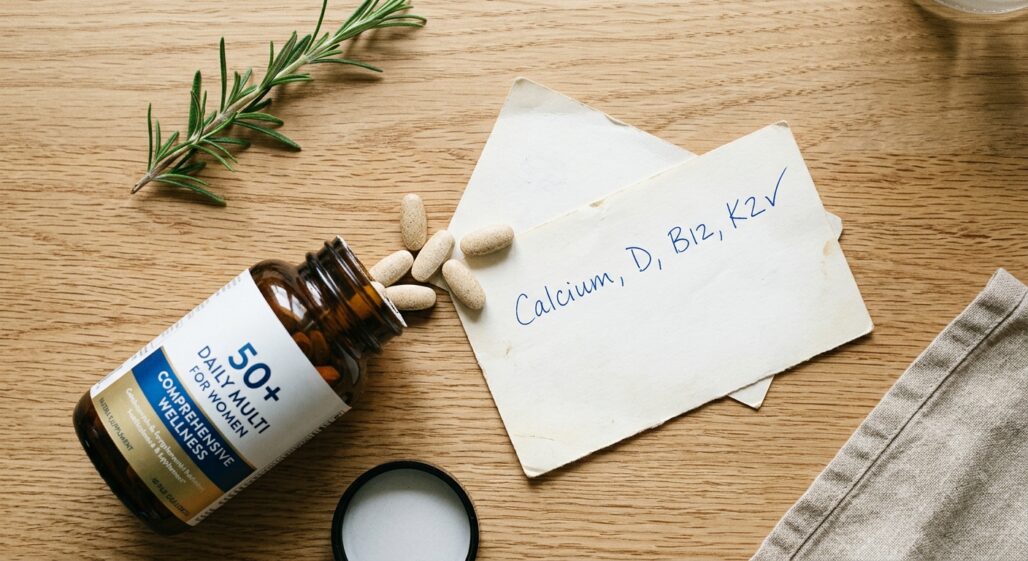
Pick up almost any bottle labeled "Women's 50+" and you'll find the same multivitamin that's sold to a 35-year-old, with the dose nudged and the marketing changed. That's the problem. Menopause flips the nutritional math, and a formula that ignores the flip is solving last decade's problem.
The picks at the bottom of this page are the iron-free, bone-forward formulas I'd actually keep in my own family's cabinet for a woman past menopause. But first, here's what the guidelines and trials say should drive that choice.
Affiliate disclosure: this article contains affiliate links. As an Amazon Associate, UsefulVitamins.com earns from qualifying purchases at no extra cost to you.
Before you decide

A multivitamin is a floor, not a treatment. If you've been diagnosed with osteoporosis, anemia, B12 deficiency, or thyroid disease, that's managed by your clinician with targeted doses and monitoring — a daily multi is a baseline, not the plan.
If you have a known kidney stone history, kidney disease, or take a thiazide diuretic, talk to your doctor before adding calcium, because your tolerance for supplemental calcium is lower than the general guidance suggests.
The honest starting point is that most of these nutrients should come from food first, and a multivitamin earns its place by covering the gaps a real diet leaves. You can see how I weigh evidence and conflicts of interest on the how we review supplements page, and the broader category in the complete guide to multivitamins.
What changes after menopause
Three things shift at menopause, and a good 50+ formula reflects all three.
First, iron need collapses. Monthly menstrual loss disappears, so the body's iron demand drops sharply. The NIH Office of Dietary Supplements puts the iron RDA at 18 mg/day for women 19-50 but only 8 mg/day from age 51 — less than half — and notes most U.S. women already meet that from diet alone.
That matters because excess iron isn't excreted efficiently; it accumulates. For a postmenopausal woman without diagnosed deficiency, an iron-containing multivitamin adds a nutrient she doesn't need and can't easily clear. The body has no active route to dump surplus iron — it can only down-regulate absorption — so once menstrual losses stop, a daily iron tablet is pushing against a closed exit.
There's a practical side effect too. Supplemental iron is a common cause of constipation and stomach upset, and it competes for absorption with other minerals in the same pill. So an iron-free 50+ formula isn't just avoiding a theoretical risk; for many women it's also a more comfortable tablet. The one genuine exception is a documented deficiency — anemia, heavy bleeding from a fibroid or a GI source — and that's a diagnosis with a blood test behind it and a targeted dose from your doctor, not a reason to default to an iron-containing multi.
Second, bone loss accelerates. The estrogen drop at menopause speeds up bone turnover, which is why the 2021 North American Menopause Society position statement makes adequate calcium and vitamin D the nonpharmacologic foundation of bone care, recommending 1,200 mg/day of calcium (diet first) for women over 50.
Third, B12 absorption gets less reliable. With age the stomach makes less acid, which loosens the protein-bound B12 in food. The NIH ODS estimates 10-30% of older adults malabsorb food-bound B12 and advises getting it from supplements or fortified foods, because the crystalline B12 in a pill is absorbed normally even when food B12 isn't.
The chain of events is worth understanding, because it changes what "eating enough B12" means after 50. Food B12 arrives bound to protein, and it takes stomach acid plus the enzyme pepsin to cut it loose before it can attach to intrinsic factor and be absorbed. Atrophic gastritis — low stomach acid, increasingly common with age — quietly breaks that first step, so a woman can eat plenty of B12-rich meat, eggs, and dairy and still absorb too little of it. The crystalline B12 in supplements and fortified cereals skips the acid step entirely, which is exactly why it keeps working when food B12 stalls.
This is also why two common situations stack the odds further. A long-term proton-pump inhibitor or H2 blocker for reflux suppresses the same acid, and metformin interferes with B12 absorption downstream — so a 50+ woman on either of those has more reason, not less, to make sure her B12 comes from a supplement or fortified food rather than meat alone. Deficiency can show up as fatigue, tingling in the hands or feet, or memory fog, and because those creep in slowly they're easy to write off as "just getting older." A blood level settles it.
What the evidence shows
The bone nutrients are where the formula earns its keep, but the evidence is more nuanced than the label suggests.
Calcium and vitamin D are the established base. NAMS treats them as the floor every other bone intervention sits on. The catch is that supplements work best as gap-fillers, not megadoses — the NIH ODS calcium sheet sets the RDA at 1,200 mg total per day and the tolerable upper limit at 2,000 mg, so a multi delivering 200-300 mg of calcium complements dietary intake rather than trying to supply the whole 1,200 mg in one tablet.
Vitamin D is the nutrient most worth confirming. The RDA is 800 IU/day for women over 70 and 600 IU under 70, and many older women run low. This is the single nutrient where a blood level and your doctor's input beat guessing from a label.
The reason D and calcium are paired is mechanical, not marketing. You can eat all the calcium you want, but without enough vitamin D the gut absorbs only a fraction of it — D is what lets the intestine pull calcium across into the bloodstream, where parathyroid hormone and bone can use it. A 50+ formula that loads calcium but skimps on D is filling a bucket with a hole in it.
And the pairing has outcome data behind it, not just a mechanism. A 2015 National Osteoporosis Foundation meta-analysis pooling eight randomized trials and nearly 31,000 middle-aged-to-older adults found calcium plus vitamin D cut total fractures by about 15% and hip fractures by about 30% (hip fracture summary relative risk 0.70, 95% CI 0.56-0.87). That is the strongest bone-outcome evidence in this whole category, and it's why the two nutrients — not K2, not anything trendier — are the load-bearing part of the formula.
Vitamin K2 is promising but not proven for bone density. It's the trendy addition to 50+ formulas, and the theory is sound — K2 activates osteocalcin, the protein that binds calcium into bone. But a 3-year randomized trial of 375 mcg MK-7 in 142 postmenopausal women with osteopenia found that adding K2 to vitamin D and calcium did not improve bone density over D and calcium alone, even though it did improve the osteocalcin marker. An earlier trial in women over 60 found a modest BMD benefit, so the literature is genuinely mixed.
A 2020 meta-analysis in Food & Function pooling eight randomized trials sits in the middle of this: it found vitamin K plus vitamin D produced a small but statistically significant gain in total bone mineral density (pooled effect size 0.316, 95% CI 0.031-0.601), alongside a clear drop in undercarboxylated osteocalcin. So at the pooled level there's a signal — but it's modest, the confidence interval nearly touches zero, and it's a density surrogate, not a fracture count. That's a meaningfully weaker grade of evidence than the calcium-plus-D fracture data.
The fair reading: K2 is a reasonable, low-risk addition, but it's not the reason a multivitamin works — and you shouldn't pay a premium for it as if it were proven. The undercarboxylated-osteocalcin number always improves; whether that translates into fewer broken bones is exactly the question the trials haven't settled. If a formula includes a sensible K2 dose at no real cost premium, take it. Don't let it be the deciding feature.
The calcium-and-heart question, handled honestly

You may have seen headlines that calcium supplements raise heart risk. The signal is real but narrow, and it deserves an even-handed read rather than a scare.
A 2021 meta-analysis of 13 placebo-controlled trials found supplemental calcium associated with about a 15% higher relative risk of cardiovascular disease in healthy postmenopausal women (RR 1.15, 95% CI 1.06-1.25). Other large cohorts, including population studies, have found no such association, so the evidence is contested rather than settled.
The most useful detail in that literature is where the risk shows up. The signal sits with supplemental calcium — a bolus dose swallowed in one or two tablets — not with calcium eaten in food. Dietary calcium spread across meals comes packaged with the rest of a meal, is absorbed more gradually, and doesn't produce the same sharp serum spike a large supplement does, and the proposed mechanism for any cardiovascular harm runs through that spike. The food-versus-pill distinction isn't hand-waving; it's the core of the debate.
Observational data leans the same direction. A 2024 study in Nutrients of postmenopausal Korean women found that higher dietary calcium intake was not associated with cardiovascular harm — and in women more than ten years past menopause, intake above 800 mg/day from food tracked with lower cardiovascular risk, not higher. Cohorts and trials disagreeing like this is the usual fingerprint of a real food-versus-supplement difference rather than a uniform calcium effect.
What this does not mean is that calcium is dangerous. The practical takeaway most guidelines land on is "food first": get calcium from diet where you can, and use supplements to fill a measured gap rather than to layer 1,000+ mg on top of an already-adequate diet.
That's exactly why a sensible 50+ multi carries a modest calcium dose, not a megadose — and why you should talk to your clinician if you're stacking a separate calcium pill on top. I cover dose, forms, and food sources in the complete guide to calcium.
What to look for when buying
Most of the decision comes down to five label checks. Use the table as a quick screen.
| Label feature | What you want after 50 | Why it matters |
|---|---|---|
| Iron | Iron-free (0 mg) unless deficiency is diagnosed | RDA drops to 8 mg at 51; excess accumulates and isn’t easily cleared |
| Vitamin D | At least 800 IU (20 mcg) | The nutrient most older women run low on; underpins calcium absorption |
| Vitamin B12 | Present in crystalline form, well above 2.4 mcg RDA | Food-bound B12 absorption falls with age; pill B12 is absorbed normally |
| Calcium | Modest (200-300 mg), not megadosed | Meant to complement a food-first 1,200 mg target, not replace it |
| Third-party testing | USP, NSF, or equivalent verified seal | Independent check on identity, dose, and contaminants |
The one-line screen: iron-free, real vitamin D and B12, calcium that complements rather than replaces your diet, and a third-party seal. A formula that megadoses calcium or still includes a full iron load is solving the wrong decade's problem.
Recommended Products

As an Amazon Associate, UsefulVitamins.com earns from qualifying purchases at no extra cost to you. We only recommend products supported by published research or third-party testing.
FAQ
Do women over 50 need iron in a multivitamin?
Usually not. Once periods stop, the iron RDA falls to 8 mg/day and most diets already cover it. Unless a blood test shows iron deficiency, an iron-free 50+ formula is the safer default — ask your doctor before taking supplemental iron after menopause.
How much calcium should a 50+ multivitamin contain?
A modest amount, around 200-300 mg. NAMS targets 1,200 mg total per day with diet first, so the multivitamin is meant to top up the gap, not deliver the whole requirement. Pairing it with dietary calcium and adequate vitamin D matters more than the number on any single pill.
Is vitamin K2 worth paying extra for?
It's a reasonable, low-risk addition, but the bone-density evidence is mixed — a 3-year MK-7 trial found no BMD benefit beyond vitamin D and calcium, while an earlier trial found a modest one. Don't pay a premium for K2 as if it were the proven active ingredient.
Why do older adults need more B12 from supplements?
Because aging reduces stomach acid, which the body needs to release B12 from food. The crystalline B12 in supplements and fortified foods doesn't depend on that step, so the NIH advises older adults get B12 from those sources. Persistent fatigue or numbness warrants a B12 blood test, not just a multivitamin.
Can a multivitamin replace a calcium or vitamin D pill?
Often, yes, for the average diet — but not always. If you eat little dairy or get little sun, your doctor may want a separate vitamin D dose based on a blood level. A multivitamin is a floor, not a substitute for individualized dosing in someone with osteoporosis or deficiency.
Is dietary calcium safer for the heart than a calcium supplement?
The evidence leans that way. The cardiovascular signal in the trials sits with supplemental calcium, not calcium eaten in food, and at least one cohort found higher dietary calcium tracked with lower heart risk in women well past menopause. The proposed mechanism runs through the serum spike a large pill produces, which a meal spread across the day doesn't. That's the whole reason a sensible 50+ multi carries a modest dose and leans on food for the rest.
Does taking a PPI or metformin change what B12 I need?
Yes — both make the case for supplemental B12 stronger. Acid-suppressing reflux drugs (PPIs and H2 blockers) blunt the stomach acid needed to free B12 from food, and metformin interferes with B12 absorption further along. If you take either long-term, getting B12 from a supplement or fortified food rather than meat alone matters more, and it's worth asking your doctor about a periodic B12 level.
Is it better to take a 50+ multivitamin with a meal?
Generally yes. Vitamin D and the carotenoids are fat-soluble, so a little dietary fat improves their absorption, and taking the tablet with food also softens the stomach upset some formulas cause. Splitting the dose isn't necessary for a standard multi — the more important habit is simply taking it consistently, since a daily floor only works if it's actually daily.
The bottom line on women's 50+ multivitamins
The right multivitamin after menopause isn't a brand — it's a formula that reflects the change menopause actually made. Iron need fell, bone protection and B12 reliability rose, and the label should follow that shift.
So the screen is simple: iron-free, real vitamin D and B12, a modest food-complementing calcium dose, optional K2 you don't overpay for, and a third-party seal. A generic "Women's 50+" tablet that still over-irons or megadoses calcium is solving the wrong problem.
And remember the order of operations: a multivitamin is the floor, food is the base, and anything beyond that — a calcium target, a vitamin D dose, a bone-density scan — is a conversation with your clinician, not a label you read at the pharmacy.
Reviewed by Michael Ward, MD MPH, Preventive Medicine, focused on guideline-based chronic disease management. See more from Michael Ward. This article is educational and is not a substitute for individualized medical advice; talk to your doctor before starting or changing a supplement, especially if you have osteoporosis, kidney disease, or a diagnosed deficiency.
