
Calcium is the mineral people reach for the moment they hear the word "bones," and it's also the one most likely to be over-supplemented out of vague worry rather than a measured gap. The number that matters isn't on the front of any bottle; it's the difference between what your diet already delivers and what your age and sex actually require.
This guide works through that math first, then the part of the calcium story that genuinely deserves caution: who benefits from a supplement, who should be careful, and what the cardiovascular debate does and doesn't say.
Before you decide

Calcium is one of the few supplements where more is not just useless but potentially counterproductive, so the first step is to estimate what you already eat. If you have a glass of milk, a serving of yogurt, fortified cereal, or a few servings of leafy greens on a typical day, you may be closer to the RDA than you think, and the supplemental dose that helps is only the part your diet misses.
A registered dietitian or a quick food-recall exercise can put a real number on it. There's a difference between the dose that closes a genuine gap and the dose that just stacks up in your kidneys.
A few people should be especially deliberate. If you have a history of kidney stones, hyperparathyroidism, sarcoidosis, or any condition that raises blood or urine calcium, talk to your physician before adding a supplement, because for you the calculation is different. The same goes if you take thiazide diuretics, digoxin, thyroid medication, or certain antibiotics, all of which interact with calcium timing.
And if your real concern is bone density, the smarter move is to ask your doctor about a bone scan and a vitamin D blood test before assuming calcium is the missing piece, since vitamin D status changes how much calcium you absorb in the first place. You can see how I weigh evidence and conflicts of interest on the how we review supplements page.
What calcium actually is (and its role in bone)
Calcium is the most abundant mineral in the body, and about 99% of it sits in your skeleton and teeth as the mineral hydroxyapatite, the crystalline matrix that gives bone its hardness. The remaining 1% circulates in blood and soft tissue, where it runs muscle contraction, nerve signaling, blood clotting, and hormone secretion.
That 1% is non-negotiable: your body keeps blood calcium in a narrow range no matter what, and if your diet falls short, it will pull calcium out of bone to maintain it.
That last point reframes how bone calcium works. Your skeleton is not a static bank vault; it's an active reserve constantly being deposited and withdrawn. When dietary calcium is adequate and the hormonal signals are right, deposition keeps pace. When intake is chronically low, the withdrawals outrun the deposits and bone density gradually declines.
This is why calcium gets its bone reputation, and also why a single high-dose pill can't undo years of an inadequate pattern. Bone responds to steady, adequate supply, not to spikes.
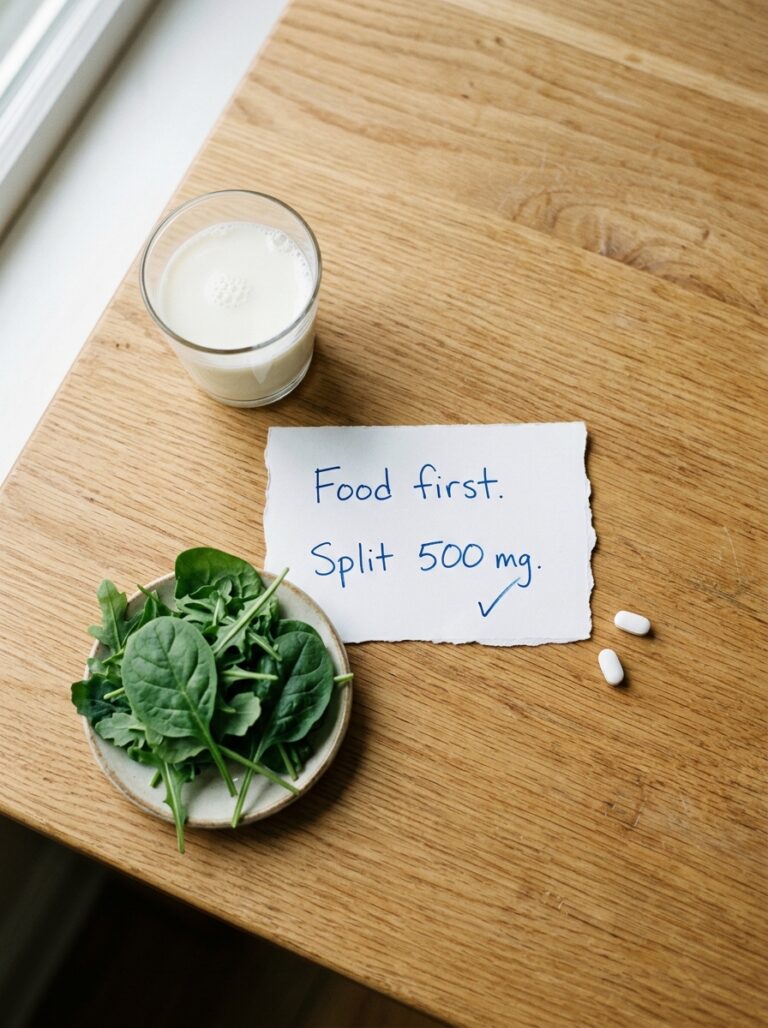
Absorption is the other half of the story. According to the NIH Office of Dietary Supplements, the body absorbs roughly 36% of a 300 mg calcium load but only about 28% of a 1,000 mg one, because the percentage absorbed falls as the dose climbs. That single fact, that efficiency drops with size, is the reason every credible source recommends splitting calcium rather than taking it all at once, and it's the verdict on this guide's card for a reason.
Why calcium matters (bone and beyond)
The clearest role is structural. Adequate lifelong calcium intake supports peak bone mass in early adulthood and slows the rate of loss later, particularly after menopause when estrogen's protective effect on bone fades. Calcium is a necessary input for bone health, though it's worth being precise: it's necessary, not sufficient.
Bone also depends on vitamin D for absorption, on protein and vitamin K for matrix and regulation, and on weight-bearing activity for the mechanical signal to build. A supplement that ignores those other inputs is solving one variable in a multi-variable equation.
Beyond the skeleton, that circulating 1% does quiet, constant work. Calcium ions trigger the release of neurotransmitters at nerve endings, drive the contraction of skeletal and cardiac muscle, and form part of the clotting cascade. You don't feel any of this when intake is adequate because your body defends blood calcium so tightly.
You'd only notice severe deficiency through neuromuscular signs like muscle cramps or tingling, and by then the issue is usually medical rather than dietary. For most people in a developed-country diet, the practical question is never "do I have enough for my heartbeat," it's "do I have enough, over decades, to protect bone." That long horizon is exactly why steady dietary intake beats episodic supplementation.
Food sources and the RDA

The RDA for calcium is 1,000 mg per day for most adults aged 19 to 50, rising to 1,200 mg for women over 50 and everyone over 70, with 1,300 mg recommended for teenagers because of rapid bone growth, according to the Institute of Medicine's Dietary Reference Intakes for calcium. Pregnancy and lactation do not raise the requirement above the age-appropriate RDA for adults, which surprises people.
The Daily Value used on supplement labels is 1,300 mg, so a "100% DV" product is actually slightly above what most adults need.
Food covers this requirement more easily than the supplement aisle suggests. Dairy is the densest common source, but it's far from the only one, and several non-dairy foods carry calcium that absorbs well. The table groups everyday options so you can estimate your own intake before deciding whether a pill is even necessary.
| Food | Typical serving | Calcium (approx.) | Note |
|---|---|---|---|
| Plain yogurt | 1 cup | 300 to 450 mg | Well absorbed; also delivers protein |
| Milk or fortified soy milk | 1 cup | 300 mg | Fortified plant milks match dairy closely |
| Canned sardines or salmon with bones | 3 oz | 180 to 325 mg | Bones are the calcium source; eat them |
| Tofu set with calcium sulfate | half cup | 250 to 430 mg | Varies by brand; check the label |
| Kale, bok choy, broccoli | 1 cup cooked | 90 to 180 mg | Low-oxalate greens absorb well |
| Spinach | 1 cup cooked | 240 mg listed | High oxalate; little is actually absorbed |
Notice the spinach line. The number on a nutrition label is the calcium present, not the calcium you absorb, and spinach is the classic trap: its oxalate binds most of that calcium so it passes through. Low-oxalate greens like kale and bok choy are the opposite, with absorption rates that rival dairy.
The practical takeaway for a dietitian is that two or three good servings of dairy or fortified alternatives plus some low-oxalate greens often gets a person most of the way to the RDA, leaving only a modest gap for a supplement to fill, if any.
Who needs to supplement (and who should be cautious — CVD signal)
Supplements earn their place when the diet doesn't cover the requirement. The clearest candidates are people who avoid dairy without replacing it (lactose intolerance, dairy allergy, or a plant-based diet that skips fortified products), postmenopausal women whose requirement has risen to 1,200 mg, and people on long-term corticosteroids or with malabsorptive conditions.
For these groups a supplement closes a real gap, and the dose should be sized to the gap, not to the bottle. If your dietary intake of calcium is already at or above the RDA, more isn't better.
This is also where the cardiovascular question belongs, because it changed the calculus for casual supplementers. In 2010 a widely cited BMJ meta-analysis by Bolland and colleagues reported that calcium supplements (without co-administered vitamin D) were associated with roughly a 30% increase in myocardial infarction risk, translating in their model to a small number of additional cardiac events per 1,000 people treated over five years. The finding was controversial and never settled into consensus, but it reframed supplements as something to use for a reason rather than by default.
The counterweight matters just as much. A 2016 evidence review and the accompanying clinical guideline from the National Osteoporosis Foundation and the American Society for Preventive Cardiology concluded that, for generally healthy adults, calcium intake from food and supplements within the recommended range and below the tolerable upper limit is not meaningfully linked to cardiovascular disease.
The honest synthesis is this: dietary calcium has never carried the same signal, the supplement signal is modest and disputed, and the safest reading is to meet your target through food where you can and keep any supplement within the gap rather than piling on excess. That is a caution about overshooting, not a cure or harm claim, and it belongs in a conversation with your doctor if you have existing heart disease.
Forms of calcium compared (citrate vs carbonate vs others)
The two forms you'll see most are calcium carbonate and calcium citrate, and the choice between them is more practical than the marketing implies. Carbonate is the most concentrated (about 40% elemental calcium by weight) and the cheapest, which is why it dominates the shelf, but it needs stomach acid to dissolve, so it should be taken with food.
Citrate is less concentrated (about 21%) and costs more, but it absorbs with or without food and doesn't depend on gastric acid, which absorption research suggests makes it the better choice for anyone on acid-reducing medication or with low stomach acid. Other forms exist mostly for niche reasons.
| Form | Elemental calcium | Best for | Watch-out |
|---|---|---|---|
| Calcium carbonate | ~40% | Most people; cheapest per mg; take with food | Needs stomach acid; can cause gas or bloating |
| Calcium citrate | ~21% | Low stomach acid, PPI/antacid users, older adults | More pills for the same dose; costs more |
| Calcium citrate malate | low | Fortified juices and drinks; absorbs well | Mostly a fortification ingredient, not standalone pills |
| Coral or algae-derived | varies | Those wanting a “whole food” source | Largely carbonate chemistry at a premium price |
| Calcium phosphate | ~38% | People who don’t tolerate carbonate’s gas | Adds phosphorus, rarely a concern in healthy adults |
The "elemental calcium" column is the one to read on any label, because a 1,250 mg calcium carbonate tablet provides about 500 mg of actual calcium, and that 500 mg is what counts toward your RDA.
The coral and algae products are worth a flag: they're marketed as natural alternatives but are chemically close to ordinary carbonate, usually at a higher price, which I unpack in coral vs algae vs rock calcium. If you want the deeper absorption science behind these comparisons, I keep a dedicated breakdown at calcium bioavailability forms compared.
How much to take (split dosing, with/without food, pairing with D3 and K2)
Start from your gap, not from a default pill. If you eat two servings of dairy and some greens, you might already be near 700 to 800 mg, leaving a gap of only 200 to 400 mg that a small supplement closes. Sizing the supplement to the gap is the whole game, because the tolerable upper intake level is 2,500 mg per day for adults up to 50 and 2,000 mg for those over 50, counting food plus supplements, and there's no benefit to approaching it.
Then split it. Because absorption is most efficient at 500 mg or less per dose, anyone needing more than that should divide it, for example one dose at breakfast and one at dinner. Carbonate goes with meals so stomach acid can dissolve it; citrate can go any time.
Pairing matters too: calcium absorption depends on adequate vitamin D, so if your vitamin D status is low, fixing that may do more for your calcium economy than adding more calcium, which is why I treat them together in the complete guide to vitamin D.
Some people also add vitamin K2 on the theory that it helps direct calcium toward bone rather than soft tissue, an idea I cover in the vitamin K2 complete guide and the practical pairing logic in calcium, D3 and K2 synergy. The evidence for K2 is still developing, so I'd frame it as reasonable rather than essential. If your goal is protecting bone over the long term, the broader strategy lives in my guide to supplements for osteoporosis prevention.
Side effects and interactions (kidney stones, cardiovascular debate, drug interactions)
The most common nuisances are gastrointestinal: carbonate in particular can cause gas, bloating, or constipation, which often eases by switching to citrate, splitting the dose, or taking it with food. Those are tolerability issues, not safety ones. The two safety topics worth real attention are kidney stones and the cardiovascular signal discussed above.
Kidney stones show one of the most counterintuitive findings in nutrition. Higher dietary calcium is associated with a lower risk of stones, because calcium in food binds oxalate in the gut and stops it reaching the kidney; a large prospective study in women found the highest dietary calcium intake carried about a 35% lower stone risk, while supplemental calcium was associated with roughly a 20% higher risk.
The Women's Health Initiative randomized trial reinforced this, finding a 17% increase in self-reported urinary tract stones among women taking calcium plus vitamin D. The likely explanation is timing: food calcium meets oxalate at a meal, while a between-meals supplement raises urinary calcium without that protective binding. The practical fix is to take supplements with food and to favor dietary sources, especially if you've ever had a stone.
On drug interactions, calcium can blunt the absorption of thyroid hormone, certain antibiotics (tetracyclines and fluoroquinolones), bisphosphonates, and iron, so separate these from your calcium dose by several hours. Thiazide diuretics can raise blood calcium, and very high doses with vitamin D can push it higher still.
None of this means calcium is dangerous at sensible doses; it means a supplement should be a deliberate, gap-sized addition cleared with your pharmacist if you take other medication. Calcium supports bone health within standard care, it doesn't replace medical treatment for osteoporosis or any other condition.
FAQ
Can I get enough calcium without supplements?
Many people can. Two to three servings of dairy or fortified alternatives plus some low-oxalate greens often reaches the RDA. A supplement makes sense mainly when diet falls short, your requirement has risen after menopause, or absorption is impaired.
Should I take calcium with or without food?
Carbonate with food, because it needs stomach acid to dissolve. Citrate can be taken either way. Taking any calcium with a meal also lowers the kidney-stone risk by letting it bind oxalate in the gut.
Why split the dose instead of taking it all at once?
Because the percentage your body absorbs drops as the single dose rises. Absorption is most efficient at 500 mg of elemental calcium or less, so larger needs are better divided across the day.
Do calcium supplements really cause heart problems?
The evidence is mixed and disputed. One influential meta-analysis flagged a modest increase in heart-attack risk with supplements, while a later expert guideline found no clear link within recommended intake limits. Dietary calcium has not shown the signal. Meeting your target through food and keeping supplements to the gap is the cautious path.
Is calcium citrate worth the higher price?
For most people with normal stomach acid, no, carbonate with food works and costs less. Citrate is worth it if you take acid-reducing drugs, have low stomach acid, or are an older adult, since it doesn't depend on gastric acid.
The bottom line on calcium
Calcium is a requirement, not a free upgrade, and the right amount is the amount your diet doesn't already provide. For most adults that target is 1,000 to 1,200 mg a day, and food, dairy, fortified plant milks, canned fish with bones, and low-oxalate greens, often supplies most of it.
When a supplement is genuinely needed, size it to the gap, split anything over 500 mg, take carbonate with food or citrate any time, and make sure your vitamin D status is adequate so the calcium can be absorbed.
The cardiovascular and kidney-stone findings don't make calcium something to fear; they make it something to take deliberately rather than by reflex, with dietary sources first and supplements as the patch. If you're worried about your bones, the most useful next step isn't a bigger calcium pill, it's a conversation with your doctor about a bone scan and a vitamin D test.
Reviewed by Sarah Thompson, Registered Dietitian, focused on vitamin and mineral nutrition. See more from Sarah Thompson. This article is educational and is not a substitute for individualized medical advice; talk to your doctor before starting a supplement, especially if you have a history of kidney stones, heart disease, or are managing a diagnosed condition.
