
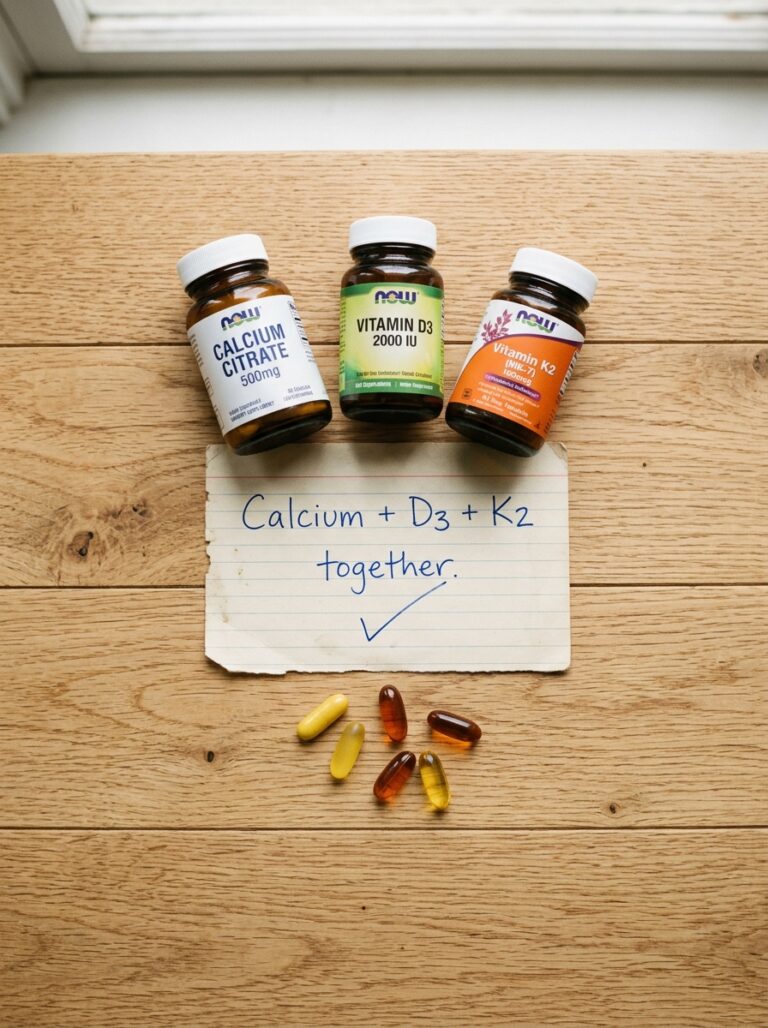
If you have shopped for a calcium supplement lately, you have probably seen the trio: calcium, vitamin D3, and vitamin K2, sold together with the promise that they "work better as a team." The pitch is partly real physiology and partly marketing, and the two are worth separating before you spend money on a combined bottle.
The short version is that D3 genuinely helps you absorb the calcium you take, the K2 story is more biologically plausible than it is proven, and which of the three you actually need depends on your diet and your blood work, not on the label. The three combined calcium, D3, and K2 products we land on at the bottom are the ones we would actually keep in our own family's cabinet, if you want to scroll straight to them.
Affiliate disclosure: this article contains affiliate links. As an Amazon Associate, UsefulVitamins.com earns from qualifying purchases at no extra cost to you.
Before you decide

A few people should not start a calcium-D3-K2 product on their own. If you take warfarin or another vitamin-K-antagonist blood thinner, vitamin K in any form directly opposes how that drug works, and adding K2 can destabilize your INR. That is a conversation to have with the prescribing physician before you touch a combined product, not after.
If you have a history of kidney stones, hypercalcemia, sarcoidosis, primary hyperparathyroidism, or chronic kidney disease, calcium and vitamin D both need clinician oversight rather than a self-prescribed trial, because the dosing math changes and excess can do harm. None of what follows is a treatment plan; it is how a dietitian thinks about whether you need each of the three at all.
If none of that applies, start with the honest question of whether you have a gap. Calcium is one of the few nutrients where the recommended intake is high enough that diet alone often falls short: the RDA sits at 1,000 mg/day for most adults and rises to 1,200 mg/day for women over 50 and everyone over 70, according to the NIH Office of Dietary Supplements calcium fact sheet.
If you eat dairy, fortified foods, canned fish with bones, and leafy greens daily, you may already be close. If you avoid dairy, your intake is likely well under target, and that is a real gap a supplement can close rather than overshoot.
Blood work changes the question for the other two: a vitamin D level (25-hydroxyvitamin D) tells you whether D3 is filling a deficiency or just stacking up. Ask your doctor about a vitamin D blood test before assuming you are low, because the dose that fixes a deficiency is different from the dose that does nothing useful. You can see how I weigh evidence and conflicts of interest on the how we review supplements page.
How the three actually relate

The reason these three get bundled is that they sit at three different points along the same pathway: getting calcium into the body, and then getting it into the right tissue.
Calcium is the building block. Your skeleton holds about 99% of the body's calcium, and the small amount in your blood is kept in a tight range because it runs nerves, muscle, and clotting.
When dietary calcium is low, your body tightens absorption and, if needed, pulls calcium out of bone to keep blood levels steady. That is why chronically low calcium intake is a bone problem before it is anything else.
Vitamin D3 is the gatekeeper for absorption. Once D3 is converted in the liver and then the kidney into its active hormone form (1,25-dihydroxyvitamin D), its principal job in calcium balance is to switch on active, transcellular calcium uptake in the small intestine, as the NIH vitamin D fact sheet describes. Without adequate D status, you absorb a smaller fraction of the calcium you eat, and the supplement underperforms.
This is the part of the trio with the clearest, least controversial mechanism: D3 is genuinely required to use calcium well, which is why fracture-prevention trials almost always pair the two and why standalone calcium without D draws the most cardiovascular scrutiny (more on that below). For the deeper dose-and-form discussion, see the complete guide to vitamin D.
Vitamin K2 is the proposed traffic director. K2 activates proteins that depend on it to function, including osteocalcin, which helps bind calcium into the bone matrix, and matrix Gla protein (MGP), which sits in artery walls and is one of the body's natural inhibitors of vascular calcification. The hypothesis, and it is a hypothesis, is that adequate K2 helps direct calcium into bone where you want it and keeps it out of arteries where you do not.
The biology is real; whether supplementing K2 changes hard outcomes in people who are not deficient is where the evidence gets thin. I cover the forms (MK-4 versus MK-7) and food sources in the vitamin K2 complete guide.
| Nutrient | Role in the trio | Strength of evidence | Food sources |
|---|---|---|---|
| Calcium | The mineral itself; the building block your skeleton stores and your body keeps tightly regulated in blood | Strong for bone when intake is below target; benefit is closing a gap, not megadosing | Dairy, fortified plant milks, canned fish with bones, tofu set with calcium, leafy greens |
| Vitamin D3 | Switches on active calcium absorption in the gut; without it you absorb a smaller share of what you eat | Strong and well established for absorption; the least controversial member of the trio | Sunlight on skin, fatty fish, egg yolk, fortified dairy and cereals |
| Vitamin K2 | Activates osteocalcin (binds calcium to bone) and matrix Gla protein (inhibits artery calcification) | Plausible mechanism; bone trials are mixed and the artery outcome trials are largely null so far | Natto, some aged cheeses, egg yolk, modest amounts in animal foods; little in a typical Western diet |
What the calcium-and-D3 evidence shows
The calcium-plus-D3 pairing is the part of this product that rests on the firmest ground, and it is also where a real safety nuance lives. A 2010 meta-analysis in the BMJ found that calcium supplements taken without vitamin D were associated with roughly a 27 to 31% higher risk of myocardial infarction, with a pooled relative risk around 1.27 for heart attack. That finding has been debated for years, the trials were not designed with heart attacks as their primary endpoint, and later analyses that included vitamin D did not consistently reproduce the signal.
But the practical takeaway has held up reasonably well: if you are going to supplement calcium, pairing it with vitamin D and not exceeding the amount you actually need is the sensible approach, and getting calcium from food carries none of this concern. This is one reason the standalone calcium pill has fallen out of favor and the combined product has risen.
It is worth being clear about what D3 does and does not do here. It improves how much calcium you absorb, which makes a given calcium dose more effective. It does not give you license to take more calcium. The goal is still to land near your RDA from food plus supplement combined, not to stack high doses of both. For the full picture on calcium dosing, forms like citrate versus carbonate, and timing, see the complete guide to calcium.
Where the K2 evidence actually stands

This is the section the marketing tends to skip. The K2 hypothesis is appealing and mechanistically coherent, but the human outcome data is genuinely mixed, and an honest read does not support treating K2 as the reason to buy the product.
On bone, the headline trial is encouraging. A three-year randomized, placebo-controlled study in 244 healthy postmenopausal women found that 180 micrograms per day of MK-7 (the long-acting K2 form) improved vitamin K status and slowed the age-related decline in bone mineral density at the spine and femoral neck, with a favorable effect on bone strength. That is a real, well-conducted result.
But a separate three-year randomized trial in postmenopausal women with osteopenia, using a higher 375 microgram MK-7 dose, found that bone density declined at all sites with no significant difference between MK-7 and placebo, even though the supplement clearly improved osteocalcin carboxylation. So one good trial says it helps and another good trial says it does not, which is exactly the kind of split that should make you cautious about strong claims.
On arteries, the most direct test was disappointing for the hypothesis. a 24-month randomized, double-blind trial gave 365 older men with established aortic valve calcification 720 micrograms of MK-7 plus vitamin D daily, and found no significant difference in calcification progression versus placebo. That does not disprove the underlying biology, the participants already had advanced calcification and the trial may have come too late in the process, but it is the best available randomized evidence on a hard imaging outcome, and it did not show benefit.
The fair summary: K2 reliably activates the relevant proteins, the bone evidence is promising but inconsistent, and the artery evidence in supplementation trials is so far null. K2 is a low-risk addition, and if a combined product includes a reasonable MK-7 dose at a price you would pay anyway, there is little downside for most people.
Just do not pay a large premium for it on the belief that it is proven to protect your arteries, because it is not yet.
How to choose a combined product
If you have decided a combined product fits your situation, a few things separate a sensible formula from a marketing one.
Match the calcium dose to your gap, not the maximum. A combined product often supplies 500 to 600 mg of calcium per serving, which is usually meant to top up dietary intake rather than replace it. If your diet already provides most of your RDA, you may want the lower end or a product you take once rather than twice a day. More is not better here; the target is your total daily intake near the RDA, food plus supplement combined.
Look for vitamin D3, not D2, at a real dose. D3 (cholecalciferol) is the form that raises and holds blood levels most reliably. A combined product carrying 1,000 to 2,000 IU of D3 is reasonable for general use, but if a blood test showed you are deficient, your doctor may direct a higher corrective dose separately rather than relying on the small amount bundled in a calcium pill.
For K2, MK-7 is the form used in the bone trials. The studies above used MK-7 specifically because it stays active in the body far longer than MK-4 and can be dosed once daily. A product listing MK-7 in the 90 to 180 microgram range mirrors the dose ranges studied. K2 is fat-soluble, so taking the product with a meal that contains some fat helps absorption.
Take it with food, and split if the dose is high. Calcium absorbs best in doses of 500 mg or less at a time, and the fat-soluble D3 and K2 both absorb better with a meal. If a product packs a large calcium dose into one serving, splitting it across the day is gentler and better absorbed.
One more dietitian's note: if you eat natto, leafy greens, and some dairy or fortified foods, you may be getting more of the K and calcium picture from food than the label assumes. Supplements earn their place when the diet does not cover the requirement, or when blood work or a medication situation calls for a measured top-up.
The bottom line on calcium, D3, and K2
The trio is not equal parts. Calcium plus D3 is the workhorse: D3 is required to absorb calcium well, and pairing the two is the version of calcium supplementation that holds up best on both effectiveness and safety. K2 is the optional, plausible third member, with real biology behind it but mixed bone-trial results and so-far-null artery-trial results, which means it belongs in the "low-risk, reasonable add-on" category rather than the "this is why you should buy it" category.
The smartest move is to figure out your actual calcium gap from your diet, check your vitamin D status with a blood test, and only then decide whether a combined product or a simpler single supplement closes the gap you actually have. None of this replaces medical care: if you take a blood thinner, have kidney or parathyroid issues, or have a history of stones, the dosing belongs with your clinician, not a label promise.
Recommended Products

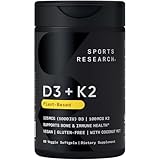

As an Amazon Associate, UsefulVitamins.com earns from qualifying purchases at no extra cost to you. We only recommend products supported by published research or third-party testing.
Reviewed by Sarah Thompson, Registered Dietitian, focused on vitamin and mineral nutrition. See more from Sarah Thompson. This article is educational and is not a substitute for individualized medical advice; talk to your doctor before starting a supplement, especially if you take a blood thinner, are pregnant, or are managing a diagnosed condition.
