
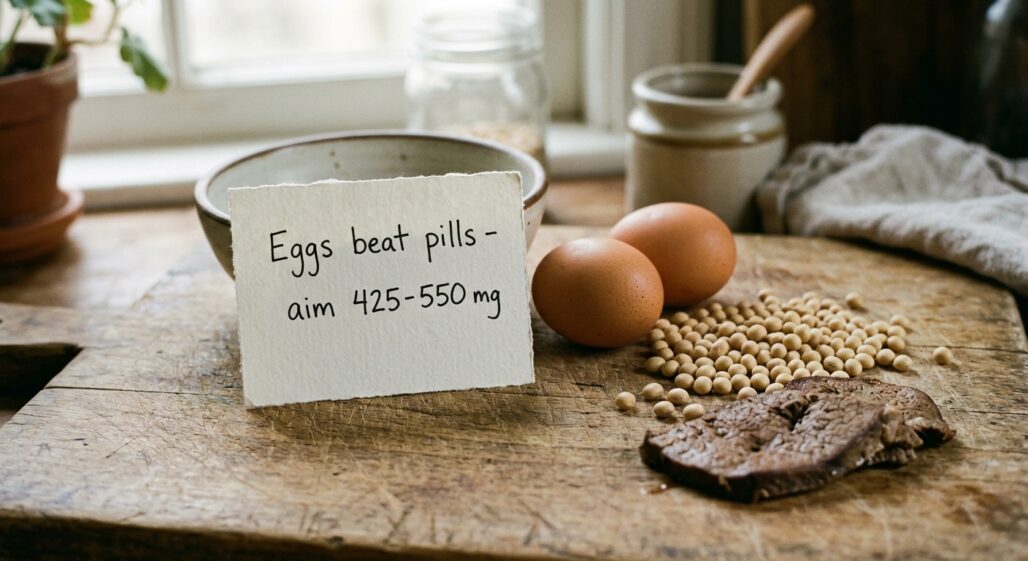
If you searched "choline guide," you have probably seen it called a brain nutrient, a liver nutrient, or the next big nootropic, and you want to know which framing is real and whether you need to buy anything. The honest answer: choline is genuinely essential, most people eat less than the recommended amount, and for the large majority the gap closes with eggs rather than a capsule. This guide covers what choline does in the body, how much you need, where the food is, what the brain and liver evidence actually shows, the pregnancy case, and the trimethylamine-N-oxide (TMAO) heart-health question that gets either ignored or over-hyped.
Before you decide
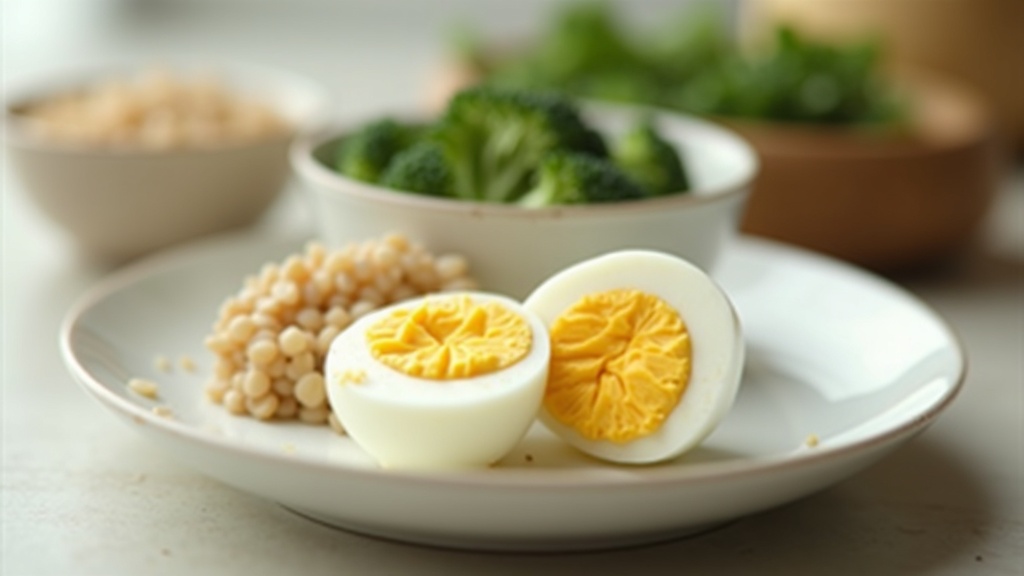
Start with food, not a bottle. Choline is one of the few nutrients where a single common food, the egg, can cover roughly half your daily target on its own, so the first move is to look at your plate before your supplement cart.
The group that actually runs short is narrower than the headlines suggest. People who eat eggs, meat, fish, or dairy most days usually land within reach of the target. The reliable shortfalls show up in strict vegans and vegetarians, people who avoid eggs, and a subset with a common variant in the PEMT gene that limits how much choline the body can make on its own.
The TMAO worry, in plain terms: gut bacteria turn some dietary choline into a compound called TMAO, and high blood TMAO has been linked to heart disease in observational studies. The practical point most guides bury is that this is largely a marker question, the rise from a couple of eggs is transient, and the populations short on choline have a clearer, nearer-term problem than a speculative one.
If you are pregnant, nursing, taking medication, or managing liver disease, treat the dosing notes below as background and confirm specifics with your clinician. You can read how we vet nutrient evidence on our supplement review methodology page.
What choline actually does in the body
Choline is not a vitamin in the textbook sense, but it behaves like an essential nutrient because the body cannot make enough to keep up. It feeds three jobs at once, which is why it shows up in brain, liver, and pregnancy conversations.
First, the brain job. Choline is the raw material for acetylcholine, the neurotransmitter that carries signals for memory, attention, and muscle activation. When choline is the limiting input, acetylcholine synthesis at cholinergic neurons depends on it. This is the mechanistic hook behind every "choline for memory" claim, and it is real at the biochemistry level even where the human data are softer.
Second, the membrane job. Most dietary choline becomes phosphatidylcholine, a phospholipid that forms the membranes wrapping every cell and the lipoprotein particles that move fat out of the liver. The NIH life-cycle review of choline intake describes choline's roles in acetylcholine synthesis, membrane phospholipids, and methyl-group metabolism as its three defining functions.
Third, the methylation job. Choline converts to betaine, a methyl donor that helps recycle homocysteine and supports one-carbon metabolism alongside folate and B12. That overlap is why choline and folate needs partly cover for each other, and why a low-folate diet can raise the choline you require.
Mechanistically these pathways are well mapped. The gap, as always, is between "the pathway exists" and "swallowing more changes how you feel," which is where the dose-and-evidence sections below get honest.
The recommended amount, and why most people fall short
There is no full RDA for choline because the controlled deficiency data were thin when the reference values were set, so an Adequate Intake (AI) was used instead. The NIH Office of Dietary Supplements choline fact sheet sets the AI at 550 mg per day for adult men and 425 mg per day for adult women, rising to 450 mg in pregnancy and 550 mg during lactation.
Now the part most people do not realize: measured intakes sit well below those numbers. The life-cycle review reports US mean intakes around 396 mg/day for men and 260 mg/day for women, both under the AI, with similar shortfalls reported internationally. Population estimates commonly put the majority of adults below their AI.
This is the quiet differentiator. Choline deficiency is not a dramatic, symptomatic state for most people; it is a routine, unnoticed gap that the average diet leaves open. Being under the AI is the normal state, not the exception.
The fix is unusually cheap, which is the other half of the framing. Closing the gap does not require a specialty product. It requires eggs, or the foods below.
Food sources: why the egg wins

Choline tracks with protein-rich animal foods plus a few plant standouts. The single most efficient everyday source is the whole egg, because the yolk is where the choline lives.
Here is how the common sources compare per standard serving.
| Food | Choline per serving | Share of a 425 mg target | Notes |
|---|---|---|---|
| Beef liver (3 oz, cooked) | about 356 mg | roughly 84 percent | Densest source; strong taste, eaten rarely |
| Two large eggs | about 250 mg | roughly 59 percent | Cheap, daily-friendly, yolk-dependent |
| Soybeans (1/2 cup, roasted) | about 107 mg | roughly 25 percent | Top plant source for egg-avoiders |
| Chicken breast (3 oz) | about 72 mg | roughly 17 percent | Reliable everyday contributor |
| Salmon (3 oz) | about 90 mg | roughly 21 percent | Pairs choline with omega-3s |
The takeaway is concrete. Two eggs at breakfast plus an ordinary protein at lunch and dinner gets most adults to the AI without any product at all. If you skip the yolk, you skip most of the choline, so whole eggs, not whites, are the point. For egg-avoiders, soybeans and other legumes are the most useful plant levers, which is also why pairing choline planning with our complete guide to omega-3 makes sense for anyone leaning on fish.
Brain and memory: what the evidence honestly shows
This is where Maria's lane matters, so let me separate mechanism from proof. The acetylcholine pathway gives choline a plausible cognitive mechanism. The human evidence is mostly observational, and observational evidence cannot tell you a supplement will sharpen your memory.
The most cited human signal comes from the Framingham Offspring Cohort analysis of 1,391 adults aged 36 to 83. Higher concurrent dietary choline intake was associated with better verbal and visual memory scores, and higher earlier intake tracked with less white-matter damage on brain imaging. Those are real associations on validated endpoints.
But this was a cross-sectional, diet-tracking study, not a randomized trial of a choline pill. People who eat more choline also tend to eat more eggs, fish, and whole foods, and that confounding cannot be untangled here. Trials giving extra choline to healthy adults to improve memory are sparse and inconsistent, and some older-adult datasets found no link between choline intake and cognitive change at all.
So the honest read for a general adult chasing focus: meeting the AI through food is well justified; expecting a memory upgrade from a high-dose choline capsule is not supported by strong trials. If your concern is attention or brain fog, see our roundups on supplements for memory and supplements for focus and concentration, where the evidence tiers are laid out compound by compound.
Liver: where the deficiency case is strongest
The clearest "you genuinely need this" evidence is hepatic, not cerebral. Because choline exports fat from the liver as phosphatidylcholine, running low lets triglycerides pool in liver cells.
This is not theoretical. The life-cycle review notes that liver damage with elevated liver enzymes appeared in healthy men after only about three weeks of severe choline restriction, reversing when choline was restored. That is one of the few controlled human deficiency findings for any nutrient.
On the population side, a prospective analysis found that higher dietary choline intake was associated with a lower risk of non-alcoholic fatty liver in normal-weight Chinese women. Postmenopausal women and people carrying PEMT variants appear most vulnerable, because estrogen drives the body's own phosphatidylcholine production and falling estrogen removes that backup. None of this means choline treats liver disease; it means adequacy protects a function the liver depends on.
Pregnancy and fetal brain development: the strongest supplement case
If there is one group where extra choline has randomized human support, it is pregnancy. The fetal brain pulls heavily on maternal choline for membrane building and methylation during rapid neurodevelopment.
In a controlled-feeding randomized trial by Caudill and colleagues, pregnant women in the third trimester were assigned 480 or 930 mg of choline per day. Infants of the higher-intake mothers showed faster information processing speed across testing at 4, 7, 10, and 13 months. A seven-year follow-up of a related trial reported better sustained attention in the children of higher-choline mothers.
These are small studies, and the higher arm used roughly double the AI, so they are not a license to megadose. But they are randomized, which puts pregnancy ahead of every other use case. The practical issue is that most prenatal vitamins contain little or no choline, and most pregnant women fall short of even the 450 mg AI. If you are pregnant, raise choline-rich foods and prenatal formulation with your OBGYN rather than self-prescribing a high dose.
The TMAO heart question, without the scare
Here is the nuance most choline guides handle badly. Gut bacteria convert some choline to trimethylamine, which the liver oxidizes to TMAO, and high blood TMAO has been associated with cardiovascular events in cohort studies. Read quickly, that sounds like a reason to fear eggs.
Read carefully, it is not. In a randomized dose-response study of egg ingestion, only about 14 percent of egg choline converted to TMAO, and the rise in plasma TMAO was transient, returning toward baseline rather than staying elevated. Longer-term egg studies likewise show the bump is acute, not sustained.
Two things keep this in proportion. TMAO is mostly a biomarker that travels with kidney function and overall metabolic health, and large studies have not shown a clear rise in cardiovascular risk from higher dietary choline itself. For the average egg-eater, the under-intake problem is real and present; the TMAO worry is speculative and small. People with advanced kidney disease are the reasonable exception and should individualize with their clinician.
How much to take, and the supplement reality
For most adults the operating target is simply the AI, 425 mg for women and 550 mg for men, reached through food first. A supplement is a gap-filler, not a default.
If you do supplement because you avoid eggs and meat, note the dose-vs-bottle mismatch Maria flags everywhere. Many choline bottles are dosed at 250 to 500 mg, and forms differ in how much actual choline they carry: choline bitartrate is about 41 percent choline by weight, while alpha-GPC and CDP-choline are pricier nootropic forms aimed at acute cognition rather than general adequacy. For closing a dietary gap, a modest bitartrate dose or a few hundred extra milligrams from a prenatal is plenty.
The safety ceiling matters because more is not better. The NIH fact sheet sets a tolerable upper intake level of 3,500 mg per day for adults, above which a fishy body odor, sweating, low blood pressure, and GI upset can appear. You are extremely unlikely to hit that from food. If you want to go deeper on products and forms, our best choline supplements roundup compares specific options.
FAQ
Do I need a choline supplement if I eat eggs? Usually no. Two whole eggs cover roughly half the daily target, so a regular egg-eater with other protein is generally within reach of the AI through food alone.
Is choline good for memory? It is essential for the acetylcholine that memory relies on, and observational data link higher intake to better memory scores. Trials proving that extra choline sharpens a healthy adult's memory are not strong.
Should pregnant women take choline? Needs rise to 450 mg and most fall short, and randomized trials suggest higher maternal intake aids infant attention and processing speed. Discuss food sources and a choline-containing prenatal with your OBGYN before adding a high dose.
Are eggs bad for my heart because of TMAO? For most people, no. The TMAO rise from eggs is small and transient, and higher dietary choline has not shown a clear cardiovascular risk in large studies. People with advanced kidney disease should individualize.
Which form should I buy? For general adequacy, choline bitartrate is the cheap workhorse. Alpha-GPC and CDP-choline are costlier forms marketed for acute cognition, which is a different goal than filling a dietary gap.
The bottom line on choline
Choline is essential, quietly under-eaten by most adults, and unusually cheap to fix. The brain mechanism is real but the human proof for memory upgrades is thin; the liver and pregnancy cases are where the evidence actually earns the word "need." The net-new point worth keeping: most people sit below the AI without knowing it, eggs close that gap for pennies, and the TMAO scare is far smaller than the under-intake problem it distracts from.
Next steps:
- Add two whole eggs (yolks included) to most days, or soybeans and legumes if you avoid eggs, before reaching for a capsule.
- If you are pregnant, review choline foods and your prenatal's choline content with your OBGYN.
- If you avoid all animal foods, compare gap-filling options in our best choline supplements roundup, and read more from Maria Rodriguez's author page.
Reviewed by Maria Rodriguez, MS Nutrition Science, focused on cognitive and mood biochemistry.
This article is for informational purposes and not medical advice. Consult a licensed physician before starting any supplement, particularly if you are pregnant, nursing, taking prescription medications, or managing a chronic condition such as kidney or liver disease.
