
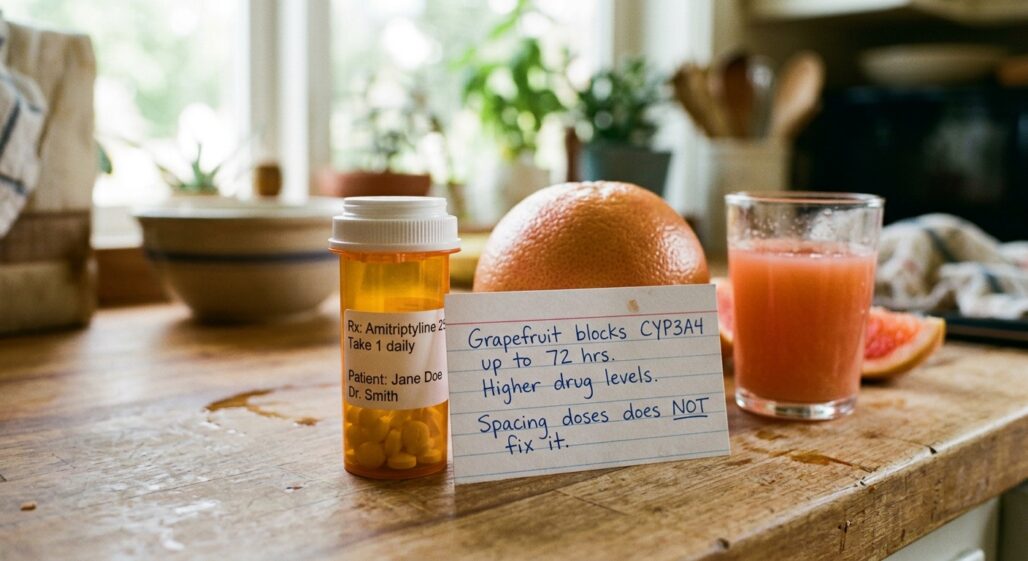
If you searched "grapefruit drug interactions," you probably either spotted a warning sticker on a pill bottle, or you heard you can just take the pill at breakfast and the juice at dinner. The short answer: for the drugs that matter, that timing trick does not work, because grapefruit knocks out an intestinal enzyme for up to about three days, not just for the hour you drink it. This article covers what the interaction actually is, how large the effect can be in real numbers, which drug classes are involved, and exactly what to do, framed against how clinicians and the drug labels handle it.
This is general health information, not personal medical advice, and it is the kind of conflict worth tracking deliberately if you manage several prescriptions at once.
Before you decide
A quick frame before anything else. This article is general information and is not a substitute for advice from your own doctor or pharmacist, who knows your exact medication list. Nothing here is a reason to stop, skip, or change a prescription on your own.
The standard of care is simple and well established: the drug label tells you whether to avoid grapefruit, and the safe move is to follow that label, not to improvise around it. If you have been drinking grapefruit juice with a medicine that warns against it, the correct step is to call your pharmacist, not to stop the drug.
The people who need to be most careful are those on statins, blood pressure pills called calcium channel blockers, transplant immunosuppressants, and certain heart-rhythm drugs. For these, even one large serving can matter. Older adults and people on several CYP3A4-metabolized drugs at once carry the most stacked risk.
Call your doctor or pharmacist promptly if you notice new muscle pain or weakness, dark urine, unusual dizziness or a racing heart, or swelling, after combining grapefruit with one of these medicines. Those can be signs that drug levels climbed too high.
What the grapefruit interaction actually is
Most people picture a drug interaction as two pills fighting in the bloodstream. This one is different: grapefruit acts in the wall of your small intestine, before the drug ever reaches your blood. That single fact explains almost everything strange about it.
Your gut lining is studded with an enzyme called CYP3A4. For many oral drugs, CYP3A4 chews up a large share of each dose during absorption, so only a fraction makes it into circulation. That built-in loss is called first-pass metabolism, and the drug's dose is calibrated around it.
Grapefruit contains compounds called furanocoumarins, mainly bergamottin and 6,7-dihydroxybergamottin. As the FDA explains in its consumer update, these block intestinal CYP3A4, so "more of the drug enters the blood and stays in the body longer." With the gatekeeper disabled, a dose engineered to lose, say, 70% on the way in suddenly loses much less.
Think of it like a tollbooth that normally taxes most cars before they reach the highway; grapefruit jams the gate open, and far more traffic pours through at once. The drug dose did not change. The amount actually reaching you did.
One more wrinkle matters here. The furanocoumarin inhibition is largely irreversible, meaning the affected enzyme molecules are destroyed, not just paused. A 2013 CMAJ review by Bailey and colleagues describes how the gut then has to manufacture new CYP3A4 from scratch, which is why the effect outlasts the meal by days.
How big the effect is (with real numbers)
This is where the cited figures beat vague warnings. In one of the foundational trials, grapefruit juice more than doubled blood levels of the blood pressure drug felodipine. In Bailey's 1993 study in Clinical Pharmacology & Therapeutics, felodipine AUC reached 206% and peak concentration 170% of the water control, with some participants hitting 330%.
The effect varies a lot by drug. Statins are the headline concern because the size of the jump is large for some of them. A 1998 trial showed grapefruit juice greatly increased serum lovastatin and its active acid, and simvastatin behaves similarly, which is why too much drug raises the risk of muscle and liver injury.
It reaches well past the cardiovascular world. A 2025 review of psychiatric medications in Cureus reports the anti-anxiety drug buspirone rising about 4.3-fold and diazepam roughly 3-fold in AUC when taken with grapefruit. That is a real, large signal, not a rounding error.
For perspective on scope, the 2013 CMAJ review counted more than 85 drugs that interact with grapefruit, of which 43 carry the potential for serious adverse effects. The mechanism is one enzyme, but the reach is broad.
Why spacing doses out does not fix it

Here is the misconception worth dismantling directly. Because grapefruit destroys the enzyme rather than competing with the drug, taking your pill hours before or after the juice does not protect you. The gut stays low on CYP3A4 long after the glass is empty.
The timing study makes this concrete. In Lilja's 2000 trial in Clinical Pharmacology & Therapeutics, simvastatin taken 24 hours after high-dose grapefruit juice still showed about 10% of the full interaction effect, and the interaction potential only dissipated over the following 3 to 7 days. Recovery to normal takes roughly 24 to 72 hours, with full washout sometimes longer.
So the practical reality is binary, not a schedule. If your drug carries a grapefruit warning, the safe approach is to avoid grapefruit entirely for as long as you take that drug, not to ration it to non-dose hours. A morning grapefruit and an evening statin are still the same interaction.
A companion fruit note: this is not only grapefruit. Pomelo, Seville (sour) oranges used in marmalade, and tangelos contain the same furanocoumarins. Sweet oranges and regular orange juice do not, so standard OJ is generally fine with these drugs.
Which drugs are affected, by class
You do not need to memorize a list; you need to know which shelves to check with your pharmacist. The table below groups the higher-concern classes drawn from the CMAJ 2013 interaction table and FDA labeling. It is a prompt for that conversation, not a substitute for your own drug label.
| Drug class | Common examples | Why grapefruit matters here |
|---|---|---|
| Some statins | Simvastatin, lovastatin, atorvastatin | Higher levels raise the risk of muscle injury (myopathy) and liver enzyme rises. Pravastatin and rosuvastatin are not CYP3A4 drugs and are generally unaffected. |
| Calcium channel blockers (BP) | Felodipine, nifedipine, nicardipine | Levels can more than double, dropping blood pressure too far and causing dizziness or a fast heartbeat. |
| Transplant immunosuppressants | Cyclosporine, tacrolimus, sirolimus | A narrow safety window means small level changes risk toxicity; grapefruit is generally avoided outright. |
| Certain anti-arrhythmics | Amiodarone, dronedarone, quinidine | Higher levels can worsen heart rhythm problems; the dronedarone label specifically says avoid grapefruit juice. |
| Some CNS and others | Buspirone, certain benzodiazepines, sildenafil | Large AUC increases (buspirone ~4.3-fold) can amplify sedation, dizziness, or blood-pressure effects. |
For deeper, drug-specific breakdowns we keep dedicated guides on grapefruit and statins, grapefruit and blood pressure medication, and grapefruit and blood thinners. The broader picture of food and supplement conflicts lives in our guide to drug and supplement interactions.
Who is most at risk
Not everyone on these drugs faces the same danger, and a preventive lens helps sort it. The highest-risk group combines a narrow-margin drug, an older body that clears drugs more slowly, and several CYP3A4 medicines taken together. That overlap is common in transplant, cardiology, and complex polypharmacy patients.
Older adults matter for a specific reason: they tend to take more of these medications and may have less baseline enzyme reserve, so the same glass produces a bigger swing. That is the population pharmacists watch most closely.
The drug also matters more than the dose of fruit in many cases. A statin with a wide safety margin and a small grapefruit habit is a very different situation from tacrolimus, where the standard of care is to keep blood levels inside a tight target range. When the target window is narrow, even a modest level rise is a real problem.
People on the unaffected alternatives have far less to worry about. Pravastatin and rosuvastatin are not CYP3A4 substrates, and regular orange juice is not a furanocoumarin source, so those combinations are not the same concern.
When to see a clinician
Use this section as a decision rule, not a reason to panic. If you take any medicine and are unsure whether grapefruit applies, ask your pharmacist before your next serving; that single question resolves most cases in two minutes. Pharmacists field this constantly and can check your full list at once.
Book a conversation with your prescriber if you regularly eat grapefruit or drink the juice and you are starting one of the higher-risk drugs above. The cleaner move is to flag the habit up front so the prescriber can pick a drug that is not affected, which is often possible.
Seek prompt medical attention, not a wait-and-see, if you have already combined grapefruit with a warned drug and develop new muscle pain or weakness, very dark urine, marked dizziness or fainting, an irregular or racing heartbeat, or unusual swelling. These can signal that drug levels rose too high and need same-day evaluation.
To keep a multi-drug list straight, our companion app StackMyMed helps you spot and flag conflicts like this one so you can raise them with your pharmacist; it is a prompt for that conversation, not a replacement for it. You can also try our drug and supplement interaction checker as a first-pass screen.
Frequently asked questions
Does the interaction depend on how much grapefruit I eat? Larger amounts produce bigger effects, but the FDA notes that even one serving can affect some drugs, and the effect varies by person and product strength. For warned drugs, the safe assumption is that any amount counts.
Is regular orange juice a problem too? No. Sweet oranges and standard orange juice lack the furanocoumarins that drive this interaction. The culprits are grapefruit, pomelo, Seville (sour) oranges, and tangelos.
How long after grapefruit is it safe to take an affected drug? The enzyme recovers over roughly 24 to 72 hours, but the Lilja 2000 study found measurable effect even at 24 hours and full dissipation over 3 to 7 days. That is exactly why timing tricks fail and avoidance is the practical answer.
Are all statins affected? No. Simvastatin, lovastatin, and atorvastatin are CYP3A4 drugs and are affected, while pravastatin and rosuvastatin are not metabolized that way and are generally considered safe with grapefruit. Confirm your specific statin with your pharmacist.
Can I just switch to a grapefruit-free week and resume? That is a conversation for your prescriber, not a self-managed plan. For narrow-margin drugs like immunosuppressants, the standard advice is steady avoidance rather than on-and-off use.
Conclusion: the bottom line on grapefruit drug interactions
Strip away the folklore and the mechanism is clean: grapefruit's furanocoumarins permanently disable intestinal CYP3A4, so more of an affected drug is absorbed, and the effect lasts up to about 72 hours. Because the enzyme is destroyed rather than briefly blocked, separating your pill from the juice does not protect you, which is the single point most casual advice gets wrong. The defensible verdict is avoidance for warned drugs, not scheduling.
The drugs that matter most are some statins, calcium channel blockers, transplant immunosuppressants, and certain anti-arrhythmics. Your own drug label and pharmacist are the authority on your specific case.
Next steps:
- Check each of your prescriptions for a grapefruit warning, and ask your pharmacist about any you are unsure of.
- If you love grapefruit, ask your prescriber whether a non-CYP3A4 alternative (for example pravastatin or rosuvastatin instead of simvastatin) fits your situation.
- Read how we vet our health content in our editorial review process, and see more from the UsefulVitamins Editorial Team.
As an Amazon Associate, I earn from qualifying purchases. Product recommendations are based on real reviews and independent research.
Reviewed by the UsefulVitamins Editorial Team.
This article is for informational purposes and not medical advice. Grapefruit and other foods can interact with prescription medications. Consult a licensed physician or pharmacist before changing your diet or supplements, and never stop, skip, or adjust a prescription on your own, particularly if you are pregnant, nursing, taking prescription medications, or managing a chronic condition.
