
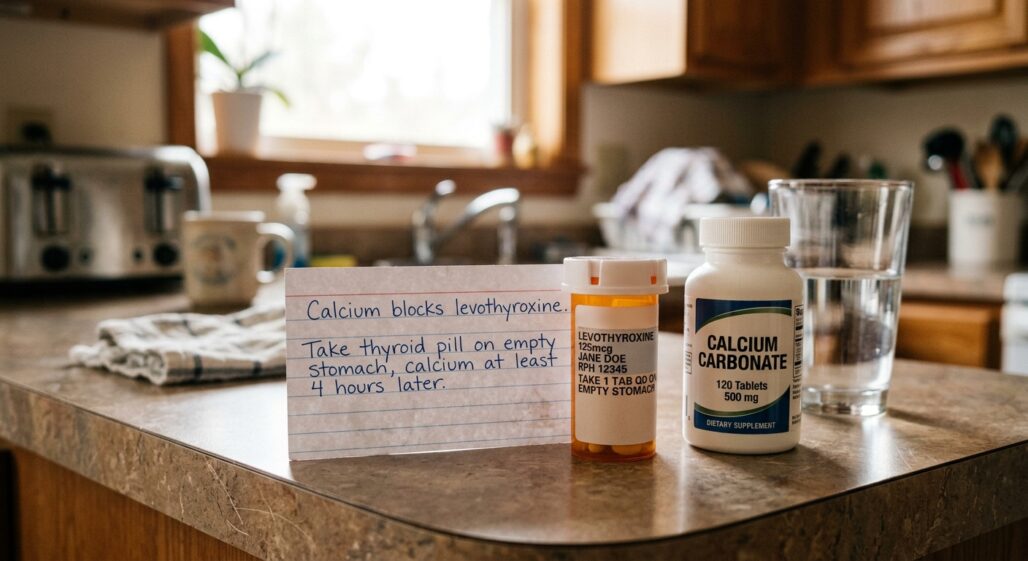
If you take a thyroid pill every morning and a calcium supplement for your bones, you have probably wondered whether the two are quietly fighting each other. The short answer: yes, calcium can blunt your levothyroxine, but the fix is timing, not stopping either one. This piece walks through what the interaction actually is, how big it is in the trial data, exactly how long to wait, who needs to be most careful, and when to call your doctor or pharmacist.
Before you decide
This is general health information, not medical advice, and it is not a reason to change anything on your own today. Levothyroxine is the standard of care for hypothyroidism, and your dose was set with blood tests; never stop it, skip it, or adjust it because of something you read here.
The people who need to be most careful are anyone whose thyroid was fully removed or ablated, anyone pregnant or trying to conceive, older adults on several pills at once, and anyone whose TSH has been hard to stabilize. In those situations a 20-percent absorption dip is not academic, it can move your labs.
Call your doctor or pharmacist before changing your routine if your TSH has crept up, if you have recently started or stopped a calcium supplement, or if your morning schedule makes a clean 4-hour gap impossible. The interaction is real but completely manageable once your care team knows your actual routine. A pharmacist can sort this out in five minutes, and our how we review supplements process reflects the same defer-to-clinicians stance.
What the calcium and levothyroxine interaction actually is

Levothyroxine is a synthetic copy of your thyroid hormone T4, and it is absorbed mostly in the upper small intestine in a fairly narrow window after you swallow it. Calcium interferes by physically binding the drug before your gut can take it up. This is a classic absorption interaction, not a chemical that makes the hormone stop working once it is in your blood.
Two things happen at once. Calcium, especially calcium carbonate, forms an insoluble complex with levothyroxine in the stomach and intestine, and calcium carbonate also raises stomach pH, which matters because levothyroxine dissolves best in an acidic environment. The NIH MedlinePlus drug page for levothyroxine treats calcium carbonate and iron the same way for exactly this reason.
Think of it like dropping a vitamin into a glass of milk and watching it cloud over. The pill is still in there, but it is now tangled up with something else and far less of it crosses into you.
This is why the food rule exists too. The American Thyroid Association's patient guidance on thyroid hormone treatment lists iron, calcium, soy and certain antacids among the things that can "prevent the absorption of the full dose," which is why levothyroxine is taken on an empty stomach in the first place.
How big is the effect (the actual numbers)
This is where the trial literature is genuinely useful, because the effect size is specific, not hand-wavy. Calcium does not nibble at the edges; it removes about a fifth to a quarter of the dose when taken together.
In a single-dose pharmacokinetic study of eight healthy adults, Zamfirescu and Carlson in the journal Thyroid (2011) found that 500 mg of elemental calcium reduced levothyroxine absorption by about 20.8 percent as carbonate, 18.6 percent as citrate, and 24.9 percent as acetate. The headline there is that no calcium form is a safe loophole, the older belief that calcium citrate was gentler did not hold up.
The clinical consequence shows up in your bloodwork. In a study of 20 patients on stable long-term levothyroxine, Singh, Singh and Hershman in JAMA (2000) added 1,200 mg of elemental calcium daily and watched mean TSH climb from 1.6 to 2.7 mIU/L, with free T4 falling, both of which reversed once calcium was stopped.
For context, an under-replaced patient with a TSH drifting from 1.6 to 2.7 is the kind of move that prompts a clinician to recheck and sometimes re-dose. That is a real but modest and fully reversible signal, exactly the kind of margin where timing earns its keep. If you want the broader map of these conflicts, our ultimate guide to drug and supplement interactions puts levothyroxine in context with the other big offenders.
How long to wait, and what to do
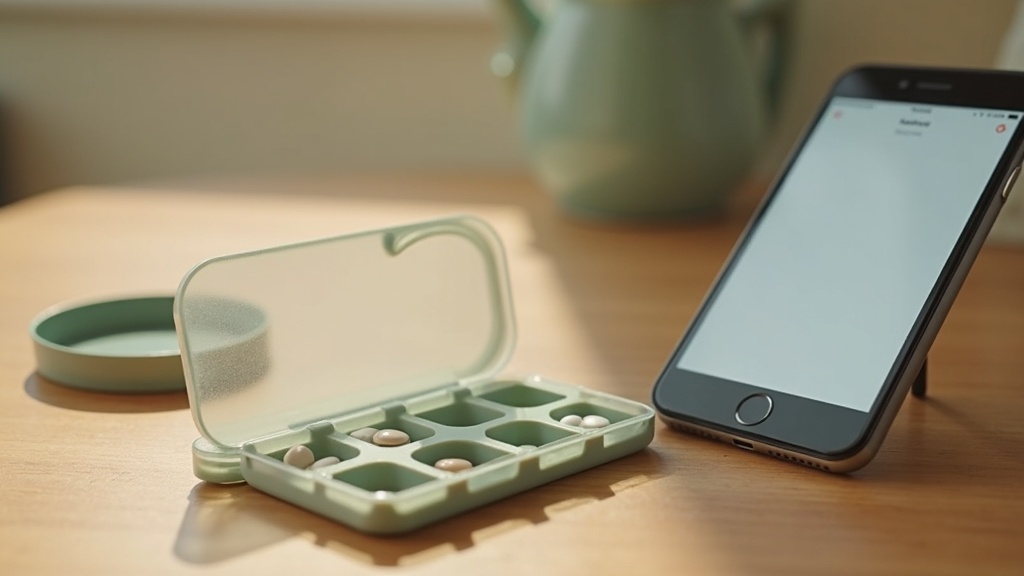
Here is the practical core. Take levothyroxine first, on an empty stomach, then put calcium as far away from it as your day allows, at least 4 hours.
The numbers line up across independent sources. NIH MedlinePlus says to take calcium carbonate or an iron supplement "at least 4 hours before or 4 hours after" levothyroxine. UCLA Health's endocrine surgery guidance says calcium and iron "should be taken 3-4 hours after." Mayo Clinic's patient library puts it at "at least four hours before or after."
A clean routine for most people looks like this.
| Time | What you take | Why |
|---|---|---|
| Wake up | Levothyroxine + full glass of water | Empty stomach, acidic gut, nothing to bind it |
| 30 to 60 min later | Breakfast and coffee | Food and coffee blunt absorption, so wait |
| 4+ hours after the pill | Calcium supplement (with food) | Past the absorption window; calcium is fine now |
A few details matter. Coffee is its own absorption blocker, not just calcium, so the empty-stomach wait protects you from both, and our deeper dive on coffee and levothyroxine timing covers that. Splitting a large calcium dose helps you too, since the gut only absorbs roughly 500 to 600 mg of calcium at once, so an afternoon and evening split keeps it far from the morning pill and improves calcium uptake.
If a strict morning gap is genuinely unworkable, bedtime levothyroxine is an evidence-backed alternative. A bedtime-versus-morning crossover randomized trial in older adults found bedtime dosing kept TSH well controlled, which lets some people park calcium in the morning and the thyroid pill at night, several hours after dinner. Actionable takeaway: pick one consistent pattern, keep calcium at least 4 hours from the pill, and recheck TSH 6 to 8 weeks after any timing change.
Tracking a multi-pill routine like this is exactly where a tool helps. Our companion app StackMyMed lets you log the stack and flags spacing conflicts so you can catch them, but it helps you spot and space doses, it does not replace your pharmacist.
Who is most at risk
Not everyone feels this equally, and the preventive-medicine view is to size the risk to the person. The thinner your thyroid reserve, the more a 20-percent dip matters.
People with no working thyroid sit at the top of the list, anyone who has had a total thyroidectomy or radioactive iodine ablation has zero internal buffer, so absorption changes translate directly into TSH swings. Pregnancy is the other high-stakes setting, since levothyroxine needs rise and tight control protects the pregnancy; if you are pregnant or trying to conceive, work the timing out with your OBGYN, do not improvise it.
Older adults are vulnerable for a different reason. Many take calcium for bone health, an iron supplement, and a stack of other pills, and the morning routine collapses everything into the same 20 minutes. That is the population the bedtime-dosing trial was designed around.
One more group: anyone whose calcium is actually coming from an antacid. A few daily calcium-carbonate antacid tablets count as a calcium dose for this interaction, and people often forget to mention them. The same logic applies to iron, which is covered in our piece on iron and thyroid medication timing.
When to see a clinician
Timing is a self-care lever, but lab interpretation and dosing are not. See your doctor or pharmacist, do not self-adjust, in these situations.
Get checked if your TSH has risen or your hypothyroid symptoms have crept back (fatigue, cold intolerance, weight gain, brain fog) after starting or increasing calcium. Bring it up promptly if you are newly pregnant, since thyroid targets tighten fast. And ask before you change anything if you cannot realistically maintain the 4-hour gap, because there are alternatives like bedtime dosing that a clinician can set up safely.
Standard advice is to recheck TSH about 6 to 8 weeks after any change in how or when you take the medication. That blood test, not how you feel on a given morning, is what tells you whether the timing is working. If you ever want a structured way to surface conflicts before a pharmacy visit, our drug and supplement interaction checker is a starting point, not a substitute for that conversation.
FAQ
Can I take calcium and levothyroxine together if I just need them both daily?
You can take both daily, you just cannot take them at the same time. Keep at least a 4-hour gap, levothyroxine on an empty stomach first and calcium later with food.
Does the type of calcium matter, like citrate versus carbonate?
Not enough to rely on. The Thyroid (2011) data showed carbonate, citrate and acetate all cut absorption by roughly 20 to 25 percent, so separate the timing regardless of which form you take.
What about the calcium in my breakfast, milk, yogurt or a fortified latte?
Dietary calcium follows the same logic, which is part of why levothyroxine is taken on an empty stomach with a 30-to-60-minute wait before eating. A calcium-heavy breakfast is fine once that window has passed.
I accidentally took them together once, is that a problem?
A single overlap is unlikely to matter; this interaction shows up when the overlap is the daily habit. Get back on your spaced routine the next day rather than doubling up.
Should I just take levothyroxine at night instead?
For some people that is a reasonable, evidence-supported option that lets calcium live in the morning. Decide it with your clinician and confirm with a follow-up TSH; do not switch silently. You can read more about author background on the the UsefulVitamins Editorial Team.
Will calcium ruin my thyroid treatment?
No. It can reduce how much medication you absorb if taken together, which timing fixes completely. The reversibility seen when patients stopped calcium in the JAMA study is the reassuring part. If you need a primer on dosing and forms, see our complete guide to calcium.
Conclusion: the bottom line on calcium and levothyroxine timing
Calcium and levothyroxine are not enemies, they are just bad roommates if you make them share a single moment of your morning. The whole problem is solved by space and consistency: pill first on an empty stomach, calcium at least 4 hours later, same way every day.
The evidence is unusually clean for a supplement question, a measurable ~20 to 25 percent absorption hit and a reversible TSH bump, both fixed by separating the doses. That is a managed-margin issue, not a reason for alarm, and it is firmly a layer on top of your standard treatment, never a substitute for it.
Next steps:
- Set levothyroxine as your first action of the day, water only, then a 30-to-60-minute wait before food or coffee.
- Move calcium (and any calcium antacids) to at least 4 hours later, ideally split into smaller afternoon and evening doses.
- If the gap is impossible, ask about bedtime dosing and recheck TSH 6 to 8 weeks after any change; for the wider picture see our ultimate guide to drug and supplement interactions.
This article is for informational purposes and not medical advice. Levothyroxine is a prescription medication; never stop, skip, or change your dose on your own. Talk with your physician or pharmacist before adding, stopping, or re-timing any supplement, particularly if you are pregnant, nursing, or managing a chronic condition.
Reviewed by the UsefulVitamins Editorial Team.
