
Affiliate disclosure: this article contains affiliate links. As an Amazon Associate, UsefulVitamins.com earns from qualifying purchases at no extra cost to you.
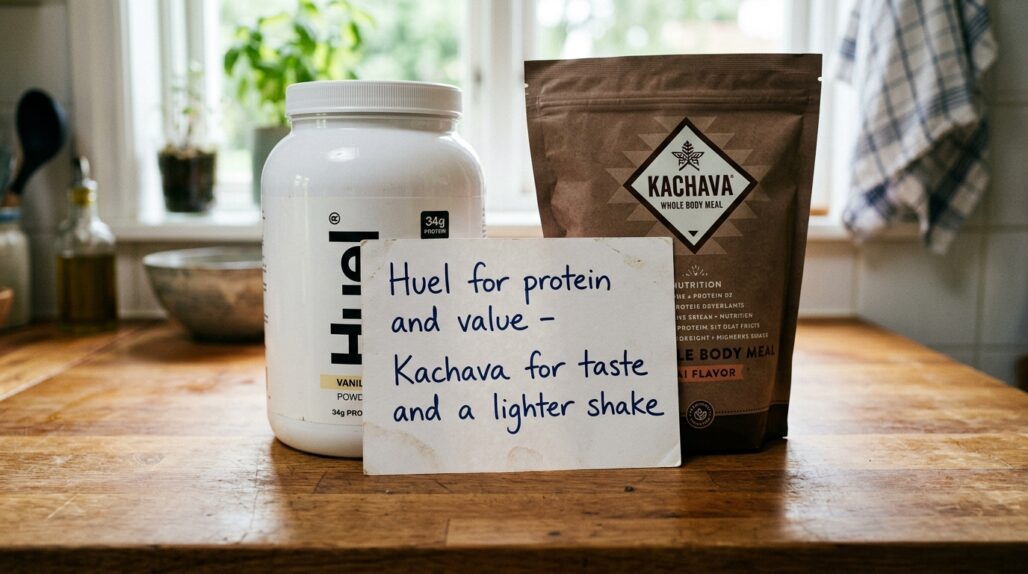
Two tabs open, cart half full, and you just want someone to say which one to click. Here is the short version, then the table, then a clean pick-this-if so you can close the tab.
Before you buy
This is not really a contest of which shake tastes better. It is a choice between two products that happen to share a shelf and almost nothing else.
Huel Black Edition is a meal. Four hundred calories, 40g of protein, real fat and fiber, built to replace lunch on a day you cannot make one. That is the value-and-function play.
Ka'Chava is a 240-calorie wellness shake. It sells a whole-food story built on greens, adaptogens, mushrooms, and probiotics, and it leans on taste and a premium feel.
So the question underneath the price tags is simple. Do you want a calorie-dense meal with transparent doses at a low cost per serving, or a lighter, better-tasting shake you are happy to pay up for? If your real goal is steady all-day energy rather than a single drink, skim our guide to the best supplements for energy and fatigue first, because the right answer might not be a shake at all.
The numbers side by side
Here is the part you came for. Figures are per serving, pulled from each brand's official nutrition page as of writing.
| Factor | Huel Black Edition | Ka’Chava |
|---|---|---|
| Calories | 400 per 90g serving | 240 |
| Protein | 40g (pea + brown rice) | 25g (pea, rice, sacha inchi) |
| Carbs | around 15g net | around 22g |
| Fat | around 17-18g | around 6g |
| Fiber | 9-11g | 6-7g |
| Added sugar | 0g, no artificial sweeteners | around 4g |
| Vitamins and minerals | 27 essential nutrients | around 24 listed |
| Dose transparency | Full amounts disclosed, no proprietary blends | Proprietary blends, superfood doses hidden |
| Cost per serving | around $2.65 (sub) to $3.31 (one-time) | around $4.00 (sub) to $4.66 (one-time) |
| Format | around 17 meals per bag, 10+ flavors | 15 servings per bag, 7+ flavors |
Read it once and the gap is hard to miss. Huel gives you a bigger meal, 15g more protein, full dose transparency, and a lower price. Ka'Chava gives you fewer calories, less protein, and a higher bill, in exchange for taste and the superfood narrative.
Protein, calories, and what actually fills you up
If a shake is replacing a meal, two things matter most. Does it carry enough protein to keep you full and protect muscle, and does it carry enough calories to count as a meal at all?
Huel wins both on paper. Forty grams of protein is genuinely meal-sized. Ka'Chava's 25g is a solid snack-to-light-meal amount.
At 400 calories, Huel holds most people for hours. At 240 calories, Ka'Chava sits closer to a heavy snack – fine if that is what you want, but it will not stand in for a 600-calorie lunch without leaving you hungry by mid-afternoon.
Ka'Chava's defenders point to the greens, adaptogens, mushrooms, and probiotics. The catch is dosing. Because those ingredients live inside proprietary blends, the brand does not tell you how much reishi, ashwagandha, or any single superfood you actually get.
Independent testers, including BarBend's hands-on review, flag the same gap. Split one blend weight across dozens of superfoods and there is little room for any single ingredient to reach a studied dose. You get a sprinkle of many things rather than a meaningful amount of any one. For what the evidence actually asks of individual nutrients, the NIH Office of Dietary Supplements fact sheets are the neutral reference.
Huel's micronutrient panel is the more complete of the two at 27 nutrients, and every amount is printed on the label. If you currently lean on a multivitamin and wonder whether a complete shake could replace it, check our best multivitamins comparison and our complete guide to B vitamins, since B12 and folate are the usual gaps for plant-based eaters.
Quality and third-party testing
This is where the two brands genuinely split, and it is worth thirty seconds before you buy.
Huel publishes a detailed quality-standards page. It states that products are routinely tested through ISO 17025-accredited independent labs, covering microbes, nutrition, heavy metals, pesticides, and allergens from raw material to finished product. The product is also certified 100% vegan, non-GMO, and gluten-free.
Black Edition itself is not carried as a separate third-party certification, but it runs through that same testing program and keeps full-dose transparency.
Ka'Chava is murkier. The brand says it tests for arsenic, cadmium, lead, and mercury, and that each batch gets a Certificate of Analysis reviewed internally before release. It also says it stays under FDA interim reference levels for lead.
The gap is what reaches you. Ka'Chava does not hand customers a public, per-batch COA, so you are trusting the brand's word rather than a document you can read.
Two facts are worth knowing. Both the vanilla and chocolate flavors were named in a 2021 California Proposition 65 notice over lead, and the brand keeps a public Prop 65 statement on trace heavy metals, which are common across plant-based protein powders.
Separately, a consumer advocate published a 2025 XRF screening of a Ka'Chava matcha sample reporting detectable lead, cadmium, and arsenic. Treat that carefully: XRF is a consumer-grade screening method, not an accredited quantitative lab assay, so it is a reason to ask questions, not a verified contamination result.
The honest read is not "scandal." It is transparency. With hidden doses and no published COA, you cannot independently verify what you are getting. If testing weighs on your decision, walk through our supplement quality indicators checklist before you commit to either brand.
Cost per serving, subscriptions, and the real bill
The price gap is the cleanest tiebreaker here.
Huel Black Edition runs about $45 for a 17-meal bag on subscription, which is roughly $2.65 a meal, or about $56 one-time at around $3.31 a meal, as of writing. Check the current price, since both brands shift pricing and run promos.
Ka'Chava is about $59.95 for a 15-serving bag on subscription and $69.95 one-time, which lands near $4.00 to $4.66 per serving. So you pay roughly a third to a half more per serving for fewer calories and less protein.
Both run subscriptions, so read the cancellation terms before you sign up. Neither locks you in the way some DTC supplement funnels do, but autoship has a way of quietly draining a card.
If a shake is your daily lunch, that per-serving gap of about a dollar-fifty compounds fast. Across a month of weekdays it is the difference between roughly $58 and roughly $92.
Where to buy and the value pick
Both brands sell direct, and you will also find each on Amazon alongside comparable meal-replacement and protein options, where cross-shopping price per serving is easy.
Our value pick for a true meal replacement is Huel Black Edition, on price and protein. If you specifically want the lighter, dessert-like superfood shake and the budget does not faze you, Ka'Chava is the splurge.


As an Amazon Associate, UsefulVitamins.com earns from qualifying purchases at no extra cost to you.
Disclosure: UsefulVitamins earns from qualifying Amazon purchases at no extra cost to you. It never changes our verdict or what we recommend.
Taste, texture, and best use case
Most head-to-head reviewers give Ka'Chava the taste win. It is smoother, sweeter, and more dessert-like, and it mixes thin and easy in a shaker. That is a real reason people pay up: a shake you look forward to is a shake you keep drinking.
Huel Black Edition reads more as functional food than treat. It is thicker, heartier, and a little textured, with a slightly earthy plant-protein note depending on flavor. People who want a filling meal tend to like that; people who want a light drink sometimes do not.
So the use cases split cleanly. Huel is a meal for skipped-breakfast mornings, working lunches, or a post-gym refuel. Ka'Chava is a lighter once-a-day shake or a snack you enjoy. Pick the job first, then pick the product.
| Your priority | Pick Huel Black Edition if | Pick Ka’Chava if |
|---|---|---|
| Calories and fullness | You want a genuine meal at 400 cal, 40g protein | You want a lighter 240-calorie once-a-day shake |
| Cost | You care about cost per serving and want the cheaper option | Price is not a deciding factor and taste is |
| Transparency | You want every dose on the label, no proprietary blends | You are sold on the whole-food superfood positioning |
| Taste and mixability | You want documented heavy-metal and allergen testing | A smooth, dessert-like taste is the priority |

FAQ
Is Huel or Ka’Chava better for weight loss? Neither is magic, and the math favors different goals. Ka’Chava’s 240 calories slot easily into a deficit as a meal substitute, while Huel’s 400 calories and 40g of protein keep you fuller and can curb later snacking. For appetite control, the higher-protein option usually wins.
Can I replace a full meal with either one? Huel is built to be a meal at 400 calories and 40g of protein, so it stands in for lunch comfortably. Ka’Chava at 240 calories is closer to a hearty snack, so you may need fruit, nut butter, or a side to make it hold you. Do not replace every meal of the day with a shake without talking to a clinician or dietitian.
Why can’t I see the doses of Ka’Chava’s superfoods? Ka’Chava groups its greens, adaptogens, mushrooms, and probiotics into proprietary blends, which legally lets a brand list a total blend weight without breaking out each ingredient. The practical downside is you cannot tell whether a studied dose of any single ingredient is present, or just a trace.
Is Ka’Chava safe given the Proposition 65 history? Trace heavy metals show up across many plant-based protein powders because plants draw them from soil. Ka’Chava was named in a 2021 Prop 65 notice over lead and says it now tests below FDA interim reference levels, though it does not hand customers a public Certificate of Analysis. If verifiable testing is a priority, that missing public COA is a fair reason to prefer a brand that shares one.
Are these shakes good for vegans? Both are fully plant-based. Huel uses pea and brown rice protein and adds B12, while Ka’Chava uses pea, rice, and sacha inchi protein. If you rely on a shake for nutrients you would otherwise miss on a plant-based diet, check the B12 and iron amounts against a reliable nutrient reference.
Which one mixes and tastes better? Most independent reviewers give taste and mixability to Ka’Chava, which is sweeter, smoother, and thinner in a shaker. Huel is thicker and more savory-leaning, which fits its meal-replacement role but is not as dessert-like. If “will I enjoy drinking this every day” is your deciding factor, Ka’Chava usually takes it.
The verdict
For the everyday buyer, Huel Black Edition is the better buy. You get more protein, a true meal's worth of calories, a complete and fully disclosed micronutrient panel, documented heavy-metal and allergen testing, and a price that runs roughly a third lower per serving.
Ka'Chava earns its place in a narrower case. You want a lighter, dessert-smooth once-a-day shake, you are drawn to the whole-food story, and the higher price and hidden doses do not bother you. For that buyer it is a genuinely pleasant product, just an expensive one.
If you are truly on the fence, default to Huel and pocket the difference. And if your real goal is steady energy rather than a shake habit, it is worth checking whether a simpler protein-plus-multivitamin approach gets you there for less.
This article is for general information only and is not medical advice. Meal-replacement shakes are not a substitute for a varied diet, and they are not right for everyone. Talk to a doctor, pharmacist, or registered dietitian before relying on one, especially if you are pregnant, nursing, managing a health condition, or taking medication. Prices and formulas change often, so verify current details on the brand's official page before you buy.
Reviewed by the UsefulVitamins Editorial Team.
