
Affiliate disclosure: this article contains affiliate links. As an Amazon Associate, UsefulVitamins.com earns from qualifying purchases at no extra cost to you.
Cymbiotika is one of the loudest premium supplement brands online. The pitch rests on three things: liposomal "delivery," sleek black pouches, and a subscribe button that is easy to click and oddly hard to find again.
The marketing wants you to believe this is nutrition that works on a different level than what sits on the pharmacy shelf. The skeptic's question is simpler. Are you getting more nutrient, or just a pricier way to swallow the same nutrient?
Mostly the second. But "mostly" hides the part that matters, so this article does the math instead of the vibes.
Before you buy
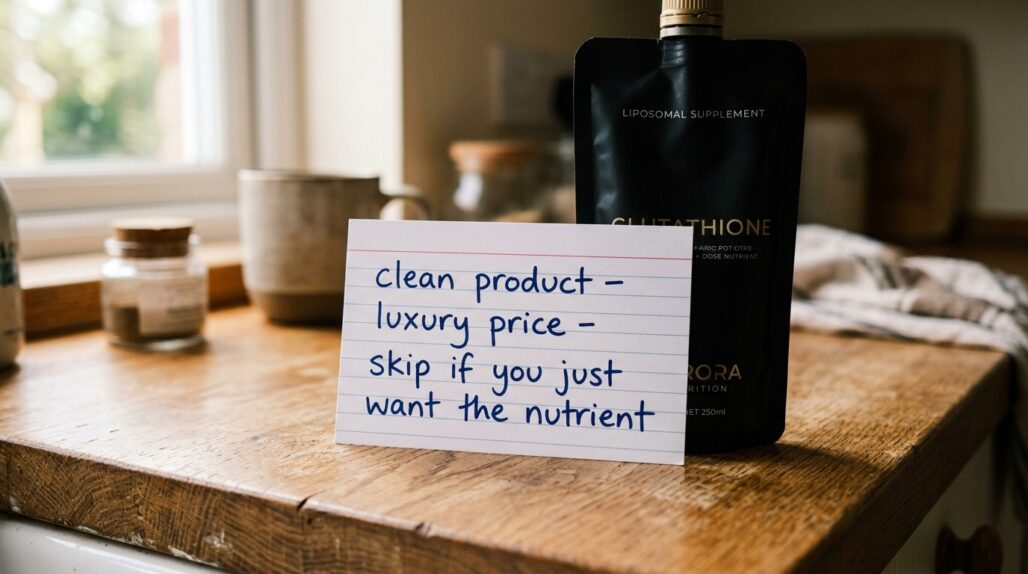
The phrase "is Cymbiotika worth it" is rarely a question about whether the products are bad. They are not. The labels are clean, the doses are printed in full, and the flavors are good.
The real decision is whether the liposomal premium – the extra you pay over a plain vitamin C or glutathione – buys a benefit you can feel, or just funds a brand aesthetic.
You are choosing between two things that look similar but are not:
- Buying the nutrient (vitamin C, glutathione, magnesium) as cheaply and reliably as you can.
- Buying a daily ritual, a pleasant liquid you will actually keep using.
Cymbiotika is excellent at the second and a bad deal for the first. Once you know which one you are shopping for, the verdict mostly writes itself. The rest of this is receipts.
What Cymbiotika actually sells
Cymbiotika is a direct-to-consumer brand whose identity is built on liposomal delivery. Nutrients are wrapped in a phospholipid (phosphatidylcholine) that is meant to survive digestion and absorb better. Most of the flagship line comes in single-serve liquid pouches you squeeze into your mouth or a drink.
The headliners, with prices as listed on the official store, as of writing – check current pricing:
- Liposomal Vitamin C – 30 pouches. Around $62 one-time, about $55.80 on subscription.
- Liposomal Glutathione – glutathione plus CoQ10 and PQQ, sold as a one-month supply. Around $88 (the official glutathione page lists the current figure).
- Vitamin D3 + K2 + CoQ10 around $76, Magnesium complex around $68, B12 + B6 around $52.
Credit where it is due. Cymbiotika does not bury its doses inside proprietary blends, which already puts it ahead of most "superfood" brands. The supplement facts list real amounts.
The brand also says its products are tested for purity by Certified Labs, posts a Certificate of Analysis, and displays a Clean Label Purity Award badge. Those are real positives. None of them touches price, and price is where this brand lives or dies.
The liposomal claim, weighed honestly
Here the marketing gets loud and the evidence goes quiet.
Does liposomal delivery do anything? For some nutrients, probably yes. A 2025 scoping review pulled together 10 human studies of liposomal vitamin C, and nine showed higher blood levels, with peak concentrations roughly 1.2 to 5.4 times higher than plain vitamin C (Carr, 2025 review). So the absorption story is not fiction.
Now the part the ads leave out. That same review noted the studies used wildly different formulations across a huge dose range, rarely measured baseline vitamin C status, and – this is the kicker – only two of ten checked whether the extra plasma vitamin C did anything biologically. Both found minimal difference.
A higher line on an absorption graph is not a healthier person. The authors landed on "interesting signal, weak proof, more research needed."
A bigger problem sits underneath all of it. Past about 1,000 mg of oral vitamin C a day, your gut transporters saturate, fractional absorption falls below 50%, and the surplus leaves in your urine (oral vitamin C absorption review, 2025).
The RDA is only 75 to 90 mg (NIH dietary reference intakes). So a high-dose liposomal pouch may put more vitamin C in your blood than a high-dose tablet would – but most people never needed that much in the first place. You are paying a premium to absorb more of a dose you did not require. That is the skeptic's whole case in one line.
One more thing. "Liposomal" is not a regulated term. No enforced standard says what counts as a true liposome in a supplement, and liposome size and stability vary even in pharmaceutical work. On a label it is partly a spec and partly a marketing word.
The price, as cost per serving
This is the number no brand prints on its homepage. Here is what each daily dose actually costs once you divide the sticker by the servings. Treat every figure as "around," as of writing, and confirm current numbers yourself.
| Factor | Cymbiotika Liposomal Vitamin C | Plain alternative |
|---|---|---|
| Sticker (one-time) | ~$62 | ~$8 to $15 per bottle |
| Servings | 30 pouches | 100 to 250+ tablets |
| Cost per serving | ~$2.07 | ~$0.03 to $0.10 |
| Format | flavored liquid pouch | tablet, capsule, or powder |
| Dose transparency | full, no proprietary blend | usually full |
The sticker prices drift, but the gap does not. A liposomal vitamin C at roughly $2 a day runs 20 to 60 times the per-serving cost of a perfectly good plain vitamin C.
Be generous about the absorption bump and call it 1.5x to 2x more vitamin C reaching your blood. You are still not getting 20 to 60 times the nutrient. The glutathione math is gentler – a quality liposomal cap runs closer to $0.50 to $1.00 a serving against Cymbiotika's roughly $3.40 – but the direction is identical.
You are paying for the format and the brand. That can be a fair purchase. It is not a value purchase.
The subscription trap
A short, blunt warning, because this is where people actually lose money with Cymbiotika.
The brand leans hard on "Subscribe & Save." The discount is real, often around 10% with a bigger intro offer up front. The catch is the standard DTC playbook: subscribing is frictionless, and remembering you did is not.
People sign up for one discounted pouch, forget, and three shipments later discover they have spent more on liquid vitamin C than on their phone bill.
If you genuinely take a product daily and would re-buy it anyway, a subscription is fine. Take the discount. If you are just trying it, buy the one-time size.
Either way, set a calendar reminder before the next charge. A 10% discount you forgot to cancel is a 100% charge you never wanted.
Where to buy and the smarter value play
If you have read this far and still want it – and there are real reasons to, covered in the verdict – buy it where you can sidestep the auto-ship if you do not want it. The brand's own site carries the subscription discount; third-party retailers and Amazon often stock the same pouches without locking you into a recurring order.
For most people, the honest move is to buy the nutrient, not the brand. A well-dosed plain vitamin C, a reputable glutathione cap, or a basic D3+K2 softgel does the same nutritional job for a fraction of the price.
Cheaper does not have to mean junky, though. Use the guides below to tell a genuinely good budget product from a bargain-bin one. The luxury here is the pouch and the flavor; the nutrient inside is a commodity, and you should pay commodity prices unless the experience is the thing you actually want.


As an Amazon Associate, UsefulVitamins.com earns from qualifying purchases at no extra cost to you.
Heads up: UsefulVitamins earns a commission from qualifying Amazon purchases made through links on this page, at no extra cost to you. It never changes our verdict – we recommend skipping a product just as happily as buying one.
Before you trust any premium brand, run it through our checklist of supplement quality indicators and the warning signs worth watching for. If absorption is your real concern, our breakdown of bioavailable nutrient forms shows where delivery format earns its keep and where it is just marketing. And if you are really treating Cymbiotika as a daily multivitamin-style habit, weigh the value in our multivitamin comparison first.

FAQ
Is Cymbiotika a scam or a legit company? It is legit. The products are real, the doses are fully disclosed, the brand says it tests for purity through Certified Labs, and it posts a Certificate of Analysis. “Legit” and “good value” are separate questions – this is a genuine product at a luxury price.
Does liposomal vitamin C absorb better than a normal tablet? For blood levels, the evidence leans yes. A 2025 scoping review found most studies showed higher plasma vitamin C with liposomal forms. But the studies are inconsistent, rarely show a real benefit beyond the higher numbers, and most people do not need the mega-doses where the difference would matter.
Why is Cymbiotika so expensive? You are paying for liposomal liquid manufacturing, single-serve pouches, clean sourcing, and a strong brand. At roughly $2 to $3.40 a serving, the markup over a plain version of the same nutrient dwarfs any absorption advantage it can claim on nutrition grounds alone.
Should I avoid the Cymbiotika subscription? The discount is real, but the auto-ship is easy to forget. Only subscribe to something you genuinely take daily and would re-buy anyway, and set a reminder to review it before each charge. If you are just testing a product, buy the one-time size.
What is a cheaper alternative that does the same thing? For the nutrient itself, a well-dosed plain vitamin C, a reputable glutathione capsule, or a basic D3+K2 softgel delivers the same nutrition for far less. You lose the liquid format and the flavor, not the nutrient. Our quality-indicators guide helps you pick a good one.
Is Cymbiotika ever genuinely worth buying? Yes, if you truly will not swallow pills, you want a transparent label and a pleasant daily liquid you will stick with, and the premium does not strain your budget. A product you take every day beats a cheaper one gathering dust. Just buy it knowing the experience is what you are paying for.
The verdict
Is Cymbiotika worth it? For most people asking, no – not on value. You are paying a 20 to 60 times per-serving premium for a delivery format the science only weakly supports, often at doses you did not need to begin with. The plain version of nearly everything Cymbiotika sells does the same nutritional job for pennies.
But honesty cuts both ways. This is not a junk brand dressed in black packaging. The labels are transparent, the doses are real, the testing claims sit above average for the category, and the products taste good enough that some people will take them daily when they would skip a capsule.
If that is you – pill-averse, transparency-minded, and untroubled by the cost – then the ritual you will keep can be worth more than the bargain you will abandon.
So skip it if you are buying the nutrient. Consider it if you are buying the habit. Either way, do not sleepwalk into the subscription.
This article is for general information, not medical advice. Supplement needs, interactions, and the right doses vary by person, so talk to a clinician or pharmacist before making changes, especially if you are pregnant, on medication, or managing a health condition. Prices and formulas change constantly, so verify current details before you buy.
Reviewed by the UsefulVitamins Editorial Team.
