
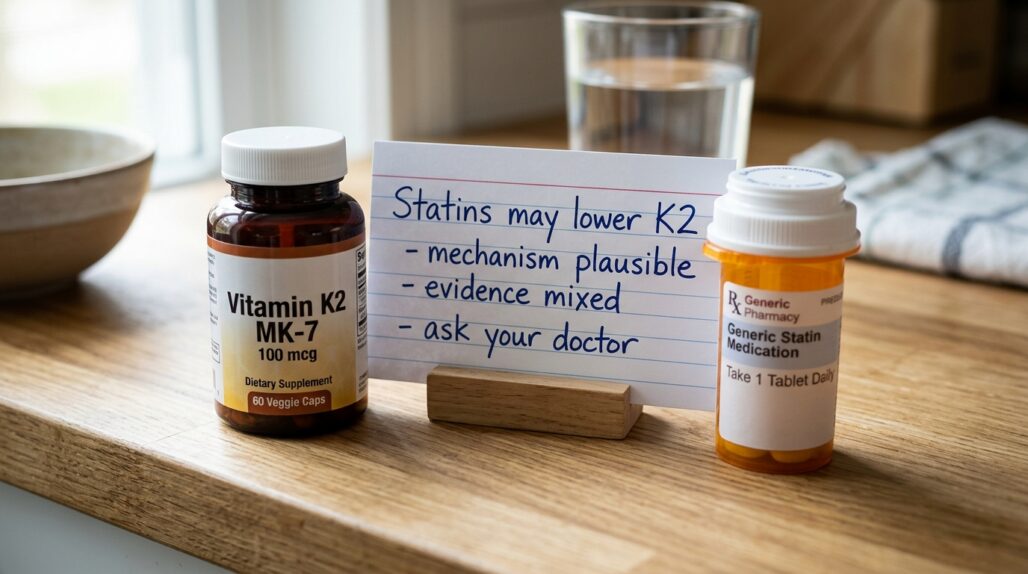
Before you decide
This is general information, not medical advice for your situation. Statins are among the most studied drugs in medicine, and for most people the cardiovascular benefit is well established. The question here is narrower: does taking one quietly drain your vitamin K2, and if so, does that matter?
The honest answer is that the science is unsettled. There is a coherent biochemical story, some animal data, and a real clinical paradox to explain. There is no clean human trial showing that statins cause a vitamin K2 deficiency you need to fix.
The people who should pay closest attention are anyone on an anticoagulant, people with chronic kidney disease or known vascular calcification, and anyone already taking high-dose K2 for bones or heart who also started a statin. For those groups the stakes of getting it wrong are higher, and the decision belongs with a clinician.
The hypothesis: how a statin could lower your K2
Your liver makes cholesterol through a pathway that runs on a molecule called mevalonate. Statins work by blocking HMG-CoA reductase, the rate-limiting enzyme near the top of that pathway. That same pathway also produces isoprenoids such as geranylgeranyl pyrophosphate (GGPP), which your body uses as raw material elsewhere.
Here is where vitamin K2 enters. The form your tissues make from dietary vitamin K, menaquinone-4 (MK-4), is built using those isoprenoid intermediates. The 2024 review by Tan and Li in Nutrition & Metabolism describes two routes by which statins could reduce MK-4: by shrinking the isoprenoid pool upstream, and by directly interfering with UBIAD1, the enzyme that converts vitamin K into MK-4.
The idea was put forward sharply in a 2015 paper. Writing in Expert Review of Clinical Pharmacology, Okuyama and colleagues argued that statins inhibit the synthesis of vitamin K2, the cofactor that switches on a protein called matrix Gla-protein. That paper read statin effects in a provocative way, so treat its conclusions as a hypothesis to test, not a verdict.
The proposed downstream consequence is the part worth understanding, so it gets its own section.

Why MK-4 and matrix Gla-protein matter
Matrix Gla-protein (MGP) is one of the strongest natural brakes on calcium building up in your arteries. But MGP only works once it has been activated through a vitamin K-dependent step called carboxylation. No active vitamin K in the tissue, no fully active MGP.
When vitamin K status is low, your body carries more of the inactive, uncarboxylated form of MGP. Higher levels of that inactive form have been repeatedly associated with more arterial calcification. So the logic chain runs: statin lowers MK-4, less MK-4 means less MGP activation, less active MGP means weaker protection against vascular calcification.
That chain is biologically reasonable. It is also where the argument stops being clean, because real bodies do not always behave like a flowchart.
Where the evidence gets messy
A few studies have observed that long-term statin use tracks with more coronary artery calcification, not less, in certain populations. That sounds like it supports the K2 story. The catch is that denser calcium can mean plaque is being stabilized, which may be protective rather than harmful, so the same finding has more than one reading.
Most of the direct statin-to-MK-4 evidence is mechanistic or from animals. The Tan and Li review notes mouse work in which a statin reduced MK-4 formation in tissue, and it explicitly frames the human mechanism as a "putative" one that needs more investigation. There is no large human trial demonstrating that statin users develop a clinically meaningful K2 deficiency that requires treatment.
Meanwhile, vitamin K supplementation trials in people are themselves inconsistent. A systematic review of controlled trials found that vitamin K can improve markers of MGP activation, but evidence that supplementing actually prevents cardiovascular events remains limited and inconclusive. So even if statins do nudge K2 down, it does not automatically follow that taking K2 fixes a hard outcome.
The fair summary: the mechanism is plausible, the human proof is missing, and confident claims in either direction are running ahead of the data.
The warfarin warning you cannot skip
If you take warfarin (Coumadin) or another vitamin K antagonist, the statin-K2 debate becomes a different, more urgent conversation, and the direction flips.
Warfarin works by interfering with vitamin K recycling, so any vitamin K you add – including K2 – opposes the drug. The FDA's Coumadin prescribing information warns that dietary vitamin K affects therapy and tells patients to keep vitamin K intake consistent and avoid drastic changes, with dosing controlled by regular INR checks. A K2 supplement is exactly the kind of change that breaks that consistency.
How small a dose matters? Smaller than most bottles. In a controlled study published in the Journal of Thrombosis and Haemostasis, even low daily doses of MK-7 (10 to 45 micrograms) measurably destabilized anticoagulation in people on a vitamin K antagonist. Many K2 supplements pack 90 to 180 micrograms per capsule, far above the amount that moved the needle.
So if you are on warfarin, do not add K2 to counter a statin without your anticoagulation clinic. Lowering your INR raises clot risk. This is a managed decision, not a self-experiment.
| Your situation | How relevant is the statin-K2 question | Sensible next step |
|---|---|---|
| On a statin, balanced diet, no anticoagulant | Theoretical; you likely get vitamin K from food | Mention it at your next review; no urgency to supplement |
| On a statin and on warfarin | High – any K2 can lower your INR | Do not add K2 alone; involve the anticoagulation clinic first |
| On a statin plus a DOAC (apixaban, rivaroxaban) | Different mechanism; vitamin K is not the lever here | Still confirm with the prescriber before any new supplement |
| CKD or known vascular calcification | Actively studied; do not freelance | Decide with your specialist, who may track MGP markers |
If you are not on a blood thinner
For the larger group on a statin who do not take an anticoagulant, the practical picture is calmer.
Vitamin K is present in leafy greens, some vegetable oils, and fermented and animal foods, so a reasonably varied diet supplies a baseline. There is no established recommendation to add K2 simply because you take a statin, and no specific dose has been proven to "restore" anything in statin users.
If you and your clinician do decide K2 is worth trying – often in the context of bone health or a family history of vascular calcification rather than the statin itself – keep a few things in mind. Forms differ: MK-7 has a far longer half-life than MK-4, which is precisely why it matters so much on warfarin. Studied amounts in supplements typically sit in the tens to low hundreds of micrograms per day, but the right number for you, if any, is a clinician's call, not a label's.
What you should not do is treat a viral "statins steal your K2" post as a reason to self-prescribe. The mechanism is interesting; it is not a prescription.

When to talk to a clinician or pharmacist
Bring this up at a routine visit rather than treating it as an emergency, unless one of the red-flag situations applies.
- You take warfarin or any vitamin K antagonist and are considering or already taking K2 – contact your anticoagulation clinic.
- You notice unusual muscle pain, weakness, or dark urine on a statin – that points to a separate statin-muscle issue and warrants prompt medical attention.
- You have kidney disease or documented arterial calcification and want a K2 strategy.
- You already take multiple supplements and are unsure how they stack with your prescriptions.
A pharmacist is an underused resource here and can run an interaction check on your full list in a few minutes. If you want to walk in with that list organized, a tool like StackMyMed lets you log every supplement and prescription so you can flag possible overlaps to raise with a professional. It helps you prepare the conversation; it does not replace clinical judgment.
For more background, see our vitamin K2 complete guide and the deeper vitamin K2 science explainer. You can sanity-check any combination with our drug-supplement interaction checker, and our ultimate guide to drug-supplement interactions covers the wider picture.
FAQ
Do statins definitely deplete vitamin K2? No. There is a plausible mechanism and some animal and lab support, but human evidence is mixed and clinically meaningful depletion has not been proven.
Should I take K2 just because I am on a statin? Not on your own. No dose has been shown to “fix” a statin effect in people, and the decision should involve the clinician who manages your statin, especially if you take other medications.
Is K2 dangerous with warfarin? It can be. Vitamin K opposes warfarin, and studies show even 10 to 45 micrograms of MK-7 daily can lower anticoagulation. Never add K2 to warfarin without your anticoagulation clinic.
What about K2 with apixaban or rivaroxaban? Those direct oral anticoagulants do not work through vitamin K, so this particular concern does not apply the same way. Still confirm any new supplement with your prescriber.
What is the difference between MK-4 and MK-7? Both are forms of K2. MK-7 has a much longer half-life and accumulates more in the blood, which makes it more likely to interfere with vitamin K antagonists like warfarin.
Does this mean statins cause artery calcification? The data are conflicting. Some studies link long-term statin use with more coronary calcium, but denser calcium can reflect plaque stabilization rather than harm, so the finding does not prove a net negative.
Conclusion: a real mechanism, not a reason to freelance
The statin-vitamin K2 link is a genuine scientific question, not a myth and not a settled fact. Statins sit upstream of the building blocks your body uses to make MK-4, and that could in theory weaken the proteins that keep calcium out of your artery walls. But the human evidence for actual depletion is thin, and supplementation trials are inconsistent about whether adding K2 changes hard outcomes.
The safe move is the same for almost everyone: keep eating a balanced diet, and raise any K2 plan with the clinician or pharmacist who knows your full medication list – urgently so if you take warfarin. Curiosity about the mechanism is healthy. Self-prescribing around your heart medication is not.
This article is for general education and is not a substitute for personalized medical advice. Supplement and medication decisions, including anything affecting anticoagulation, should be made with a qualified healthcare professional who knows your history.
Reviewed by the UsefulVitamins Editorial Team.
