

You are gathering a list, not making a diagnosis
It is easy to spiral here. A parent mentions a new turmeric capsule or a friend's vitamin recommendation, and suddenly you are searching late at night trying to decide whether it is dangerous next to their heart pills. That worry is reasonable, but the task is smaller and calmer than it feels.
You are not the person who decides whether a combination is safe. A pharmacist or doctor does that, and they do it fast when they can see the whole picture. What they almost never have is the whole picture, because supplements get bought at a different store, started without anyone being told, and left off the chart.
So your real job is collection. Build one accurate, complete list of everything your parent takes, then bring it to someone trained to read it. Everything below helps you do that part well.
Why this slips through the cracks
Older adults often see several prescribers. A cardiologist, a primary care doctor, maybe an orthopedist after a hip replacement. Each one knows what they prescribed, but no single person reliably sees the full stack, and supplements rarely make it onto any chart at all.
That gap matters because risk rises with the number of products. Adults aged 65 and older are far more likely to land in the hospital from an adverse drug event than younger people, in part because they simply take more medicines at once, as the CDC medication safety data describe. Pharmacist-led reviews of the full bag regularly turn up duplicate medicines, wrong doses, and combinations worth a closer look, according to the AHRQ Patient Safety Network summary of brown bag review outcomes.
Most of what you will find is harmless. But a few combinations come up often enough in older adults that they are worth knowing by name, so you can flag them rather than panic about them.
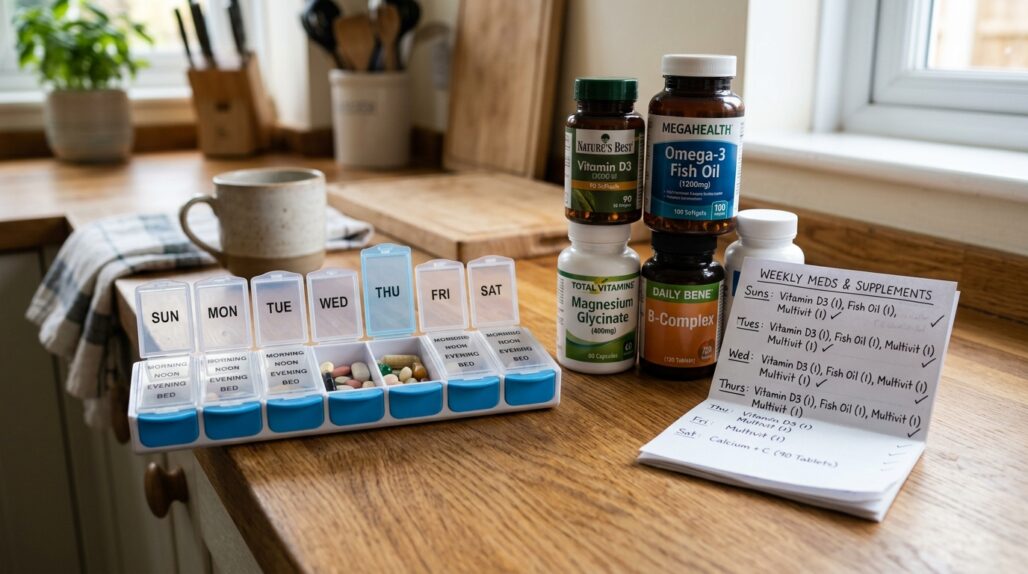
Step one: gather everything in one place
Before you worry about any single interaction, get the inventory right. A list that is missing two bottles is worse than no list, because it looks complete and is not.
- Pull every container your parent actually takes, not just the prescriptions. That means tablets, capsules, liquids, eye drops, inhalers, patches, creams, and anything bought at a pharmacy, grocery store, or online.
- Include the supplements people forget to count: a daily multivitamin, fish oil, magnesium, calcium, vitamin D, probiotics, herbal teas, and anything labeled "natural."
- Check more than one room. The kitchen cabinet, the bathroom, the nightstand, a handbag, and the car glovebox all tend to hold strays.
- Note who prescribed or recommended each one, and which pharmacy filled it. This is how a reviewer spots two doctors prescribing the same thing under different names.
- Write down the dose and how often, exactly as your parent takes it, which is not always what the label says.
If you can, keep the original containers together in one bag. The labels carry strength, prescriber, and fill date that a handwritten note often loses.
A list you can build on paper today
You do not need any app or service for this. A single sheet works, and a pharmacist will happily read it. Copy this layout into a notebook or print a version for the fridge.
| Product name | Strength and dose | How often and when | Prescribed by / bought where |
|---|---|---|---|
| Warfarin | 3 mg, one tablet | Daily, evening | Cardiologist / Main St Pharmacy |
| Levothyroxine | 75 mcg, one tablet | Daily, empty stomach AM | Primary care / Main St Pharmacy |
| Fish oil | 1000 mg | Twice daily with meals | Self / grocery store |
| Calcium + vitamin D | 600 mg / 800 IU | Morning with breakfast | Self / pharmacy |
Keep a few blank rows. People remember the cinnamon capsule or the eye drops halfway through the conversation, and you want room to add them on the spot.
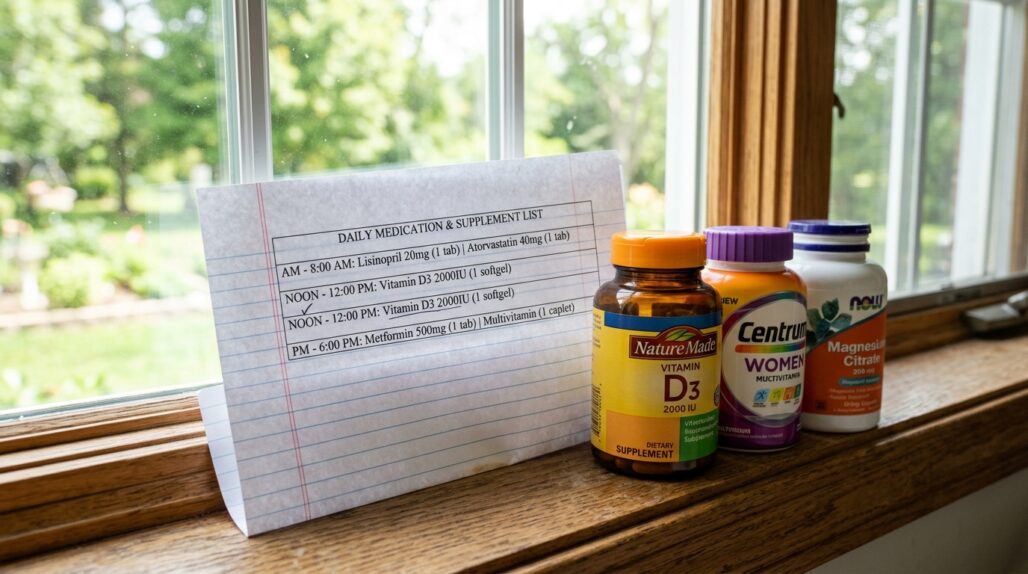
Common combinations worth flagging (not diagnosing)
These are examples to raise with a pharmacist, not a verdict you reach yourself. Many people take some of these pairings safely under monitoring. The point is to put a small star next to them on your list so they get a second look.
Blood thinners with supplements that thin blood further. If your parent takes warfarin or another anticoagulant, several common supplements may add to bleeding risk. One large analysis in a Veterans Administration population found a measurable increase in bleeding events among warfarin users who also took ginkgo, reported in this NCBI/PMC study. High-dose fish oil and vitamin E above roughly 400 IU can push the same direction. None of this means stopping anything; it means the combination deserves a pharmacist's eyes.
Vitamin K and warfarin. Vitamin K is the counterweight to warfarin, so a sudden change in intake, including a new high-dose supplement or a green-heavy diet shift, can swing how well the medication works. The guidance is steady intake plus regular blood testing, not avoidance, as Mayo Clinic explains in its warfarin interaction overview. A new vitamin K product is a reason to call before starting.
St. John's Wort with almost anything. This herbal mood supplement can weaken a long list of important medicines by speeding up how the body clears them. The NCCIH overview of St. John's Wort names warfarin, digoxin, birth control pills, cyclosporine, certain statins, and several others. If you find it in the bag, flag it clearly.
Calcium or iron close to thyroid pills. Both minerals can block absorption of levothyroxine when taken around the same time, which can quietly make the thyroid dose work less well. The usual fix is timing, not stopping: a systematic review of levothyroxine interactions with food and supplements supports separating them by several hours. Some antibiotics have a similar spacing rule.
Potassium supplements with certain heart and blood pressure medicines. ACE inhibitors and ARBs already tend to raise potassium, and adding a potassium supplement or a potassium-based salt substitute on top can push levels too high, especially with the reduced kidney function common in older age. The NIH Office of Dietary Supplements potassium fact sheet spells out that risk, which makes this a clear "ask before adding" item.
Step two: bring the list to a pharmacist
A pharmacist is the most reachable expert for this exact question, and many pharmacies offer a free review where you bring everything in a bag. It is sometimes called a brown bag review, and it is built for the situation you are in.
Bring the bag of original containers and your written list. Note any product started in the last few months, since new additions cause most fresh interactions, and mention every prescriber so duplicates surface. Ask directly: "Is anything here working against something else, and is the timing right?"
The pharmacist will check for duplicate ingredients, doses that look off, timing conflicts, and combinations to watch. What they flag goes back to the prescribing doctor; you do not change a dose on your own, and you never stop a parent's prescription without that conversation.
Once you have a clean list, the work is keeping it current. The hard part is not the first list, it is remembering to update it when a doctor adds a pill or your parent grabs a new bottle. A weekly habit of glancing at the pill organizer and a quick note on the fridge sheet handles this for most families. If you would rather keep it on a phone, StackMyMed (our own free app) lets you log every prescription alongside the supplements and flags possible interactions to raise at the next pharmacist visit, which is still where the safety call gets made. Whether the list lives on paper or in an app, the value is the same: one current record, reviewed by someone trained to read it.

When to stop checking and call
Most of this is calm, unhurried work. But a few signs mean you skip the list and call a doctor or seek care now.
- Unusual bleeding or bruising: nosebleeds or gum bleeding that will not stop, blood in urine or stool, black tarry stools, or bruises appearing without injury, especially on a blood thinner.
- Sudden dizziness, weakness, or confusion, or a fall, which can signal a blood pressure or medication problem.
- A bad reaction after starting something new: rash, swelling, trouble breathing, or a racing heart.
Mayo Clinic notes that bleeding risk is higher in adults over 65, so do not wait out symptoms that worry you. When in doubt, the urgent-care or emergency line is the right call, and the list you built comes with you.
FAQ
Do I really need to involve a pharmacist, or can I just search each one online? Search results can tell you a combination exists, but they cannot weigh your parent’s actual doses, kidney function, and full medication list together. A pharmacist sees the whole picture and is free to consult.
My parent takes a lot of supplements. Is that automatically dangerous? Not automatically, but more products mean more chances for overlap and interaction. A review is the calm way to find out which are pulling their weight and which are worth a question.
Should I just throw out the supplement I am worried about? No. Some supplements are prescribed or matter for a real reason, and stopping abruptly can cause its own problems. Flag it on the list and let the pharmacist or doctor advise.
What if different doctors do not know what the others prescribed? That is exactly what your single list fixes. Bringing one complete record to each visit, or to a pharmacist, is the simplest way to close that gap.
Are over-the-counter products and vitamins really worth listing? Yes. Common items like high-dose fish oil, vitamin E, calcium, and St. John’s Wort are among the ones that interact with prescriptions, and the FDA’s guidance for dietary supplement users advises telling every provider about all of them. Leaving them off defeats the purpose.
How often should we redo the review? A good rule is at any new prescription, after a hospital stay, and roughly once a year otherwise. Keeping the list current between reviews makes each one faster.
The bottom line
The worry is valid, but the task is smaller than the worry. Build one complete list of everything your parent takes, star the few combinations that come up often in older adults, and hand it to a pharmacist or doctor to read. You are gathering and asking, not diagnosing or adjusting doses. If bleeding, dizziness, confusion, or a reaction to something new shows up, that is a call-now moment, and the list goes with you. For deeper reading on specific pairings, see our drug and supplement interaction checker, the ultimate guide to drug and supplement interactions, and our notes on CoQ10 and warfarin and vitamin K2 MK-7 and warfarin.
This article is for general information and is not medical advice. It does not replace a conversation with your parent's pharmacist or doctor, who can weigh their full history before any change. Never start or stop a prescription, or adjust a dose, on your own.
StackMyMed is made by UsefulVitamins. It helps you organize your list and flag things to discuss with a pharmacist or doctor; it is not a diagnosis or treatment tool and does not replace professional medical advice.
Reviewed by the UsefulVitamins Editorial Team.
