
Affiliate disclosure: this article contains affiliate links. As an Amazon Associate, UsefulVitamins.com earns from qualifying purchases at no extra cost to you.
Why the timing question is the wrong place to start
Most people search "morning or night" expecting a single correct answer. The honest version is that the clinical trials did not test time of day as the variable that drives results – they tested a daily dose taken consistently for weeks.
Ashwagandha is an adaptogen. Its stress and sleep effects come from steady daily exposure that nudges your cortisol rhythm over time, not from a same-day kick you feel within an hour. That is why the timing decision is really a convenience and goal decision.
So the useful question is not "what hour is best" but "what is my goal, and which schedule keeps me taking it every single day?" Get those two right and the morning-versus-night debate mostly disappears.
The goal-based decision tree
Pick the row that matches what you are actually after. Each maps to a timing that fits how people use it in practice and how the doses were studied.
| Your main goal | When to take it | Typical daily amount | Why this timing |
|---|---|---|---|
| Daytime stress and focus | Morning, with breakfast | 300 to 600 mg root extract | Lines up support with the part of the day you feel most stress; avoids any daytime drowsiness for those sensitive to it |
| Sleep and evening wind-down | Evening, 1 to 2 hours before bed, with food | 300 to 600 mg root extract | Sleep trials dosed in the evening or split; some people find it mildly calming, so night fits better |
| All-day stress plus sleep | Split, about 300 mg morning and 300 mg evening | 600 mg total | Mirrors the twice-daily design used in several stress and sleep studies; smooths the dose across the day |
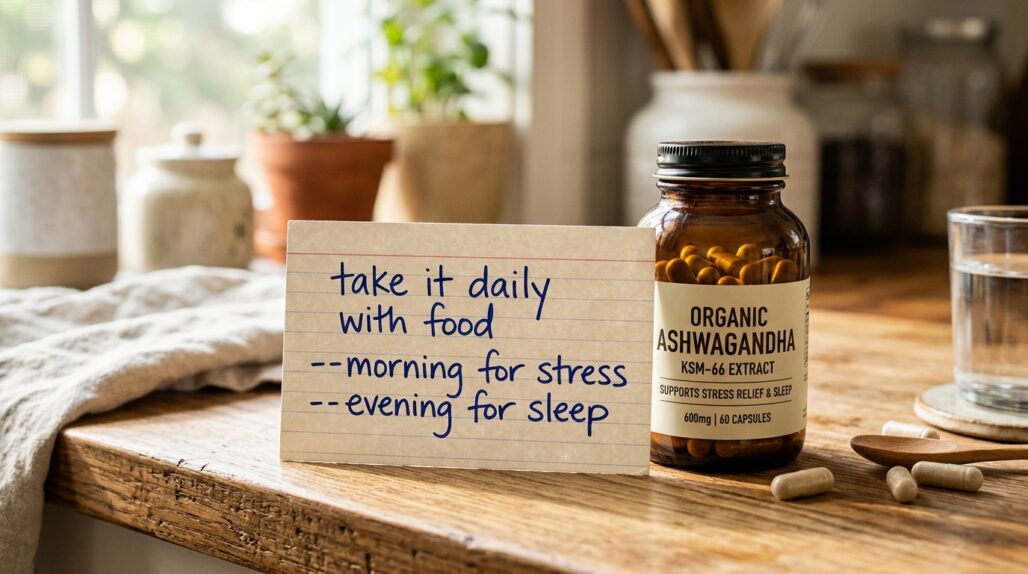
A practical note on the split schedule: the well-known stress study split 600 mg into two 300 mg capsules taken morning and evening, so a split is not a compromise – it is exactly how the higher dose was delivered in the trial.
If you genuinely do not have a single goal, default to the split or to whichever single time you will never forget. A dose you take every day beats a perfectly timed dose you skip twice a week.
Take it with food, and why that helps
Across consumer and clinical guidance, the steady recommendation is to take ashwagandha with food. The main reason is tolerability – on an empty stomach it can cause stomach upset, nausea, or loose stools in some people.
Food also gives a little fat for the fat-soluble withanolides (ashwagandha's active compounds) to travel with, which is the practical reason most labels say "with a meal." Benefits are not known to drop if you take it without food; the with-food rule is mostly about comfort.
If you chose the evening schedule, that means dinner or an evening snack, not a glass of water on an empty stomach right before bed. Pair the dose with a meal you eat reliably and the habit sticks.
KSM-66 vs Sensoril: which extract fits morning vs night
Not all ashwagandha is the same product. The two most-studied branded extracts are built differently, and that shapes which one fits your timing.
KSM-66 – the all-rounder, leans morning or split
KSM-66 is a root-only extract standardized to about 5% withanolides, typically dosed at 300 to 600 mg per day. It has the largest body of trials behind it, including the stress study where 600 mg daily for 8 weeks reduced serum cortisol by roughly 32% versus baseline in healthy stressed adults, published in a double-blind placebo-controlled trial by Salve and colleagues.
Because it is balanced rather than heavily sedating, KSM-66 is the easy pick for morning use or a morning-plus-evening split. It is also the extract with the strongest published sleep data, so it works in the evening too.
Sensoril – higher concentration, leans evening
Sensoril is a root-and-leaf extract standardized to about 10% withanolides, so a much smaller milligram dose (often around 125 to 250 mg) delivers a comparable withanolide load. It tends to be marketed for relaxation and sleep.
Many people find Sensoril more noticeably calming, which is why it shows up in evening and sleep formulas. If a daytime dose makes you feel a little flat, an evening Sensoril dose may suit you better than a daytime one.
| Extract | Plant part | Withanolide standardization | Common dose | Best fit |
|---|---|---|---|---|
| KSM-66 | Root only | About 5% | 300 to 600 mg/day | Morning or split; broad stress, sleep, and general use |
| Sensoril | Root and leaf | About 10% | 125 to 250 mg/day | Evening; relaxation and sleep-leaning use |
One safety footnote on extract choice: the leaf contributes more withaferin A, the compound most often named in liver-injury case reports. That is not a reason to panic over a standard dose, but it is a reason to stick to a labeled amount of a known branded extract rather than an unstandardized "more is better" powder.

How long before you feel anything
This is where expectations matter most. Ashwagandha is not acute – you should not judge it by how you feel an hour after the first capsule.
In the stress trial, the meaningful drops in cortisol and Perceived Stress Scale scores were measured at the 8-week mark, with the higher dose moving PSS from about 23 down to 14. Many people report feeling steadier somewhere in the 2 to 4-week range, but the studied window is longer.
For sleep, a systematic review and meta-analysis of ashwagandha and sleep found the effect was clearer at doses of at least 600 mg per day taken for at least 8 weeks. A separate double-blind insomnia and anxiety study by Langade and colleagues used a root extract over several weeks before seeing improvement.
| Stage | What is realistic |
|---|---|
| Day 1 to week 1 | Usually nothing dramatic; some feel a faint calm, many feel no change yet |
| Weeks 2 to 4 | Subtle, building changes in stress reactivity or sleep for many people |
| Weeks 6 to 8 | The window where trials measured clear cortisol, stress-score, and sleep effects |
| Beyond 12 weeks | Reassess; long-term daily safety is less studied, so this is a good point to check in with a clinician |
If you are several weeks in at a sensible dose and feel no change at all, that is your signal to stop chasing the timing and look at the bigger picture instead of stacking more capsules.
Cycling, sedatives, and the cautions that actually matter
A common question is whether to take breaks. Trial evidence mostly covers about 8 to 12 weeks, and major reviews note ashwagandha is generally considered safe for short-term use of up to about 3 months. Many people prefer to cycle on and off rather than run it indefinitely; we walk through the why and how in our guide to cycling ashwagandha on and off.
The interactions worth taking seriously, per the NCCIH overview of ashwagandha safety:
- Sedatives and sleep medication. Ashwagandha can add to drowsiness, so do not stack it with benzodiazepines, sleep aids, or other CNS depressants without a pharmacist's sign-off.
- Thyroid medication. It may raise thyroid hormone levels; people on thyroid drugs or with thyroid disorders should check first.
- Diabetes and blood pressure medication. It can lower blood sugar and blood pressure, which may stack with those drugs; if you are on a common one, see our note on taking ashwagandha with metformin.
- Pregnancy, breastfeeding, surgery, autoimmune conditions, and hormone-sensitive prostate cancer. NCCIH lists these as reasons to avoid it or get medical advice.
On the liver: the NIH LiverTox database rates ashwagandha a probable but uncommon cause of liver injury, with cases that have generally been mild to moderate and reversed after stopping. Stop and seek care if you notice jaundice, dark urine, persistent nausea, or right-upper-belly pain. That is not a timing issue; it applies whenever you take it.

Which form to buy for your timing
The choice is less about brand and more about matching the extract to your goal and dose. If you want broad stress support or a morning or split routine, a standardized KSM-66 root extract is the straightforward pick. If you are aiming squarely at evening wind-down, a higher-concentration Sensoril option or a lower-cost standardized capsule can work. Our roundup of standardized ashwagandha supplements compares specific products on extract type and dose.
We may earn a commission from the links below, at no extra cost to you. It does not change which forms we recommend.


As an Amazon Associate, UsefulVitamins.com earns from qualifying purchases at no extra cost to you.
Whatever you pick, check the label for the branded extract name and the milligram dose per capsule so you actually know whether you are taking 300 mg or 600 mg, and so your morning or evening dose is consistent day to day.
FAQ
Can I take ashwagandha on an empty stomach? You can, but many people get mild stomach upset that way. Taking it with a meal improves comfort and gives the fat-soluble withanolides something to absorb with, so with food is the safer default.
Does ashwagandha work the first day I take it? Not in the way most people hope. It is an adaptogen, so the studied stress and sleep effects build over about 2 to 4-plus weeks, with the clearest trial results at the 8-week mark.
Is it better for sleep specifically? For sleep, the evidence is strongest at doses of at least 600 mg per day for at least 8 weeks, and many people take that dose in the evening. See our complete ashwagandha guide for the trial details.
Should I split the dose or take it all at once? Both are used in trials. A single 600 mg dose and a 300 mg morning-plus-evening split were both studied; split it if you want all-day coverage or if a single large dose bothers your stomach.
Can I take ashwagandha with my sleeping pill or anti-anxiety medication? Do not combine them on your own. Ashwagandha can add to sedation, so talk to a pharmacist or doctor before pairing it with sedatives, sleep aids, or other CNS depressants.
How does ashwagandha fit with the rest of my routine? Treat it as one piece, not a fix-all. Our complete ashwagandha guide covers extracts, dosing, evidence, and safety in one place if you want the full picture before you start.
The bottom line
Morning or night is a goal question, not a rules question. Take it in the morning for daytime stress, in the evening for sleep, or split about 300 mg twice daily for both – and take it with food at the same time every day.
The thing that actually moves results is consistency over several weeks at a sensible 300 to 600 mg dose of a standardized root extract, not the hour on the clock. Match the extract to your goal, give it time, and reassess around the 8 to 12-week point.
This article is general education, not medical advice, and ashwagandha is not a treatment for any condition. Talk to a pharmacist or doctor before starting it, especially if you take prescription medication, are pregnant or breastfeeding, or have a thyroid or liver condition.
Reviewed by the UsefulVitamins Editorial Team.
