
If you're on semaglutide or tirzepatide and dealing with constipation, you've probably stared at a wall of Amazon magnesium listings and wondered which one actually helps. The short answer: magnesium citrate is the right starting point for most GLP-1 users, but the form matters more than the brand, and most labels are designed to confuse you on dose. This article breaks down which form addresses the GLP-1 mechanism, which are oversold for this purpose, and how to read a label so you don't buy something with 300 mg of compound that delivers only 18 mg of the mineral you actually need. You'll get a comparison table, five product picks with honest trade-offs, and one category to skip.
Affiliate disclosure: this article contains affiliate links. As an Amazon Associate, UsefulVitamins.com earns from qualifying purchases at no extra cost to you.

Quick answer: best magnesium for GLP-1 constipation
Top Pick for most users: Pure Encapsulations Magnesium Citrate. Third-party tested, transparent elemental dosing, reliable for GI relief without the cramping risk of oxide.
Best for: GLP-1 users with constipation as the primary complaint; adults who want an evidence-anchored form without guesswork on dose.
Not ideal for: People with kidney disease; anyone on antibiotics, diuretics, or bisphosphonates without prescriber sign-off; cost-sensitive buyers (see the budget pick below).
What to check before buying: Elemental dose stated on Supplement Facts? Specific salt named? Third-party verification beyond GMP?
Decision shortcut: 200-400 mg elemental citrate at bedtime. Sleep disruption also a concern? A bisglycinate-citrate blend covers both. Cost-sensitive? NOW Foods citrate, same molecule, far less.
Why GLP-1 medications slow your gut
GLP-1 receptor agonists like semaglutide (Wegovy) and tirzepatide (Zepbound) slow gastric emptying intentionally, to reduce hunger. The same slowing extends down the GI tract, and constipation affects roughly 25% of GLP-1 users, especially in early weeks on a dose.
Magnesium addresses this osmotically: certain forms draw water into the colon, soften stool, and stimulate movement. "Certain forms" is doing the work in that sentence — not every salt does this. For a full side-effect overview, see common GLP-1 peptide side effects.
Choosing the right form
Think of magnesium salts like different delivery trucks carrying the same cargo. The destination (elemental magnesium) is identical; the route and speed differ dramatically.
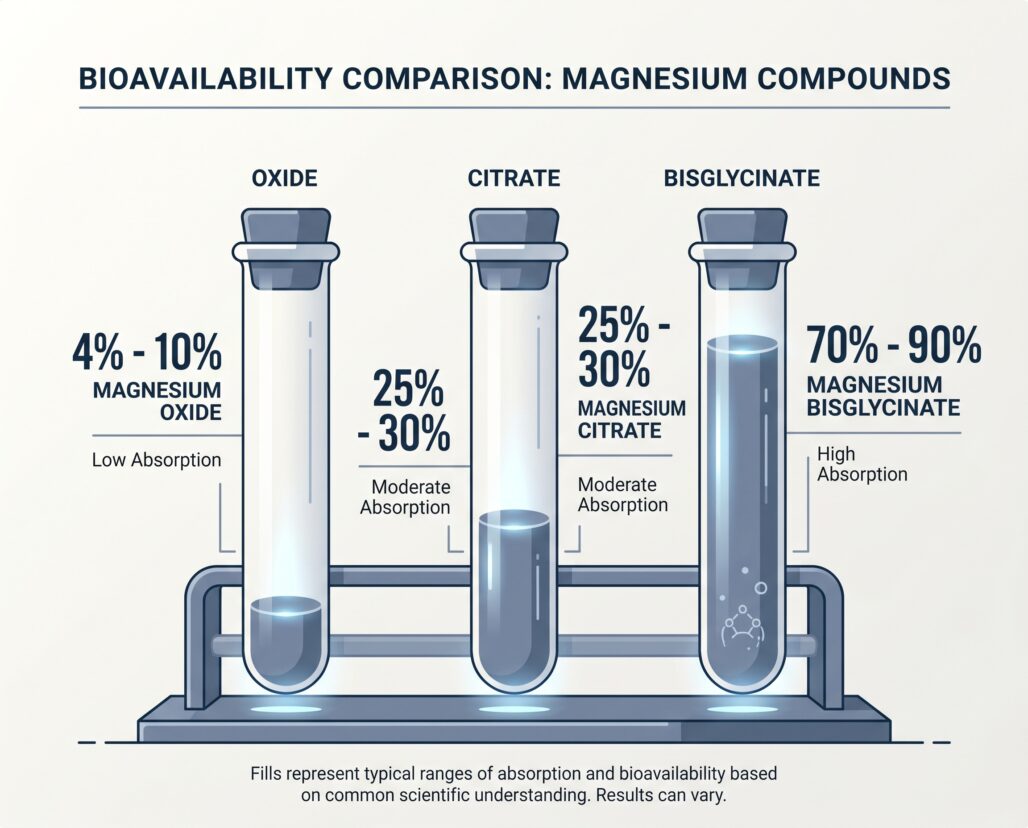
Magnesium oxide is cheapest and has the strongest osmotic effect, with roughly 4% absorption. What isn't absorbed pulls water into the intestine fast — which is why oxide works, and also why it carries a meaningful cramping risk at typical doses.
Magnesium citrate hits the middle ground most GI clinicians prefer: meaningful osmotic effect, ~30% bioavailability, lower cramping risk than oxide at equivalent elemental doses.
Magnesium bisglycinate (glycinate) is gentle and sleep-friendly, but not an osmotic agent at typical doses. Reaching for glycinate because it "sounds gentle" is the wrong call when constipation is the acute problem. It's the right form once your bowel function normalizes — and it's the centerpiece of the magnesium cluster (A) launching here in July 2026.
Magnesium threonate is designed for brain penetration. For a slow colon, it's the wrong tool for the job.
The label math problem
"Magnesium Oxide 500 mg" on the front of a bottle is ~300 mg elemental, absorbed poorly. "Magnesium Glycinate 240 mg" may be only 24 mg elemental, depending on the chelation ratio. The compound mass tells you nothing useful. Always check the Supplement Facts panel for elemental magnesium.
How we picked
We reviewed 25+ products tagged "magnesium citrate" or "magnesium for constipation" on Amazon with at least 500 reviews. Selection criteria: elemental dose stated explicitly on the Supplement Facts panel, magnesium salt clearly identified, third-party verification (NSF, USP, or ConsumerLab), and cost per 100 mg elemental as the price comparator. We cross-referenced availability on practitioner platforms (FullScript, Wellevate) as a quality proxy. We did not conduct lab testing.
Comparison table
| Brand | Form | Elemental Mg per dose | Cost per 100 mg elemental | GI tolerability | Sleep-friendly | Third-party verified | Best for |
|---|---|---|---|---|---|---|---|
| Pure Encapsulations Mag Citrate | Citrate | 150 mg | ~$0.23 | Moderate, low cramping risk | No | Yes (NSF) | Top Pick: daily GLP-1 constipation |
| NOW Foods Magnesium Citrate | Citrate | 120 mg | ~$0.07 | Moderate | No | Yes (GMP certified) | Budget: same form, lower cost |
| Solgar Magnesium Citrate | Citrate | 200 mg | ~$0.16 | Moderate | No | Yes (USP ingredient standard) | Higher elemental dose, easy titration |
| Doctor's Best High Absorption | Bisglycinate (Albion TRAACS) | 100 mg | ~$0.12 | Gentle | Yes | Yes (Albion chelate verified) | Sensitive stomach + sleep combo |
| BioOptimizers Magnesium Breakthrough | 7-form blend | ~75 mg citrate fraction | ~$1.77 total dose | Variable | Yes (glycinate fraction) | No independent 3P on full blend | Premium multi-symptom stacking |
| Nature Made Magnesium Oxide | Oxide | 250 mg | ~$0.02 | High laxative effect, cramping risk | No | Yes (USP) | Occasional use only |
Product picks
Top Pick: Pure Encapsulations Magnesium Citrate
Form: Magnesium citrate (150 mg elemental per 2-capsule serving)
Best for: Most GLP-1 users seeking reliable daily constipation support
Why we picked it: Pure Encapsulations states the elemental dose on the label without requiring conversion math, sources from verified pharmaceutical-grade suppliers, and holds NSF certification on this product line. The citrate form delivers meaningful osmotic effect without the cramping risk of oxide, and 150 mg elemental per serving sits inside the 200-400 mg clinical range at two capsules.
The trade-off: At roughly $0.23 per 100 mg elemental, it costs about 3x the NOW Foods citrate below. You're paying for NSF verification and transparent supply-chain disclosure, not a chemically superior molecule. Both deliver magnesium citrate.
Skip if: Cost is the deciding factor, or you only need occasional support. NOW Foods delivers the same form for far less.
Actionable takeaway: Our default recommendation for GLP-1 users who want citrate without the label-reading headache.
Premium choice: BioOptimizers Magnesium Breakthrough
Form: 7-form blend including citrate, malate, bisglycinate, taurate (~500 mg compound per serving)
Best for: People managing GLP-1 constipation AND sleep disruption AND exercise recovery at once
Why we picked it: BioOptimizers combines citrate (GI motility) with bisglycinate and taurate (sleep, relaxation) in one product, which is genuinely useful when you're managing multiple GLP-1 side effects at once.
The honest valuation: BioOptimizers Magnesium Breakthrough costs around $80 for 60 capsules, roughly $1.33 per dose. NOW Foods Magnesium Citrate is about $0.13 per dose. The 10x premium buys six additional magnesium forms — but there are no head-to-head RCTs showing additive benefit over single-form citrate for constipation. More forms in one capsule is not necessarily more effective.
Skip if: Constipation is your only concern. BioOptimizers has also not published NSF or USP testing on the full finished blend as of this writing.
Actionable takeaway: Worth considering only when managing several GLP-1 side effects simultaneously and single-form citrate has proven insufficient.
Budget pick: NOW Foods Magnesium Citrate
Form: Magnesium citrate (120 mg elemental per 3-capsule serving)
Best for: Cost-sensitive buyers; first-time magnesium users testing the form before committing to a premium brand
Why we picked it: NOW Foods discloses the form and elemental dose clearly, holds GMP certification, and is consistently available with high review volume. For GLP-1 constipation, it delivers the same citrate molecule as the Pure Encapsulations option at roughly one-third the cost per dose.
The trade-off: GMP certification is a manufacturing quality floor, not the same as NSF product-specific third-party testing on finished capsules. The label is honest; the independent audit trail is lighter.
Skip if: You want batch-by-batch finished-product verification.
Actionable takeaway: A sensible starting point. If you respond well and want more supply-chain assurance long-term, move up to Pure Encapsulations.
Best for sensitive stomach: Doctor's Best High Absorption Magnesium
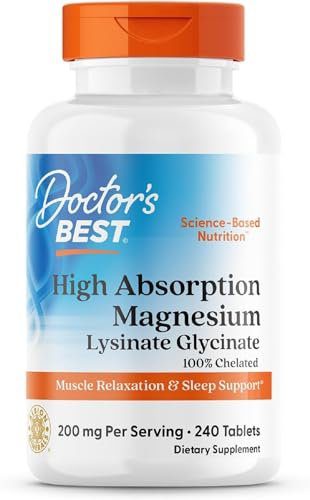
Form: Magnesium bisglycinate chelate (Albion TRAACS), 100 mg elemental per 2-tablet serving
Best for: GLP-1 users with GI sensitivity beyond constipation (nausea, cramping, IBS overlap); anyone bridging from constipation relief to long-term daily magnesium support
Why we picked it: Albion TRAACS is the most documented chelation source in the clinical literature on magnesium glycinate, and Doctor's Best discloses the supplier on-label. Bisglycinate at this dose is gentle enough for indefinite daily use without osmotic urgency.
Important caveat: Bisglycinate won't deliver constipation relief at typical doses — it isn't osmotic. Use citrate first while constipation is active, then transition to bisglycinate for maintenance. This is also the form the magnesium cluster (A) launching in July 2026 will cover in depth.
Skip if: You need acute constipation relief today.
Actionable takeaway: Our pick for transitioning from acute relief to daily maintenance, especially if sleep disruption is also a concern.
Best for sleep plus constipation: Solgar Magnesium Citrate
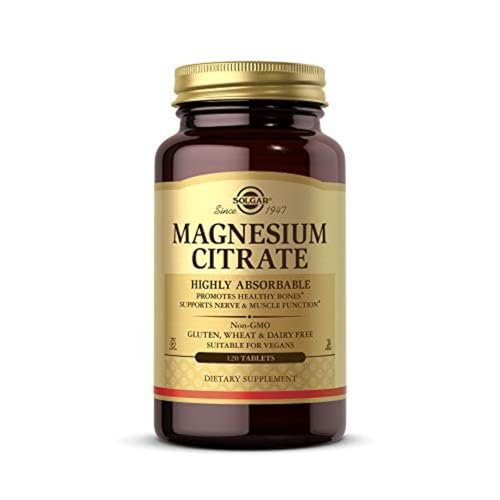
Form: Magnesium citrate (200 mg elemental per 2-tablet serving)
Best for: GLP-1 users who want the higher end of the clinical citrate range in one serving; people who prefer tablets to capsules
Why we picked it: Solgar delivers 200 mg elemental citrate per serving — the upper end of the clinical range — without swallowing six capsules. USP ingredient standards, long practitioner track record.
The trade-off: At 200 mg elemental per serving, loose-stool risk is slightly higher than with the 150 mg Pure Encapsulations option. Start at one tablet (100 mg elemental) and titrate.
Skip if: 150 mg elemental is already working.
Actionable takeaway: A clean dose-escalation step when 150 mg elemental citrate proves insufficient.
Brands to skip
Skip: Nature Made Magnesium Oxide 250 mg as a daily GLP-1 strategy
Nature Made is a legitimate brand with USP verification. The problem is the form. Oxide has roughly 4% oral absorption compared to ~30% for citrate. At 250 mg elemental in one dose, the cramping risk is real — and for GLP-1 users already managing nausea and variable motility, adding an unpredictable osmotic event is poor symptom management.
Occasional low-dose use is fine. As a daily GLP-1 constipation strategy, citrate is more controlled.
The honest move: If cost is the objection, NOW Foods Magnesium Citrate delivers a better form for $0.07 per 100 mg elemental. Oxide's price advantage collapses when most of what you're buying isn't absorbed.
Skip: Any product listing only "magnesium 500 mg" without naming the salt
Dozens of Amazon listings do this. Without knowing the salt, you cannot determine the elemental dose or predict the GI effect. There is no legitimate reason to omit the form. If the label doesn't specify the salt, skip it.
How to use magnesium for GLP-1 constipation
Starting dose: 200 mg elemental magnesium citrate at bedtime — the lower end of the GI motility study range.
Titration: No improvement after 3-5 days? Increase to 300-400 mg elemental. Don't exceed 400 mg supplemental without pharmacist input.
Timing: Bedtime. The osmotic effect is gradual (6-12 hours), so evening dosing produces movement the next morning.
When to reassess: Once constipation resolves, drop to 100-150 mg elemental maintenance or switch to bisglycinate.
Side effects and when not to use it
GI side effects (loose stools, urgency, cramping) are dose-dependent and more common with oxide than citrate at equivalent elemental doses.
Kidney disease is a hard contraindication. In CKD stage 3b or higher, supplemental magnesium can accumulate. Do not supplement without nephrologist guidance.
Drug interactions to flag with your prescriber: antibiotics (quinolones, tetracyclines) and bisphosphonates — space magnesium by at least 2 hours. Diuretics and proton pump inhibitors — effect on magnesium levels varies; discuss with prescriber.
For a broader picture of GLP-1 supplement interactions, see supplements for GLP-1 muscle loss.

FAQ
How much magnesium citrate should I take for GLP-1 constipation?
Start at 200 mg elemental at bedtime. Titrate up by 100 mg increments every 3-5 days if needed, up to 400 mg. Loose stools signal you've exceeded your threshold.
Can I take magnesium alongside my GLP-1 injection?
Timing relative to your GLP-1 injection is not a documented concern. The interaction risk is with Rx medications (antibiotics, diuretics), not with semaglutide or tirzepatide.
How long before I notice results?
Most users notice a change within 1-3 days of starting 200 mg elemental citrate. Pairing it with adequate fiber and fluid speeds results. See our fiber supplements for GLP-1 users guide for the dietary fiber half of the equation.
Can I take too much?
Yes. Above 400-500 mg elemental/day from supplements, diarrhea is common. The NIH tolerable upper intake level for supplemental magnesium is 350 mg/day (separate from dietary intake). Hypermagnesemia is rare with healthy kidneys but a real risk in CKD.
Is the budget NOW Foods option just as good as Pure Encapsulations?
The molecule is the same: magnesium citrate. NOW Foods holds GMP manufacturing certification; Pure Encapsulations holds NSF product-specific testing on finished capsules. Defensible for short-term use; for long-term daily supplementation, the additional testing is worth the step-up cost.
What's the difference between citrate and bisglycinate for this purpose?
Citrate draws water into the colon osmotically — that's why it relieves constipation. Bisglycinate has no osmotic effect at typical doses. Use citrate while constipation is active; switch to bisglycinate for long-term daily maintenance once bowel function normalizes.
As an Amazon Associate, I earn from qualifying purchases. Product recommendations are based on real reviews and independent research.
Related reading
- Common GLP-1 peptide side effects: what to expect on Wegovy and Zepbound
- Best fiber supplements for GLP-1 users
- Best electrolyte drinks for GLP-1 nausea
- Supplements for GLP-1 muscle loss
Conclusion: the bottom line on magnesium for GLP-1 constipation
GLP-1 constipation is common and manageable. Magnesium citrate at 200-400 mg elemental at bedtime addresses the mechanism directly: it draws water into a slowed colon without the unpredictable cramping risk of oxide. The form matters. "#1 best-seller on Amazon" should never be the only reason to buy. Most top-ranked products list compound mass on the front of the label and bury the elemental dose in the Supplement Facts panel. Check the Supplement Facts first.
For most readers: Pure Encapsulations Magnesium Citrate is the cleanest starting point. Cost-sensitive? NOW Foods citrate is the same molecule at a fraction of the price. Managing sleep disruption alongside constipation? Bisglycinate once the acute phase resolves — or a multi-form blend if you need to address both immediately.
Next steps:
- Confirm no kidney disease or interacting medications before starting
- Start at 200 mg elemental citrate at bedtime; titrate up by 100 mg every 3-5 days if needed
- Pair with adequate fiber intake (see best fiber supplements for GLP-1 users)
- Reassess at 4-6 weeks; if constipation has resolved, transition to bisglycinate for long-term daily magnesium support
This article is for informational purposes and not medical advice. Peptides — especially those marketed for therapeutic use — can interact with medications and health conditions. Consult a licensed physician before starting any supplement, particularly if you are pregnant, nursing, taking prescription medications, or managing a chronic condition.
As an Amazon Associate, I earn from qualifying purchases. Product recommendations are based on real reviews and independent research.
