
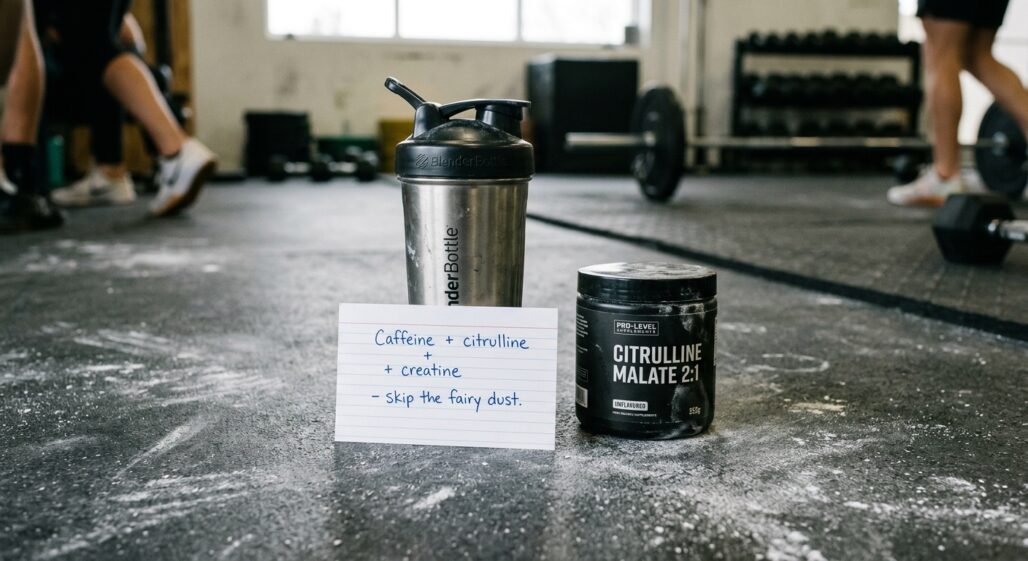
If you are shopping for the best pre-workout supplements, you have probably scrolled past a wall of tubs promising explosive pumps, laser focus, and 30-plus ingredients in a single scoop. The honest answer: a pre-workout that actually moves the needle is mostly three proven ingredients at real doses, and most of the rest is expensive flavoring. This guide walks through which ingredients have trial-backed effects, the doses that match those trials, how to read a label so you do not pay for a hidden under-dose, and when a stim-free option makes more sense. These are the kind of picks I would keep in my own family's gym bag, so the recommendations at the end are worth the scroll.
Affiliate disclosure: this article contains affiliate links. As an Amazon Associate, UsefulVitamins.com earns from qualifying purchases at no extra cost to you.
Before you decide
Caffeine tolerance is personal, and it is the single biggest reason two people react differently to the same scoop. If you already drink two or three coffees a day, a 300mg pre-workout stacks on top of that and can leave you jittery, not focused.
A simple rule: count your total daily caffeine from all sources before you add a pre-workout, and keep the combined amount under roughly 400mg for most healthy adults. If you train in the evening, take blood pressure medication, are pregnant or nursing, or are sensitive to stimulants, a stim-free pre-workout is the smarter starting point. Ask your doctor about your blood pressure and heart rate before adding a high-stimulant product if you have any cardiovascular history.
The biggest trap is the proprietary blend. When a label lists a "Blend 6,500mg" instead of the milligrams of each ingredient, you cannot verify whether the active ingredients are dosed anywhere near the levels used in trials. Independent reporting has found that a large share of pre-workout ingredients are hidden inside these blends, which makes dose verification structurally impossible for the buyer.
If you compete in a tested sport, only buy products carrying NSF Certified for Sport or Informed Sport certification. Pre-workouts are a high-risk category for contamination with banned stimulants.
The ingredients that actually work (and their real doses)
Strip away the marketing and the evidence clusters around a short list. These are the ingredients with repeatable, trial-backed effects, and just as important, the doses those effects required.
Caffeine
Caffeine is the one ingredient that reliably changes how hard a session feels and how much work you can do. In the ISSN position stand on caffeine and exercise performance, doses of 3 to 6 mg per kg of body mass improved muscular endurance, strength, sprinting, and a wide range of aerobic and anaerobic tasks.
For a 70kg lifter that is about 210 to 420mg, taken roughly 45 to 60 minutes before training. The same review notes the minimal effective dose may be as low as 2 mg/kg, and that very high doses near 9 mg/kg mostly add side effects, not performance.
A practical starting point is 150 to 200mg, not the 300 to 400mg many tubs default to. More caffeine is not more performance past your effective dose; it is just more heart rate and jitter.
Actionable takeaway: start at the low end, time it about 45 minutes out, and only climb if a genuine training plateau, not habituation, calls for it.
L-citrulline
Citrulline is the "pump" ingredient with the most legitimate, if modest, evidence. It raises nitric oxide and blood flow and has been studied mainly for reducing perceived effort and next-day soreness. A systematic review and meta-analysis on citrulline found that pre-exercise citrulline reduced post-exercise rating of perceived exertion and muscle soreness in mostly trained individuals.
The doses that produced effects were about 3 to 6g of L-citrulline, or 6 to 12g of the citrulline malate form, taken roughly an hour before training. Note that the evidence is for feeling and recovery markers more than for raw strength numbers.
It is not a guaranteed win. An acute citrulline malate CrossFit trial using 4.4g found no significant difference in workout rounds completed versus placebo, a useful reminder that the under-dosed amounts common in blends may do nothing measurable. For a deeper breakdown of forms and brands, see our guide to the best citrulline supplements.
Creatine monohydrate
Creatine is the most studied ergogenic supplement there is, and it belongs in a serious training plan even though it is not strictly a pre-workout ingredient. The ISSN creatine position stand concludes that creatine monohydrate is the most effective and extensively studied form for increasing high-intensity exercise capacity and lean body mass.
The dosing is simple: about 3 to 5g per day, every day, with or without a 0.3 g/kg loading phase for 5 to 7 days if you want full muscle stores faster. Timing relative to your workout barely matters because creatine works by saturating muscle stores over days, not by an acute pre-session spike. That is why I would rather see it as a flat daily 5g than buried in a pre-workout scoop you only take on training days.
The position stand is also clear that the fancy "buffered" and "HCl" forms have not beaten plain monohydrate. You are paying more for marketing. Our complete guide to creatine covers loading, forms, and water retention in detail.
Beta-alanine (optional)
Beta-alanine buffers acid buildup and helps during sustained hard efforts. The ISSN beta-alanine position stand reports that 4 to 6g daily for at least 2 to 4 weeks improves performance, most clearly in efforts lasting 1 to 4 minutes.
Two caveats keep it in the "optional" tier. First, the benefit comes from weeks of daily dosing, not a single pre-workout serving, so the 1.6 to 2g in many scoops on training days alone is not the studied protocol. Second, the harmless tingling (paresthesia) it causes is not a sign it is "working," it is just a skin sensation that fades.
Ingredients that are mostly hype
A long ingredient list is a marketing asset, not a performance one. The NIH Office of Dietary Supplements review of exercise and athletic performance supplements rates the evidence for most exotic pre-workout add-ins as limited, mixed, or absent at the doses used in products.
The most common "fairy dust" ingredients are added in amounts far below anything tested, so their presence on the label does more for the price than for your set. Watch for these sprinkled-in extras:
- Tyrosine and "nootropic" focus blends at a few hundred milligrams, well below the gram-plus doses in cognition research.
- BCAAs in a product you take while eating enough protein, where they add little.
- Exotic stimulant cousins and "patented" trademarked compounds that sound proprietary precisely because the human evidence is thin.
- Beetroot or "nitric oxide" sprinkles at token doses; if blood-flow support is your goal, a properly dosed nitrate source studied in its own right is more honest, as we cover in our best beetroot supplements roundup.
This is the reframe that matters: the real question is not how many ingredients are in the tub, it is how many are at a dose the research actually used.
How to read a label and dodge proprietary blends
A supplement brand can look impressive on a label and still hide the basics. Here is how to judge a scoop in 30 seconds without a sports-science degree.
| What you see on the label | What it means | What to do |
|---|---|---|
| Each active listed with its own mg (e.g. “L-Citrulline 6,000mg”) | Fully disclosed, you can verify the dose | Compare each active to the trial dose above |
| “Proprietary Blend 6,500mg” with a sub-list, no individual mg | Total is disclosed but per-ingredient dose is hidden | Assume the cheap, heavily-marketed actives are under-dosed |
| Caffeine listed but no amount | You cannot manage your total daily caffeine | Skip it, especially if you drink coffee |
| NSF Certified for Sport or Informed Sport seal | Tested for banned substances and label accuracy | Required if you are a tested athlete |
The single best filter is the supplement facts panel: if every active ingredient is not listed with its own milligram amount, you cannot confirm it is dosed to work, and you should treat the blend as under-dosed by default. A clinically-dosed formula has nothing to hide and shows its math. A fairy-dusted one needs the blend to obscure how little of each active you are getting.
Stim vs stim-free: which scoop fits you
Stimulant pre-workouts lean on caffeine for the acute lift. They suit morning and early-afternoon training when the caffeine will not wreck your sleep, and when your total daily intake leaves room.
Stim-free pre-workouts skip caffeine and rely on citrulline, creatine, and sometimes nitrate or electrolytes. A stim-free scoop is the better default for evening lifters, anyone monitoring blood pressure or resting heart rate, and people who already get plenty of caffeine from coffee. You lose the buzz but keep the blood-flow and recovery support that does not depend on a stimulant.
Think of it like coffee versus a warm-up routine. Caffeine wakes you up fast; the non-stimulant actives are the slower, structural support that works whether or not you feel anything.
What to look for when buying
A short decision shortcut before you click buy:
- Fully disclosed doses, every active in mg, no proprietary blend.
- Caffeine in the 150 to 200mg range for a starting product, clearly labeled, so you can manage your daily total.
- Citrulline at 6 to 8g (or citrulline malate at 8g-plus), not a token sprinkle.
- Third-party testing (NSF Certified for Sport, Informed Sport) if you compete, and ideally for everyone in this contamination-prone category.
- A short, honest ingredient list over a 30-ingredient kitchen-sink blend.


As an Amazon Associate, UsefulVitamins.com earns from qualifying purchases at no extra cost to you. We only recommend products supported by published research or third-party testing.
Who should skip pre-workout altogether
Some people get little upside and real downside from these products. If you are caffeine-sensitive, manage high blood pressure or a heart rhythm condition, are pregnant or nursing, or train late enough that a stimulant would cut into sleep, a stimulant pre-workout is not for you. A stim-free option or simply a strong coffee earlier in the day often covers the same ground.
There is also a food-first point worth making. If you are training fasted at dawn, a banana and water plus a small dose of caffeine will do more for that session than a 30-ingredient scoop. The supplement earns its place when it closes a real gap, not when it replaces a meal you skipped.
If you are looking for context on how we weigh evidence and pick products, our how we review supplements page lays out the testing-criteria framing used here, and you can read more about the author on the Sarah Thompson author page.
FAQ
Do I need a pre-workout at all?
No. A pre-workout is convenient, not essential. Caffeine from coffee plus daily creatine covers most of the proven benefit. The scoop mainly bundles those into one drink with flavor and a few extras.
Is more caffeine better for a harder workout?
Not past your effective dose. The ISSN caffeine review puts the useful range at 3 to 6 mg/kg; higher doses mostly add jitter, elevated heart rate, and poor sleep without extra performance.
Should creatine be in my pre-workout?
It can be, but it works by daily saturation, not pre-session timing. A flat 3 to 5g every day, even on rest days, is what the creatine position stand supports, so a standalone tub is fine.
What does the tingling from beta-alanine mean?
It is paresthesia, a harmless skin sensation, not a sign of potency. Per the beta-alanine position stand, it can be reduced with smaller divided doses or a sustained-release form.
Are proprietary blends ever okay?
For a flavor system, sure. For the active ingredients you are paying for, no. If you cannot see the milligrams of caffeine, citrulline, and beta-alanine, you cannot confirm they are dosed to do anything.
The bottom line on the best pre-workout supplements
The best pre-workout supplements are not the ones with the longest ingredient list; they are the ones that put caffeine, L-citrulline, and creatine on the label at doses the research actually used, with beta-alanine as an optional add-on for sustained hard efforts. Everything past that short list is mostly flavor and marketing. The contrarian but defensible point this guide makes that most roundups skip: for many lifters, building your own from three single-ingredient powders beats most pre-mixed tubs on both transparency and cost-per-active-gram.
Next steps:
- Add up your total daily caffeine first, then choose a stim or stim-free scoop that fits under roughly 400mg.
- Buy only fully-disclosed labels, and add NSF Certified for Sport if you compete.
- If you want the cheapest honest option, pair bulk caffeine and citrulline with a daily 5g from our complete guide to creatine.
As an Amazon Associate, I earn from qualifying purchases. Product recommendations are based on real reviews and independent research.
Reviewed by Sarah Thompson, Registered Dietitian, focused on vitamin and mineral nutrition.
This article is for informational purposes and not medical advice. Pre-workout supplements, especially high-stimulant ones, can interact with medications and health conditions. Consult a licensed physician before starting any supplement, particularly if you are pregnant, nursing, taking prescription medications, or managing a heart, blood pressure, or other chronic condition.
