
If you’re searching for the best supplements for eye health, the most evidence-backed options depend on your goal: protecting the macula as you age, supporting night vision, or easing dry eye. Research is clear on one thing – “eye vitamins” are not one-size-fits-all. A targeted AREDS2-style formula can slow progression for certain people with age-related macular degeneration (AMD), while omega-3s may help tear quality for dry eye. This guide breaks down what works, typical doses, who benefits most, and how to choose a quality product.
Affiliate disclosure: this article contains affiliate links. As an Amazon Associate, UsefulVitamins.com earns from qualifying purchases at no extra cost to you.
Summary / Quick Answer: Best supplements for eye health
The best supplements for eye health are the ones matched to your specific need (AMD support vs dry eye vs general nutrition). Here’s the quick, evidence-led shortlist:
For intermediate AMD (most proven): AREDS2 formula
Lutein 10 mg + zeaxanthin 2 mg + vitamin C 500 mg + vitamin E 400 IU + zinc 80 mg + copper 2 mg
Shown to reduce progression risk in at-risk patients, based on the landmark National Eye Institute AREDS2 research.For dry eye symptoms: Omega-3s (EPA/DHA)
Often 500-1,000 mg combined EPA/DHA to support tear film quality.For general “nutrition insurance”: Lutein + zeaxanthin (food-first, supplement second)
Common supplemental range: lutein 10-20 mg + zeaxanthin 2 mg.
Quick note: Supplements may help specific outcomes, but they won’t “fix” eyesight or replace eye exams.
What the science says about the best supplements for eye health (and who they’re for)
Most people buy vision supplements hoping to “protect eyes long-term.” That’s a reasonable goal, but the strongest clinical evidence is actually narrower: it centers on slowing progression of AMD in people who already have intermediate disease (or advanced AMD in one eye).
The best-known evidence comes from AREDS and AREDS2. In AREDS2, replacing beta-carotene with lutein and zeaxanthin kept benefits while improving safety for smokers and former smokers. According to the National Eye Institute’s AREDS2 findings, the AREDS2 formula reduced the risk of progression to advanced AMD in at-risk groups.
Who should consider an AREDS2 supplement?
Think of AREDS2 like a “therapeutic nutrition formula,” not a general multivitamin. It’s most appropriate if:
- An eye doctor has told you that you have intermediate AMD
- You have advanced AMD in one eye
- You’re being monitored for AMD progression and want evidence-based support
It’s not generally recommended as a preventive supplement for people with healthy eyes. The National Center for Complementary and Integrative Health (NCCIH) overview on supplements for eye conditions also emphasizes that evidence is condition-specific, and that many popular ingredients don’t have strong support.
Visual: “Which supplement fits which goal?”
| Your main goal | Best-supported supplement approach | Who benefits most |
|---|---|---|
| Slow progression of AMD | AREDS2 formula (specific doses) | Intermediate AMD or advanced in one eye |
| Dry, gritty, burning eyes | Omega-3s (EPA/DHA) | Dry eye sufferers (especially low fish intake) |
| General macular nutrition | Lutein + zeaxanthin, diet-first | People low in leafy greens |
| Night vision/corneal support | Vitamin A if deficient | Those at risk of deficiency (medical guidance) |
Building a supplement routine for this? Our companion app, StackMyMed, lets you scan each product, track your real daily intake, and get timing reminders plus interaction checks across your whole stack.
Practical takeaway
Before buying anything, identify your “why.” If you’re not sure whether you have AMD, the best next step is a dilated eye exam. Supplements can support, but diagnosis drives smart choices.
AREDS2 eye vitamins explained: ingredients, exact doses, and safety notes
Nature’s Way Lutein 20 mg, 60 Softgels
Limited search results confirm the product exists from Nature’s Way with 20 mg lutein per softgel, available on sites like iHerb and GoSupps for eye health support using FloraGLO lutein, but no Amazon ASIN, ratings, reviews, or third-party testing data was located; cannot recommend for affiliate purposes without verified Amazon details.
If you only remember one section, make it this one. Many products market themselves as “AREDS2,” but the benefit in trials came from specific nutrients at specific doses.
The AREDS2-style formula typically includes:
Lutein (10 mg) + zeaxanthin (2 mg)
Carotenoids concentrated in the macula. They act as antioxidants and help filter high-energy blue light.Vitamin C (500 mg)
Supports antioxidant defenses and connective tissue (including collagen).Vitamin E (400 IU)
Fat-soluble antioxidant that helps protect cell membranes.Zinc (80 mg) + copper (2 mg)
Zinc supports retinal metabolism and vitamin A transport. Copper is included to reduce the risk of copper deficiency from high-dose zinc.
These doses are far above daily requirements for some nutrients. For context, the NIH Office of Dietary Supplements vitamin C fact sheet and NIH Office of Dietary Supplements vitamin E fact sheet outline recommended intakes for the general population, which are much lower than AREDS2 levels.
Why lutein and zeaxanthin replaced beta-carotene
Beta-carotene was used in the original AREDS formula, but later safety concerns emerged for smokers. AREDS2 moved toward lutein and zeaxanthin, which better fit eye tissue biology and avoid the smoking-related risk tied to beta-carotene. The NCCIH clinical summary discusses these evidence and safety considerations.
Visual: AREDS2 dose checklist (use this to compare labels)
| Nutrient | Evidence-based target | Label check tip |
|---|---|---|
| Lutein | 10 mg | Often listed as “lutein (marigold extract)” |
| Zeaxanthin | 2 mg | Sometimes listed separately or as “zeaxanthin isomers” |
| Vitamin C | 500 mg | Usually as ascorbic acid |
| Vitamin E | 400 IU | Mixed tocopherols may be a plus, but dose matters |
| Zinc | 80 mg | Usually zinc oxide in AREDS formulas |
| Copper | 2 mg | Often copper oxide |
Practical takeaway
If you have AMD and your clinician recommends AREDS2, choose a product that matches the clinical formula closely. “Eye support” blends with tiny amounts of lutein and zinc may be fine for general nutrition, but they are not the same as AREDS2.
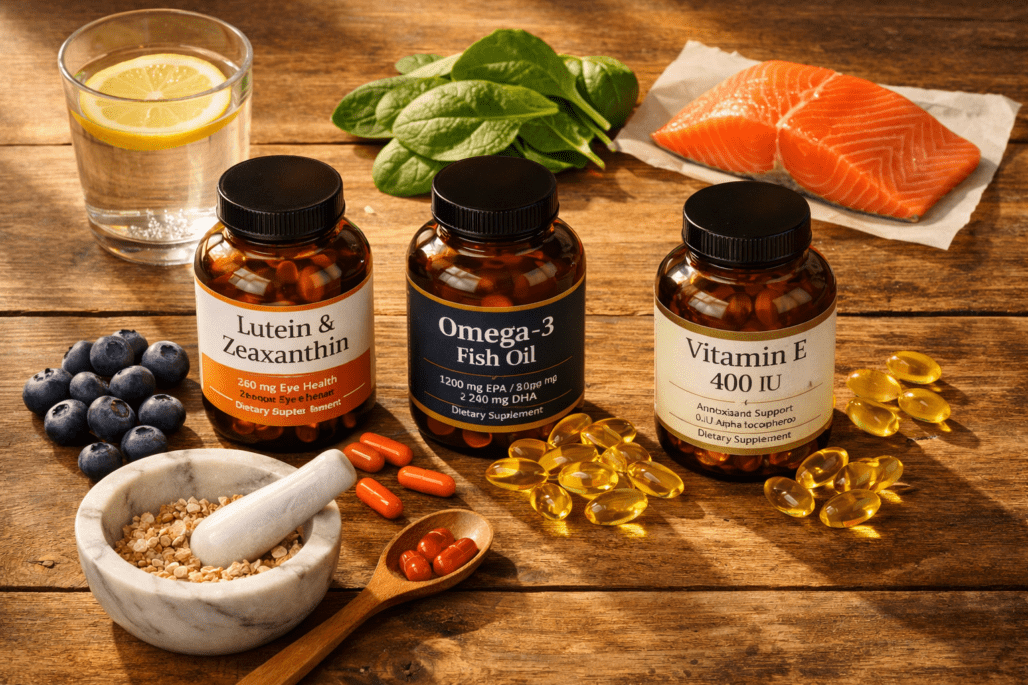
Omega-3s for dry eye: what to look for (and what not to expect)
Bausch + Lomb Ocuvite Eye Vitamins, 90 Softgels
Bausch + Lomb Ocuvite Eye Vitamins (90 Softgels) is a solid affiliate recommendation with 4.6 stars from over 12,400 Amazon reviews, backed by lutein, zeaxanthin, and vitamins C/E/ zinc per AREDS2 research for age-related eye health. Users report better eye comfort and reduced fatigue, though effects build over time; at ~$18.99, it’s affordably priced with strong value despite minor pill size complaints.
Dry eye is one of the most frustrating eye issues because it’s daily and hard to ignore. If your eyes burn, feel gritty, or fluctuate between watering and dryness, you’re not alone. Many people reach for omega-3s because they’re associated with inflammation control and tear film support.
The most practical way to think about omega-3s: they may help the quality of the tear film, not “force” your eyes to make tears. The tear film has an oily layer that slows evaporation. EPA and DHA are often used to support that layer.
What dose is reasonable?
In supplement studies and clinical practice, a common range is:
- 500-1,000 mg combined EPA/DHA per day
Many labels list “fish oil 1,000 mg,” but that’s not the same as 1,000 mg EPA/DHA. You need to check the breakdown.
Visual: how to read an omega-3 label for dry eye
- Ignore the front: “1,200 mg fish oil” can be misleading.
- Find “Supplement Facts” and look for:
- EPA (eicosapentaenoic acid): ___ mg
- DHA (docosahexaenoic acid): ___ mg
- Add them together to get your true dose.
What omega-3s won’t do
Omega-3s are not proven to prevent or treat AMD on their own, and they won’t replace basics like:
- Artificial tears (when needed)
- Screen breaks and blink training
- Treating eyelid inflammation (if present)
If you’re also working on whole-body inflammation, it can help to compare your omega-3 plan with other evidence-based options discussed in Best Supplements for Inflammation.
Practical takeaway
If dry eye is your main issue, prioritize a high-quality omega-3 with clearly listed EPA and DHA, and give it at least 8-12 weeks before judging results. Pair it with screen and environment fixes for better odds of improvement.
Lutein, zeaxanthin, vitamin A, zinc, C and E: what each nutrient does for vision
Viva Naturals Omega-3 Fish Oil, 180 Softgels
Viva Naturals Omega-3 Fish Oil, 180 softgels, stands out for its triple-strength formula delivering 2,250 mg omega-3s (1,500 mg EPA, 570 mg DHA) per serving in highly absorbable re-esterified triglyceride form, with third-party certifications from Labdoor and IFOS ensuring purity and no fishy aftertaste; strong 4.8-star ratings and top Amazon sales rankings make it a reliable recommendation for heart, brain, and joint support despite the premium price.
Eye supplements often look like a long list of nutrients. The trick is separating “biologically plausible” from “clinically proven for your condition.” Here’s what the core nutrients actually do, in plain terms.
Lutein + zeaxanthin (macular pigments)
These carotenoids accumulate in the macula, where they help filter blue light and neutralize oxidative stress. People who eat few leafy greens often have lower dietary intake.
Food-first sources:
- Kale, spinach, collards
- Egg yolks (smaller amount, but more absorbable for some)
Supplement ranges you’ll commonly see:
- Lutein 10-20 mg
- Zeaxanthin 2 mg
Vitamin A (night vision and corneal support)
Vitamin A is essential for rhodopsin, a pigment needed for low-light vision, and for maintaining the cornea. True deficiency is uncommon in many high-income countries, but it can occur with malabsorption issues or very restricted diets.
If you’re considering vitamin A, it’s worth reading Vitamin A Benefits first, especially because excess preformed vitamin A (retinol) can be harmful in high doses.
Zinc (retinal metabolism and vitamin A transport)
Zinc supports enzymes involved in retinal function and helps move vitamin A from the liver to the retina. High-dose zinc is a cornerstone of AREDS formulas, but it’s not automatically appropriate for everyone.
Key safety point: high zinc can interfere with copper status, which is why AREDS2 includes copper.
Vitamins C and E (antioxidant protection)
These antioxidants help protect cells from oxidative stress. In AREDS2, they’re part of a combined approach rather than standalone “magic bullets.”
Visual: nutrient “role map” (simple mental model)
| Nutrient | Think of it as supporting… | Best fit |
|---|---|---|
| Lutein + zeaxanthin | Macular “sunglasses” | Aging eyes, low veggie intake, AMD support |
| Vitamin A | Night vision chemistry + corneal surface | Only if intake is low or deficiency risk |
| Zinc (+ copper) | Retinal repair support | AREDS2 when indicated |
| Vitamin C + E | Antioxidant backup | Part of AREDS2, not a cure-all |
Practical takeaway
For general nutrition, lutein and zeaxanthin are often the most targeted “eye-specific” nutrients. For therapeutic support in AMD, the combined AREDS2 formula matters more than any single ingredient.
How to choose a high-quality eye supplement (and avoid common mistakes)
Standing in front of a shelf of “vision supplements” can feel like trying to pick a lock. Many labels use similar language, but quality and dosing vary widely.
Step 1: Match the formula to your goal
Use this simple decision tree:
Diagnosed intermediate AMD?
Choose an AREDS2-matching product and confirm doses.Dry eye is your main complaint?
Choose an EPA/DHA-forward omega-3 and verify the actual EPA + DHA amount.No diagnosis, just general support?
Consider lutein + zeaxanthin, and focus on diet and lifestyle first.
Step 2: Watch for these common pitfalls
Assuming “more is safer”
High-dose nutrients can cause side effects or interactions. Zinc can upset the stomach; vitamin E can interact with some medications.Using beta-carotene if you smoke (or used to)
AREDS2 avoided beta-carotene due to safety concerns in smokers. If a product still uses it, treat that as a red flag unless a clinician advises otherwise.Buying “proprietary blends” that hide doses
If you can’t see exact milligrams or IU amounts, you can’t compare to evidence.Ignoring nutrient interactions
Minerals can compete for absorption, and high doses can shift balance over time. The Nutrient Interactions Guide is a helpful reference if you’re stacking multiple supplements.
Step 3: Look for quality signals that matter
Quality isn’t just marketing. Prioritize:
- Third-party testing (USP, NSF, or similar programs)
- Clear labeling of active forms and doses
- Lot numbers and expiration dates
- Transparent allergen statements (fish, soy, etc.)
For a deeper checklist, use Supplement Quality Indicators.
Visual: quick “label audit” checklist (save this)
- Does it match AREDS2 doses if it claims AREDS2?
- Are EPA and DHA listed separately (for omega-3)?
- Are doses clear (no hidden proprietary blend)?
- Is there third-party testing or strong manufacturing transparency?
- Does it fit your health status (smoker, pregnancy, medications)?
Practical takeaway
A “good” eye supplement is one that matches evidence, fits your diagnosis and risk profile, and meets basic quality standards. If any of those are missing, it’s usually better to skip it.
Conclusion: the smartest way to use supplements for long-term eye health
The best results come from aligning supplements with the condition they’re actually shown to help. If you have intermediate AMD, an AREDS2-style formula is the most evidence-backed option for slowing progression, supported by the National Eye Institute AREDS2 research. If dry eye is the problem you feel every day, omega-3s with meaningful EPA/DHA amounts may support tear film quality, especially alongside lifestyle changes.
Next step: bring your supplement label to your next eye appointment and confirm it matches your diagnosis and meds. For related reading, see Vitamin A Benefits and Nutrient Interactions Guide to make sure your plan is both effective and safe.
As an Amazon Associate, I earn from qualifying purchases. Product recommendations are based on real reviews and independent research.
