
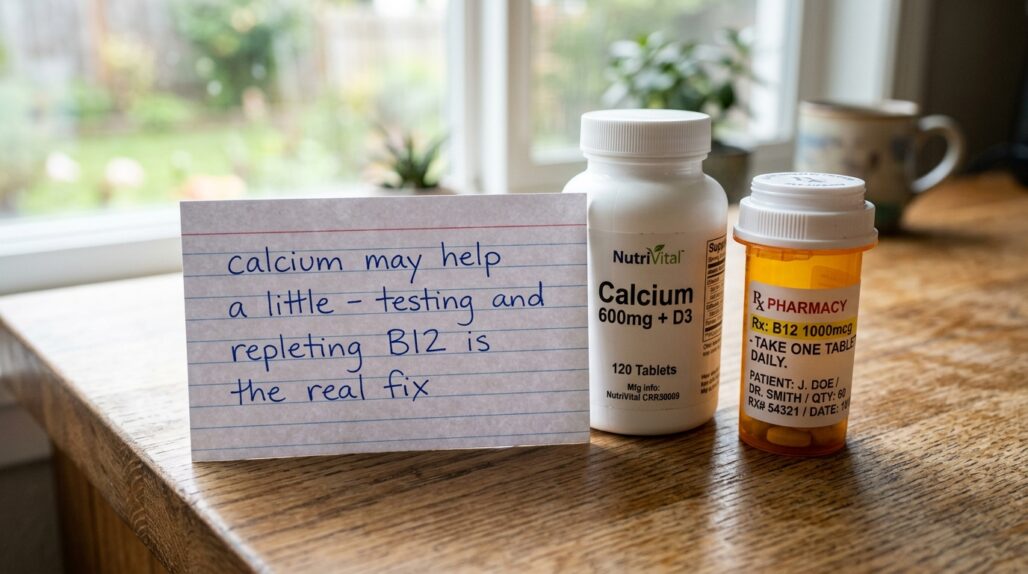
Before you decide
This is general information, not medical advice. B12 status and any change to your medications or supplements should be reviewed by your own doctor or pharmacist, who can see your labs and history.
The people most affected here are adults on long-term metformin for type 2 diabetes or prediabetes. Risk climbs with years of use and higher daily doses, and it stacks on top of other reasons B12 runs low, such as a vegan diet, older age, or past stomach or bowel surgery.
The calcium question is genuinely interesting, and the underlying biology is real. But it sits at the edge of what the research can support, so this article separates what is well established from what is still a small, promising signal. If you came here because your B12 came back low on metformin, the depletion side is covered in depth in our guide to metformin and vitamin B12 depletion, and you can see how this fits the wider picture in our overview of drug and supplement interactions.
What metformin actually does to B12 absorption
B12 absorption is not simple. In the stomach and upper gut, dietary B12 binds to a carrier protein called intrinsic factor. That B12-intrinsic factor complex then travels to the ileum, the last section of the small intestine, where specialized cell-surface receptors pull it into the body.
That final ileal step is calcium-dependent. The receptor needs calcium ions present at the cell membrane to grab the complex and take it in. This is the lever metformin appears to pull.
In a 2000 study published in Diabetes Care, William Bauman and colleagues proposed that metformin adds a positive charge at the ileal cell surface that displaces calcium ions, disrupting the calcium-dependent uptake of the B12-intrinsic factor complex. They reported that patients on metformin had lower total B12 and lower holotranscobalamin, the active fraction that actually delivers B12 to tissues. You can read their account in the Bauman 2000 Diabetes Care paper.
The takeaway is mechanistic, not magic. Metformin does not destroy B12 or block it everywhere – it interferes with one specific, calcium-needing step at the end of the absorption chain.

How calcium is supposed to help
If metformin works by displacing calcium at the ileal membrane, then flooding the area with more calcium should, in theory, push that step back toward normal. That is exactly what the early data suggest.
In the same 2000 study, oral calcium supplementation reversed the metformin-induced drop in holotranscobalamin in the patients studied. The authors concluded the malabsorption was driven by a calcium-dependent ileal membrane effect that supplemental calcium could overcome.
More recently, a 2024 pilot study in Clinical Nutrition ESPEN tested this directly using a labeled [13C] cyanocobalamin tracer in healthy adults, which lets researchers measure how much B12 is actually absorbed. The pattern lined up with the older theory:
- B12 alone (control): about 42.6 percent absorbed
- With metformin: dropped to about 30.8 percent
- With metformin plus calcium: back up to about 46.4 percent
In other words, calcium co-administration restored absorption to baseline in that small experiment. The details are in the 2024 calcium and metformin B12 tracer pilot study.
So the signal is consistent across two decades. The honest caveat is how thin it still is.
How strong is the evidence, really?
Not strong enough to treat calcium as a B12 strategy. Two studies, both small, point in the same direction – but neither answers the question that matters for you.
The 2024 pilot used healthy young adults, not people who have taken metformin for years. The authors said plainly that calcium "as a strategy to prevent B12 deficiency needs to be further studied" in actual metformin users. A short absorption experiment is not the same as preventing a deficiency over time.
There is also a gap between absorption and outcomes. Showing that calcium nudges a tracer number back up is not the same as showing it keeps people out of clinically low B12, prevents nerve symptoms, or reduces the need for treatment. No large trial has tested that.
| What we know | Evidence strength | What it means for you |
|---|---|---|
| Metformin lowers B12 via a calcium-dependent ileal step | Well supported mechanistically | A real, repeatable effect worth monitoring |
| Oral calcium can raise B12 absorption on metformin | Small studies, promising | Plausible help, not a guarantee |
| Calcium prevents clinical B12 deficiency long-term | Not established | Do not rely on it alone |
| Testing and repleting B12 corrects the problem | Established practice | This is the dependable fix |
Treat calcium as an interesting adjunct, not the plan. The plan is testing.

What actually fixes low B12 on metformin
The reliable approach is straightforward: find out where your B12 sits, then replete it if it is low. That is the path supported by guidelines and clinical practice.
The American Diabetes Association suggests periodic B12 testing for people on long-term metformin, especially at higher doses or longer durations, and testing sooner if there is anemia or peripheral neuropathy. Risk rises notably after roughly 4 to 5 years of use. See the ADA Standards of Care 2026 for the current wording.
When B12 is genuinely low, repletion is the answer, and most people do not need injections. According to the NIH Office of Dietary Supplements B12 fact sheet, the adult RDA is just 2.4 mcg/day, but deficiency is typically corrected with high oral doses in the range of 1 to 2 mg (1,000 to 2,000 mcg) daily, because high-dose oral B12 can be absorbed by a second, passive route that does not need intrinsic factor.
A few practical points worth raising with your clinician:
- Form rarely matters as much as marketing implies. Cyanocobalamin and methylcobalamin both work for most people; our vitamin B12 dosage guide walks through the differences.
- Injections are for specific cases. Intramuscular B12 bypasses the gut entirely and is used for severe deficiency, neurological symptoms, or when oral repletion is not working.
- Retest after starting. Levels should respond, and your doctor can confirm the dose is enough.
Calcium can sit alongside this if you take it for bone health anyway, but it is the supporting act, not the treatment. For choosing a product, our roundup of the best vitamin B12 supplements covers forms and doses, and for a wider view of what to consider alongside it, see our guide to the best supplements for metformin users.
When to see a clinician
Low B12 is not something to ride out, because some of the damage can become permanent if left too long. Nerve injury from B12 deficiency often recovers with timely treatment, but advanced neurological problems may not fully reverse, as the NHS guidance on B12 deficiency complications explains.
Get checked promptly if you notice any of these:
- Numbness, tingling, or pins and needles in the hands or feet
- Balance problems or an unsteady walk
- Unusual fatigue, breathlessness, or pale skin (signs of anemia)
- Memory, mood, or concentration changes that are new for you
- A sore, smooth, or red tongue
Importantly, neurological symptoms can appear before anemia shows up, and even before standard B12 numbers look clearly abnormal, as documented in the StatPearls review of B12 deficiency. So do not wait for a "low" lab result if your symptoms fit. Bring it up.
Never stop metformin on your own to protect your B12. Metformin is doing a job for your blood sugar, and the B12 issue is manageable without dropping the drug. That tradeoff is a conversation for your prescriber.
If you are not sure whether a combination is worth raising, our drug and supplement interaction checker is a quick starting point before you talk to a professional.
Keeping an accurate list of everything you take makes that conversation faster. A tool like StackMyMed lets you log your medications and supplements and flag the combination so you can raise it with your pharmacist. It helps you organize the question; it does not replace clinical judgment.
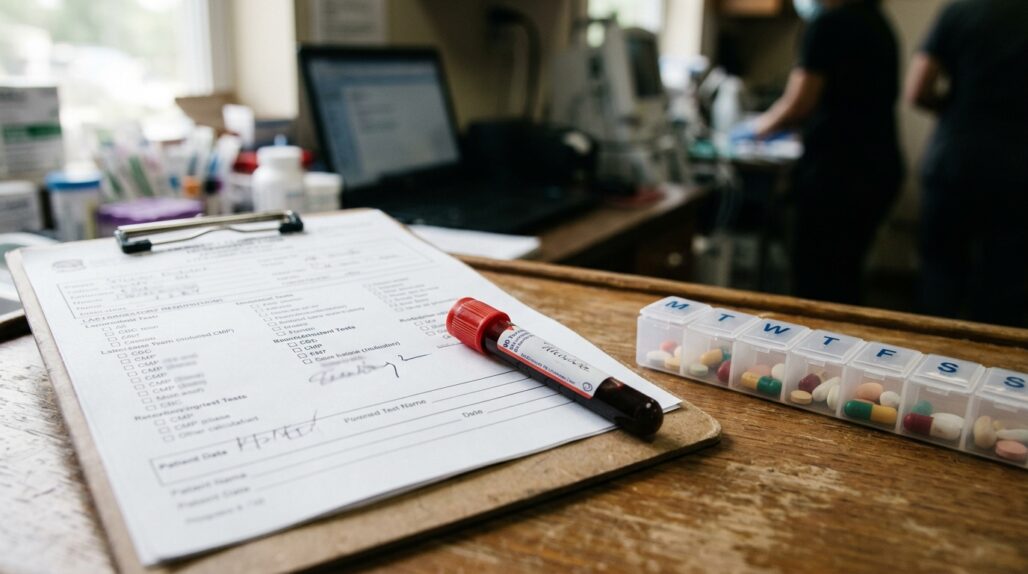
FAQ
Does taking calcium with metformin prevent B12 deficiency? Not reliably. Small studies show calcium can improve B12 absorption on metformin, but no large trial proves it prevents deficiency over time. Periodic B12 testing and repletion if low is the established approach.
How does metformin lower vitamin B12 in the first place? Metformin appears to disrupt a calcium-dependent step in the ileum, the lower small intestine, where the B12-intrinsic factor complex is normally absorbed. It interferes with that one uptake step rather than blocking B12 everywhere.
If I already take a calcium supplement, am I protected from low B12? Do not assume so. Calcium may help mechanistically, but it is not a substitute for checking your level. If you are on long-term metformin, ask your doctor about a B12 blood test regardless of calcium intake.
Do I need B12 injections, or will pills work? Most people with metformin-related low B12 can be corrected with high-dose oral B12, often around 1,000 to 2,000 mcg daily, because high oral doses use a passive absorption route. Injections are reserved for severe deficiency or neurological symptoms. Your clinician decides which fits.
How often should B12 be checked on metformin? Guidelines suggest periodic testing for long-term users, with more attention after about 4 to 5 years or at higher doses, and sooner if you have anemia or nerve symptoms. There is no single fixed schedule, so confirm timing with your doctor.
Should I stop metformin to protect my B12? No, not on your own. Metformin manages your blood sugar, and low B12 can be treated without stopping it. Any change to the medication should come from your prescriber.
Conclusion: a real mechanism, a small fix, a better plan
The biology checks out. Metformin interferes with a calcium-dependent B12 uptake step, and adding calcium can partly reverse that in the small studies done so far. It is a clean, plausible story.
But "plausible" is not "proven for prevention." The data are thin, drawn from small groups, and have not shown that calcium keeps people out of true deficiency long-term. So calcium is a reasonable footnote, not your strategy.
The dependable move is the boring one: if you take metformin long-term, get your B12 tested and treat it if it is low. For the full picture on how this depletion develops, start with our metformin and vitamin B12 depletion guide.
This article is for general education and does not replace personalized medical advice. Talk to your doctor or pharmacist before changing any medication or supplement, especially if you take prescription drugs or have a health condition.
Reviewed by the UsefulVitamins Editorial Team.
