
Affiliate disclosure: this article contains affiliate links. As an Amazon Associate, UsefulVitamins.com earns from qualifying purchases at no extra cost to you.
What "absorbs better" actually depends on
People assume a powder dissolved in water has to beat a capsule, since the capsule has a shell to break down first. For magnesium, that intuition is mostly wrong.
A capsule shell opens in your stomach within minutes, and the magnesium inside ends up in the same dissolved state as a stirred powder. The body absorbs magnesium ions, not the delivery vehicle. So a glycinate capsule and a glycinate powder land in roughly the same place.
The real lever is the chemical form. The NIH Office of Dietary Supplements notes that the aspartate, citrate, lactate, and chloride forms absorb better than magnesium oxide and magnesium sulfate. That difference dwarfs anything powder-versus-capsule does.
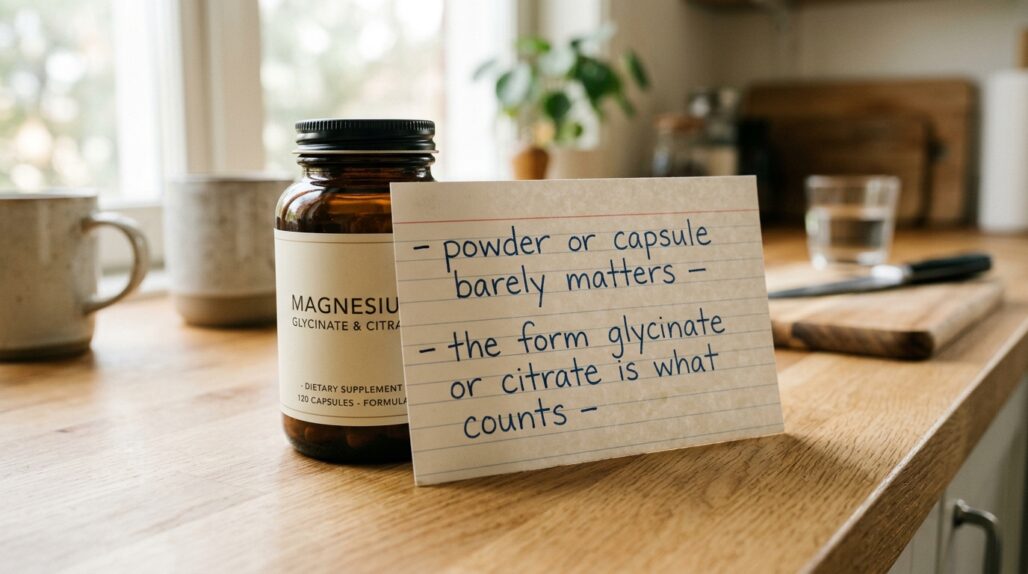
So this page is really two questions stacked together. Which form you take matters a lot. Whether that form arrives as powder or capsule matters mainly for your wallet and your routine.
The form is the absorption story, not the format
Magnesium oxide is the cheapest and most common filler in bargain supplements, and it is the worst absorbed. Older work by Firoz and Graber on US commercial preparations found oxide poorly bioavailable while organic salts like citrate absorbed well, and oxide's bioavailability has been estimated as low as around 4 percent in some methods.
A 2003 randomized, double-blind trial reported that magnesium citrate was more bioavailable than oxide by 24-hour urinary excretion. A 2024 comparative clinical study tracking plasma levels also saw real differences in absorption timing and tolerability across oxide, citrate, and bisglycinate, with oxide and citrate both nudging gut motility.
Here is the practical hierarchy most people care about.
- Glycinate (bisglycinate): gentle on the stomach, well tolerated for daily use, the common pick for sleep and stress.
- Citrate: well absorbed and mildly to moderately laxative, which is useful if constipation is part of your picture.
- Oxide: cheap, high elemental content by weight, poorly absorbed, and the most likely to cause loose stools.
None of that changes based on whether the powder went into water or the capsule went down with it. Match the form to the job, and the format question gets easy.

Powder vs capsule: where each one wins
Now the format. Both work. They just suit different people and different doses.
Powder is usually cheaper per milligram and makes it simple to take a larger dose without swallowing a handful of pills. A scoop in water before bed is one motion. Many powders are citrate (sometimes as the fizzy "magnesium drink" type), which is why a powder habit can mean a more laxative habit if you push the dose.
Capsules win on dose control and convenience. Each one is a fixed amount, easy to count, easy to travel with, and easy to take with food. They do cost a bit more per milligram, and a higher target dose can mean three or four capsules.
There is no absorption penalty for either. The 2024 clinical comparison and the form-based bioavailability work both point to the compound, not the packaging, as the variable that matters.
| Factor | Powder | Capsule |
|---|---|---|
| Absorption | Same as capsule for the same form | Same as powder for the same form |
| Cost per mg | Usually lower | Usually higher |
| Dose control | Scoop, less precise | Fixed per capsule, precise |
| Easy to hit a high dose | Yes, one scoop | May need 3-4 capsules |
| Common form sold | Often citrate (more laxative) | Often glycinate (gentler) |
| Travel and routine | Needs water and a scoop | Grab and go |
Elemental magnesium: the number that trips people up
This is where most people accidentally over- or under-dose, and it has nothing to do with powder versus capsule either.
A label might say "1,000 mg magnesium citrate." That is the weight of the whole compound, not the magnesium you get. Citrate is only about 16 percent elemental magnesium by weight, glycinate around 14 percent, while oxide is roughly 60 percent elemental (the one number that flatters the worst-absorbed form).
So that 1,000 mg of citrate delivers only about 160 mg of elemental magnesium – the figure that counts against your daily target and the 350 mg supplemental upper limit. Read the "elemental magnesium" line on the Supplement Facts panel, not the bold marketing number on the front.
Doing this math by hand for every product is tedious, so we built a tool for it. Plug your form and goal into our magnesium dose calculator to get the elemental milligrams you actually absorb and the target for your situation, instead of guessing from the front label.

Pick by goal, then by stomach
Start from what you want, not from the shelf.
- Sleep, stress, daily maintenance: glycinate is the usual first try. It is gentle and well tolerated, and a glycinate capsule keeps the dose tidy at night.
- Occasional constipation: citrate's mild laxative pull is the point. A citrate powder in water makes a higher, water-drawing dose simple.
- Tight budget, no GI complaints: an oxide or citrate powder is the cheapest path to your number, accepting that oxide absorbs poorly and citrate can loosen stools.
Then sanity-check against your gut. Harvard's Nutrition Source notes that magnesium can have a laxative effect at higher doses, and the 2024 comparison saw both oxide and citrate increase intestinal motility. If a citrate powder sends you to the bathroom, that is the form talking, not a defect in the powder format – switch to glycinate and the problem usually settles.
For a broader rundown of which products test clean and dose honestly, our overall best magnesium supplement guide compares specific brands across forms.
Which product or form to buy
Below are vetted picks covering the two practical lanes: a gentle glycinate (tablet, daily use) and a citrate (powder, occasional constipation), plus a value glycinate. Choose by goal first, then format.
We may earn a commission from purchases made through the links below, at no extra cost to you. This does not influence our recommendations.


As an Amazon Associate, UsefulVitamins.com earns from qualifying purchases at no extra cost to you.
A topical option sits outside this comparison; if you have seen the lotion and oil claims, see our take on whether magnesium spray actually works before you spend on it.
What to watch for, and who should be careful
For most healthy adults, supplemental magnesium is well tolerated near label doses. The most common issue at higher intakes is diarrhea, nausea, and abdominal cramping, which the NIH ODS lists as the typical signal you have taken too much from supplements.
Stay at or below the 350 mg supplemental upper limit unless a clinician has told you otherwise. That ceiling is for magnesium from supplements and medications, not the magnesium in food, and it exists because excess supplemental magnesium is what triggers the gut effects. Our explainer on how much magnesium is too much walks through the upper limit and the warning signs in more detail.
True magnesium toxicity is rare in healthy people because the kidneys clear the excess. The risk rises with impaired kidney function, where magnesium can build up. The NIH ODS consumer sheet describes signs of very high magnesium as low blood pressure, vomiting, difficulty breathing, irregular heartbeat, and in extreme cases cardiac arrest.
So a few people should not just grab a tub: anyone with kidney disease, anyone on prescriptions that magnesium can interact with (some antibiotics and osteoporosis drugs absorb less when taken with it), and anyone who reacts badly. If you are on cholesterol medication, see whether magnesium is safe with statins before adding a supplement. Those are pharmacist or doctor conversations, not label-reading exercises.

FAQ
Does magnesium powder absorb faster than a capsule? Marginally and not in a way that matters. A pre-dissolved powder skips the few minutes a capsule needs to open, but both deliver the same magnesium ions to the same place, so total absorption tracks the form, not the format.
Is magnesium glycinate available as a powder too? Yes, though capsules are more common for glycinate and powders are more common for citrate. If you want glycinate in powder form for cost or dosing reasons, it exists, and it absorbs the same as the capsule version.
Why does my magnesium powder give me loose stools? Most powders are citrate, which draws water into the bowel and is mildly laxative by design. That is the form, not the powder. Switching to a glycinate capsule or powder usually fixes it while keeping the magnesium.
How much magnesium should I take from a supplement? Most adults supplement roughly 100 to 350 mg of elemental magnesium daily, staying at or under the 350 mg supplemental upper limit. Use our calculator to convert your chosen form into elemental milligrams and match your target.
Is magnesium oxide worth buying because it has more magnesium? Its high elemental percentage is misleading because it is poorly absorbed, with bioavailability estimated as low as about 4 percent. It is fine as a cheap option if you tolerate it, but citrate and glycinate give you more usable magnesium per dose.
Can I take magnesium if I have kidney problems? Not without medical guidance. Reduced kidney function lets magnesium build up, which is the main route to toxicity, so anyone with kidney disease should clear any magnesium supplement with a doctor first.
The bottom line
Powder versus capsule is the wrong first question. For the same magnesium compound, they absorb about the same, so the choice comes down to cost, dose size, and what fits your routine – powder for cheap, higher, flexible dosing, capsules for precision and grab-and-go.
The decision that actually changes how much magnesium reaches your blood is the form: glycinate for gentle daily use and sleep, citrate when you want the mild laxative effect, oxide only as a budget pick you may not absorb well. Pick the form for your goal, read the elemental magnesium number, and stay under the 350 mg supplemental limit.
If you want the exact figure for your age, sex, and goal, run it through our magnesium dose calculator, then buy whichever format you will actually take every day.
This article is general education, not medical advice. It does not diagnose or treat any condition, and it is not a reason to start, stop, or change any prescription. Talk to a pharmacist or doctor about your situation, especially if you have kidney disease or take other medicines.
Reviewed by the UsefulVitamins Editorial Team.
