
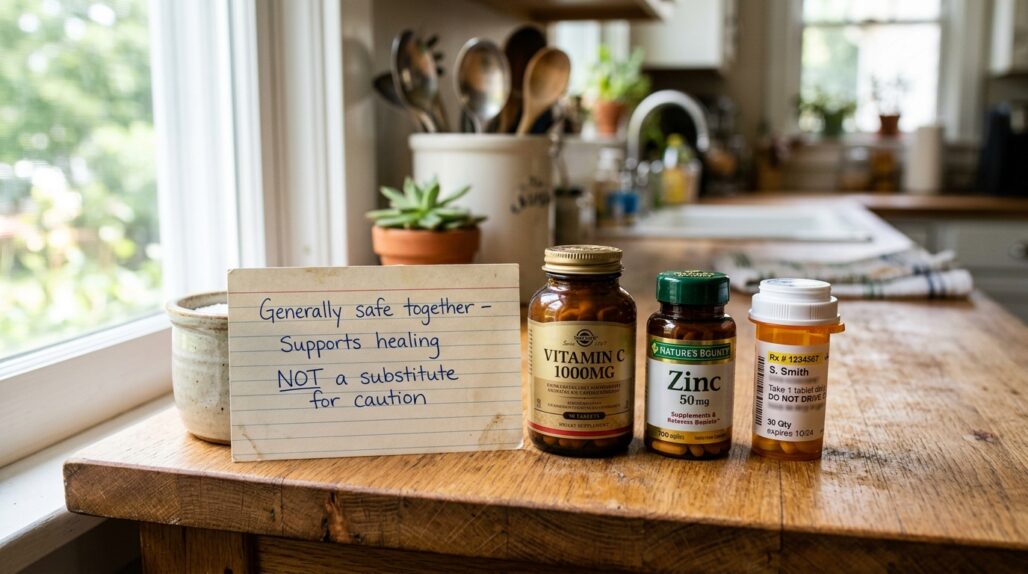
Before you decide
This article is general information, not medical advice. Prednisone is a powerful drug and your situation – the dose, how long you have taken it, and why – changes what is safe for you. A pharmacist or your prescriber should make the final call on your specific stack.
The people who ask this question are usually anxious about catching something while their immune system is dialed down. That worry is reasonable. The good news is that adding vitamin C and zinc rarely causes a problem with prednisone.
The part worth slowing down on is the expectation. Vitamin C and zinc will not cancel out the immune suppression that prednisone produces. They support normal body processes; they do not override a drug that is doing its job. The most useful angle for most steroid patients is not infection-proofing – it is skin and wound healing, which prednisone genuinely impairs.
Highest-risk readers: anyone on 20 mg of prednisone or more per day, anyone on a steroid for more than two weeks, transplant or autoimmune patients on stacked immunosuppressants, and people due for a live vaccine. These groups should route every supplement decision through their care team.
Is there a drug interaction between vitamin C, zinc, and prednisone?
Short answer: no significant one. When you run prednisone against a combined vitamin C plus zinc product through a standard checker, the result comes back clean. The Drugs.com interaction checker reports no interactions between prednisone and vitamin C plus zinc.
"No interaction found" is not the same as "studied exhaustively," so the usual caveat applies. But there is no known mechanism by which ordinary supplemental doses of vitamin C or zinc change how prednisone is absorbed, metabolized, or cleared. You do not need to time these apart from your steroid the way you would with, say, calcium and a thyroid pill.
There is one nutrition footnote worth knowing. Long-term corticosteroids can increase urinary loss of several nutrients, including vitamin C and zinc. That is a depletion concern, not a dangerous interaction – and it is part of why some clinicians are relaxed about patients on steroids taking modest amounts of both.
So the take-home is reassuring but bounded. Safe to combine in normal doses; just keep the doses normal.

What vitamin C actually does on a steroid
Vitamin C earns its place here through skin and wound repair, not through fighting infection. Your body cannot build collagen properly without it.
The NIH Office of Dietary Supplements notes that vitamin C is required for collagen synthesis, the structural protein that holds skin, blood vessels, and healing tissue together. Mechanistically, vitamin C lets enzymes hydroxylate proline and lysine in procollagen so the collagen triple helix can form and stay stable. No vitamin C, no proper collagen.
This matters on prednisone specifically. Glucocorticoids suppress the same collagen machinery from the other direction. A review in Clinical, Cosmetic and Investigational Dermatology describes how corticosteroids inhibit type I and type III collagen synthesis and push up matrix-degrading enzymes, which is the engine behind steroid-related skin thinning, easy bruising, and slower wound healing.
Vitamin C does not undo that, but supporting the raw material for collagen is a logical move when a drug is taxing your skin. Research on vitamin C and wound healing on PMC points to roles across the inflammatory, proliferative, and remodeling phases of repair.
A few grounding facts on dose:
- The RDA is roughly 90 mg/day for men and 75 mg/day for women.
- The tolerable upper intake level for adults is 2,000 mg/day, above which loose stools and stomach upset become common.
- Most people get enough from food; supplementing makes the most sense if intake is low or healing demand is high.
There is no need to megadose. Above what your body can use, the excess is mostly excreted, and very high intakes can irritate the gut or, in prone people, feed kidney stone risk.
Zinc – useful for healing, easy to overdo
Zinc is the other half of the classic immune-and-skin pairing, and it is genuinely involved in both. The NIH zinc fact sheet describes its role in immune cell function, protein synthesis, and wound healing. Adequate zinc supports skin integrity and tissue repair – again relevant when a steroid is thinning your skin.
The catch with zinc is the opposite of vitamin C: the risk is too much, not too little. High-dose zinc blocks copper absorption. Per the NIH, intakes of around 50 mg/day or more over weeks can inhibit copper absorption, reduce immune function, and lower HDL cholesterol – the very immune effect you were trying to support, flipped on its head.
That is why the numbers matter:
- RDA: about 11 mg/day for men and 8 mg/day for women.
- Tolerable upper limit for adults: 40 mg/day, total from food and supplements.
- Sustained copper depletion from excess zinc can eventually cause anemia and neurological problems such as numbness and poor coordination.
Practical reading of that: a typical 15 to 25 mg zinc supplement is fine for most adults, and you should stay at or under 40 mg/day unless a clinician is directing higher, time-limited dosing. The high-dose zinc lozenge regimens marketed for colds are short-course tactics, not daily habits to layer on top of a multivitamin.
If you already take a multivitamin, add up the zinc across everything. Stacking products is the usual way people drift past the upper limit without noticing.
| Nutrient | Adult RDA | Upper limit (adults) | Main concern at high doses |
|---|---|---|---|
| Vitamin C | 75-90 mg/day | 2,000 mg/day | GI upset, loose stools, possible kidney stone risk in prone people |
| Zinc | 8-11 mg/day | 40 mg/day | Copper depletion, lowered immunity, low HDL, neurological effects |
The honest part – supplements do not undo immunosuppression
This is where the marketing and the medicine part ways. Prednisone suppresses your immune system on purpose, and no over-the-counter nutrient reverses that.
Vitamin C and zinc help your immune cells work normally when you are not deficient. They do not push immunity above normal, and they certainly do not outmuscle a drug specifically chosen to quiet inflammation and immune activity. Selling "immune boosting" to a steroid patient sets up the wrong expectation.
The realistic value is correcting any shortfall and supporting tissue repair – not building a force field. If you feel sick on prednisone, your supplements are not a treatment. Fever, a spreading wound, shortness of breath, or feeling genuinely unwell are reasons to contact your clinician promptly, because steroids can also blunt the usual warning signs of infection.
So keep both ideas at once. Vitamin C and zinc are reasonable supportive nutrients. They are not a substitute for the infection precautions your care team gives you.
Vaccines and infection precautions belong with your clinician
Two steroid-specific issues sit firmly in clinician territory, and no supplement changes them.
First, live vaccines. The CDC's guidance on altered immunocompetence treats 20 mg or more of prednisone per day for 14 or more days as a threshold for concern with live-virus vaccines. At or above that, live vaccines such as MMR, varicella (chickenpox), or the live attenuated nasal-spray flu vaccine are generally deferred, often until weeks after the steroid is stopped (the common shingles vaccine, Shingrix, is non-live and is actually the preferred option for people with weakened immunity, though timing is still your prescriber's call). Short courses and low doses are usually less of a problem – but this is a decision for your prescriber, not a checklist you run yourself.
Second, infection vigilance. Because prednisone raises infection risk in a dose-dependent way and can mask symptoms, your team may advise specific precautions, inactivated vaccines, or earlier check-ins. Vitamin C and zinc do not replace any of that.
If you take several medications and want help keeping the picture organized, you can log your full stack in a tracker like StackMyMed and bring the list to a pharmacist. A tracker helps you flag what to ask about; it does not replace clinical judgment.
For the bigger picture on combining nutrients and medications, see our guide to drug and supplement interactions and run your own list through the drug-supplement interaction checker.

FAQ
Can I take vitamin C with prednisone safely? Generally yes. Standard interaction checkers find no clash, and there is no known mechanism by which ordinary vitamin C doses change how prednisone works. Keep intake reasonable, since the adult upper limit is 2,000 mg/day, and confirm with your pharmacist if you take other medicines.
Will vitamin C and zinc protect me from infection while on prednisone? Not in the way the label suggests. They support normal immune cell function if you are deficient, but they do not reverse the immune suppression prednisone causes. Treat them as support and follow the infection precautions your clinician gives you.
How much zinc is safe to take with a steroid? Most adults can take a typical 15 to 25 mg zinc supplement. Stay at or under the 40 mg/day upper limit, counting all sources, because sustained high zinc intake blocks copper absorption and can lower immunity over time.
Does prednisone deplete vitamin C and zinc? Long-term corticosteroids can increase urinary loss of several nutrients, including vitamin C and zinc. This is a depletion concern rather than a dangerous interaction, and it is one reason modest supplementation can be reasonable for some patients on long courses.
Can vitamin C help with steroid skin thinning? It may support the process. Vitamin C is required to build collagen, and prednisone suppresses collagen synthesis, which drives skin thinning and slow healing. Vitamin C does not reverse the steroid effect, but it supplies a building block your skin needs.
Can I get a vaccine while taking vitamin C, zinc, and prednisone? The supplements are not the issue; the steroid is. Live vaccines are generally deferred at higher prednisone doses taken for two weeks or more. Always check vaccine timing with your prescriber, who knows your dose and duration.
Conclusion: support, not a shield
For most people, vitamin C and zinc are safe to take alongside prednisone, with no meaningful drug interaction and a real role in supporting collagen and tissue repair while a steroid is thinning your skin. Keep zinc at or under 40 mg/day to protect copper status, and keep vitamin C in a sensible range.
The honest framing is the whole point. These nutrients support; they do not shield. They will not reverse prednisone's immune suppression, and decisions about vaccines and infection precautions belong with your clinician. If you want the bone-health side of steroid care, our piece on calcium and vitamin D with prednisone for bone loss covers the protection most steroid patients actually need from day one.
For deeper reading on each nutrient, see our vitamin C science, benefits, and dosage guide, the complete guide to zinc, and our roundups on the best supplements for immune system support and the best supplements for skin health. If you want the wider picture, our overview of the best supplements for prednisone users ties these pieces together.
This article is for general education and is not a substitute for personalized medical advice. Talk with your doctor or pharmacist before starting, stopping, or changing any supplement or medication, especially while taking prednisone.
Reviewed by the UsefulVitamins Editorial Team.
