
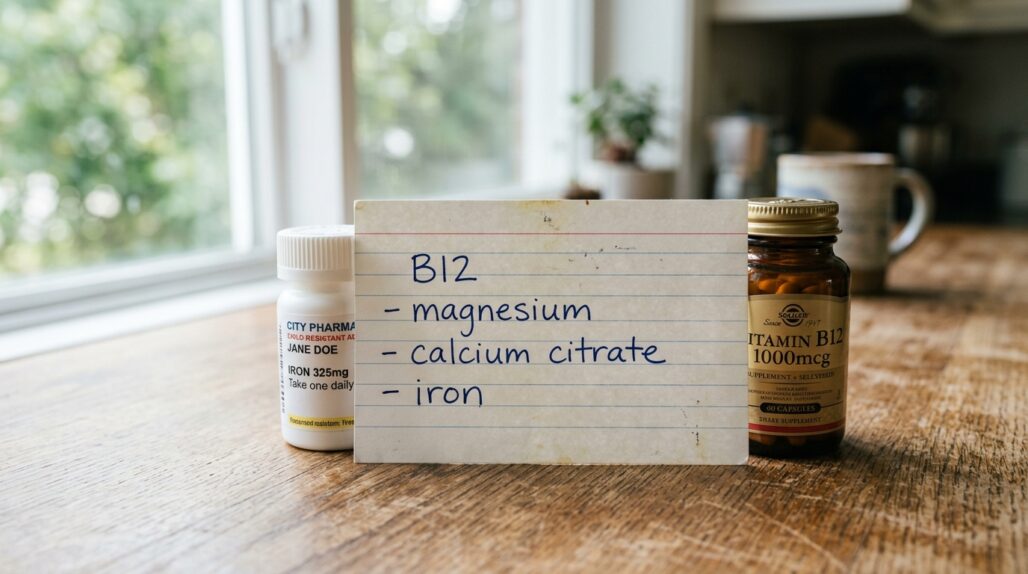
Affiliate disclosure: this article contains affiliate links. As an Amazon Associate, UsefulVitamins.com earns from qualifying purchases at no extra cost to you.
Before you decide
This article is general information, not medical advice. Omeprazole and other proton pump inhibitors (PPIs) are useful drugs, and the goal here is not to scare you off a medication you may genuinely need. It is to help you spot the handful of nutrient issues that long-term acid suppression can cause, and to bring a sharper question to your next appointment.
The people who need to pay attention are long-term users, roughly a year or more of daily use. Short courses of a few weeks rarely cause nutrient problems. Risk climbs with higher doses, older age, a vegetarian or low-meat diet, and other drugs that move the same nutrients (diuretics, metformin, certain antibiotics).
One more honest caveat. Most people on a PPI never develop a clinically meaningful deficiency. The point of a checklist is to know what to monitor, not to assume every symptom is a vitamin gap. Labs settle the question; guessing does not.
Why omeprazole changes nutrient absorption at all
Omeprazole blocks the gastric proton pump, the H+/K+-ATPase that parietal cells use to acidify the stomach. Less acid means a higher gastric pH, and that single change ripples through four different nutrients in four different ways.
Acid does real chemical work in digestion. It activates pepsin to break protein bonds, it keeps iron in its absorbable state, and it dissolves certain mineral salts. Take that acid away for months and some nutrients simply do not get processed the way they normally would.
What follows is the PPI nutrient checklist: the four issues, why each happens, and the form and timing that work around it.
Vitamin B12: the depletion most worth tracking
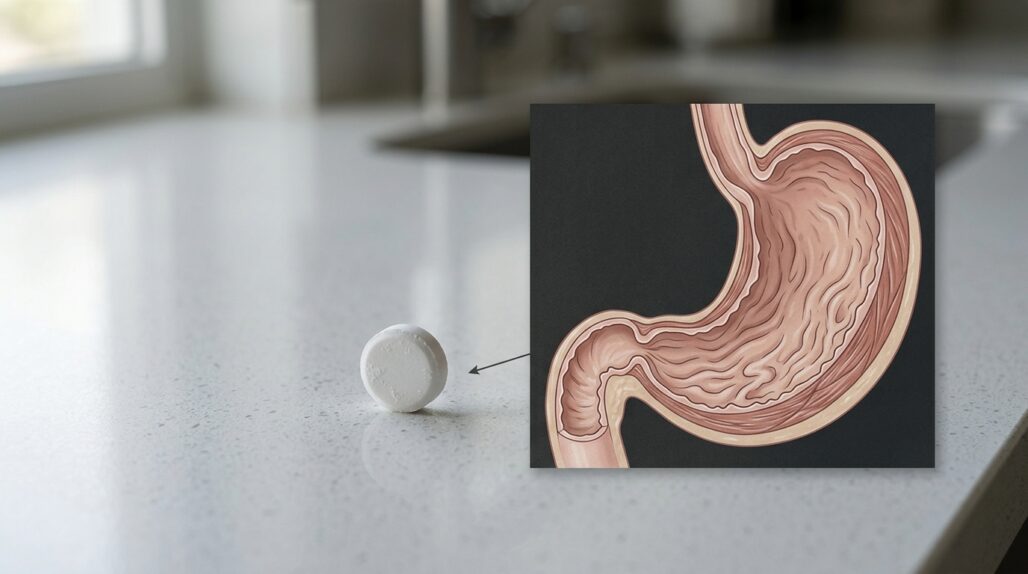
Food-bound B12 arrives stuck to protein, and stomach acid plus pepsin is what frees it so it can bind intrinsic factor and be absorbed downstream. Suppress the acid and that release step stalls. The 2018 review in Advances in Nutrition on PPIs and vitamin B-12 deficiency describes exactly this mechanism, and notes that the association with deficiency shows up mainly with use beyond about 12 months, not short courses.
The NIH Office of Dietary Supplements vitamin B12 fact sheet makes the same point: acid-suppressing drugs can lower absorption of protein-bound B12, while free, supplemental B12 is far less affected. That detail is the workaround. A supplement does not need stomach acid to free it from food, so it sidesteps the main bottleneck.
What this means in practice:
- A methylcobalamin or cyanocobalamin supplement is reasonable for long-term PPI users; both are well studied and inexpensive.
- Sublingual and oral forms work because supplemental B12 is already unbound; you do not need an exotic format.
- If B12 is already low or symptomatic (fatigue, tingling, balance problems, a sore tongue), repletion dosing or injections may be needed – that is a clinician call, not a guess.
Ask for a B12 level, and ideally methylmalonic acid, which catches early deficiency before the standard level drops. Do not start high-dose B12 in the week before bloodwork if your panel also includes other markers your doctor wants clean.
Magnesium: the FDA-flagged risk
This is the one with a formal regulator warning behind it. The FDA Drug Safety Communication on low magnesium with long-term PPI use reports that hypomagnesemia turned up in patients on PPIs, with most cases appearing after about a year of treatment. In roughly a quarter of the reported cases, supplements alone were not enough and the PPI had to be stopped to restore magnesium.
The mechanism appears to involve reduced intestinal magnesium uptake through the TRPM6 and TRPM7 channels, which is harder to override with oral doses than a simple absorption problem. That is why severe cases sometimes only resolve once the drug is paused.
Severe low magnesium is not subtle. Reported symptoms include muscle cramps and spasms, tremor, tetany, abnormal heart rhythms, and seizures. If you notice cramping or palpitations on a long-term PPI, that warrants a serum magnesium check, and the FDA specifically advises baseline magnesium when someone will be on a PPI long term, especially alongside diuretics or digoxin.
For supplementing, magnesium glycinate or citrate are well absorbed and gentler on the gut than oxide, which is poorly absorbed and tends to cause loose stools. Keep one timing rule in mind: magnesium can bind certain drugs in the gut, so separate magnesium from levothyroxine by at least 4 hours, a chelation interaction the FDA levothyroxine prescribing information flags for minerals.
Calcium: the form actually matters here
This is where the supplement aisle quietly works against PPI users. Calcium carbonate needs stomach acid to dissolve. Strip the acid and absorption of carbonate, taken on an empty stomach, drops sharply.
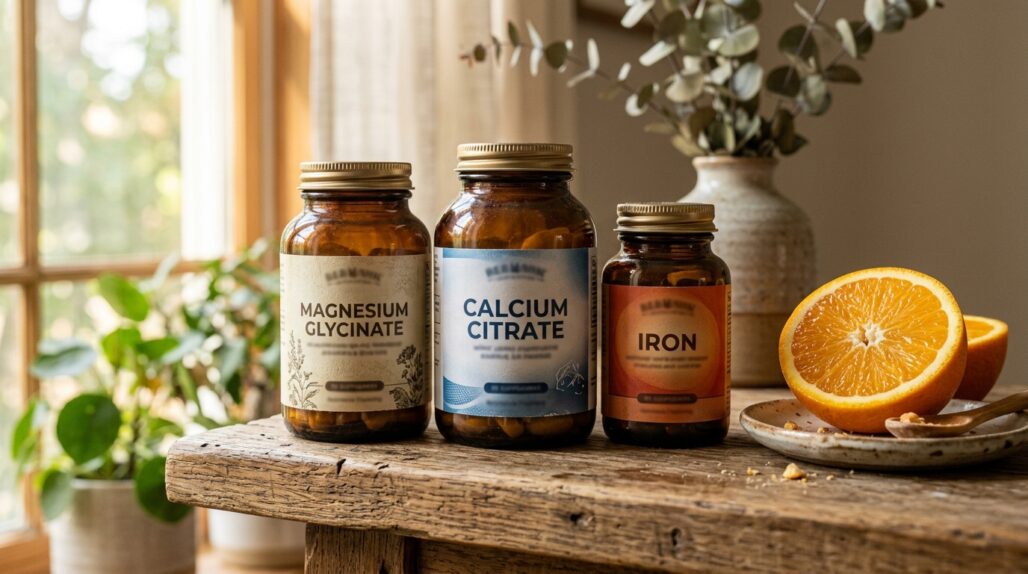
The classic data come from achlorhydric patients. As summarized in a review on chronic PPI therapy and calcium metabolism, Recker's work showed fasting absorption of calcium carbonate fell to near zero in people with no stomach acid, while calcium citrate was absorbed normally. Later work on omeprazole found a meaningful reduction in fasting carbonate absorption. The practical takeaway is blunt.
- Choose calcium citrate on a PPI. It does not depend on gastric acid, so it absorbs whether your stomach is acidic or not, fasting or fed.
- If you only have carbonate, take it with food, which restores absorption even when acid is low.
- Split doses so you take no more than about 500 to 600 mg of elemental calcium at once; the gut absorbs a fraction of any single large dose.
- Pair calcium with vitamin D, since D drives the active calcium transport that does the absorbing.
There is a real-world reason to care: prescription PPIs carry an FDA label note about a possible increased risk of hip, wrist, and spine fractures with use of a year or longer, or at high doses, and the leading hypothesis is calcium malabsorption from acid suppression. Do not over-supplement to compensate, though – more calcium is not automatically better, and total intake well above recommended levels has its own cardiovascular cautions. Aim to meet, not exceed, your target.
Iron: why the supplement may not be working
If your iron stubbornly will not rise on a PPI, the mechanism explains a lot. Most dietary iron is non-heme iron in the ferric (Fe3+) form, and the body absorbs the ferrous (Fe2+) form. Stomach acid and vitamin C are what reduce ferric to ferrous so it can cross into the intestinal cells. Remove the acid and that conversion stalls.
The review on the effect of proton pump inhibitors on vitamins and iron in the American Journal of Gastroenterology lays out this acid-dependent step and the resulting drop in non-heme iron absorption. PPIs also lower the ascorbate in gastric juice, which doubles the problem, since vitamin C normally helps drive iron uptake.
What works around it:
- Take iron with vitamin C (or a glass of orange juice). Ascorbic acid partially restores the ferric-to-ferrous reduction that the missing stomach acid would have done.
- Separate iron from the omeprazole dose rather than swallowing them together.
- Heme iron and some chelated forms are less dependent on gastric acid, so they may absorb better in low-acid conditions.
- Alternate-day dosing can improve overall iron absorption and is easier on the gut than daily high doses for some people.
If iron stays low despite a reasonable oral trial, that is a signal to investigate the cause rather than just push more pills. Persistent iron deficiency on a PPI sometimes needs a workup for blood loss, and occasionally intravenous iron. Loop in your clinician.

The PPI nutrient checklist at a glance
| Nutrient | Why omeprazole affects it | Best form on a PPI | Timing tip |
|---|---|---|---|
| Vitamin B12 | Low acid cannot free B12 from food protein | Methylcobalamin or cyanocobalamin | Any time; supplemental B12 needs no acid |
| Magnesium | Reduced intestinal uptake; FDA-flagged lows | Glycinate or citrate | Keep 4+ hours from levothyroxine |
| Calcium | Carbonate needs acid to dissolve | Calcium citrate, with vitamin D | Split into 500 to 600 mg doses |
| Iron | No acid to reduce ferric to absorbable ferrous | Iron plus vitamin C; heme iron | Take apart from the omeprazole dose |
What to take, and how to keep it organized
Here is the short version of the stack most long-term omeprazole users land on, after labs and a conversation with their clinician or pharmacist.


As an Amazon Associate, UsefulVitamins.com earns from qualifying purchases at no extra cost to you.
UsefulVitamins may earn a commission from purchases made through links on this page, at no extra cost to you. This never changes which products we recommend or how we describe the evidence.
A few rules tie the whole checklist together. Separate your minerals from each other where you can, since calcium, magnesium, and iron compete for the same transporters. Keep iron away from the omeprazole dose, take calcium with vitamin D, and pair iron with vitamin C. None of this requires precision to the minute; consistency over weeks is what moves your labs.
Tracking four supplements plus a prescription is exactly where things slip. A logging app like StackMyMed can hold your full list in one place and flag overlaps to raise with a pharmacist. It is a memory aid, not a substitute for clinical judgment – the pharmacist still makes the call.
When to get labs, and the bigger question
Long-term users deserve a baseline. If you have been on omeprazole a year or more, are over 65, or have symptoms like cramps, palpitations, persistent fatigue, or numbness, ask for B12 (with methylmalonic acid), serum magnesium, ferritin and iron studies, and vitamin D. Recheck after any change to your routine rather than assuming it worked.
Then the question worth asking out loud: do you still need the PPI? The AGA Clinical Practice Update on de-prescribing of proton pump inhibitors advises that every long-term user have their ongoing indication reviewed, and that many people without a firm reason for chronic use can attempt a supervised step-down. Some genuinely need lifelong therapy; others were never reassessed after the original problem resolved.
Do not stop omeprazole cold on your own. Abrupt discontinuation can trigger rebound acid that feels like a relapse but is temporary. Any taper belongs with your prescriber, who can also weigh whether the nutrient concerns above tip the balance.
FAQ
Do I really need supplements just because I take omeprazole? Not automatically. Short courses rarely cause problems. The checklist matters most for long-term use of a year or more, and labs are what tell you whether you actually have a gap rather than a theoretical one.
Which calcium should I take with omeprazole? Calcium citrate, because it absorbs without stomach acid. If you only have carbonate, take it with food, which restores absorption even when acid is suppressed, and pair calcium with vitamin D.
Why isn’t my iron supplement working on a PPI? Without stomach acid, your body struggles to convert dietary ferric iron to the absorbable ferrous form. Taking iron with vitamin C helps, as can heme iron and spacing it away from the omeprazole dose. Persistent low iron deserves a workup.
How do I know if my magnesium is low? Watch for muscle cramps, tremor, or heart palpitations, which can signal hypomagnesemia. The FDA links low magnesium to long-term PPI use, so a serum magnesium check is reasonable, especially if you also take a diuretic or digoxin.
Can I take all these supplements at the same time? It is better not to. Calcium, magnesium, and iron compete for absorption, and minerals can bind some medications. Stagger them across the day, keep minerals away from levothyroxine by at least 4 hours, and stay consistent.
Should I just stop the omeprazole instead? Maybe, but only with your clinician. Many long-term users can attempt a supervised step-down, but stopping abruptly can cause rebound acid symptoms, and some people genuinely need ongoing therapy.
Conclusion: a short list, done consistently
Long-term omeprazole does not wreck your nutrition, but it tilts four nutrients in a predictable direction. B12, magnesium, calcium, and iron are the ones to watch, and the fixes are unglamorous: the right form, sensible timing, and labs to confirm rather than guesswork.
The single most useful move is to bring this checklist, and your full supplement list, to your next visit – then ask whether the PPI itself still earns its place. For the wider picture of how medications and supplements interact, see our guide to drug and supplement interactions and run your own combination through the drug-supplement interaction checker. You can also read how we vet what we recommend in how we review supplements, and dig into the specific PPI nutrient issues in our pieces on omeprazole and magnesium depletion, omeprazole and vitamin B12 deficiency, omeprazole and iron absorption, and whether calcium citrate beats carbonate on a PPI. If reflux is the reason you are on it, our roundup of the best supplements for acid reflux is a useful companion.
This article is for general education and does not replace personalized medical advice. Supplement needs, doses, and the decision to continue or stop a PPI depend on your individual health, labs, and other medications. Talk with your doctor or pharmacist before changing your regimen.
Reviewed by the UsefulVitamins Editorial Team.
