
Affiliate disclosure: this article contains affiliate links. As an Amazon Associate, UsefulVitamins.com earns from qualifying purchases at no extra cost to you.
Before you decide
This is general information, not medical advice for your specific case. Iron deficiency has many causes, and the right fix depends on why you're low and how low you are. Use this to ask better questions, not to self-manage anemia.
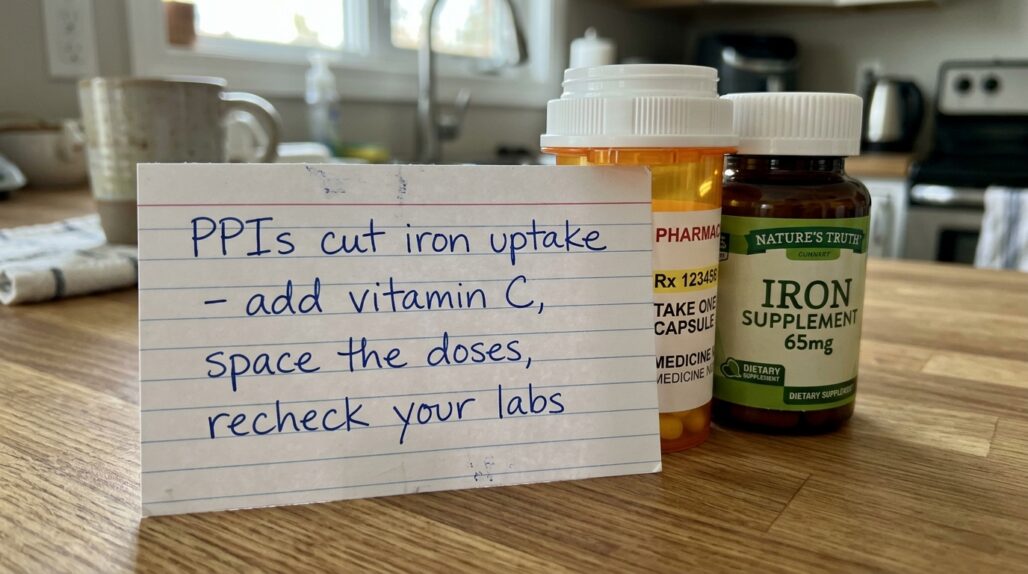
The people most affected here are long-term omeprazole users – roughly a year or more – especially those on higher daily doses. Menstruating women, frequent blood donors, people with celiac disease or inflammatory bowel disease, and anyone recovering from blood loss start with thinner reserves, so a hit to absorption shows up faster.
If you've been swallowing ferrous sulfate for weeks and your labs haven't moved, you're not imagining it. The interaction is real, it's well documented, and it's usually fixable without dramatic measures.
What omeprazole actually does to iron
Omeprazole is a proton pump inhibitor. It shuts down the acid pumps in your stomach lining, which is the point when you're treating reflux or an ulcer. The side effect is a stomach that sits at a much higher pH than nature intended.
Iron from food and most supplements arrives as ferric iron (Fe3+), which your small intestine barely absorbs. Stomach acid does two jobs: it frees iron bound to food proteins, and it helps convert that ferric iron into ferrous iron (Fe2+), the form your gut transporter actually takes up. The NIH Office of Dietary Supplements iron fact sheet describes this acid-dependent reduction step as central to non-heme iron absorption.
Remove the acid and you blunt that conversion. The iron is still in your gut, but a larger share passes straight through. This is the same reason your doctor warns that omeprazole can reduce the absorption of other acid-dependent medications – iron salts are explicitly on that list.
There's a second, quieter mechanism. PPIs also lower the amount of usable vitamin C in gastric juice, and vitamin C is one of the strongest natural promoters of non-heme iron uptake. So omeprazole works against iron from two directions at once.
How big is the effect, really
For most healthy people taking omeprazole for a few days, iron absorption barely changes. A small controlled study by Tempel and colleagues (2013) in the Turkish Journal of Hematology found no significant effect on iron absorption after short-term omeprazole in healthy volunteers with normal iron stores. Short courses are not the worry.
The picture changes with time and with iron status. In a large Kaiser Permanente analysis, Lam and colleagues (2017), published in Gastroenterology, compared more than 77,000 people newly diagnosed with iron deficiency against nearly 390,000 controls. Two or more years of PPI use carried an adjusted odds ratio of about 2.5 for iron deficiency, and H2-blockers like famotidine carried a smaller but real signal too.
Two patterns from that study matter for you. The risk climbed with higher daily doses and longer duration, and it fell after people stopped the drug. That tells you the effect is dose-dependent and at least partly reversible, not a permanent change to your gut.
Experimental work backs the mechanism up. In studies feeding a labeled test meal, even seven days of acid suppression measurably cut non-heme iron uptake. The reassuring counterpoint is the form of iron, which we get to next.
Heme iron mostly sidesteps the problem
Not all iron needs acid. Heme iron – the form in red meat, poultry, and fish – is absorbed by a completely separate pathway that does not depend on stomach pH. PPIs leave it largely untouched.
That's a useful lever. If you eat meat, the iron from that meal is working normally even while your omeprazole is active. The interaction is specific to non-heme iron, which is the kind in plants, fortified foods, and standard ferrous-salt supplements.
This also points to a practical workaround for people who can't tolerate standard tablets. Some products use heme iron polypeptide or various chelated forms (such as ferrous bisglycinate) that researchers consider less dependent on gastric acid than plain ferrous sulfate. Evidence quality varies by product, so treat these as options to raise with a pharmacist rather than guaranteed upgrades.
What to do about it
The goal is simple: give the iron you take the best shot at getting absorbed, despite the missing acid. A few adjustments do most of the work.


As an Amazon Associate, UsefulVitamins.com earns from qualifying purchases at no extra cost to you.
UsefulVitamins is reader-supported. We may earn a commission from links below, at no cost to you. It never affects which products we recommend.
Start with timing. Take your iron well away from the omeprazole dose so it isn't sitting in the most acid-suppressed window. Many people take omeprazole before breakfast and their iron in the afternoon or evening, on a relatively empty stomach.
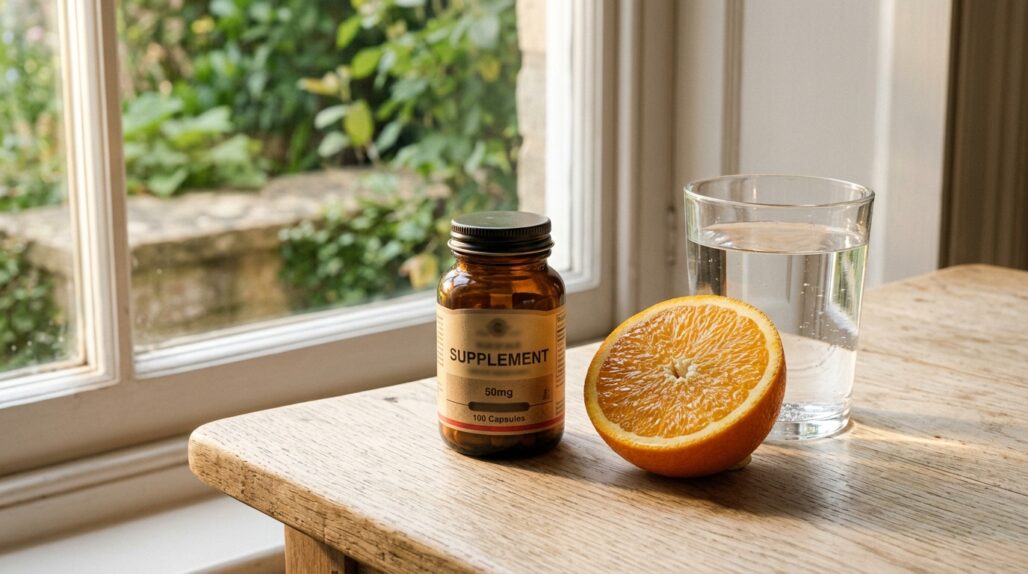
Add vitamin C. Taking iron with a source of ascorbic acid – a glass of orange juice or a vitamin C tablet – partly restores non-heme iron absorption by doing some of the chemistry your stomach acid normally would. The NIH Office of Dietary Supplements notes vitamin C is a well-established enhancer of non-heme iron uptake.
Consider alternate-day dosing. In two randomized trials, Stoffel and colleagues (2017) in The Lancet Haematology found that iron taken every other day was absorbed more efficiently than the same dose taken daily, because daily dosing spikes hepcidin and shuts the door on the next dose. Fewer, well-spaced doses can mean more iron in and fewer side effects.
Avoid the absorption blockers. Calcium supplements, coffee, tea, and high-dose zinc all compete with or bind iron – keep them at a distance from your iron dose.
Here's how those factors sort out:
| Factor | Effect on iron uptake | Practical move |
|---|---|---|
| Omeprazole timing | Highest pH near the dose | Take iron several hours apart |
| Vitamin C with iron | Partly restores non-heme uptake | Pair iron with a vitamin C source |
| Heme iron (meat) | Acid-independent, unaffected | Keep meat, poultry, or fish in the diet |
| Alternate-day dosing | Higher fractional absorption | Ask about every-other-day schedules |
| Calcium, coffee, tea | Reduce absorption | Separate from the iron dose |
For the supplement itself, form and dose are best set with a pharmacist who can see your full medication list. Choosing a product is the part where a quick comparison helps – see our roundups for the best iron supplements, the best supplements for PPI and omeprazole users, and the difference between heme and non-heme iron bioavailability.
When to stop tinkering and see a clinician
Self-adjusting only goes so far. Oral iron is slow even under good conditions, and on a PPI it can be slower, so give any new routine 8 to 12 weeks before judging it by a repeat blood test.
If your ferritin and hemoglobin still aren't climbing on a consistent, well-timed regimen, that's a signal to investigate rather than just push more pills. The British Society of Gastroenterology guidelines (2021) recommend looking for the underlying cause of iron deficiency and reserving intravenous iron for people who can't absorb or tolerate oral iron, or who need correction urgently.
Get prompt medical attention – not a supplement tweak – if you have any of the following:
- Black or tarry stools, or blood in the stool – this can signal bleeding and needs evaluation.
- Chest pain, severe shortness of breath, or a racing heart, which can accompany significant anemia.
- Worsening fatigue, dizziness, or fainting despite treatment.
It's also worth asking whether you still need the omeprazole at all. Many people stay on PPIs longer than the original reason justified. Deprescribing or stepping down the dose is a clinician's call, never something to do abruptly on your own, but it's a fair question to raise at your next visit.
A reliable way to keep this organized is to log every supplement and medication in one place so a pharmacist can scan the whole stack for timing conflicts. The free StackMyMed app helps you record and flag a stack to discuss at a visit. It's a prompt for a real conversation, not a substitute for clinical judgment.
For the bigger picture on iron itself, our complete guide to iron and our vitamin C science, benefits and dosage explainer go deeper than we can here.
FAQ
Can I take iron and omeprazole at the same time? You can, but you’ll likely absorb less, since the iron lands in your most acid-suppressed window. Spacing the two by several hours and adding a vitamin C source gives the iron a better chance.
Does omeprazole cause iron deficiency? Long-term use is associated with a higher risk. A large 2017 study found two or more years of PPI use roughly doubled to tripled the odds of iron deficiency, with stronger links at higher doses, and the risk eased after stopping the drug.
Which iron form is best while on a PPI? Heme iron and some chelated forms (like ferrous bisglycinate) are considered less dependent on stomach acid than plain ferrous sulfate. The right choice depends on your tolerance and labs, so confirm the form and dose with a pharmacist.
Will vitamin C fix the problem completely? It helps but rarely fully compensates. Vitamin C partly restores non-heme iron absorption by reducing ferric to ferrous iron, doing some of the work the missing stomach acid would do, though it does not replace gastric acid entirely.
How long before my iron levels improve? Oral iron is slow – plan on a repeat blood test after about 8 to 12 weeks of consistent dosing. If your numbers haven’t moved, that’s the point to see a clinician rather than simply taking more.
Should I stop omeprazole to fix my iron? Not on your own. Stopping a PPI abruptly can worsen reflux, and it may not be the only factor in your deficiency. Ask your prescriber whether the PPI is still needed and whether a lower dose or step-down makes sense.
Conclusion: the iron isn't the problem, the timing is
When oral iron stalls on omeprazole, it's usually an absorption issue, not a willpower or product issue. The drug raises your stomach pH, and non-heme iron needs acid to become the form your gut can take up.
You have practical levers: space the iron from the omeprazole, pair it with vitamin C, lean on heme iron from food, and ask about alternate-day dosing. Give any new routine a couple of months, then recheck your labs. If the numbers still won't move, bring your full list to a clinician or pharmacist to rule out other causes and weigh whether IV iron or a change to the PPI is warranted.
This article is for general education and does not replace personalized medical advice. Iron supplementation and any change to prescription medication should be guided by your own clinician or pharmacist.
Reviewed by the UsefulVitamins Editorial Team.
