
Introduction
Calcium supplements can help fill a real nutrition gap when you cannot meet your needs through food, but the “best” choice depends on your diet, age, stomach acid, medications, and kidney stone risk. Many people start a pill for bone health, then wonder why they feel constipated, why their lab results did not change, or whether they are taking too much. This article breaks down what calcium does, who actually benefits from supplementing, how to pick a form and dose that absorbs well, and how to avoid common safety mistakes.
Summary / Quick Answer
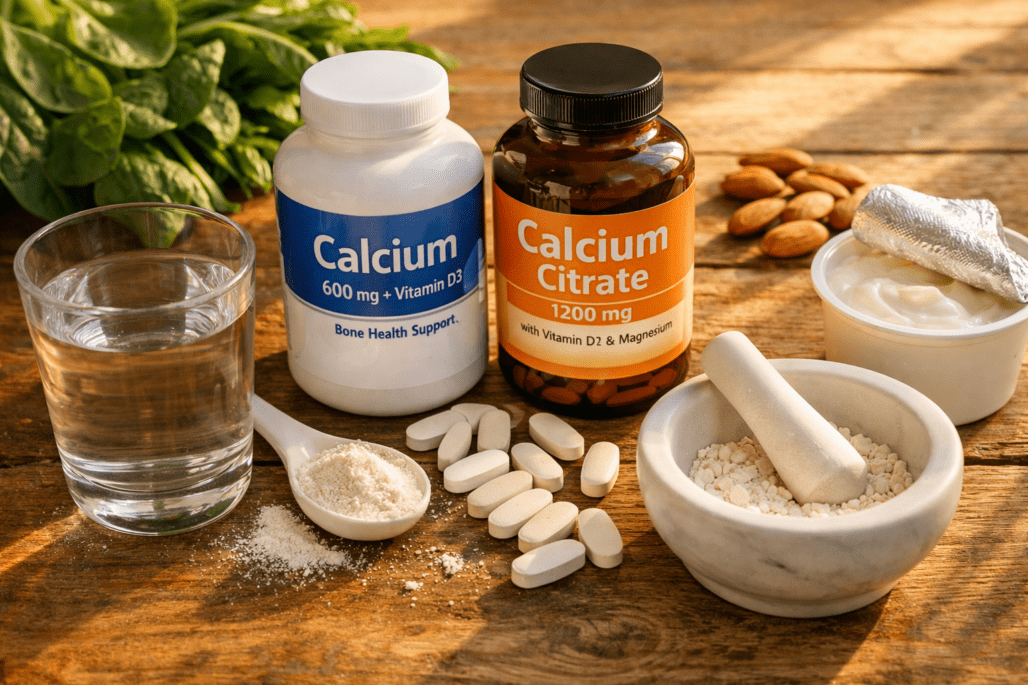
If you’re considering calcium supplements, the most practical approach is: aim for most calcium from food, then supplement only the shortfall, using split doses for better absorption and fewer side effects.
Quick guide
- Most adults need: about 1,000–1,200 mg/day total calcium from food + supplements (needs vary by age and life stage).
- Best-absorbed option for many people: calcium citrate, especially if you’re older or take acid-reducing meds.
- Most budget-friendly option: calcium carbonate, best taken with meals.
- Per-dose limit: take 500–600 mg elemental calcium max per dose, then split if needed.
- Pair with: vitamin D if intake or levels are low (see Vitamin D Comprehensive Guide).
- Avoid common mistakes: taking calcium at the same time as certain antibiotics or iron.
Elemental calcium cheat sheet
| If you want… | Consider | Best timing |
|---|---|---|
| Highest absorption with low stomach acid | Calcium citrate | Any time |
| Cheapest, highest elemental % | Calcium carbonate | With meals |
| Gentle option with less constipation | Calcium phosphate | With meals or as directed |
Calcium Supplements: Who Needs Them (and Who Often Doesn’t)
It’s tempting to treat calcium like an insurance policy: “Take a tablet, protect your bones.” The science is more selective. Calcium matters for bone mineral structure, muscle contraction, nerve signaling, and even steady heart rhythms. But your body also keeps blood calcium tightly controlled. If intake runs low for a while, it can pull calcium from bone to keep blood levels stable. That’s why early problems can feel invisible.
Start with the real question: are you short on calcium intake?
Most people benefit more from checking their usual diet than guessing. According to the Mayo Clinic’s overview on supplementation and safety, food is the preferred source, and supplements are mainly for people who cannot meet needs consistently through diet or have higher requirements. Their guidance also notes absorption limits per dose and common side effects like constipation and gas.
A practical way to think about it:
- If you regularly get 2–3 calcium-rich servings daily, you may not need much supplemental calcium.
- If you avoid dairy, have a low-calcium diet, or have higher needs (for example, many postmenopausal women), supplements can be useful.
Who is at higher risk for calcium deficiency?
True hypocalcemia (low blood calcium) is often not caused by diet alone. Clinical references from the Cleveland Clinic and the Merck Manual describe common causes such as vitamin D deficiency, hypoparathyroidism, kidney disease, and certain medications. Dietary gaps still matter, but they’re not the only driver.
Higher-risk groups include:
- People who avoid dairy (including many vegans), especially without fortified foods
- Postmenopausal women and older adults (bone loss accelerates with age)
- People with low vitamin D or limited sun exposure
- Chronic kidney disease patients (calcium and phosphate balance changes)
- People taking certain medications, including long-term corticosteroids or some anticonvulsants
If you’re in midlife and rethinking your baseline supplement plan, see Best Vitamins For Women In Their 40s for a broader, age-relevant framework.
Visual: “Do I likely need a supplement?” decision map
- Step 1: Do you eat calcium-rich foods daily (dairy, fortified plant milk, calcium-set tofu, leafy greens)?
- Yes → You may only need a supplement if advised for bone health or labs show a problem.
- No → Go to Step 2.
- Step 2: Can you add 2–3 servings of calcium-rich foods most days?
- Yes → Try food-first for 2–4 weeks, then reassess.
- No → A supplement to cover the shortfall is reasonable.
- Step 3: Do you have kidney stones, kidney disease, parathyroid issues, or take interacting meds?
- Yes → Talk with a clinician before supplementing.
- No → Choose a form and dose based on absorption and tolerance.
Signs of Low Calcium: Symptoms, Testing, and What “Deficiency” Really Means

Many readers search for calcium deficiency symptoms because they feel “off” – twitchy muscles, tingling, cramps, brittle nails, or unexplained fatigue. Here’s the catch: dietary low intake and low blood calcium are not the same thing. Blood calcium is regulated so tightly that you can be depleting bone stores while routine labs still look “normal.”
What hypocalcemia looks like clinically
Hypocalcemia usually refers to low blood calcium, often below about 8.5 mg/dL (lab ranges vary). Clinical summaries from UPMC and the Cleveland Clinic describe symptoms that may include:
- Tingling around the mouth or in fingers and toes
- Muscle cramps or spasms
- Irritability, confusion, or brain fog
- More severe cases: seizures or abnormal heart rhythms
A key point from the NIH’s StatPearls review is that hypocalcemia is often driven by underlying issues like low vitamin D, low magnesium, parathyroid problems, or kidney disease, not simply “not enough milk.”
What to test (and why it matters)
If symptoms are persistent or you’re high risk, guessing is not the best plan. Ask a clinician about:
- Serum calcium (often with albumin correction)
- 25(OH) vitamin D
- Magnesium
- Parathyroid hormone (PTH)
- Kidney function and phosphate (when relevant)
Why magnesium? Low magnesium can block correction of low calcium. If you want a clear breakdown of forms and dosing, see Magnesium Benefits Types Dosage.
Visual: Symptom severity guide (when to act fast)
| Symptom pattern | What it may suggest | What to do |
|---|---|---|
| Mild cramps, occasional tingling | Could be hydration, electrolytes, vitamin D, magnesium, or calcium intake | Review diet and meds; consider labs |
| Frequent spasms, numbness, worsening fatigue | Possible electrolyte imbalance or developing hypocalcemia | Schedule medical evaluation soon |
| Seizure, fainting, chest pain, palpitations | Possible severe hypocalcemia or arrhythmia | Seek urgent care |
<
Choosing the Best Calcium Supplement Form: Carbonate vs Citrate (and More)
Standing in front of a shelf of bottles, the labels look similar. The differences are not marketing details – they affect absorption, side effects, and whether the dose is realistic.
The most important label detail: “elemental calcium”
Supplement facts list the compound (carbonate, citrate) and the amount of elemental calcium you actually get. Elemental calcium is what counts toward your daily total.
A useful rule: absorption drops as the dose rises, so taking one huge dose is often less effective than splitting it.
Carbonate vs citrate: how to choose
According to Mayo Clinic guidance, calcium is best absorbed in amounts of 500 mg or less at a time, and the form matters.
Calcium carbonate
- Highest elemental calcium percentage (often about 40%)
- Usually cheapest
- Best absorbed with food because stomach acid helps
- More likely to cause constipation or gas in some people
Calcium citrate
- Lower elemental percentage (often about 21%)
- Often better tolerated and absorbed, especially for:
- Older adults
- People on acid reducers (PPIs, H2 blockers)
- People who get constipation from carbonate
- Can be taken with or without food
Other forms you may see:
- Calcium phosphate: generally well absorbed, sometimes gentler on digestion
- Calcium gluconate/lactate: lower elemental calcium; more common in clinical settings or specific use cases
Visual: quick comparison table (practical, not hype)
| Form | Absorption notes | Best for | Common downside |
|---|---|---|---|
| Carbonate | Needs stomach acid; take with meals | Budget, fewer pills | Constipation, gas |
| Citrate | Absorbs well even with low acid | Older adults, reflux meds | More pills, higher cost |
| Phosphate | Generally good absorption | People sensitive to constipation | Less common |
| Gluconate/Lactate | Low elemental calcium | Special situations | Inefficient for daily targets |
Quality and dosing strategy that works in real life
Look for third-party testing (USP or similar). Then plan dosing like this:
- Calculate your dietary calcium first.
- Supplement only what you’re missing.
- Split into 500–600 mg elemental calcium per dose.
- Consider pairing with vitamin D if your intake is low or labs show deficiency. Useful Vitamins’ Vitamin D Comprehensive Guide explains dosing ranges and testing.
Safety, Interactions, and Common Mistakes With Calcium Supplements
Calcium is essential, but more is not automatically better. Problems often come from stacking: a multivitamin, a bone formula, fortified foods, and antacids can quietly push total intake too high.
Upper limits and why “extra” can backfire
Many adults aim for about 1,000–1,200 mg/day total calcium (food + supplements), but the tolerable upper limit is higher. Still, routinely taking large supplemental doses without a reason can raise the risk of side effects, including constipation and, in some people, kidney stones. Healthline’s overview of calcium deficiency and treatment also notes that excessive supplementation may increase kidney stone risk.
If you have a history of stones, kidney disease, or high calcium levels, get medical guidance before supplementing.
Medication interactions: the timing matters
Calcium can bind to certain medications in the gut and reduce absorption. A common example is some antibiotics. If you’re currently taking antibiotics or may need them, read Calcium Blocks Antibiotic Effectiveness for timing strategies and what to ask your pharmacist.
Other common spacing issues:
- Iron and zinc: calcium may reduce absorption when taken together
- Thyroid hormone (levothyroxine): often needs separation by several hours
- Some heart medications (including digoxin) and diuretics: require clinician oversight
A simple habit that prevents many issues:
- Take calcium at a different time than iron, zinc, and interacting meds, often 2+ hours apart (follow your prescriber’s advice).
Steroids, bone health, and joint pain confusion
Long-term corticosteroid use can increase bone loss risk, and people sometimes add calcium without addressing the full picture. If steroids are part of your health history and you’re trying to connect symptoms like aches or joint pain with supplement choices, see Joint Pain Calcium Supplements Steroids for context and next steps.
Visual: “safe use” checklist
- Do calculate your total daily calcium from food + supplements.
- Do split doses (500–600 mg elemental at a time).
- Do choose citrate if you have low stomach acid or constipation.
- Do check vitamin D and magnesium if labs or symptoms suggest a problem.
- Don’t take calcium with certain antibiotics, iron, or thyroid meds.
- Don’t self-prescribe high doses long term without monitoring.
<
Conclusion
Calcium supplements are most helpful when they fill a clear gap, not when they replace a calcium-rich diet. Start by estimating your usual calcium intake, then choose a form that fits your digestion and medication schedule. For many people, that means split doses of calcium citrate or carbonate (with meals), plus attention to vitamin D and magnesium status when needed.
If you want to tighten up your plan, review the Vitamin D Comprehensive Guide and keep the interaction timing tips from Calcium Blocks Antibiotic Effectiveness handy. A few small scheduling changes often make supplementation safer and more effective.
