
Why the first week home is the riskiest
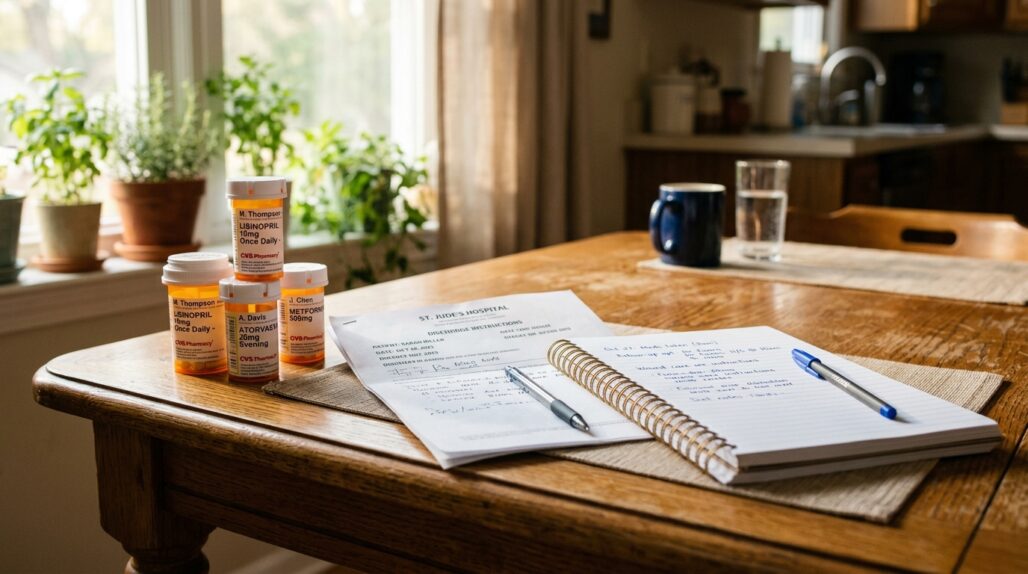
Discharge feels like the finish line. In medication terms it is one of the most error-prone moments in the whole stay. The hospital built a fresh list during admission, sometimes without a complete picture of what your parent was already taking, and now two lists have to be merged back into one. That merge is where things slip.
The numbers are sobering. A systematic review of patients moving from hospital to home found that about half had at least one unintentional medication discrepancy, and adverse drug events turned up in roughly one in five patients after they left, according to the review published in Drug Safety on medication errors after discharge. A separate randomized trial reported that about half of discharged patients had a clinically important medication error, with roughly a quarter of those rated serious, as documented in this trial of a pharmacist discharge intervention.
This is not about anyone being careless. It is a handoff problem, and you, sitting at the kitchen table with both pieces of paper, are in a real position to catch what the handoff missed.
What "reconciliation" actually means at your kitchen table
Hospitals have a name for this comparison: medication reconciliation. The Agency for Healthcare Research and Quality describes it as reviewing the complete medication regimen and comparing it against the regimen for the new setting of care to catch omissions, duplicates, and wrong doses. There is even a National Patient Safety Goal requiring hospitals to compare what you brought in against what they ordered.
You are doing the home version of that same job. You do not need clinical training for it. You need the old list, the new sheet, and a calm hour. The goal is simple: account for every single line, so that nothing was dropped by accident and nothing got doubled up.
One reason this matters so much: people often do not realize what changed. In one study, about 12 percent of admission medications were stopped and 10 percent were redosed at discharge, yet most patients could not correctly describe those changes afterward, per this analysis of patient understanding at discharge. Writing it down closes that gap.
Gather the two lists first
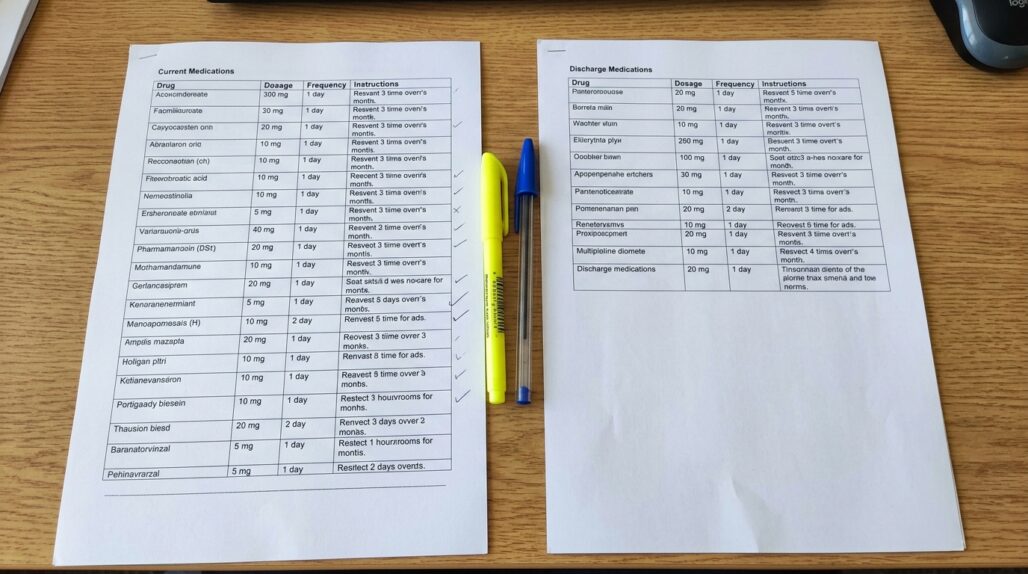
Before you compare anything, get both pictures in front of you.
- The pre-hospital list. Everything your parent took at home before admission: prescriptions, over-the-counter medicines, vitamins, and supplements. If there is no written list, build one from the bottles in the cabinet.
- The discharge paperwork. The official medication list the hospital sent home. It usually says what to take, how much, and how often. If you only got a verbal rundown, call and ask for the written discharge medication list before your parent takes anything.
- The actual bottles. Line up the physical containers too. Sometimes a new bottle from the hospital pharmacy and an old bottle at home are the same drug under different labels.
If a written pre-hospital list does not exist, that is normal. Many families reconstruct it from memory and the medicine cabinet. That reconstruction is exactly what our companion piece on the brown bag medication review walks through, and it is worth doing once so you have a baseline for next time.
The compare checklist: tag every difference
Now go line by line down the discharge sheet and match each item against the old list. For each medicine, decide which bucket it falls into. A printable version you can copy onto paper is below.
| Category | What it means | What to do |
|---|---|---|
| Added | On the discharge sheet, not on the old list | Confirm the reason it was started and how long to take it |
| Stopped | On the old list, missing from the discharge sheet | Confirm it was meant to stop, not dropped by accident |
| Dose changed | Same drug, different strength or frequency | Note the old and new dose; ask which is current |
| Possible duplicate | A brand name and a generic that may be the same drug | Flag it; do not take both until a pharmacist confirms |
| Supplement | A vitamin or supplement, often absent from the hospital list | Hold and ask before restarting (see below) |
The duplicate trap deserves a second look. A discharge sheet might list a drug by its generic name while the same medicine sits in the cabinet under a brand name. To a tired family member they read like two different pills, and that is how a parent ends up taking a double dose. The U.S. Food and Drug Administration notes that a generic contains the same active ingredient and strength as its brand-name version, which is reassuring for treatment but is precisely why two labels can mean one drug. When two names look like they might match, set both aside and ask.
Here is a paper template you can write out in two minutes. No app required:
- Drug name (and any other name on the bottle): __________
- Old dose / new dose: __________
- Category (added / stopped / changed / duplicate / supplement): __________
- Question for the pharmacist: __________
Supplements: do not just restart everything
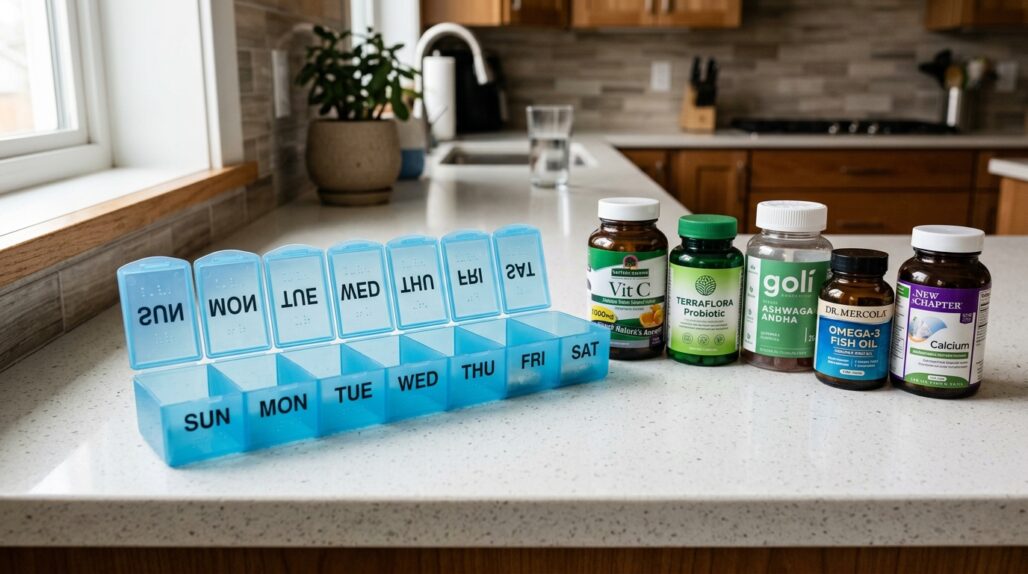
Vitamins and supplements are the items most likely to vanish from a hospital list. They often are not treated as medications during the stay, so they simply do not get written down. A review of the problem found that over-the-counter products and dietary supplements are frequently left out of the medication record even when patients are taking them.
That blank space is not a signal to resume the old supplement routine on autopilot. Some supplements interact with new prescriptions, and a few affect bleeding, blood pressure, or blood sugar in ways that matter more after a hospital stay. The safer move is to keep the supplement list visible, hold the items you are unsure about, and ask the pharmacist which ones are fine to restart now and which should wait. Our guide on whether a parent's supplements are safe alongside prescriptions covers the common ones to flag.
What to ask the discharge nurse or pharmacist
Before you leave, or on the follow-up call, you have permission to ask plain questions until the answers make sense. The teach-back approach hospitals use works in reverse here: repeat the plan back in your own words and let them correct you.
- What changed and why? Which medicines were added, stopped, or had their dose adjusted, and the reason for each.
- What should we stop completely? Confirm anything that was on the old list but is gone now was meant to go.
- What do we resume, and when? Including the home supplements you held back.
- Are any of these the same drug under two names? Point to your flagged duplicates.
- Who do we call with questions, and when is the follow-up? Get a name and number, not just a brochure.
Keep one list, and keep it current
Once you have reconciled everything, you have a single accurate list. The job now is to keep it that way, because the next dose change, refill, or follow-up visit will move things again.
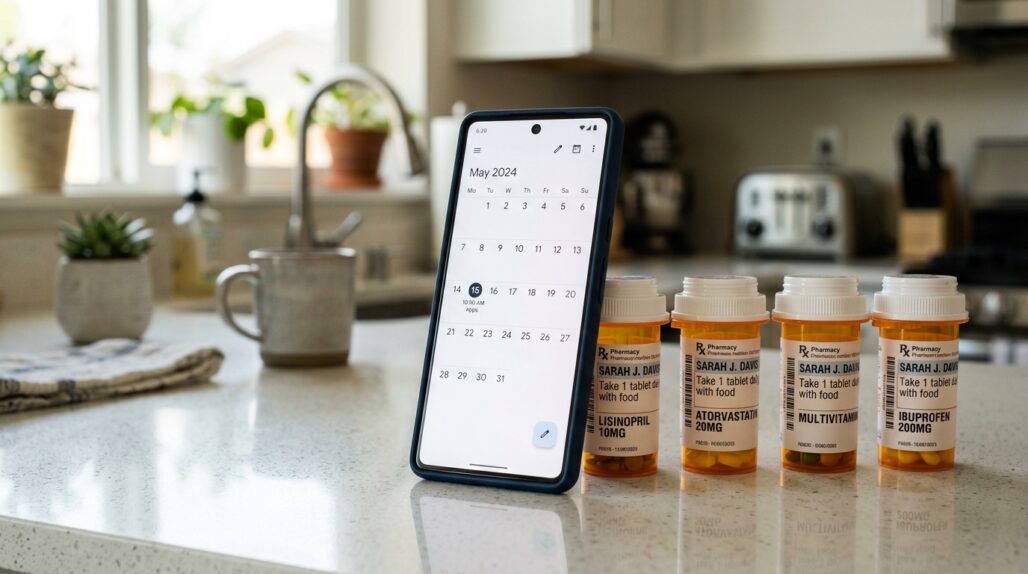
The low-tech version is a good one: a printed sheet on the fridge and a weekly pill organizer your parent fills every Sunday. That alone prevents most slips. If you would rather keep the list on your phone so it is always with you at appointments, that works too. Discharge is the highest-risk moment for dose mix-ups, so keeping the old list in StackMyMed (our own free app) makes it straightforward to spot what was added, stopped, or changed and to export a clean copy for the follow-up visit, while a paper printout on the fridge does the same job for anyone who prefers nothing digital. Either way, when the app or your notes surface a possible duplicate or interaction, treat that as a prompt to ask the pharmacist, not as a final answer.
For the longer reference on combinations worth raising, our guide to drug and supplement interactions is a useful companion to keep bookmarked, and you can run a specific pairing through our drug and supplement interaction checker before you raise it with the pharmacist.
FAQ
How soon after discharge should I do this comparison? Before the first dose at home if you can, and certainly within the first day. The early days carry the most risk, so the sooner both lists are reconciled, the better.
A medicine my parent always took is missing from the discharge sheet. Did they make a mistake? Maybe, maybe not. Sometimes a drug is stopped on purpose during a stay and that decision is intentional. Do not restart it on your own and do not assume it was dropped by error. Call the pharmacist or prescriber and confirm.
Should I just restart all the vitamins and supplements they took before? Not automatically. Supplements are often left off hospital lists, and some interact with new prescriptions. Keep the list visible and ask the pharmacist which to resume and which to hold.
The discharge sheet and an old bottle seem to be the same drug. What do I do? Set both aside and do not give both. A generic and a brand name can be one medicine, and taking both is a double dose. Have a pharmacist confirm which one to use.
Can I change a dose myself if the new sheet looks wrong? No. Flag it, write down your question, and ask the prescriber or pharmacist. Adjusting a dose on your own is exactly the kind of guess this whole process is meant to prevent.
Who is the right person to call with a discrepancy? Either the pharmacy that filled the discharge prescriptions or the prescriber’s office. Both can read the orders and tell you what is current.
The bottom line
The single most useful thing you can do in the first day home is put the old list and the new discharge sheet side by side and account for every line, tagging what was added, stopped, dose-changed, or possibly duplicated. Hold any supplement you are unsure about rather than restarting on autopilot. When something does not add up, that is a call to the pharmacist or prescriber, not a decision to make yourself. The family organizes the list; the professionals make the medical calls.
This article is for general education and is not medical advice. It is not a substitute for guidance from your doctor or pharmacist, who know your parent's full history. Never start, stop, or change a medication or supplement on your own.
StackMyMed is made by UsefulVitamins. It helps you organize your list and flag things to discuss with a pharmacist or doctor; it is not a diagnosis or treatment tool and does not replace professional medical advice.
Reviewed by the UsefulVitamins Editorial Team.
