
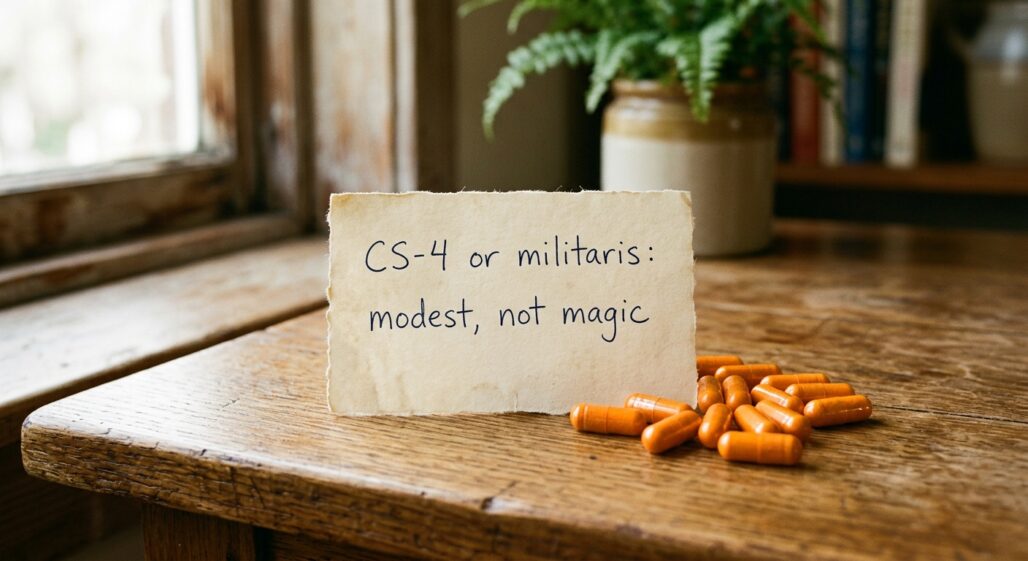
If you are searching for the best cordyceps supplements, you have probably seen the promise that this orange mushroom turbocharges energy and VO2max. The honest answer: cordyceps may give a small, real bump in exercise capacity for some people, but the human evidence is modest and mixed, so keep your expectations low. This article walks through what cordyceps actually is, what the trials really found, why most cheap products are mostly grain starch, and which forms are worth the money. The picks at the end are the ones I would keep in my own family's cabinet, not a list of everything that sells.
Affiliate disclosure: this article contains affiliate links. As an Amazon Associate, UsefulVitamins.com earns from qualifying purchases at no extra cost to you.
Before you decide
The exercise evidence for cordyceps is genuinely modest and mixed, not a sure thing. One well-known positive trial actually tested a multi-mushroom blend, and a clean trial in trained cyclists found no benefit at all. Go in expecting a small effect at best, and only after weeks of daily use.
The bigger money trap is quality. Most "cordyceps" sold in the US is mycelium grown on grain, which can be up to 65% residual starch rather than active mushroom. The label often shows a wild caterpillar fungus the product does not contain. Spend on a fruiting-body extract or a true research-grade fermented CS-4, not the starchy filler version.
Cordyceps is not for everyone. If you take blood thinners or antiplatelet drugs, immunosuppressants, or you have surgery scheduled within two weeks, skip it until you talk to your doctor. Pregnant and breastfeeding people and children should also pass for now, because safety data are thin. And if your fatigue is new, severe, or unexplained, ask your doctor about a blood test for things like iron, ferritin, B12, and thyroid before you reach for a mushroom.
What cordyceps actually is: CS-4 vs militaris and cordycepin
Cordyceps is a genus of fungi, and the supplement world really revolves around two of them. Cordyceps sinensis is the wild Himalayan "caterpillar fungus," and Cordyceps militaris is the bright orange species that is easy to cultivate. They are not interchangeable on a label, even though marketing often blurs them.
Wild sinensis is essentially not in your bottle. It is one of the most expensive biological commodities on earth, and a 2018 PNAS analysis documents how climate change and overharvesting have collapsed wild populations across the Himalayan plateau. Because harvesting the real thing is neither affordable nor sustainable, the industry standardized on a cultivated mycelium strain called CS-4, a fermented biomass of Cordyceps sinensis selected decades ago as the closest cultivable match to the wild fungus.
Then there is the active-compound story. Cordyceps militaris is prized for cordycepin (3'-deoxyadenosine), a nucleoside analog that militaris produces in far higher amounts than sinensis. A 2020 review in Frontiers in Pharmacology catalogs cordycepin and the cell-wall beta-glucans as the main bioactives, with effects on immune signaling and adenosine pathways. Most of that work, though, is lab and animal data, not human energy trials. Think of CS-4 as the strain the exercise studies used and militaris as the strain with the headline molecule.
The actual performance evidence, told honestly
Here is the part most roundups skip. The cordyceps energy story rests on a handful of small trials that point in different directions. That is not a reason to dismiss it, but it is a reason to stay calm about the marketing.
The trial that fans cite most is a 2017 study where participants improved VO2max and time to exhaustion after three weeks. In a randomized placebo-controlled trial published in the Journal of Dietary Supplements, VO2max rose about 4.8 ml/kg/min versus 0.9 in placebo after chronic dosing of 4 g/day. The catch: the supplement was a multi-mushroom blend, not pure cordyceps, so you cannot cleanly credit cordyceps alone. And one week of use did nothing, so this is a slow, daily-habit ingredient at best.
The cleaner cordyceps-only data are more sobering. A 12-week trial of CS-4 in healthy older adults at about 1 g/day found no change in VO2max at all, though submaximal thresholds improved modestly. And in trained athletes, a trial of CordyMax CS-4 in male cyclists concluded flatly that five weeks of supplementation had no effect on aerobic capacity or endurance performance.
So what is real? The most defensible read is a small possible gain in submaximal exercise tolerance, mainly in untrained or older people, after weeks of daily use, and probably not enough to feel like a switch flipped. That is the verdict the slick "energy mushroom" pages leave out.
The quality problem: why most cordyceps is mostly starch
This is where your money actually leaks. Cordyceps grows slowly, so producers often grow the mycelium on a bed of grain like rice or oats, then grind up the whole thing, grain included. The result can be a powder that is largely starch.
The numbers are stark. According to the supplier-science write-up from Nammex on mycelium versus fruiting body, grain-grown mycelium products can run up to 65% residual starch, while a true fruiting-body extract typically sits under 5%. The beta-glucans, the cell-wall compounds you are paying for, tell the same story: myceliated grain often lands at just 1 to 3%, while a Cordyceps militaris fruiting-body extract reaches much higher.
One honest nuance most articles get wrong: research-grade fermented CS-4 is not the same as cheap grain mycelium. True CS-4 is a controlled liquid fermentation that produces low-starch biomass, and it is the form actually used in the human trials above. The problem product is the powder grown on solid grain and sold as if the grain were medicine. A reader skimming "mycelium bad, fruiting body good" can wrongly toss out the one mycelium form that has trial support.
Here is how the common forms stack up.
| Form | What it is | Beta-glucans | Worth buying? |
|---|---|---|---|
| Militaris fruiting body | Cultivated orange mushroom, extracted | High, often labeled and standardized | Yes, best cordycepin and beta-glucan |
| Fermented CS-4 biomass | Liquid-fermented sinensis mycelium | Moderate, low residual starch | Yes, the form used in the trials |
| Mycelium on grain | Mycelium grown on rice or oats, ground whole | Low, 1 to 3%, high starch | No, you are mostly buying grain |
| “Wild sinensis” | Marketing image of caterpillar fungus | Not actually in most bottles | No, real wild is unaffordable and unsustainable |
Actionable takeaway: read the species and the form before the price. A militaris fruiting-body extract or a stated fermented CS-4 beats a vague "cordyceps mycelium" blend almost every time.
What to look for when buying
A good cordyceps label tells you what is in it without you having to guess. Use these five checks like a chef checking a knife before they buy it.
First, the species and the part. Look for the words "Cordyceps militaris fruiting body" or "fermented CS-4," not just "Cordyceps mycelium" with no species. Vagueness is usually a red flag for grain filler.
Second, the beta-glucan percentage printed on the label, not "polysaccharides," which can include the starch you are trying to avoid. A militaris fruiting-body extract should state a real beta-glucan number; the Real Mushrooms buying guide treats this as the single most useful spec.
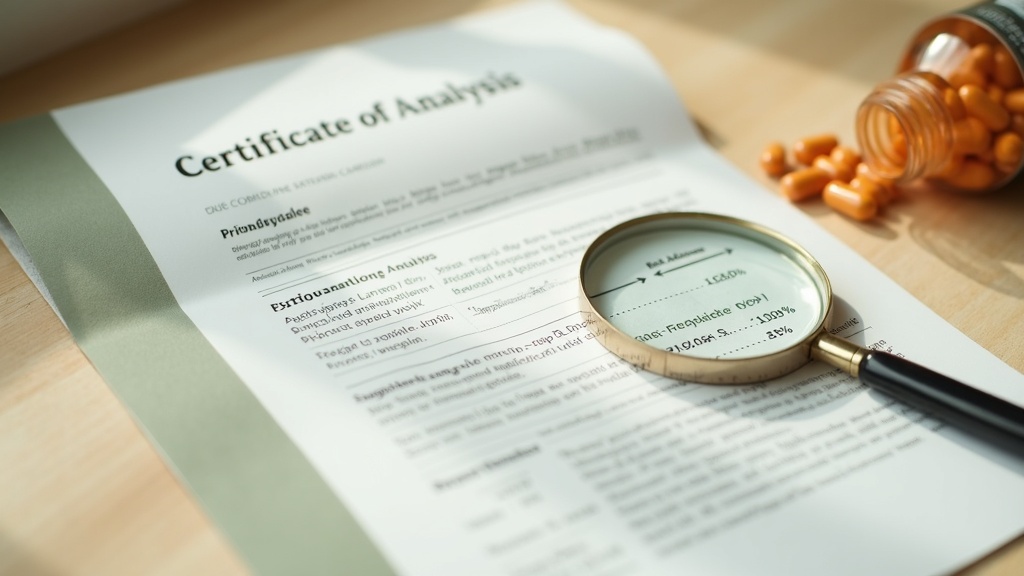
Third, a third-party certificate of analysis. Because cordyceps is not tightly regulated, an independent test for identity, heavy metals, and starch content is your best protection. The NIH Office of Dietary Supplements explains why third-party testing matters for botanical products that lack pre-market approval.
Fourth, a sane dose. Trials used roughly 1 to 4 g/day of extract, taken daily for weeks. Skip products that hide the dose inside a proprietary blend.
Fifth, no caterpillar-fungus theater. If the bottle shows a wild Himalayan caterpillar but the supplement facts say cultivated mycelium, the picture is selling a fantasy.

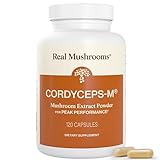

As an Amazon Associate, UsefulVitamins.com earns from qualifying purchases at no extra cost to you. We only recommend products supported by published research or third-party testing.
Who should skip cordyceps
Cordyceps is reasonably well tolerated for most healthy adults, but it is not harmless, and a few groups should clearly wait or avoid it.
If you take antiplatelet or anticoagulant drugs, cordyceps may add to bleeding risk because it can inhibit platelet aggregation. The RxList cordyceps monograph flags this interaction and advises caution with blood thinners. The same monograph notes that cordyceps may blunt immunosuppressant drugs like prednisolone and could threaten a transplanted organ, so transplant patients and anyone on immune-suppressing therapy should avoid it.
Stop cordyceps at least two weeks before any scheduled surgery, given the theoretical bleeding risk during and after procedures.
Pregnant and breastfeeding people, and children, should skip it simply because the safety data are not there yet. And anyone with an autoimmune condition should treat the immune-modulating claims as a reason for caution, not enthusiasm, since "stimulating immunity" is not what you want when your immune system is already overactive.
One practical note: cordyceps can be mildly stimulating and may disturb sleep if you take it late, and a minority of people get transient nausea or loose stools. Take it in the morning with food.
FAQ
Is cordyceps a stimulant like caffeine?
No. It does not contain caffeine and does not produce a sharp jolt. Any effect is subtle, builds over weeks of daily use, and shows up mostly as small changes in exercise tolerance rather than alertness. If you feel a strong rush, that is expectation, not pharmacology.
CS-4 or militaris, which is better for energy?
CS-4 is the form actually tested in the exercise trials, so it has the most direct, if modest, human support. Militaris has more cordycepin and beta-glucan and is the better fruiting-body extract, but its energy evidence is thinner. A reasonable choice is a quality militaris fruiting body or a true fermented CS-4, and to ignore grain mycelium either way.
How long until I notice anything?
In the trials, benefits showed up after about three to six weeks of daily dosing, not on day one. Give it a full month at 1 to 3 g/day before deciding whether it does anything for you, and be ready to conclude it does not.
Does cordyceps boost testosterone or libido?
That claim rests almost entirely on animal studies. There is no good human trial showing a meaningful testosterone or libido effect, so do not buy cordyceps for that reason.
Will a blood test tell me if I need it?
Cordyceps is not a nutrient, so there is no deficiency to test for. But if you are chasing energy, ask your doctor about checking iron, ferritin, B12, and thyroid first. Fixing a real deficiency does far more than any mushroom.
The bottom line on the best cordyceps supplements
Cordyceps is one of the more interesting fungi in the supplement aisle, and the energy story is not pure fiction. But the honest synthesis is this: the human evidence for exercise capacity is small, mixed, and slow to appear, the best-known positive trial used a mushroom blend rather than pure cordyceps, and a clean trial in athletes found nothing. If you try it, you are running a low-cost personal experiment, not buying a guaranteed result.
What separates this guide from the usual roundup is the math behind the bottle. Most "cordyceps" on the shelf is mycelium grown on grain, which can be mostly starch rather than mushroom, so the single best decision you make is choosing a militaris fruiting-body extract or a true fermented CS-4 with the beta-glucan percentage and a certificate of analysis, and skipping the starchy filler.
Next steps:
- Read the label for species, part (fruiting body or fermented CS-4), and a stated beta-glucan percentage before you compare prices.
- If you take blood thinners, immunosuppressants, or have surgery coming up, talk to your doctor first.
- For the wider mushroom picture, see our complete guide to medicinal mushrooms, the calming counterpart in our best reishi supplements guide, and if energy is really your goal, our best pre-workout supplements roundup. You can also read how we test and score products on our how we review supplements page.
As an Amazon Associate, I earn from qualifying purchases. Product recommendations are based on real reviews and independent research.
Reviewed by Sarah Thompson, Registered Dietitian, focused on vitamin and mineral nutrition.
This article is for informational purposes and not medical advice. Cordyceps can interact with medications, including blood thinners and immunosuppressants, and with surgery. Consult a licensed physician before starting any supplement, particularly if you are pregnant, nursing, taking prescription medications, or managing a chronic condition.
