
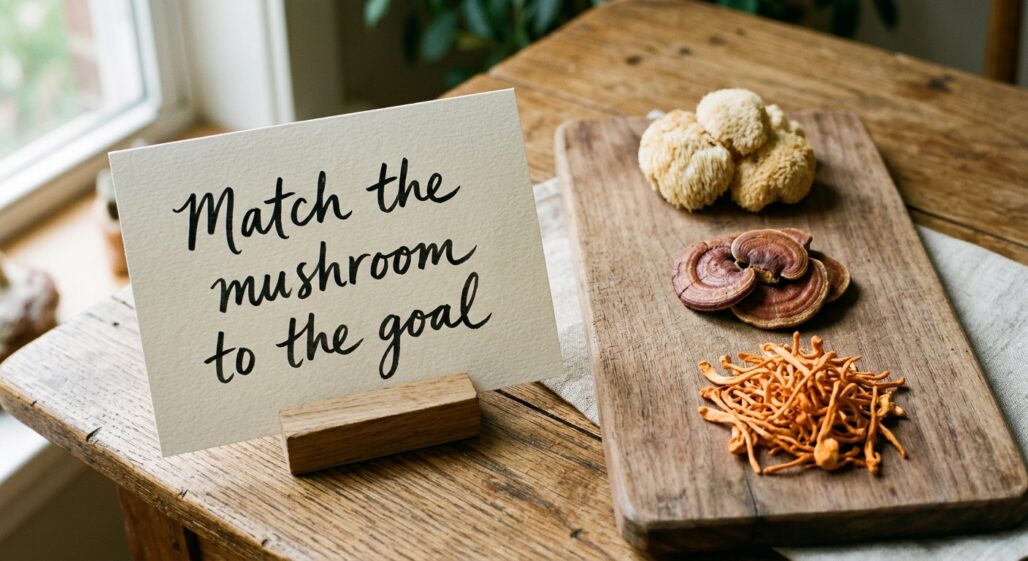
If you have ever stood in front of a wall of "shroom" powders wondering whether lion's mane, reishi, cordyceps, turkey tail and chaga actually do different things or just share a marketing aesthetic, the honest answer is: they are genuinely different compounds with different mechanisms, but most of the human evidence is small and early, and bottle quality varies wildly. This guide matches each mushroom to a real goal, ranks the evidence tier per species, and walks through the one quality issue that decides whether your powder does anything at all.
Before you decide
Read this part before you buy anything, because it changes how you should weigh every claim below. Almost all of the human trials on medicinal mushrooms are small (often under 50 people), short (8 to 16 weeks), and run on a single proprietary extract that may not match the powder you buy. That is not a reason to dismiss them, but it is a reason to keep expectations modest and treat "studies suggest" as a starting hypothesis, not a guarantee.
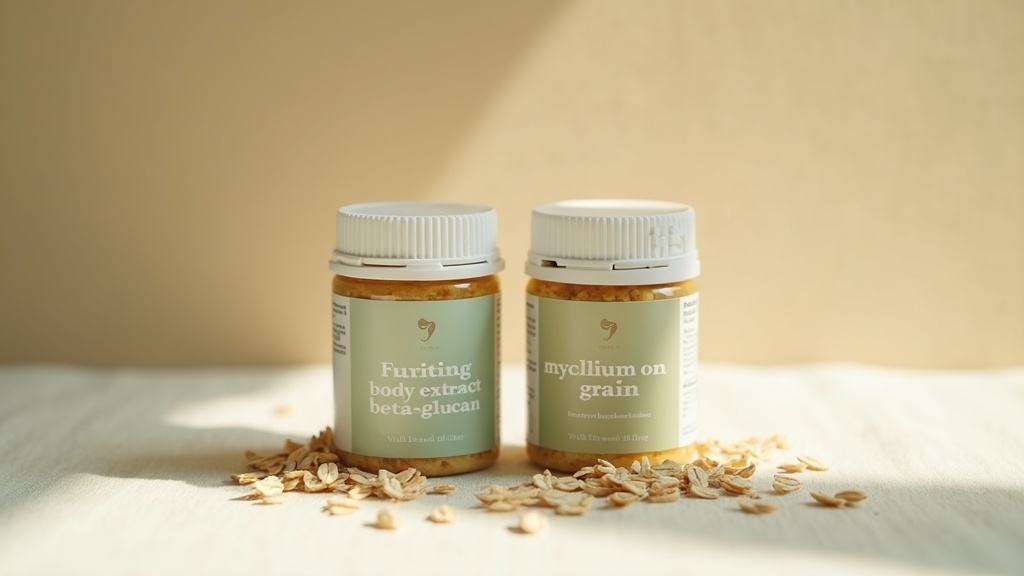
The biggest hidden variable is the raw material. A "mushroom" supplement can legally be dried mycelium grown on a bag of rice or oats, which is mostly grain starch, not the immune-active fungal compounds the studies used. I cover this in detail below, because it is the single factor most "best mushroom" roundups skip.
Turkey tail deserves a specific warning. Its purified extract PSK is used in Japan as an adjuvant given alongside surgery and chemotherapy, not as a substitute for cancer treatment, and the NCI's Medicinal Mushrooms PDQ states plainly that the FDA has not approved any medicinal mushroom to treat cancer. If you or someone you love has cancer, the only correct move is to talk to an oncologist before adding anything.
Finally, these are biologically active. Beta-glucans and triterpenes can theoretically interact with immunosuppressants and anticoagulants, so if you take blood thinners, immune-suppressing drugs, or diabetes medication, clear any mushroom supplement with your prescriber first.
What "medicinal mushrooms" and beta-glucans actually are
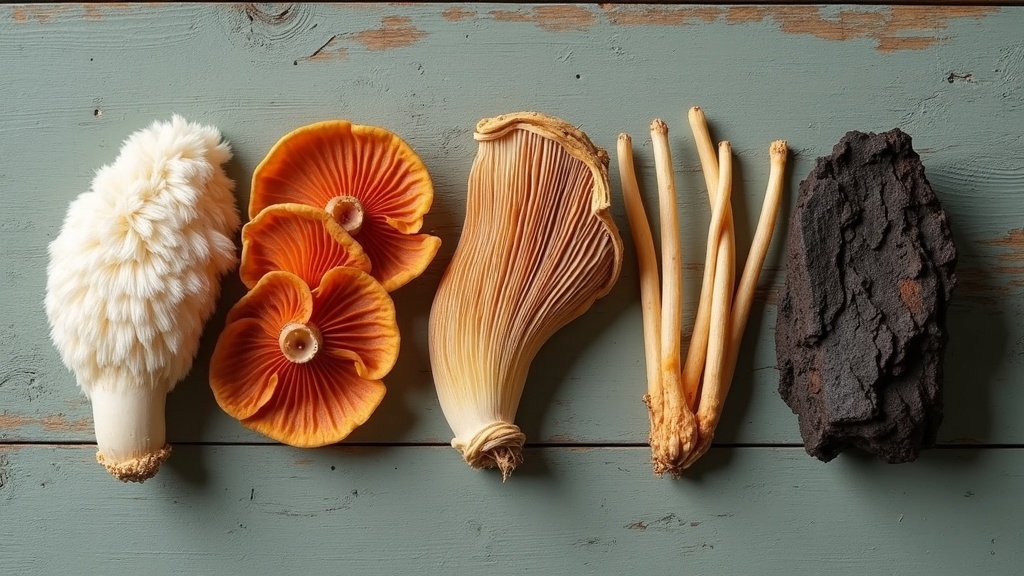
"Medicinal mushroom" is a loose umbrella for fungi traditionally used for more than food, where the active fraction is usually a class of long-chain sugars called beta-glucans, plus species-specific molecules like the erinacines in lion's mane and the triterpenes in reishi. These are not vitamins; they are signaling molecules that nudge immune cells, nerve-growth pathways, or mitochondrial function rather than filling a deficiency.
Beta-glucans are the workhorse. They are recognized by receptors on immune cells (notably Dectin-1 on macrophages and dendritic cells), and that receptor binding is the mechanistic basis for the "immune modulation" claims you see on every label. The key word is modulation: the research describes shifts in cell populations and signaling, not a switch that "boosts immunity" on command.
Here is the catch that the marketing buries. The functional beta-glucans are a 1,3/1,6 branched fiber, but a chemically similar starch from grain (alpha-glucan) inflates the "polysaccharide" number on cheap products without doing the same job. A high "polysaccharide" figure can therefore be mostly rice flour. That single distinction is why the quality section below matters more than which species you pick.
The honest evidence tiers, mushroom by mushroom
Before the per-species detail, here is the triage most roundups never put in one place: where each mushroom actually sits on human evidence, not tradition.
| Mushroom | Best-supported goal | Human evidence tier | Watch out for |
|---|---|---|---|
| Lion’s mane | Cognition, mood | Small RCTs, mixed but promising | Erinacines are in fruiting body, not grain mycelium |
| Cordyceps (Cs-4) | Aerobic capacity, fatigue | A few small RCTs in older adults | Wild cordyceps is unaffordable; you are buying fermented Cs-4 |
| Reishi | Fatigue, immune, sleep/calm | One sizeable fatigue RCT, otherwise thin | Bitter triterpenes signal a real extract; sweet powder may be filler |
| Turkey tail | Immune support (PSK adjuvant) | Strongest oncology adjuvant data, but only with standard care | Not a cancer treatment; talk to an oncologist |
| Chaga | Antioxidant (claimed) | Preclinical only (in vitro, animal) | High oxalate; caution with kidney issues |
Lion's mane: the one with cognition signal
Lion's mane (Hericium erinaceus) is the cognitive pick, and it is the one I get asked about most. Mechanistically it contains hericenones and erinacines that, in cell and animal models, stimulate nerve growth factor (NGF) expression, the signaling protein that supports neuron survival and plasticity. That is a plausible route to better memory and mood, and it is why this mushroom belongs in a nootropic conversation rather than an immune one.
The human evidence is real but thin. The cleanest result is a 2009 double-blind RCT (Mori et al., n=30) where 3 g/day of fruiting-body powder for 16 weeks improved cognitive-scale scores in older adults with mild cognitive impairment, reported in Phytotherapy Research. In healthy young adults the picture is weaker; a 2025 acute trial in Frontiers in Nutrition found faster Stroop performance an hour after a single dose but no broad cognitive transformation.
Here is the mechanism-versus-reality gap Maria always flags. The erinacines that drive the NGF story are concentrated in the fruiting body and the trial used fruiting-body powder, yet many cheap lion's mane products are mycelium on grain that may contain little of the active compound. If you want lion's mane to do what the trial showed, the dose and the form both have to match. We break down brands and forms in our roundup of the best lion's mane supplements.
Cordyceps: aerobic capacity, not your brain
Cordyceps is the endurance mushroom, and the most common mistake is buying it for focus. It targets oxygen utilization and the ventilatory threshold, not cognition. The product you are almost certainly buying is Cs-4, a fermented strain of Cordyceps sinensis, because true wild cordyceps is one of the most expensive biological materials on earth.
The human data is modest but consistent in one population. In a 2010 double-blind RCT (Chen et al., n=20 completers), Cs-4 at roughly 3 g/day for 12 weeks raised the metabolic threshold by about 10% and the ventilatory threshold by about 8% in healthy older adults, published in the Journal of Alternative and Complementary Medicine. Notably, VO2 max itself did not change, so the benefit is in the body's efficiency near threshold, not raw ceiling.
The dose-versus-bottle gap is stark here. The trials used about 3 g of Cs-4 daily, while many capsules deliver 500 mg of unspecified "cordyceps," roughly a sixth of the studied amount. Think of it like buying a third of a prescription and expecting the full effect. If endurance is your goal, see how we evaluate dosing and form in our best cordyceps supplements guide.
Reishi: tradition deep, trials shallow
Reishi (Ganoderma lucidum) has the longest pedigree of the group and the broadest claim list, which is exactly why you should be most skeptical of the hype. Its distinctive actives are triterpenes (the bitter compounds) plus beta-glucans, and the plausible targets are fatigue, immune modulation, and a calming effect that some use for sleep.
The standout human study is a fatigue trial. In a 2005 double-blind RCT (Tang et al., n=132), a Ganoderma polysaccharide extract for 8 weeks reduced the sense of fatigue more than placebo in patients with neurasthenia, reported in the Journal of Medical Food. Beyond that, most reishi evidence is preclinical or in small immune-marker studies, so the "anti-everything" framing on labels outruns the data.
A practical quality tell: reishi extract should taste genuinely bitter, because that bitterness comes from the triterpenes; a sweet or bland powder is a hint you are getting starch, not a dual extract. For sleep and calm specifically, reishi is a reasonable experiment but not a substitute for sleep hygiene or evaluation of insomnia. We compare extraction methods in our best reishi supplements roundup.
Turkey tail: the oncology adjuvant, with a hard boundary
Turkey tail (Trametes versicolor) carries the strongest clinical evidence of any mushroom here, and also the most important caveat. Its purified fractions PSK (Krestin) and PSP have been used in Japan since the 1970s as adjuvants given alongside surgery and chemotherapy, not as a treatment on their own.
The supporting data is meaningful within that boundary. The NCI's PDQ summary describes a meta-analysis of three randomized trials in colorectal cancer (1,094 patients) where adding PSK to standard care was associated with better 5-year overall survival (hazard ratio about 0.71), detailed in the NCI Medicinal Mushrooms PDQ. Mechanistically PSK modulates innate and adaptive immunity, including natural-killer activity and CD4/CD8 ratios.
This is where I have to be blunt rather than encouraging. Turkey tail is not a cancer treatment, the FDA has approved no mushroom for that purpose, and PSK only ever performed as an add-on to conventional therapy under medical supervision. Anyone facing cancer should treat turkey tail as a conversation to have with an oncologist, never a decision to make from a supplement aisle. For general immune-support context and quality, see our best turkey tail supplements guide.
Chaga: preclinical promise, no human proof
Chaga (Inonotus obliquus) is the antioxidant story, and it is the one where the gap between marketing and evidence is widest. The antioxidant, anti-inflammatory and anti-fatigue claims rest almost entirely on cell-culture and rodent studies, with essentially no controlled human trials, as summarized in a 2023 review of Inonotus obliquus.
That preclinical signal is interesting but cannot be assumed to translate. A compound that quenches free radicals in a test tube or extends swim-to-exhaustion time in mice tells you almost nothing about felt effects in a person. This is the classic animal-versus-human evidence gap, and chaga sits firmly on the unproven side of it.
There is also a real safety footnote. Chaga is high in oxalates, and case reports link heavy chaga intake to kidney injury (oxalate nephropathy), so people with kidney disease or stones should be especially cautious. If you still want to try it, treat it as a low-priority experiment, not a daily staple, and see our best chaga supplements guide for how we judge sourcing.
The quality issue that decides everything: fruiting body vs mycelium
This is the section most "shroom" roundups skip, and it matters more than your species choice. In the US, a product labeled "mushroom" is often dried mycelium grown on grain, then milled grain and all, so a large fraction of the powder is rice or oat starch rather than fungal beta-glucan.
The numbers are not subtle. Independent analyses consistently find that fruiting-body extracts carry far higher immune-active beta-glucan content, while mycelium-on-grain products are often dominated by alpha-glucan starch with single-digit or near-zero beta-glucan. Because cheap potency tests measure total "polysaccharides," they cannot tell the difference, so a label can advertise a big polysaccharide number that is mostly filler.
Here is the simple rule that protects you. Buy a fruiting-body extract that states an actual beta-glucan percentage on the label, and treat any product that lists only "polysaccharides" or that is built on "mycelial biomass" as unproven until shown otherwise. Think of it like buying olive oil: "fat content" tells you nothing, the grade and the press do. For the methodology behind our picks, see how we review supplements.
How to choose for your goal
Match the mushroom to the outcome, then check the form and dose against the trial. Lion's mane fruiting body around 3 g/day for cognition, Cs-4 cordyceps around 3 g/day for aerobic capacity, reishi dual extract for fatigue and calm, and turkey tail only under medical guidance if cancer is involved. Chaga stays optional and experimental.
Two practical heuristics keep you out of trouble. First, a stated beta-glucan percentage from a named fruiting-body source beats any quantity claim about "polysaccharides." Second, the studied dose is usually grams per day, not the few hundred milligrams in most capsules, so powders and labeled extracts tend to be better value per active gram than under-dosed pills.
Side effects and interactions
These are generally well tolerated, but "natural" does not mean inert. The most common complaints are mild digestive upset; the more serious concerns are interactions with immunosuppressants, anticoagulants, and diabetes medication driven by the immune-modulating beta-glucans and blood-sugar effects seen in some studies. Reishi in particular has anticoagulant signals worth respecting if you take blood thinners.
Three groups should clear mushrooms with a clinician first. Anyone on immune-suppressing drugs (including post-transplant), anyone on anticoagulants, and anyone who is pregnant or nursing, where safety data is simply absent. Chaga's oxalate load adds the kidney caution noted above. When a goal is medical, the supplement comes after the standard evaluation, not instead of it.
FAQ
Are medicinal mushrooms a scam?
No, but the category is uneven. The mechanisms are real and a handful of small human trials are encouraging, while a large share of products are under-dosed mycelium-on-grain that may not deliver the studied compounds. The science is legitimate; much of the retail execution is not.
Which mushroom is best for focus?
Lion's mane, by a clear margin. It is the only one in this group with a cognition-specific mechanism (NGF support) and supportive human trials, whereas cordyceps targets endurance and reishi targets fatigue and calm.
Can I take several mushrooms together?
Generally yes, and many people stack lion's mane with cordyceps or reishi. The bigger risk is paying for a blend so under-dosed in each that none reaches its studied amount, so prefer single-species extracts with stated beta-glucan content over a ten-mushroom "complex."
Is turkey tail a cancer cure?
No. PSK from turkey tail has been studied only as an adjuvant alongside surgery and chemotherapy, the FDA has approved no mushroom to treat cancer, and any use in that context belongs to an oncologist.
The bottom line on medicinal mushrooms
Medicinal mushrooms are worth understanding individually rather than as a single "shroom" category. Lion's mane has the cognition signal, cordyceps the aerobic-capacity data, reishi a fatigue RCT, turkey tail the oncology-adjuvant evidence within strict medical bounds, and chaga only preclinical promise, and the form-and-dose gap between the trials and the average bottle is the difference between an experiment and a placebo.
Next steps:
- Decide your single goal first (focus, endurance, calm/fatigue), then pick the one matching mushroom.
- Buy a fruiting-body extract with a stated beta-glucan percentage; skip "polysaccharide"-only and mycelium-on-grain labels, using how we review supplements as your checklist.
- If any goal is medical (cancer, immune disease, anticoagulation), talk to your clinician before starting.
As an Amazon Associate, I earn from qualifying purchases. Product recommendations are based on real reviews and independent research.
Reviewed by Maria Rodriguez, MS Nutrition Science, focused on cognitive and mood biochemistry. See more from Maria Rodriguez.
This article is for informational purposes and not medical advice. Medicinal mushrooms are biologically active and can interact with medications and health conditions. Consult a licensed physician before starting any supplement, particularly if you are pregnant, nursing, taking prescription medications (especially immunosuppressants or anticoagulants), or managing a chronic condition such as cancer or kidney disease.
