
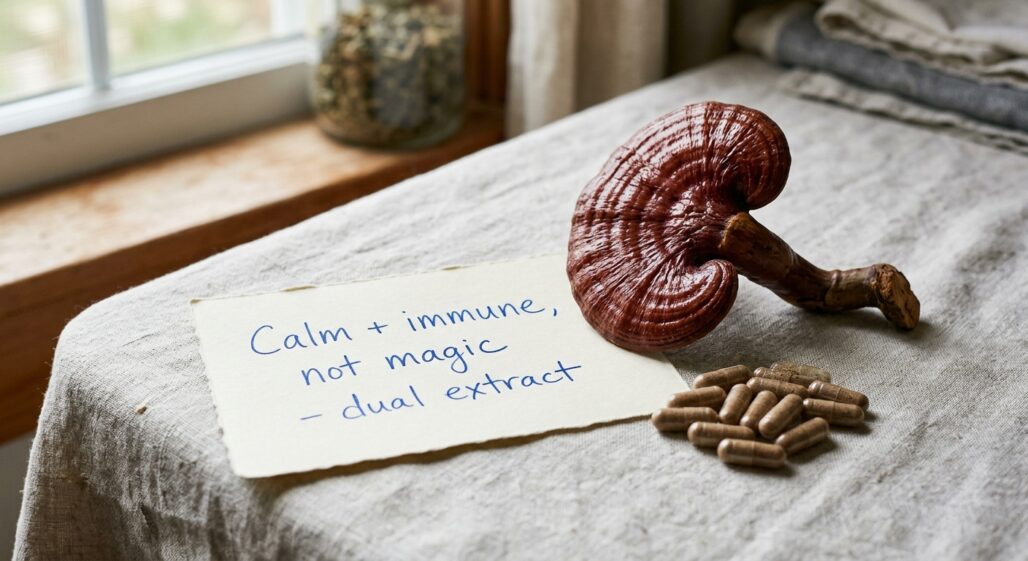
If you are searching for the best reishi supplements, you have probably seen reishi sold as everything from a sleep aid to a stress fix to a near-mythical immune and anti-cancer mushroom, and you want to know which claims actually hold up. The honest answer: reishi has reasonable human evidence for shifting immune markers and easing fatigue, a weaker but real calming signal, and a lot of marketing hype stacked on top of thin data. This guide walks through what reishi actually is, what the trials show on immunity and on calm, the cancer-adjunct finding everyone misquotes, and the one quality detail that separates a working product from inert grain starch. The picks at the bottom are the dual-extract bottles I would keep in my own family's cabinet, not the cheapest powder on the shelf.
Affiliate disclosure: this article contains affiliate links. As an Amazon Associate, UsefulVitamins.com earns from qualifying purchases at no extra cost to you.
Before you decide
The evidence here is genuinely mixed, so calibrate expectations before you buy. Reishi is best understood as a modest adjunct, not a treatment for any disease.
Do not start reishi if you take anticoagulants or antiplatelet drugs, if you are on immunosuppressants after a transplant or for an autoimmune condition, or if you have active liver disease. Talk to your clinician first if any of those apply.
If you are using reishi for cancer-related fatigue or quality of life alongside oncology care, that is a conversation for your oncologist, not a self-directed swap. The Cochrane review of Ganoderma lucidum for cancer found only very low quality evidence and explicitly did not support reishi as a first-line cancer treatment, only as a possible adjunct to conventional therapy.
There are also rare but real reports of reishi-associated liver injury, which I cover below. Reishi is not a drug-free zone just because it is a mushroom.
What reishi actually is
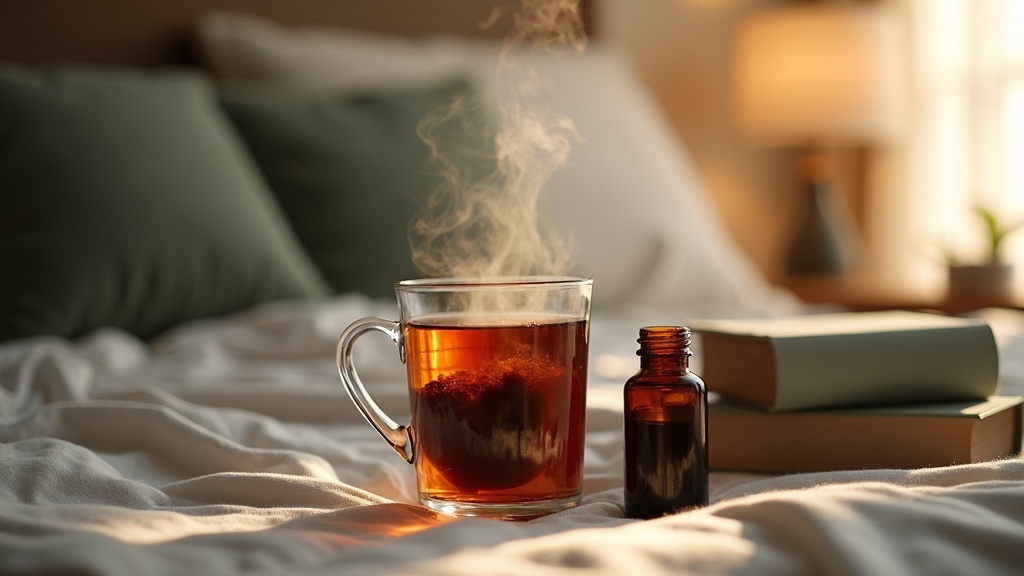
Reishi, or Ganoderma lucidum (lingzhi in Chinese medicine), is a hard, woody, reddish shelf mushroom that has been used in East Asian traditional practice for centuries. Its biological activity comes mostly from two compound classes, and knowing them is the whole key to buying well.
The first class is beta-glucans, water-soluble polysaccharides concentrated in the fruiting body. These are the immune-modulating fraction, and they appear to act largely through pattern-recognition receptors on immune cells, including TLR signaling that nudges cytokine expression and lymphocyte activity.
The second class is triterpenes, the ganoderic acids, which are alcohol-soluble and give reishi its bitter taste. These are tied to the calming and anti-inflammatory side of the profile.
Here is the catch that most product pages skip. Beta-glucans are water-soluble and triterpenes are alcohol-soluble, so a single extraction method captures only half of the active picture. That single fact is why dual extraction matters, and it drives the whole quality discussion later.
One more distinction. Reishi can be grown as a true fruiting body (the mushroom itself) or as mycelium grown on grain. Fruiting-body extracts commonly test in the 25 to 40 percent beta-glucan range, while mycelium-on-grain products often land at only 1 to 5 percent, with much of the weight being inert starch from the grain substrate. For a deeper map of the whole category, see our complete guide to medicinal mushrooms.
The immune evidence, honestly
This is reishi's strongest human signal, and it is still modest. In a randomized, double-blind, placebo-controlled trial in healthy adults aged 18 to 55, an 84-day course of Ganoderma lucidum beta-glucan raised CD3+, CD4+, and CD8+ T-lymphocyte populations, improved the CD4/CD8 ratio, and increased natural killer cell counts versus placebo. These are real, measurable shifts in immune-cell populations, not just a feeling of fewer colds.
A separate randomized, placebo-controlled study in asymptomatic children aged 3 to 5 found that reishi beta-glucans raised total peripheral lymphocyte counts, including CD3+, CD4+, and CD8+ T cells compared with placebo. Two independent populations pointing the same direction is more than most supplement claims can offer.
Here is the honest reframe. A change in lymphocyte counts is a surrogate marker, not a proven reduction in actual illness. Mechanistically the beta-glucans plausibly prime innate and adaptive immune cells, but the trials measure cells in a tube, not how many infections you actually avoid or shorten. The leap from marker to felt benefit is exactly where supplement marketing overreaches.
Think of it like a tune-up reading on an engine. The numbers on the diagnostic improved; that does not guarantee you will drive farther before the next breakdown. Useful signal, incomplete story.
Actionable takeaway: reishi's immune data is genuine but lives at the marker level, so treat it as a reasonable add-on for general immune support, not as cold insurance.
The calm, sleep, and fatigue evidence
This is where the human data gets thinner, and where reishi's reputation outruns its trials. The cleaner study is a randomized, double-blind, placebo-controlled trial of 132 adults with neurasthenia (a fatigue-and-malaise syndrome). Over eight weeks, a standardized reishi polysaccharide extract called Ganopoly produced a 28.3 percent drop in sense of fatigue versus 20.1 percent on placebo, and a larger gain in sense of well-being, with about 52 percent of the reishi group rated meaningfully improved versus 25 percent on placebo.
That is a real separation from placebo on fatigue and well-being. But note the dose: 1,800 mg three times daily, totaling 5,400 mg of extract per day. Most consumer reishi capsules deliver 1,000 to 2,000 mg per day, well under the dose that produced this result. The dose-trial-versus-supplement gap is the quiet reason a lot of people feel nothing.
On sleep specifically, the strongest mechanistic work is still in animal models. Reishi has been shown to promote sleep through a gut-microbiota and serotonin-linked pathway in mice, which is a plausible mechanism but not a human RCT. I treat the calming, sleep-supportive effect as biologically reasonable and anecdotally common, with real but limited human confirmation. We dig into the timing and the realistic expectations in our breakdown of reishi for sleep.
A 2025 GRADE-assessed systematic review and meta-analysis of Ganoderma lucidum trials is the sobering counterweight. Across 22 outcomes the overall evidence quality was rated very low, with no meaningful pooled changes in blood pressure, lipids, fasting glucose, or inflammatory markers. The honest read is that reishi is not a metabolic or cardiovascular intervention, whatever the label implies.
The cancer-adjunct finding everyone misquotes
You will see reishi marketed with heavy implications about cancer. The actual evidence base is the Cochrane review, and it says something far more restrained. Reishi is an adjunct candidate only, never a treatment, and the evidence is very low quality.
The Cochrane review pooled 5 randomized trials with 373 cancer patients. When reishi was added to chemotherapy or radiotherapy, patients were somewhat more likely to respond than with conventional therapy alone (relative risk around 1.5, of marginal significance), and four studies reported relatively better quality of life on Karnofsky scores. Reishi used alone showed negligible antitumor effect, and no study measured long-term survival.
The reviewers' own conclusion is the line to remember: they did not find sufficient evidence to justify reishi as a first-line cancer treatment, and they framed it strictly as a possible adjunct pending better research. If cancer is the reason you are here, this is an oncologist conversation, not a supplement-aisle decision. I am describing what the trials found, not recommending reishi for any disease.
Quality and dual extraction: where most products fail
Two reishi bottles at the same price can differ enormously in actual active content. The single biggest quality lever is fruiting body plus dual extraction with a stated beta-glucan percentage.
Fruiting-body extracts carry the triterpenes and concentrate the beta-glucans; mycelium-on-grain products are often mostly starch. Dual extraction (hot water plus alcohol) is what pulls both the water-soluble beta-glucans and the alcohol-soluble triterpenes into one product. A water-only extract under-delivers triterpenes; a powder that is not extracted at all leaves much of the beta-glucan locked inside indigestible chitin cell walls.
| Form | Beta-glucans | Triterpenes | What to expect |
|---|---|---|---|
| Dual-extract fruiting body | High, often 25 to 40 percent stated | Captured via alcohol step | The form used in the better trials; buy this |
| Water-only fruiting body | Good | Largely missing | Decent for immune fraction, light on calm |
| Raw fruiting-body powder | Locked in chitin, low bioavailability | Present but poorly extracted | Weak; the cell walls were never opened |
| Mycelium on grain | Often 1 to 5 percent, lots of starch | Minimal | Cheapest, frequently the weakest |
For a sister mushroom with its own quality quirks and a similar fruiting-body lesson, compare our roundup of the best cordyceps supplements.
What to look for when buying
Use these as a quick filter before you trust any reishi label.
Demand a stated beta-glucan percentage, not just total polysaccharides. Many brands list polysaccharides, which conveniently includes the starch from grain; beta-glucan percentage is the honest number. Confirm it says fruiting body and dual extract or full spectrum. Look for third-party testing (ConsumerLab, NSF, or a published certificate of analysis) and avoid proprietary blends that hide per-ingredient amounts. Our how we review supplements page lays out the testing standards we hold products to.


As an Amazon Associate, UsefulVitamins.com earns from qualifying purchases at no extra cost to you. We only recommend products supported by published research or third-party testing.
Who should skip reishi
Reishi is low-drama for most healthy adults, but a few groups should not start it. The clearest exclusion is anyone on blood thinners.
Reishi can inhibit platelet aggregation and prolong clotting, and there are case reports of elevated INR and bleeding risk when reishi was combined with warfarin, with antiplatelet effects more pronounced at doses around 3 grams or higher per day. If you take warfarin, a DOAC, or antiplatelet therapy, do not add reishi without your prescriber.
There are also rare reports of reishi-associated liver injury. A case review documents acute liver injury and a previously reported fatal fulminant hepatitis linked to Ganoderma powder, often involving powdered forms or concurrent alcohol use. These are uncommon, but they are why I steer people toward standardized extracts from tested brands and away from anonymous bulk powders.
Skip or defer reishi if you are pregnant or nursing (insufficient safety data), if you take immunosuppressants, or if you have a bleeding disorder or upcoming surgery (stop at least one to two weeks before any procedure).
Frequently asked questions
How long until reishi does anything? The immune-marker trial ran 84 days and the fatigue trial ran 8 weeks, so think in months, not days. Any calming effect you notice the first night is likely the ritual and the tea warmth as much as the triterpenes.
Is reishi a sleep aid like melatonin? No. It does not knock you out. The signal is gentle and mostly about easing fatigue and a sense of stress, with the human evidence stronger for fatigue than for measured sleep. See reishi for sleep for realistic timing.
Fruiting body or mycelium? Fruiting body, in nearly all cases. Mycelium-on-grain products often carry mostly starch and far lower beta-glucans, as the extract comparison data shows.
Can reishi treat or cure cancer? No. The Cochrane evidence is very low quality and frames reishi only as a possible adjunct to conventional oncology care, never as a treatment. That decision belongs with your oncologist.
What dose should I take? Trials used roughly 1.4 to 5.4 grams of extract daily. Most people start at the low end with food; the neurasthenia benefit appeared at the high 5,400 mg dose, which most capsules do not reach.
Conclusion: the bottom line on the best reishi supplements
Reishi clears a bar most of the supplement aisle does not: two human RCTs showing real immune-marker shifts, a placebo-beating fatigue and well-being result in neurasthenia, and a restrained Cochrane finding that supports it only as a cancer-care adjunct. What separates this guide from the hype pages is the split between the decent immune and calm signal and the cancer-cure overreach, plus the dual-extract quality point and the genuine liver and bleeding cautions most roundups bury. The realistic effect is modest, the right product is a dual-extract fruiting body with a stated beta-glucan percentage, and reishi is an adjunct to good basics, never a replacement for medical care.
Next steps:
- Pick a dual-extract fruiting-body product with a stated beta-glucan percentage and third-party testing.
- If you take blood thinners, immunosuppressants, or have liver concerns, clear it with your clinician first.
- For the wider mushroom context, read our complete guide to medicinal mushrooms, and for author background see Maria Rodriguez's profile.
As an Amazon Associate, I earn from qualifying purchases. Product recommendations are based on real reviews and independent research.
Reviewed by Maria Rodriguez, MS Nutrition Science, focused on cognitive and mood biochemistry.
This article is for informational purposes and not medical advice. Reishi can interact with medications, especially anticoagulants and immunosuppressants, and has rare liver-injury reports. Consult a licensed physician before starting any supplement, particularly if you are pregnant, nursing, taking prescription medications, or managing a chronic condition such as cancer.
