
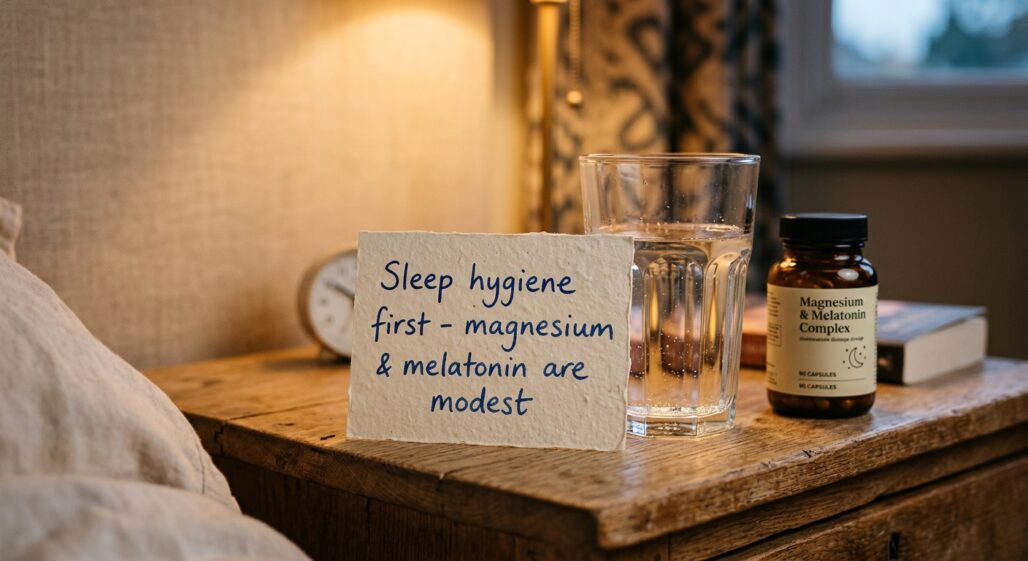
If you are searching for a sleep supplements guide, you have probably already got a half-used bottle of melatonin in a drawer and want to know what actually has biochemical signal behind it. The honest answer: the sleep-medicine guidelines do not recommend routine over-the-counter sleep aids for chronic insomnia at all, and the supplements that do help work modestly and in narrow situations. This guide leads with what the American Academy of Sleep Medicine actually concluded, then triages the popular compounds by evidence tier so you can tell the few worth a trial from the aisle full of hype.
I am a nutrition scientist who reads the primary sleep literature, and the gap between mechanism and human trial data is wide here. I will keep flagging it.
Before you decide

Start with the uncomfortable finding most affiliate roundups bury. The 2017 AASM clinical practice guideline for the pharmacologic treatment of chronic insomnia issued a weak recommendation against using melatonin, valerian, tryptophan, and the antihistamine diphenhydramine for sleep onset or sleep maintenance insomnia. Not "use with caution." Against.
The same guideline names the actual first-line treatment, and it is not a pill. Cognitive behavioral therapy for insomnia (CBT-I) is the recommended primary intervention, with medication reserved for people who cannot access CBT-I or still struggle after it.
Before you spend on any supplement, fix the cheap levers. The CDC's sleep guidance points at consistent wake times, a cool dark room, screens off before bed, and capping caffeine and alcohol. Alcohol in particular fragments the second half of the night even when it speeds sleep onset.
Then watch for red flags that supplements cannot touch. Loud snoring with gasping or witnessed pauses points toward sleep apnea, and insomnia that runs most nights for three months or longer is chronic insomnia that needs a clinician, not a gummy. See your healthcare provider if either describes you.
Why behavior beats pills here
Insomnia is rarely a melatonin deficiency. It is usually a learned arousal pattern: the bed becomes a cue for wakefulness and rumination rather than sleep. That is a conditioning problem, and you cannot supplement your way out of a conditioning problem.
CBT-I targets exactly that loop through stimulus control, sleep restriction, and cognitive work on sleep-related anxiety. In the AASM evidence review it outperformed the drug options on durability, because the effect persists after you stop, which is the opposite of how a nightly pill behaves.
Think of supplements here like a butter knife when the job needs a screwdriver. They can help at the margins of a circadian or wind-down problem, but they are the wrong tool for the conditioned-arousal core of chronic insomnia. That is the single most useful reframe in this whole guide.
The real question is not "which sleep supplement is best," it is "what is actually keeping me awake." Answer that first.
Melatonin done right (timing beats dose)
Melatonin is the one supplement with a clear mechanism and a real, if modest, signal. It is your circadian hormone, and exogenous melatonin acts on MT1 and MT2 receptors in the suprachiasmatic nucleus to shift the clock. That makes it a chronobiotic, a timing signal, far more than a sedative.
The pooled human data are honest about size. A 2013 meta-analysis of 19 trials in PLOS One found melatonin shortened time to fall asleep and lengthened total sleep, but the effects were small, on the order of single-digit minutes for sleep onset. That is genuine, and it is modest.
Where melatonin earns its keep is circadian misalignment: jet lag, delayed sleep phase, and shift work. Taken in the early evening it advances the clock; this is timing, not knockout power.
The dosing mistake people make is going too high. Physiologic-range doses of roughly 0.5 to 3 mg taken two to three hours before target bedtime work with your biology. The 5 and 10 mg gummies overshoot the receptor system and add grogginess. We break the timing and dose down in our guide to building a sensible sleep stack.
Actionable takeaway: if your problem is when you sleep rather than whether you can wind down, low-dose melatonin timed to the evening is the rational trial.
Magnesium for the wind-down
Magnesium is a cofactor in hundreds of enzymatic reactions and acts as a natural antagonist at the NMDA glutamate receptor while supporting GABAergic tone. Mechanistically that should translate to a calmer, less hyper-aroused nervous system at night, which is a plausible sleep angle.
The human evidence is suggestive but thin. A 2021 systematic review and meta-analysis in older adults with insomnia found magnesium shortened time to fall asleep by about 17 minutes versus placebo, but the authors graded the underlying trials as low to very low quality. A real but shaky signal is the fair summary.
The form matters more for tolerability than for sleep. Magnesium glycinate is the sensible default because it is gentle on the gut, where oxide and citrate at sleep doses can send you to the bathroom instead of to bed. We compare forms and doses fully in our breakdown of the best magnesium for sleep.
Magnesium is also the lowest-regret trial on this list: cheap, well-tolerated, and useful if you are not already hitting your intake from food.
L-theanine and glycine for a calmer night
L-theanine, the amino acid from green tea, promotes alpha-wave activity and modulates glutamate and GABA signaling to produce calm without sedation. It is an anxiety-and-arousal lever more than a sleep-inducer. In a 2019 randomized crossover trial in Nutrients, 200 mg daily improved the sleep-latency and sleep-disturbance subscales of the Pittsburgh Sleep Quality Index in healthy adults. We cover dosing and stacking in our deep dive on L-theanine for sleep.
Glycine works through a different pathway. It is an inhibitory neurotransmitter that appears to help by nudging core body temperature down, the same drop that normally cues sleep onset. In a 2012 trial in Frontiers in Neurology, 3 g of glycine before bed reduced next-day fatigue and sleepiness after sleep restriction. The trials are small and short, but the mechanism is coherent. Our glycine for sleep deep dive walks through the temperature angle.
The honest caveat for both: these are wind-down aids for a busy nervous system, not treatments for clinical insomnia. If you lie down already relaxed and still cannot sleep, neither one is your fix.
The weaker and overhyped options
This is where the aisle gets crowded and the evidence gets thin. The table below is the triage; the verdicts follow the trial data, not the marketing.
| Supplement | What the evidence says | Verdict |
|---|---|---|
| Melatonin (low dose) | Modest, best for circadian timing and jet lag | Worth a targeted trial |
| Magnesium glycinate | ~17 min faster onset, low-quality trials | Low-regret trial |
| L-theanine | Improved PSQI subscales, calming not sedating | Reasonable for arousal |
| Glycine | Small trials, body-temperature mechanism | Reasonable, minor effect |
| Tart cherry | Tiny melatonin bump, small open-label trial | Mild, optional |
| Valerian | Inconsistent trials; AASM advises against | Skip for chronic insomnia |
| “PM” blends | Often diphenhydramine; AASM advises against | Overhyped, tolerance builds |
Valerian is the textbook example of mechanism without consistent payoff. It is proposed to modulate GABA-A receptors, but the trial results scatter, and the AASM placed it under a recommendation against use. A plausible receptor story is not the same as a reproducible human result.
Tart cherry is the gentle outlier. Montmorency cherries contain a little melatonin, and a 2012 trial in the European Journal of Nutrition found the concentrate raised urinary melatonin and nudged sleep efficiency upward. The effect is mild and the trial small, so treat it as a pleasant minor add-on. For a study-by-study grade of those trials, including the eight-person pilot behind the viral "84 extra minutes" claim, see our verdict on whether tart cherry actually works for sleep. Our roundup of the best tart cherry supplements for sleep sorts the concentrates from the watered-down juices.
The "PM" blends deserve the most skepticism. Many lean on diphenhydramine, the antihistamine the AASM advised against, and your body builds tolerance to its drowsiness within days while the next-morning fog lingers. More ingredients on a label is not more evidence. If you have been reaching for 5-HTP instead, the serotonin-precursor story has its own caveats we cover in 5-HTP for sleep.
Product quality: the mislabeling problem
Even a supplement with decent evidence fails you if the bottle does not contain what the label claims, and melatonin is the cautionary tale. A 2023 analysis in JAMA tested 25 melatonin gummy products and found the actual melatonin ranged from 74% to 347% of the labeled amount. One product contained no melatonin at all; several also contained unlabeled CBD.
That spread means a "3 mg" gummy could be delivering anywhere from a sub-physiologic trace to a clock-disrupting megadose, which is a real problem for a hormone whose entire usefulness depends on dose and timing.
The defense is third-party verification. Look for USP Verified, NSF Certified, or a published independent assay, and skip products that lean on proprietary blends hiding the actual per-serving amounts. Our standards for this are spelled out in how we review supplements.
Who should see a clinician
Supplements are for the margins. Some sleep problems sit squarely in clinical territory, and reaching for a bottle there delays the care that actually helps.
See a clinician if your insomnia runs most nights for three months or more, if loud snoring with gasping or breathing pauses suggests sleep apnea, or if poor sleep travels with low mood, anxiety, or daytime impairment that affects work or safety. A sleep study or a CBT-I referral is the honest first step there, not another supplement order.
This guide is educational and not a substitute for that evaluation.
FAQ
Is melatonin safe to take every night?
Short-term use at low doses is generally well tolerated, but melatonin is a circadian signal, not a nutrient you are replacing. For ongoing nightly insomnia the AASM guideline does not recommend it, which is a cue to talk to a clinician rather than make it a permanent habit.
What is the best supplement for falling asleep faster?
For a circadian-timing problem, low-dose melatonin taken a couple of hours before bed has the clearest mechanism. For a "wired and can't wind down" problem, magnesium glycinate or L-theanine are the more rational trials. Neither is a cure.
Why does the AASM recommend against OTC sleep aids?
Because the trials supporting melatonin, valerian, tryptophan, and diphenhydramine for chronic insomnia were weak or inconsistent, and CBT-I outperformed them on durable benefit. The recommendations are "weak against," meaning low-quality evidence rather than proven harm.
Are sleep gummies reliable?
Often no. The JAMA testing found wide dose discrepancies in melatonin gummies, so favor third-party-verified capsules with transparent dosing over gummies with vague blends.
The bottom line on sleep supplements
The differentiator of this guide is simple: it leads with the AASM "against routine OTC sleep aids, CBT-I first" verdict that most affiliate roundups bury, then triages the supplements honestly by evidence tier instead of selling the whole shelf.
Fix the behavior and timing first, then treat supplements as narrow tools: low-dose melatonin for circadian problems, magnesium and L-theanine for wind-down, and a skeptical eye toward valerian, "PM" blends, and mislabeled gummies.
Next steps:
- Fix sleep timing, light, caffeine, and alcohol before buying anything.
- If insomnia is chronic or apnea is possible, ask a clinician about CBT-I and a sleep evaluation.
- If you do trial a supplement, start with a third-party-verified option and build a sensible sleep stack rather than stacking blind.
This guide was written by Maria Rodriguez, MS Nutrition Science, focused on cognitive and mood biochemistry.
This article is for informational purposes and not medical advice. Sleep supplements can interact with medications and health conditions. Consult a licensed physician before starting any supplement, particularly if you are pregnant, nursing, taking prescription medications, or managing chronic insomnia or a suspected sleep disorder.
