

Affiliate disclosure: this article contains affiliate links. As an Amazon Associate, UsefulVitamins.com earns from qualifying purchases at no extra cost to you.
If you're searching for L-theanine for sleep and trying to figure out whether the 200 mg dose people talk about online actually does anything, the short answer is: modestly, yes, in the right person. L-theanine reduces sleep latency and improves subjective sleep quality in small, mostly short trials, but it is a calming nudge, not a sedative..
Quick Answer: who L-theanine actually helps at bedtime
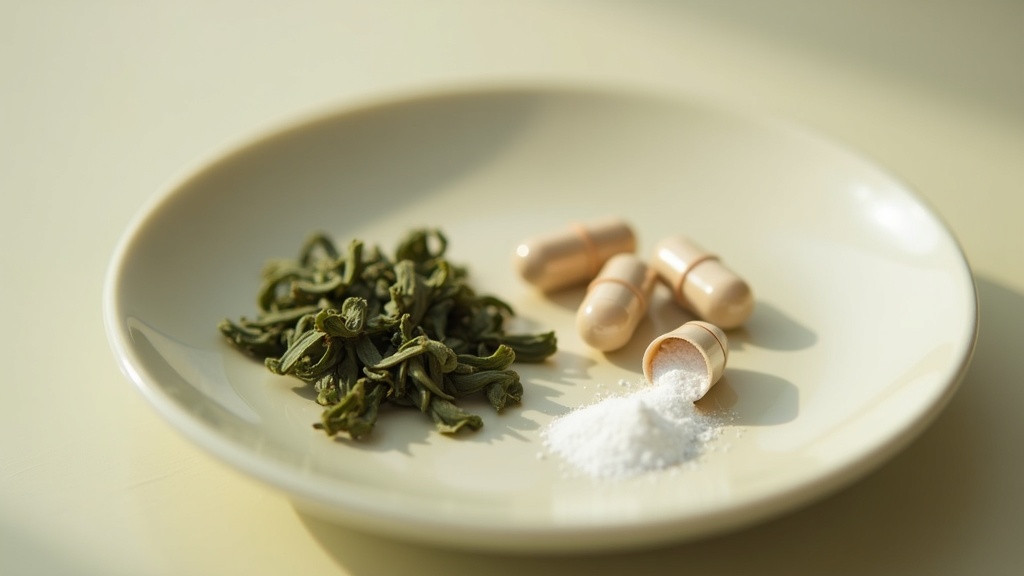
The short version, if you fit the profile:
- L-theanine 200 mg, 30 to 60 minutes before bed, preferably as Suntheanine, if you are a "wired but tired" sleeper whose mind will not switch off and you fall asleep slowly because of mental rumination.
- L-theanine 200 mg stacked with magnesium glycinate 200 to 400 mg if you also wake at 3 AM or get muscle restlessness with the mental noise.
- L-theanine 100 to 200 mg in the daytime, not the evening, if your actual problem is anxiety with sleep as a downstream casualty; the daytime use case is a separate one and is better evidenced than the bedtime one.
Who should NOT start with L-theanine without checking first: anyone on blood pressure medication, anyone on a sedative or hypnotic (benzodiazepines, Z-drugs, mirtazapine, trazodone, gabapentin used for sleep), and anyone pregnant or nursing.
What to do before adding any L-theanine: keep a one-week sleep diary. If your problem is sleep timing (you go to bed at midnight and want to be up at 6), no amino acid will fix that. Sleep restriction therapy or CBT-I beats every supplement on this page for chronic insomnia, and that is in the AASM guideline.
What L-theanine actually is, briefly
L-theanine is an amino acid that exists in nature in almost exactly one place: the tea plant, Camellia sinensis. It is structurally a glutamate analog (technically gamma-glutamylethylamide), which matters because that shape is how it gets across the blood-brain barrier and onto the receptors it works on. A standard cup of brewed green tea contains roughly 20 to 30 mg of L-theanine, which is why the calming-but-alert feel of tea differs from the jittery wakefulness of plain caffeine. The supplement industry isolates L-theanine to capsule doses of 100 to 400 mg, which is roughly 5 to 20 cups of tea worth in a single swallow without the caffeine that comes with the leaves.
Most of the human trials use a patented isolated isomer marketed as Suntheanine, produced by Taiyo. This is not branding fluff: the Suntheanine process yields the pure L-isomer at high purity, while cheaper bulk theanine can be a racemic D/L mixture in which the inactive D-form takes up bottle space and does not cross into the brain the same way. The trial doses below are all Suntheanine.
How L-theanine works in the brain

Mechanistically, L-theanine sits at the intersection of four neurotransmitter systems, which is why it does not behave like a sedative.
It is a weak antagonist at the NMDA glutamate receptor and a partial agonist at AMPA and kainate glutamate receptors. By dampening glutamate signaling at NMDA without shutting down the excitatory system entirely, it lowers the cortical "noise floor" without producing the cognitive blunting of an actual NMDA antagonist like ketamine.
It modulates GABA-A allosteric sites and also raises whole-brain GABA concentrations in animal microdialysis studies. GABA is the brain's main inhibitory neurotransmitter, so anything that nudges GABA tone up will, at the right dose, produce calm. This is the same general direction as benzodiazepines or alcohol, but at vastly lower potency and with no receptor binding that causes dependence or rebound.
It increases glycine activity at the inhibitory glycine receptor, which is the underappreciated half of the brain's inhibitory system, particularly in the brainstem and spinal cord where it gates muscle tone and arousal during sleep.
And it modulates serotonin and dopamine levels indirectly, with animal data showing increased dopamine in the striatum and increased serotonin in the hippocampus and hypothalamus at supplementation doses.
The EEG signature is the cleanest mechanistic fingerprint. In healthy adults given 50 to 200 mg of L-theanine, EEG recordings show a consistent increase in alpha-wave power (8 to 12 Hz) in the frontal and occipital cortex within 30 to 45 minutes. Alpha-wave activity is the electrical signature of relaxed-but-aware mental states, the band that rises during meditation and falls during anxiety. Nobre and colleagues' 2008 work, published in Asia Pacific Journal of Clinical Nutrition, was the cleanest early demonstration of this and is still the most-cited mechanism paper.
Actionable takeaway: the mechanism is real and well-mapped. L-theanine is not snake oil. The honest question is whether that mechanism translates into a clinical sleep effect large enough to matter to you.
What the human sleep trials actually show
This is where Maria's voice gets specific. There are not many trials. The good ones are small, short, and mostly Japanese. Here is the honest landscape.
Hidese et al. 2019 (n=30 healthy adults with high stress, double-blind crossover, 4-week treatment arms) gave 200 mg/day of Suntheanine and measured Pittsburgh Sleep Quality Index (PSQI) scores along with stress and cognitive markers. The L-theanine arm showed statistically significant reductions in PSQI total score and in sleep-latency and sleep-disturbance subscales versus placebo, with no adverse events. This is the trial the 200 mg evening dose recommendation rests on.
Lyon et al. 2011 (n=98 boys aged 8 to 12 with ADHD, 6-week placebo-controlled trial) gave 200 mg L-theanine twice daily (400 mg total). The active arm showed improved objective sleep quality measured by actigraphy (specifically higher sleep efficiency and less nocturnal activity), though subjective sleep quality differences were modest. Because this is a pediatric ADHD population, the result does not transfer cleanly to adult primary insomnia, but it is the largest randomized sleep-endpoint trial we have.
Williams et al. 2020 is a narrative review pulling together about a dozen small L-theanine trials across anxiety, stress, and sleep endpoints. The summary is that L-theanine reliably reduces acute stress markers (cortisol response to a stress task, heart-rate variability normalization) and improves subjective measures of calm, but the sleep evidence specifically remains thin: a handful of small trials with modest effect sizes, no large registered trial, no replication of Hidese in a different population.
What you will not find: a large multicenter trial with polysomnography. The trials we have used PSQI (subjective questionnaire) and actigraphy (wrist-worn movement). Both are reasonable, neither is gold standard, and the effect sizes are in the small-to-moderate range. This puts L-theanine in the "real signal, modest size, more research needed" category: meaningfully more evidence than apigenin or glycine for sleep, meaningfully less than melatonin or CBT-I.
Dose: the trial dose vs the Amazon supplement gap
Here is the gap that frustrates me as a nutrition scientist. The Hidese sleep trial used 200 mg/day of Suntheanine. The Lyon ADHD trial used 400 mg/day in two divided doses. Both are isolated L-theanine, high purity, with standardized active content.
Walk through Amazon and what you actually find:
- Generic L-theanine capsules at 100 mg, requiring two capsules to hit the trial dose
- "Sleep stack" gummies that disclose "calming blend 400 mg" without naming the per-ingredient L-theanine content (this is a proprietary blend red flag)
- L-theanine + magnesium combos with 100 mg L-theanine, which is half the trial dose
- 200 mg single-capsule products, which match the trial dose, often with the Suntheanine logo if you look for it
If you are buying L-theanine for sleep, 200 mg Suntheanine, single capsule, taken 30 to 60 minutes before bed, is the dose the evidence supports. Going up to 400 mg is reasonable if 200 mg does nothing after a 14-night trial and you tolerate it. Going below 200 mg is the most common reason people say "L-theanine didn't work for me"; they took the gummy at 50 mg and expected the Hidese effect.
The two evidence-strong stacks
L-theanine combines well with two other compounds, and each combination has a different purpose.
L-theanine + caffeine (the focus stack, not the sleep stack). A series of small trials, most notably Owen et al. 2008, showed that 100 to 200 mg L-theanine taken alongside 50 to 100 mg caffeine produces improved attention and reaction time on cognitive tasks with less of the jittery edge of caffeine alone. This is the famous "tea-like" combination. It is a daytime use case. Do not take this in the evening expecting sleep; the caffeine half-life of 5 to 6 hours will keep you up regardless of what the theanine is doing.
L-theanine + magnesium glycinate (the bedtime stack). This combination does not have its own large RCT, but the mechanistic case is straightforward and the two are widely co-formulated. Magnesium glycinate provides the glycine receptor agonist (glycine is the carrier amino acid) along with magnesium's NMDA-antagonist activity at the cortical level, which overlaps and complements L-theanine's mechanism. Anecdotally and in clinical practice, this is the most common nootropic-leaning bedtime stack used in nutrition consultations, and the side-effect profile is benign in healthy adults. For more on the magnesium half of the stack, our best magnesium for sleep review walks through the form-by-form comparison.
A newer combination, L-theanine + apigenin, has been popularized by media coverage of the Huberman protocol. Apigenin is a chamomile flavonoid with limited human sleep data. The mechanistic story is plausible (GABA-A modulation), but the human evidence for apigenin specifically is much thinner than for L-theanine. If your bottle has both, that is fine; do not pay a premium for the apigenin component until better trials land.
Side effects, interactions, and who should be careful
L-theanine is one of the better-tolerated supplements in the calming category. Most trials report no adverse events at 200 to 400 mg/day. The honest cautions:
- Blood pressure. L-theanine has shown a mild blood-pressure-lowering effect in some animal and small human studies. If you are on antihypertensive medication, the combined effect is theoretical but plausible, and additive hypotension is the relevant safety concern. Talk to your prescriber before adding it.
- Sedating medications. Benzodiazepines, Z-drugs, gabapentin used for sleep, mirtazapine, trazodone, and alcohol all share inhibitory-system mechanisms with L-theanine. Combining them is not strictly contraindicated, but the additive sedation can be more than expected. Start at the low end and avoid driving until you know your response.
- Pregnancy and nursing. Human safety data in pregnancy are limited. Defer to your OBGYN before supplementing. The fact that green tea contains L-theanine at low doses does not extrapolate to 200 mg capsule safety in pregnancy.
- Children. The Lyon ADHD trial used 400 mg/day in boys aged 8 to 12 with no adverse events, but pediatric dosing should go through a pediatrician.
- Schizophrenia and bipolar. L-theanine has been studied as an adjunct in schizophrenia with modestly positive results in two small trials, but psychiatric supplementation in serious mental illness belongs with the prescribing psychiatrist, not over the counter.
L-theanine is not in the standard insomnia guidelines from the American Academy of Sleep Medicine. The 2017 AASM guideline for chronic insomnia recommends CBT-I as first-line and specific pharmacologic agents (suvorexant, doxepin, ramelteon, eszopiclone, zolpidem, temazepam, triazolam) as second-line. L-theanine is appropriately classified as a well-tolerated adjunct, not a guideline-grade treatment.
When supplements are not enough
If your sleep problem fits any of these descriptions, an amino acid is the wrong tool:
- Insomnia that has lasted more than three months and meaningfully impairs daytime function. This is chronic insomnia disorder and CBT-I is the evidence-based first line.
- Loud snoring with witnessed apneas, waking up gasping, daytime sleepiness severe enough to nod off at the wheel. Get a sleep study for obstructive sleep apnea before any supplement.
- Sleep disrupted by restless legs, severe nighttime anxiety, recurrent nightmares, or sleep that fragments around 3 AM with racing thoughts. These have specific evaluations and treatments, and self-treating with theanine for months risks missing them.
- Sleep problems alongside persistent low mood, hopelessness, or thoughts of self-harm. Contact a clinician, and if there are active self-harm thoughts, call or text 988 (US Suicide and Crisis Lifeline).
For background on the broader category of anxiety supplements and where L-theanine sits in that lineup, see our best supplements for anxiety roundup, which is the sister page to this deep-dive.
FAQ
Will L-theanine make me drowsy the next morning?
In trials, no. L-theanine has a short half-life of about 1 hour and is largely cleared by morning. Morning grogginess on an L-theanine-only protocol is unusual; if you have it, look at what else is in the bottle (melatonin, valerian, GABA, "sleep blend").
Can I take L-theanine every night, or should I cycle?
The 4-week Hidese trial and longer open-label use have not shown tolerance development or rebound on stopping. Cycling is reasonable but not required.
Is Suntheanine actually different from generic L-theanine?
Suntheanine is a high-purity isolated L-isomer with reproducible content. Generic L-theanine can be the same compound at the same purity or can be a racemic mixture with inactive D-isomer. For the trial-equivalent dose, look for "Suntheanine" or "L-theanine (isolated isomer)" on the supplement facts panel.
Does drinking green tea before bed work the same way?
No, for two reasons. The L-theanine content per cup is 20 to 30 mg (a tenth of the trial dose), and brewed green tea also contains 25 to 50 mg of caffeine per cup, which actively works against sleep.
How long should I trial it before deciding it doesn't work?
Two weeks at 200 mg, taken 30 to 60 minutes before bed, with a simple sleep diary. If sleep latency and subjective sleep quality have not moved, it is not the right tool for your sleep problem.
Conclusion: the bottom line on L-theanine for sleep
L-theanine is a real calming agent with a mapped mechanism (NMDA modulation, GABA-A allosteric activity, glycine receptor agonism, and alpha-wave EEG enhancement) and a modest but credible sleep-improvement signal in small trials at the 200 to 400 mg dose. It is best used as an evening adjunct for the "wired but tired" sleeper whose problem is mental rumination, often stacked with magnesium glycinate. It is not a replacement for CBT-I in chronic insomnia, not a sedative, and not a treatment for sleep apnea or major depression.
Next steps:
- Try 200 mg Suntheanine, 30 to 60 minutes before bed for 14 nights, with a simple sleep diary tracking time-to-fall-asleep and morning rested-ness.
- If you also have muscle tension or 3 AM wake-ups, add magnesium glycinate 200 to 400 mg at the same time, and read our best magnesium for sleep primer.
- If sleep does not respond, the next move is not stacking more supplements. It is a one-month CBT-I program, and only then a clinician evaluation. Our editorial standards for what makes a supplement worth recommending are described in how we review supplements, and the rest of my work is at Maria Rodriguez's author page.
This article is for informational purposes and is not medical advice. L-theanine can interact with sedating medications and antihypertensives, and human safety data in pregnancy and lactation are limited. Consult a licensed clinician before starting any supplement, especially if you are pregnant, nursing, taking prescription medications, or managing a chronic condition.
Reviewed by Maria Rodriguez, MS Nutrition Science, focused on cognitive and mood biochemistry.
Recommended Products


As an Amazon Associate, UsefulVitamins.com earns from qualifying purchases at no extra cost to you. We only recommend products supported by published research or third-party testing.
