
If you're searching for eleuthero or "Siberian ginseng," the first thing worth knowing is: eleuthero is not actually ginseng, and the name has misled buyers for decades. This article breaks down what Eleutherococcus senticosus actually is, what the human RCT evidence shows (which is more complicated than most adaptogen brands suggest), and a safety issue that is well-documented in integrative medicine but almost never appears on product labels: eleuthero can cause false-positive readings on certain digoxin blood tests. You will also get a clear view of who this adaptogen might be appropriate for and who should skip it, with specific drug-interaction detail for anyone on cardiovascular or immunosuppressant medications.

Summary: quick answer on eleuthero
Eleuthero has modest, mixed human RCT evidence for stress-related fatigue in specific subgroups, and more consistent immunomodulatory signals in small controlled trials — but it carries a meaningful drug-interaction profile that belongs on the label and almost never appears there.
Best for: Adults with moderate, chronic stress-related fatigue (not acute or deficiency-driven), otherwise healthy adults looking for an immune-support adaptogen with a long safety record, people who cannot tolerate stimulant-class supplements.
Not ideal for: Anyone taking digoxin (assay interference risk), patients on immunosuppressant therapy (eleuthero stimulates immune function, directly opposing drug mechanism), people on antihypertensive medications without physician oversight (additive blood-pressure effects are possible), pregnant or nursing individuals, anyone with autoimmune disease.
What to check before buying: Standardization to eleutherosides B and E — the two marker compounds with pharmacological relevance. Products listing only "eleuthero root powder" with no standardization disclosure are telling you nothing useful about active-compound content.
Decision shortcut: If you have moderate, months-long fatigue with no underlying deficiency (iron, B12, thyroid) already ruled out, and no cardiac, immune, or anticoagulant medications, eleuthero is a reasonable low-risk trial. If you take digoxin, discuss with your prescriber before starting.
What you'll find in this guide
- What eleuthero actually is — and why it's not ginseng
- The Soviet research backstory: context, not evidence
- What the clinical evidence actually shows
- Who it's for and who should skip it
- Dosing ranges from clinical trials
- Side effects and drug interactions
- Product picks
- Frequently asked questions
What eleuthero actually is — and why it's not ginseng {#what-eleuthero-is}
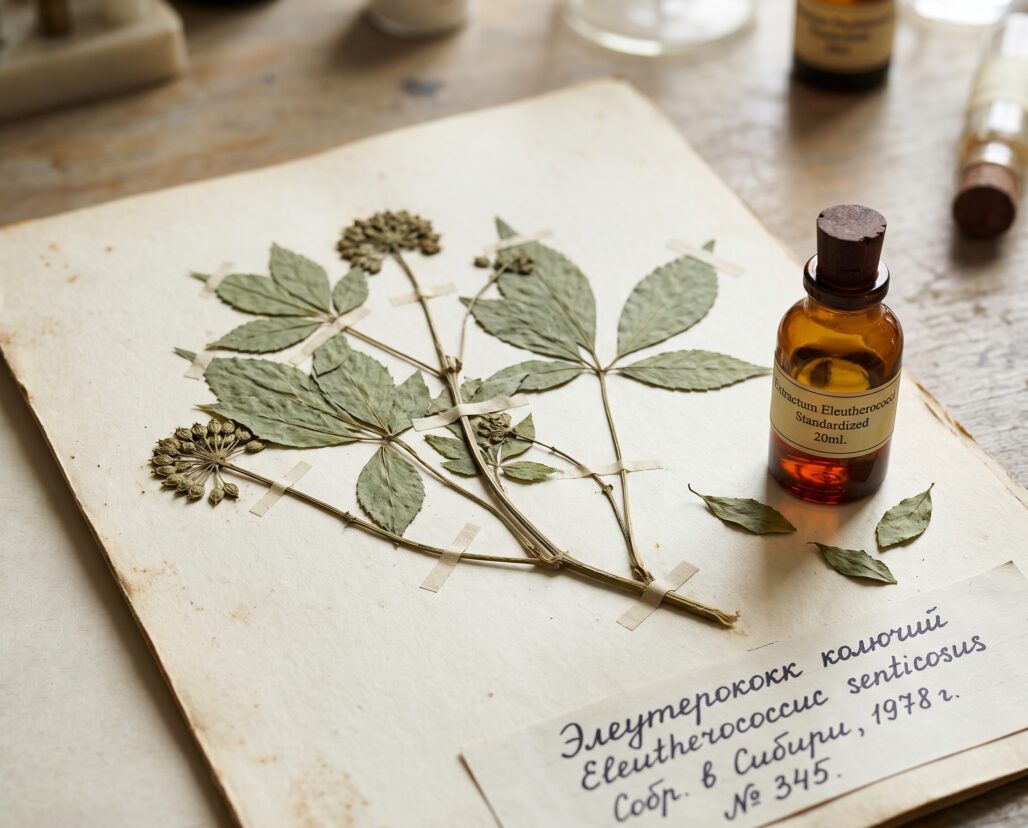
Eleuthero (Eleutherococcus senticosus) is a shrub native to northeastern Asia, particularly the Russian Far East, northeastern China, Korea, and Japan. It belongs to the Araliaceae family — the same plant family as Panax ginseng — but it is a completely different genus, with different active compounds, different pharmacological profiles, and different research histories.
The name "Siberian ginseng" was coined by Soviet pharmacologist Israel Brekhman in the 1960s to make the plant more marketable in the West, where "ginseng" was already recognized as a valuable tonic herb. The strategy worked commercially, but it created a persistent botanical confusion that persists today. Panax ginseng (Asian ginseng) and Panax quinquefolius (American ginseng) contain ginsenosides as their primary active compounds. Eleuthero contains no ginsenosides. Its marker compounds are eleutherosides — a chemically distinct group, with eleutheroside B (syringin) and eleutheroside E (liriodendrin) being the two most pharmacologically relevant.
Think of it like the difference between olive oil and sunflower oil: both are vegetable oils pressed from plants, both have culinary and nutritional use, but they are chemically distinct and the evidence for one does not transfer to the other. Eleutheroside activity is not ginsenoside activity. A product standardized to eleutherosides should not be assumed equivalent to a product standardized to ginsenosides.
The U.S. Food and Drug Administration ruled in 2002 that the name "Siberian ginseng" could no longer be used on product labels, requiring the botanical name Eleutherococcus senticosus or the common name "eleuthero." That regulatory change was correct from a botanical standpoint. Many brands still use "Siberian ginseng" informally.
Actionable takeaway: When evaluating an eleuthero supplement, look for "standardized to eleutheroside B and E" on the label. A product standardized only to total eleutherosides with no breakdown of B and E is harder to evaluate against the clinical literature.
The Soviet research backstory: context, not evidence {#soviet-backstory}
Eleuthero was extensively studied in the Soviet Union from the 1950s through the 1980s, primarily by Brekhman and his colleague Nikolai Lazarev at the Institute of Biologically Active Substances in Vladivostok. Soviet research involved large populations — including Olympic athletes, cosmonauts, and factory workers — with the goal of finding an adaptogen (a term Lazarev coined) that could improve stress tolerance and physical endurance without the toxicity of stimulants.
This history is worth knowing for context. It is not RCT evidence by Western pharmacological standards. The Soviet studies were largely uncontrolled, had no placebo comparison, used heterogeneous extracts with inconsistent standardization, and were published in Russian-language journals that were not peer-reviewed by international standards. The large sample sizes are misleading when the methodology is examined.
Traditional use is historical context, not clinical evidence. The Soviet-era data is interesting as a signal — it's why researchers in the 1980s and 1990s began running Western-standard trials. But it cannot substitute for those trials.
What the clinical evidence actually shows {#what-the-research-shows}
The Hartz 2004 chronic fatigue RCT
The most directly relevant human RCT for eleuthero's fatigue claims was published in 2004 by Hartz et al. in Psychological Medicine. The trial randomized 96 participants with chronic fatigue to eleuthero extract or placebo for 2 months, measuring fatigue severity using the Rand Vitality Index. Overall, the treatment group did not outperform placebo in the full sample. However, a pre-specified subgroup of 45 participants with moderate (rather than severe) fatigue at baseline showed a statistically significant improvement in the eleuthero group versus placebo (p=0.04). A second subgroup of 41 participants with fatigue lasting 5 years or more showed a trend toward improvement (p=0.09, non-significant).
That is an honest summary: the overall primary outcome was negative, and benefit appeared only in one subgroup. This is preliminary human data at best — it suggests eleuthero may be appropriate for moderate chronic fatigue, while severely fatigued patients may not respond, and the subgroup finding requires independent replication before it can be treated as established.
The Cicero 2004 elderly quality-of-life trial
A smaller double-blind RCT (Cicero et al., n=20) tested 300mg/day of Eleutherococcus senticosus dry extract versus placebo in elderly hypertensive volunteers for 8 weeks, assessing health-related quality of life via the SF-36v2 questionnaire. At 4 weeks, the treatment group showed significantly higher social functioning scores (p=0.02). These differences did not persist to the 8-week endpoint. Notably, all participants were on digitalis therapy, and no adverse effects on blood pressure or digoxin blood levels were observed — though the small sample size (10 per group) limits confidence in any safety signal.
The ADAPT-232 cognitive function RCT
Eleuthero is a component of ADAPT-232, a fixed combination of three adaptogens (Eleutherococcus senticosus, Schisandra chinensis, and Rhodiola rosea). A 2010 randomized, double-blind, placebo-controlled trial (Aslanyan et al., n=40) tested a single 270mg dose of ADAPT-232 against placebo in 40 healthy females under stressful cognitive conditions. The treatment group demonstrated statistically significant improvements in attention, speed, and accuracy on the d2 Test of Attention within two hours. This was a single-dose pilot study, so it cannot establish effects from sustained use, and isolating eleuthero's individual contribution from schisandra's and rhodiola's is not possible from this data.
The ADAPT-232 formula has been studied by Panossian and Wikman across multiple trials. For a deeper look at how schisandra and rhodiola contribute to that evidence picture, see the Schisandra Complete Guide.
The Schaffler 2013 null finding
A 2013 multicenter RCT (Schaffler et al., n=144) compared 120mg/day eleuthero extract alone, stress management training (SMT) alone, or combined treatment for 8 weeks in participants with stress-related fatigue. All groups improved significantly across cognitive performance, stress, fatigue, mood, sleep, and cortisol awakening response measures. The eleuthero extract added no meaningful benefit beyond stress management training alone. The researchers concluded that "effects of adding ES to SMT are, if any, negligible."
Immunomodulatory evidence
A 1987 double-blind, placebo-controlled trial (Bohn et al., n=36) tested an ethanolic eleuthero preparation in healthy volunteers over 4 weeks, measuring cellular immune status via flow cytometry. The treatment group showed substantial increases in immunocompetent cells, particularly T lymphocytes of the helper/inducer type, cytotoxic cells, and natural killer cells, with an overall enhancement of T-lymphocyte activation state. No adverse effects were observed during the 4-week trial or a 6-month follow-up.
This is the most replicated finding in eleuthero research — the immunostimulant signal is consistent. It is also clinically significant for the drug-interaction picture: immune stimulation is the mechanism behind the contraindication for patients on immunosuppressant therapy.
Actionable takeaway: The real question isn't whether eleuthero has any activity — it has documented immunomodulatory effects and fatigue signals in specific subgroups. The question is whether the dose, extract, and standardization of the product in your hand matches the doses and extracts used in these trials. Most products don't disclose enough to answer that question.
Who it's for and who should skip it {#who-its-for}
Strong fit:
- Adults with moderate, sustained fatigue (months to years) without a deficiency-driven cause (iron, B12, thyroid already checked and normal)
- Individuals looking for an immune-support adaptogen with a traditional safety record and some controlled human data
- Adults who have tried lifestyle interventions (sleep hygiene, caffeine reduction, stress management) and are seeking adjunctive support
Skip if:
- You take digoxin or any cardiac glycoside — eleuthero can cause false-elevated readings on fluorescence polarization immunoassay (FPIA) digoxin tests and may affect drug levels (see Section 6 below)
- You take immunosuppressants (tacrolimus, cyclosporine, azathioprine, biologics, corticosteroids for autoimmune conditions) — eleuthero's immune-stimulant mechanism opposes these drugs' intended effect
- You have an active autoimmune disease (rheumatoid arthritis, lupus, MS, psoriasis) where additional immune stimulation could worsen symptoms
- You are pregnant or breastfeeding — no adequate safety data exists for eleuthero in pregnancy
- You have severely uncontrolled hypertension — some evidence suggests additive blood-pressure effects with antihypertensives; discuss with your prescriber
- You take anticoagulant or antiplatelet medications — theoretical interaction risk exists, though well-documented human data are limited
| Are you in this situation? | Eleuthero appropriate? |
|---|---|
| Moderate fatigue, no medications, otherwise healthy | Reasonable trial, 8-12 weeks |
| Taking digoxin or cardiac glycosides | Discuss with prescriber first |
| On immunosuppressants for organ transplant or autoimmune disease | Avoid |
| Pregnant or nursing | Avoid |
| Fatigue from confirmed B12 or iron deficiency | Fix deficiency first; eleuthero does not address deficiency states |
| Severely fatigued (Hartz 2004 severe subgroup) | Evidence does not support benefit in this group |
Dosing ranges from clinical trials {#dosing}
These ranges reflect what was used in the clinical trials above. They are not a prescription.
In the Hartz 2004 RCT, participants received eleuthero extract for 2 months. The Cicero 2004 trial used 300mg/day of dry extract for 8 weeks. The ADAPT-232 trial used a 270mg combination tablet per dose. The Schaffler 2013 trial used 120mg/day extract.
The range across trials — 120mg to 300mg+ per day of standardized extract — reflects inconsistent product standardization across studies, making direct dose comparison difficult. Products standardized to eleutheroside B and E at a disclosed percentage are more evaluable against the clinical literature than unstandardized root powder.
Most trials in the stress/fatigue domain ran 4 to 8 weeks. The Hartz 2004 trial ran 2 months. Given that the Cicero 2004 benefits at 4 weeks did not persist to 8 weeks, expectations should be calibrated accordingly: any effect is likely modest and may not be permanent.
Cycling considerations: no human RCT has formally tested on/off cycling for eleuthero. Some practitioners suggest periodic breaks to avoid receptor accommodation, but this is protocol-driven, not evidence-based.
Actionable takeaway: Standardization to eleutheroside B and E content is more meaningful than the milligram number alone. "Eleuthero root powder 500mg" with no standardization disclosure is the supplement equivalent of "some amount of an unknown concentration of an active compound."
Side effects and drug interactions {#side-effects-interactions}
Adverse effects from clinical trials
In reported trials, eleuthero at typical doses was generally well-tolerated. Minor adverse events have included insomnia (especially with evening use), mild agitation, and occasional headache. The Schaffler 2013 trial (n=144) did not report serious adverse events attributable to the extract. The Bohn 1987 immunomodulatory trial noted no adverse effects through 6 months of follow-up. Given the small sample sizes in most trials, rare adverse effects would not be detectable.
Drug interactions — CRITICAL section
Digoxin assay interference (most clinically important interaction)
This interaction is well-documented and often unknown to patients. Eleuthero contains compounds that interfere with certain digoxin immunoassays, particularly the fluorescence polarization immunoassay (FPIA). A 2003 comparative study (Dasgupta et al.) found that Siberian ginseng preparations produced apparent digoxin readings of 0.20-0.47 ng/mL in mice fed the herb, and caused a 40% elevation in measured digoxin in FPIA analysis. A well-documented 1996 case report (McRae, PMID 8705908) described a 74-year-old male on stable long-term digoxin therapy who presented with elevated serum digoxin levels and no signs of toxicity; after disclosure of eleuthero use, stopping the herb normalized his levels, and restarting it raised them again.
Two possible mechanisms exist: the eleuthero component may interfere with the assay itself, or it may affect digoxin elimination in vivo. Either mechanism is clinically significant. Newer digoxin assays using specific monoclonal antibodies show less susceptibility to this interference, but patients cannot determine which assay their lab uses without asking.
If you take digoxin and want to use eleuthero, your prescriber should know — and your monitoring lab should be informed to use an assay not susceptible to ginseng interference.
Immunosuppressants
This interaction follows directly from eleuthero's documented mechanism. Eleuthero stimulates T-lymphocyte proliferation and NK-cell activity. Immunosuppressant drugs (tacrolimus, cyclosporine, mycophenolate, methotrexate, azathioprine, and monoclonal antibody biologics) are prescribed precisely to suppress immune activity — in organ transplant recipients to prevent rejection, and in autoimmune patients to reduce immune-driven tissue damage. Using eleuthero alongside immunosuppressants directly antagonizes these drugs' intended effect.
This is not a theoretical concern. It follows the mechanism. The NCCIH and integrative oncology references consistently flag this interaction for eleuthero and related immune-stimulating botanicals.
Antihypertensives
Some clinical data suggest that eleuthero may have mild blood-pressure effects. The Cicero 2004 trial enrolled hypertensive subjects and observed no significant blood-pressure changes at 300mg/day over 8 weeks, but the sample was n=10 per group — too small to detect a meaningful signal in either direction. Additive effects with antihypertensive drugs are biologically plausible. Patients on antihypertensive therapy should discuss eleuthero use with their prescriber and monitor blood pressure more closely in the first weeks of use.
Anticoagulants and antiplatelet agents
Theoretical interaction risk exists. No large human trial has specifically evaluated eleuthero combined with warfarin, heparin, or antiplatelet drugs (aspirin, clopidogrel). The prudent approach for patients on these medications is to disclose eleuthero use to the prescribing clinician and monitor for signs of altered bleeding tendency.
CYP3A4 and CYP2D6 substrates
A 2003 clinical trial (Donovan et al., n=12) found no statistically significant effect of standardized eleuthero extract at OTC doses on CYP2D6 or CYP3A4 enzyme activity in healthy volunteers. The researchers concluded that eleuthero is unlikely to meaningfully alter the disposition of medications primarily dependent on these pathways. This is a reassuring finding for the most common concern about herb-drug interactions, though the small sample size limits confidence.
Thyroid medication
Eleuthero has been associated with thyroid stimulation in some reports. The compliance gate for adaptogens flags eleuthero alongside ashwagandha and holy basil for an explicit thyroid-medication warning. Patients on levothyroxine or other thyroid hormone replacement should disclose eleuthero use to their prescriber.
Pregnancy and breastfeeding
No adequate safety data exists for eleuthero in pregnancy. Given the immunostimulant mechanism, theoretical concerns exist about immune modulation during pregnancy. Standard clinical guidance is to avoid eleuthero during pregnancy and nursing.
Product picks {#product-picks}
For informational purposes, two eleuthero products that are commercially available and visible on Amazon. Verification of specific eleutheroside standardization from product labels is recommended before purchase.
When evaluating any eleuthero product, the label questions that matter most:
- Does it specify eleutheroside B and E content (not just total eleutherosides)?
- Is it a root extract (preferred) or root powder?
- Is the mg amount the extract weight or the equivalent root weight? (These differ by a factor of 4-10x depending on extraction ratio.)
- Is there any third-party testing disclosed?
An adaptogen brand can have extensive marketing copy and still fail on all four of these questions.
As an Amazon Associate, I earn from qualifying purchases. Product recommendations are based on real reviews and independent research.
Frequently asked questions {#faq}
Is eleuthero the same as ginseng?
No. Despite the common name "Siberian ginseng," eleuthero (Eleutherococcus senticosus) is a distinct genus from true ginseng (Panax ginseng, Panax quinquefolius). The active compounds differ: true ginseng contains ginsenosides; eleuthero contains eleutherosides. The research bodies are separate, and the evidence for one does not transfer to the other. The "Siberian ginseng" label was a marketing decision, not a botanical one.
Can eleuthero cause a false positive on a digoxin blood test?
Yes, and this is one of the more clinically important interactions in the adaptogen category. Certain digoxin immunoassays — particularly older fluorescence polarization immunoassay (FPIA) systems — can register eleuthero compounds as apparent digoxin, producing artificially elevated readings. A documented 1996 case report showed a patient's digoxin levels rising when eleuthero was started and normalizing when it was stopped. If you take digoxin, inform both your prescriber and your clinical lab before using eleuthero.
How long does eleuthero take to work?
The Hartz 2004 RCT ran 2 months and found benefit only in the moderate-fatigue subgroup. The Cicero 2004 trial found quality-of-life improvements at 4 weeks that did not persist to 8 weeks. There is no strong evidence for rapid onset effects from eleuthero alone (unlike the ADAPT-232 single-dose cognitive study, which involves two additional adaptogens). If you see no signal after 8 weeks of a standardized product at the doses used in trials, the evidence does not support continuing.
Can I take eleuthero if I have an autoimmune disease?
This is a question for your prescriber, not a supplement label. Eleuthero is an immunostimulant. In the 1987 Bohn trial, it significantly increased T-lymphocyte activity in healthy volunteers. For patients whose autoimmune disease is driven by overactive immune responses, additional immune stimulation carries real risk. This is not theoretical caution — it follows from mechanism.
Does eleuthero interact with antidepressants?
The CYP3A4/CYP2D6 study found no significant enzyme inhibition or induction at OTC doses, which addresses one common interaction pathway for SSRIs and SNRIs. However, eleuthero has some mild stimulant-adjacent effects, and interactions at the level of mood and arousal cannot be excluded. If you take antidepressants, disclose eleuthero use to your prescriber before starting.
What's the difference between eleuthero and rhodiola for fatigue?
Both are adaptogens with fatigue-related RCT evidence, but the mechanisms and evidence profiles differ. Rhodiola (Rhodiola rosea) has a Phase III RCT (Olsson 2009) showing statistically significant improvement in burnout scores and the cortisol awakening response in 60 participants with stress-related burnout — considered the stronger RCT for fatigue in this class. Eleuthero's strongest fatigue signal was in a subgroup of the Hartz 2004 trial, with a negative primary outcome. Rhodiola also carries an MAO inhibition mechanism that makes it contraindicated with antidepressants — a drug-interaction profile that eleuthero does not share. For a full comparison of how adaptogens fit together in the C6 cluster, see the Complete Guide to Adaptogens.
Is eleuthero safe for long-term use?
The available trials run 4 to 8 weeks in most cases, with one 2-month RCT. The 1987 immunomodulatory trial included a 6-month follow-up with no adverse events reported in 36 participants. Long-term safety data beyond 6 months is sparse for controlled trials. Traditional use in Russia extended for months to years in occupational contexts, but that is not a substitute for controlled safety data.
Conclusion: the bottom line on eleuthero
Eleuthero is a genuinely interesting adaptogen that has been misrepresented on two fronts: first by the "Siberian ginseng" branding that implied a pharmacological kinship with Panax ginseng that does not exist, and second by the supplement industry's tendency to cite Soviet-era research as if it were controlled trial data.
The honest picture is narrower and more defensible than the marketing. Eleuthero has consistent immunostimulant activity in a small controlled trial. It has a fatigue signal in a specific moderate-fatigue subgroup of one RCT, with negative primary outcomes overall. It contributes to the ADAPT-232 cognitive evidence base, though the individual contribution is difficult to isolate. And it carries two well-documented drug interactions — digoxin assay interference and immunosuppressant antagonism — that belong prominently on product labels and almost never appear there.
For a healthy adult with moderate chronic fatigue, no cardiac medications, and no autoimmune condition, eleuthero is a reasonable 8-week trial with a low adverse-effect profile. For anyone on digoxin, immunosuppressants, or antihypertensives, the conversation needs to happen with a prescriber before it starts.
Next steps:
- If you want to understand where eleuthero fits in the broader adaptogen landscape, start with the Complete Guide to Adaptogens
- If you are evaluating eleuthero alongside rhodiola or schisandra (as in the ADAPT-232 combination), see the Schisandra Complete Guide for that evidence thread
Related reading
- Complete Guide to Adaptogens: What They Are, What the Evidence Shows, and How to Choose
- Holy Basil (Tulsi) Complete Guide: Adaptogens, Cortisol, and the Honest Evidence
- Schisandra Complete Guide: The Five-Flavor Berry and Its Adaptogen Evidence
This article is for informational purposes and not medical advice. Herbal adaptogens — even traditional ones — can interact with thyroid medication, antidepressants, anticoagulants, immunosuppressants, blood-pressure drugs, and more. Consult a licensed physician before starting any adaptogen, particularly if you are pregnant, nursing, taking prescription medications, or managing a chronic condition.
As an Amazon Associate, I earn from qualifying purchases. Product recommendations are based on real reviews and independent research.
